Anja Dodevska

Mental health maintenance plan
What is a mental health maintenance plan? A mental health maintenance plan is a ...

3
Last Updated: Nov 12, 2026
Free PDF 4 pages, print-ready Clinician-reviewed
A self-care workbook is a structured set of worksheets that helps an adult assess and improve their well-being, one area of life at a time. Clinicians use it as between-session homework, and individuals use it to plan their own routines. The free self-care workbook PDF below is built for both groups.
Most self-care advice stays abstract. A workbook turns it into tasks you can complete, review and track. This four-page file opens with a goals page, then gives physical, mental and emotional, social and spiritual self-care a page each.
A four-page PDF with a personal goals page, plus worksheets for physical, mental and emotional, social and spiritual self-care. It closes with a page for notes and reflection. Each domain page sets two improvement goals with a plan for each.
Start from scratch, or upload this PDF or any form you already use, and Pabau's AI Form rebuilds it with tick boxes, text fields and a signature. Attach it to the treatment once, and every patient gets it on time.
AI Form rebuilds the consent, history and aftercare forms you already use. You review each one, then publish.
Patients complete forms on their phone before they arrive, so the front desk stops retyping paper.
Every signed form is versioned and attached to the treatment record, ready when you need it.
Set how long a consent stays valid. Returning patients skip forms they have already signed.
Supports HIPAA and GDPR compliance AES-256 encryption 4.8 on G2 4.7 on Capterra Trusted by 4,000+ practices worldwide

A self-care workbook is a structured PDF of worksheets covering physical, mental and emotional, social and spiritual well-being.
Clinicians can assign it as between-session homework and review completed pages during appointments.
Assigning one domain page at a time keeps the homework manageable and gives each session a clear focus.
Helping professionals face elevated burnout risk, so clinicians benefit from completing the workbook themselves first.
Pabau, the practice management software we build, keeps completed workbook pages in Client records so progress stays visible.
A self-care workbook is a multi-page document that pairs reflection prompts with domain-specific worksheets. Each worksheet asks the user how they feel about one area of their well-being, then has them set goals and a plan for it. The structure gives a person a repeatable way to check in with themselves rather than relying on memory.
The workbook doesn’t include guided exercises. If a patient needs a daily practice to log, pair it with a mindfulness journal.
The workbook suits adults managing ongoing stress, patients working through a course of therapy, and helping professionals who need structured self-care. Clinicians also use it when they want a consistent piece of homework to assign between sessions.
Want a baseline before you assign it? A stress assessment questionnaire gives you scores to compare against once the workbook is done.
Clinicians get the most value by assigning one section at a time rather than the whole document. Start with the goals page, then work through the domains one by one. If a patient can’t decide where to begin, a wheel of life assessment shows which areas feel most out of balance.
The flow below shows how one workbook spreads across several appointments.
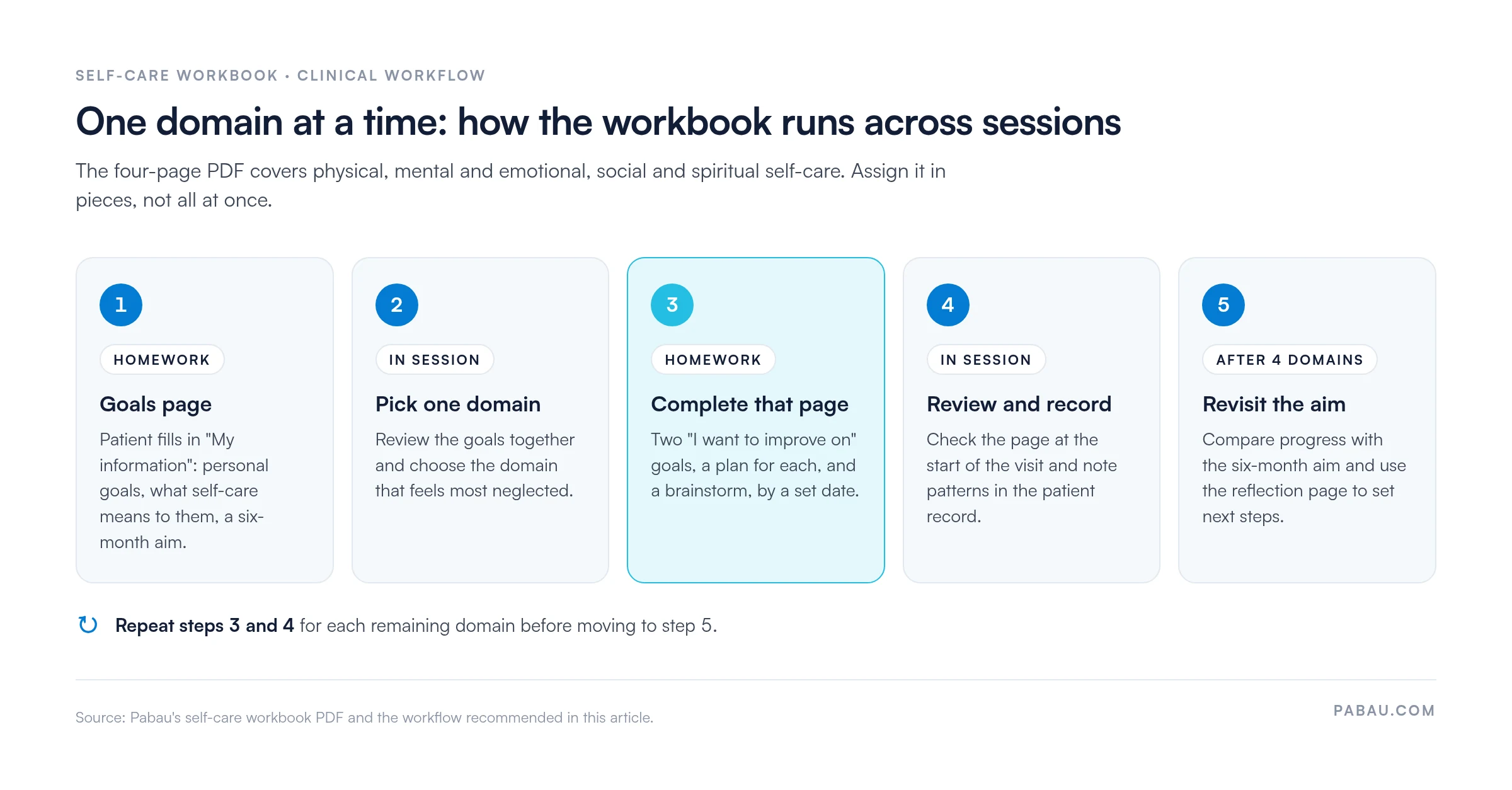
In Pabau, you can attach returned pages to the patient’s file in Client records, so progress stays visible across appointments. Use digital forms if you prefer patients to complete the workbook on screen rather than on paper.
Each domain page already ends in plans, but four pages of goals is a lot to act on at once. Condense them into one page the person can check each week. Keep it to three or four priorities so it stays realistic.
Helping professionals often put patients first and leave their own well-being for later. That pattern is a recognized contributor to burnout in clinical roles. A structured self-care routine gives professionals a defined place to start.
Complete the workbook yourself, and use the mental and emotional and social pages to track workload, boundaries and recovery time. Review it with a supervisor or peer every month, rather than only when stress peaks.
If you suspect strain has tipped into burnout, the Maslach Burnout Inventory is a widely used way to measure it.
Assign the workbook to yourself first. Complete the goals page and one domain before you give it to a patient. Then you know how the prompts feel and can explain them with confidence.
Use the download button at the top of this page to open the PDF in a new tab. Save a copy to your practice drive, or print it for in-session use.
Most practices hand the workbook out on paper. Pages come back folded in a bag, or not at all, and progress lives in the clinician’s memory between sessions.
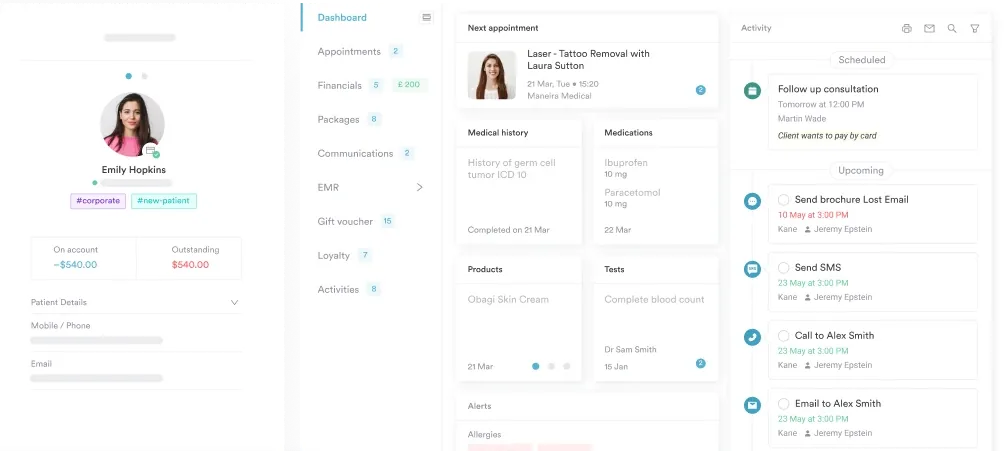
In Pabau, you can send the workbook as a digital form before the appointment. Completed pages are saved to the patient’s Client records, next to their session notes. Last month’s physical self-care goals are then a click away when the patient sits down.
Every subscription includes the full platform, so forms, records and reminders work together from day one. See how Pabau’s software built for therapists covers the rest of the therapy workflow, from booking to notes.

Pabau’s digital forms and Client records let patients complete workbook pages online and keep every page on file. You see progress across sessions without chasing paper.

A self-care workbook works best as a sequence, handed over in pieces. Start with the goals page, take one domain at a time, and review each page in session before you set the next.
Do that, and the workbook becomes a running record of what the patient is changing and what keeps slipping. The trade-off is pace. Four domains take several sessions, but each one gets a full conversation instead of a skim.
Book a demo to see how Pabau stores completed workbook pages and keeps between-session homework visible for your therapy practice.

Want to measure how well a patient copes? Coping self-efficacy scale gives you a 26-item self-report to track confidence in coping skills.
Working on self-criticism? Compassion worksheet guides patients through kinder responses to their own setbacks.
Need a quick read on life stress? Holmes and Rahe Stress Scale scores recent life events with a free PDF and scoring guide.
Tracking habits between sessions? Self-monitoring checklist sets check-in intervals for behaviors a patient is trying to change.
Building self-esteem alongside self-care? Self-esteem journal template gives patients a daily structure for noting strengths and wins.
A self-care workbook is a set of worksheets that guides a person through improving their physical, mental and emotional, social and spiritual well-being.
Yes, the self-care workbook PDF is free to download from this page.
The self-care wheel is a visual tool that maps well-being across several life domains, so a person can see which areas need attention.