Piercing consent form
A piercing consent form is a signed record that a client understood a piercing&#...

4
Last Updated: Oct 2, 2026

A self-monitoring checklist is a structured form that lets patients record their own behavior, emotions, and symptoms between sessions.
Recording a behavior tends to change it, so the form works as an intervention and not only as a measurement.
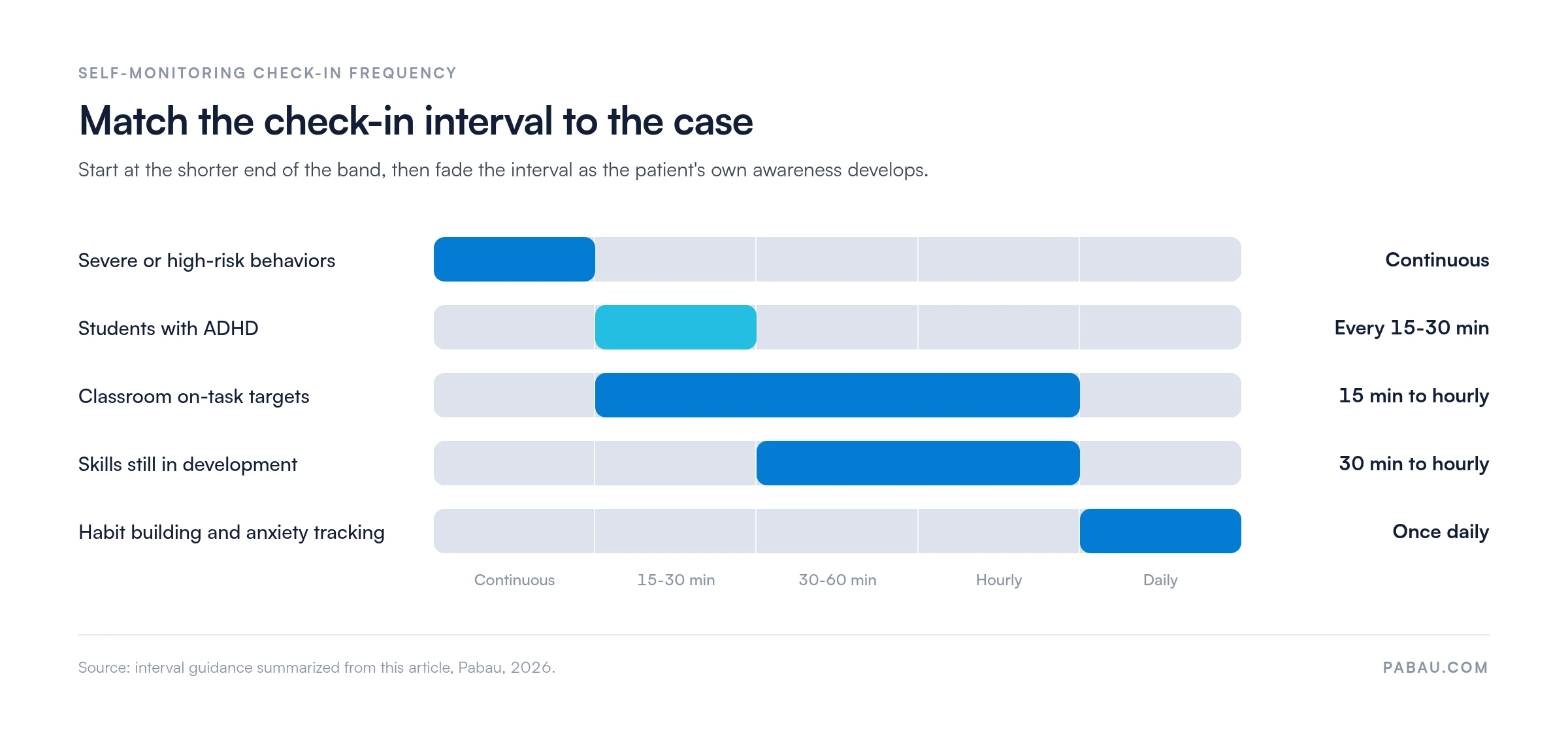
Check-in intervals should match the case, from continuous recording for severe behaviors to a single daily rating for anxiety tracking.
Self-monitoring is a core tool in ADHD management, ABA therapy, occupational therapy, and mental health treatment.
Digital forms in practice management software like Pabau let you send the checklist, collect it, and store it in the patient record.
A printable form with structured observation intervals, a row for each target behavior, and space for clinician notes. Ready to hand to a patient or student at the end of a session.
Download templateA self-monitoring checklist asks the patient to record their own behavior at a set interval, then bring that record to the next session. The form itself is simple. Choosing the target, the interval, and the reward is where the clinical work sits.
Below you get the printable form plus the judgment calls behind it. That means picking a behavior specific enough to track, setting an interval that fits the case, and fading the form once the habit holds.
A self-monitoring checklist is a structured observation form that a patient fills in about their own behavior, emotions, symptoms, or progress. Clinicians use it across mental health, occupational therapy, speech therapy, behavioral health, and education.
The principle is simple. When a patient records their own behavior at defined intervals, they become more conscious of patterns, triggers, and progress. That feedback loop speeds up behavior change and makes treatment visible to both sides of the room.
Digital forms make the same loop repeatable. The clinician builds the form once, sends it, and gets the responses back attached to the patient record.

Structured self-monitoring improves behavioral and academic outcomes across occupational therapy, psychology, and special education.
When patients track their own behavior instead of waiting for clinician feedback, engagement rises and resistance drops.
Attention difficulties respond to external structure and immediate feedback, and ADHD clinic software keeps each check-in next to the assessment scores it explains.
In schools and pediatric practice, the form shifts toward academic behaviors, task completion, and social-emotional skills.
A student version usually carries:
Students respond to seeing progress accumulate. Stickers, checkmarks, or points build motivation while the student practices watching their own behavior. Most students need the form less over time, which is the point of using it.
Executive functioning is the reason self-monitoring earns its place with ADHD students. The adapted version strips out distraction and shortens the feedback cycle.
Parents and students can read the same record together between sessions. Naming an incremental win keeps effort going while the behavior change is still too small to feel.
In applied behavior analysis and formal behavior intervention plans, the form is assessment and intervention at once. It captures baseline frequency, tracks whether the intervention is working, and builds self-regulation while it does.
A behavior-focused version usually includes:
Where the patient records their own data, staff-completed behavior tracking sheets cover the same behavior from the other side. Running both gives you two records of one behavior, which is how you test a patient’s insight.
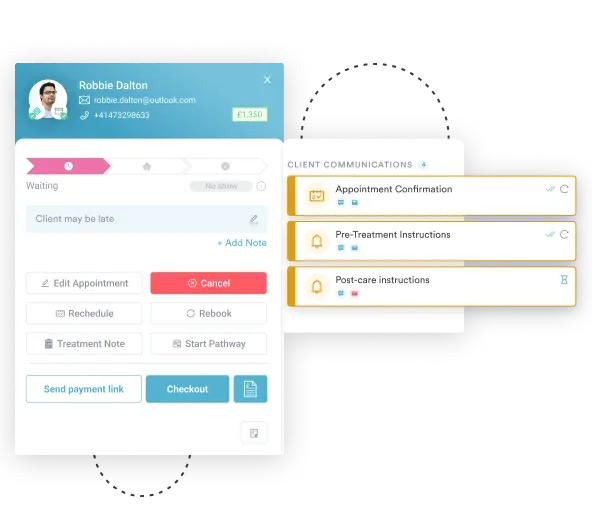
Between sessions, the checklist only works if the patient remembers it. Automated reminders carry that job, so nobody on the team is chasing a form by phone.
Building one takes six decisions. Each one changes how likely the patient is to keep using it.
Step two is the one worth slowing down on. The bands below show where each type of case usually starts, drawn from the intervals described above.
Self-monitoring checklists are a core occupational therapy and neuropsychology tool for building self-regulation. Self-regulation covers planning, working memory, impulse control, and emotional regulation.
A self-regulation version might track:
Where the picture is broader than one behavior, an executive function assessment gives you a baseline to monitor against. The checklist then tracks the two or three skills that assessment flagged.
Patients tracking mood rather than a discrete behavior often do better with a daily mood chart, which asks for one rating a day. Either way, the aim is to fade the form. The patient keeps the habit once the monitoring runs without paper.
Paper self-monitoring runs into the same problem every time. The patient holds one copy, the clinician holds another, and the treatment note refers to whichever one turns up first.
Therapy practice management software like Pabau keeps that record in one place. You build the checklist as a digital form, send it from the patient’s record, and the responses come back attached to it.
Insights Plus, our reporting add-on, helps practices visualize patient progress trends and identify which interventions drive the strongest outcomes.

Pabau’s digital forms let you build a self-monitoring checklist once, send it to the patient, and store every response in their record. Progress data stays with the treatment note that uses it.

The form is the easy part. What decides whether self-monitoring works is the interval you set, the specificity of the behavior you name, and your willingness to fade both.
Expect the first version to be wrong. Two weeks of use tells you whether the interval fits the patient’s day, and adjusting it is normal rather than a failure.
Download the form above and set the interval before you hand it over. Book a demo to see how Pabau keeps every completed checklist in the patient record it belongs to.

Need the clinician-side record too? Behavioral observation checklist covers the same behavior from the observer’s chair, so you have a second record to compare against.
Tracking what sets a behavior off? ABC behavior chart records the antecedent, the behavior, and the consequence in one row.
Need the reinforcement side of the plan? Behavior rewards chart turns completed check-ins into a reward the patient can watch building.
Working with an ADHD caseload? ADHD symptom tracker shows how to log symptoms and medication effects between appointments.
Building coping skills alongside monitoring? Coping skills checklist gives patients a menu of strategies to reach for when the rating drops.
A self-monitoring checklist is a structured form on which patients record their own behavior, emotions, or symptoms at set intervals. They complete it with checkmarks, tally marks, or ratings, then bring it to the session. The act of recording itself improves awareness and shifts behavior.
Start with a specific, observable target behavior, such as raising a hand before speaking. Choose an interval, since every 15 to 30 minutes suits students with ADHD. Pick a recording method the student can manage alone, add a small reward, and review the record weekly.
Track behaviors that are specific and observable. Examples include staying on task, raising a hand before speaking, organizing materials, or using a coping strategy when frustrated. Replace a vague goal like “being good” with the exact action you want counted.
Yes. Self-monitoring checklists are core tools in applied behavior analysis and behavior intervention plans. They document baseline frequency, track whether an intervention is working, and build self-regulation at the same time. ABA practitioners pair them with reinforcement systems.
Interval choice follows behavior severity and treatment intensity. Severe behaviors call for continuous recording, students with ADHD do well at every 15 to 30 minutes, and anxiety tracking works once daily. Start short, then stretch the interval as consistency builds.
Self-monitoring is the observation and recording of behavior, so it answers what is happening. Self-regulation is the ability to manage your own behavior, emotions, and impulses. The checklist is a tool that builds self-regulation by making patterns visible.