Managing stress worksheet: How to use all 8 sections
A managing stress worksheet gives patients a structured way to name what stresse...

3
Last Updated: Oct 21, 2026
A fair fighting rules worksheet is a therapy handout that sets out ground rules for disagreements, so couples can argue without escalating into damage. Pabau, the practice management software we build for therapy practices, publishes it as a one-page PDF of eight rules, each with a short explanation.
Therapists hand it out to make conflict rules explicit, rehearse them in session, and give partners a shared reference between appointments. The rules cover preparing for an argument, keeping it respectful, and ending on a compromise.
A one-page printable handout with eight fair fighting rules, from asking yourself why you are upset to focusing on a compromise. Each rule comes with a short explanation couples can reread before a difficult conversation.
Download template
A fair fighting rules worksheet turns unspoken conflict norms into written rules that couples can review between sessions.
Pabau’s worksheet lists eight rules, from asking yourself why you are upset to focusing on a compromise.
The rules follow the arc of an argument: two prepare the conversation, five keep it safe, and one closes it.
Clinicians introduce the worksheet once rapport is established and the presenting problem is clear.
Pabau lets therapists send homework digitally and keep session notes on the patient record.
A fair fighting rules worksheet is a therapeutic tool that lists agreed rules for constructive disagreement. Its purpose is to reduce escalation during conflict and to give couples a shared framework for discussing difficult topics.
Clinicians working in couples therapy, counseling, and mental health settings typically use it alongside communication-skills work. Our fair fighting rules guide covers the clinical background behind each rule in more depth.
The worksheet sets out eight rules. Each one targets a specific pattern that tends to turn disagreement into damage.
Read in order, the rules follow the arc of an argument, which is also a useful order to teach them in.
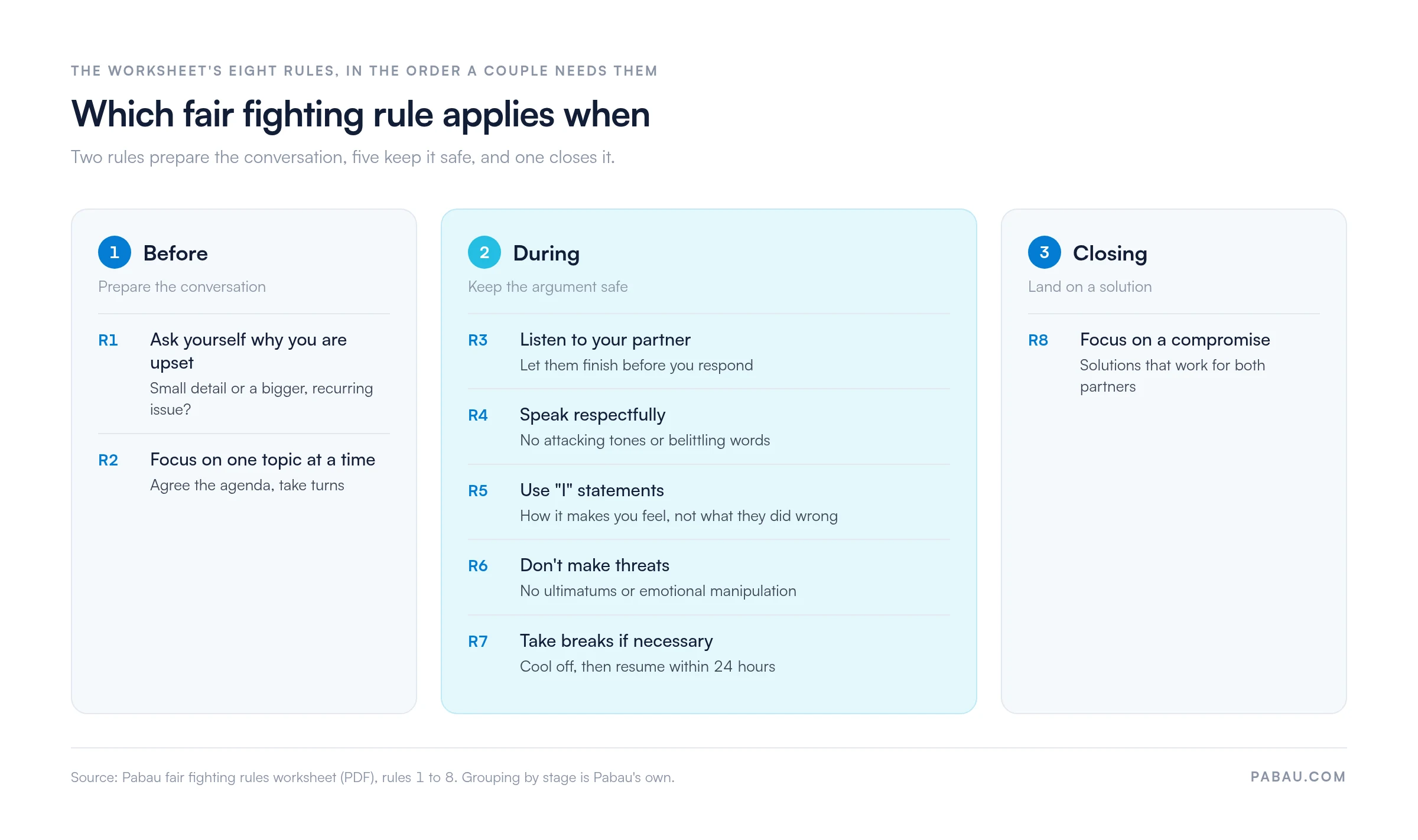
Couples who struggle with rule five can practice it on its own with an assertive communication worksheet. An active listening skills worksheet does the same for rule three.
These rules are a starting point. Clinicians often adjust the wording to match a patient’s language and presenting problem.
The worksheet works best when it is introduced deliberately, reviewed in session, and then assigned as practice. Follow these steps.
Introduce the rules once the couple has described their conflict pattern and agreed to work on it. Introducing them too early, before rapport is established, can feel like an imposed script.
Present the rules as tools that make hard conversations safer, so honesty has somewhere to land. A useful script is: “These rules help us say hard things without the conversation turning into a fight.”
Couples who share a home, finances, or children often need rules that address shared logistics as well as emotion. The eight rules still apply, but the examples you discuss should reflect their situation.
For couples working on wider relationship goals, pair the rules with a couples therapy worksheet.
Fair fighting rules and anger management work alongside each other. The worksheet gives couples a structure for disagreement. Anger management treatment addresses the underlying emotional regulation, which clinicians assess separately.
The break rule and the 24-hour return can support emotional regulation between sessions. Where anger needs its own treatment plan, a worksheet on anger management gives that work a separate structure.
The PDF can be downloaded at no cost and printed for use in session or as homework. Share only the blank handout, and keep any notes a couple writes against it within your practice’s record-keeping process.
If those notes contain identifiable patient information, handle them under your privacy obligations, such as HIPAA in US practice.
Most therapists still print the handout, hand it over at the end of a session, and hope it comes back. Homework notes end up on paper, in an email, or nowhere at all.
Therapy practice management software such as Pabau keeps that loop in one place. You can send the rules and a short homework form through digital intake forms, before or after the session.
Each partner’s responses land on their patient record next to your session notes. When the couple returns, you can see which rule they broke this week without asking them to dig out a sheet of paper.

Pabau sends worksheets and forms to patients before or after a session, and stores their responses with your notes on the patient record. You start each review with the homework already on file.

Start with the rule a couple breaks most often, not with all eight at once. Rehearse it in the room, then let the homework show you whether it held under pressure at home.
A couple who can name their trigger and call a break has the base the other rules build on. The trade-off is pace, because rules that are rushed tend to read like a script they were handed.
Book a demo to see how Pabau sends couples their homework and keeps it beside your session notes.

Working through a specific disagreement? Conflict resolution worksheet walks couples from the problem to an agreed solution.
Helping a couple recover after an argument? Gottman repair checklist gives partners ready phrases for de-escalating mid-conflict.
Building everyday communication skills? Couple communication worksheet covers the habits that make fair fighting easier to keep.
Starting with rule one? Emotional awareness worksheet helps patients name what they feel before a conversation begins.
Setting limits on off-limits topics? Marriage boundaries worksheet helps couples agree the boundaries behind their rules.
A fair fighting rules worksheet is a therapy handout that lists agreed rules for disagreement. Clinicians use it to reduce escalation and to give couples a shared reference between sessions.
Fair fighting rules are one part of conflict resolution. They set conduct guidelines for disagreement, while conflict resolution covers the wider process of reaching agreement.
They can support emotional regulation, particularly through time-outs and de-escalation steps. They are complementary to clinical anger management and do not replace it.