Journal prompts for mental health
Journal prompts for mental health are guided questions that help people process ...

2
Last Updated: Oct 13, 2026
A relationship needs checklist is a structured self-assessment that helps you name and rank what you require from a partner.
It covers emotional, physical, social, and safety needs, and sorts each one into a must-have or a nice-to-have. The free template below works for personal reflection, couples counseling, and premarital sessions alike.
Most people can describe what irritates them in a relationship far more easily than what they need from one. Without that vocabulary, resentment builds quietly and surfaces months later as conflict neither partner can trace to a cause. The American Psychological Association treats clear communication about needs as a cornerstone of relationship satisfaction. This guide covers how to fill the checklist in, how to score it, and how to bring the results to your partner or your patients.
Six categories of needs, each broken into specific statements you rate as essential, important, preferred, or not required. There is space to mark your top five non-negotiables and note what you want to raise with your partner.
Download template
A relationship needs checklist turns vague expectations into specific statements you can rate, across six categories of need.
A need is something your well-being depends on, while a want is a preference you can negotiate.
Most people land on four to six genuine must-haves, which is what makes compatibility possible to judge.
Therapists use the checklist to move couples from blame to specific requests, and to track how needs shift between sessions with therapy practice software.
A relationship needs checklist gives you a systematic way to explore what you require from a partner. Instead of leaving needs unstated and hoping your partner works them out, the tool creates a shared vocabulary for naming and discussing them. It splits needs into categories, so you assess each dimension in turn rather than describing them all as “emotional connection” or “quality time.”
Specificity is what makes the format work. Instead of writing “I need to feel supported,” you might write “I need my partner to hear about my work problems without offering advice.” Or “I need reassurance that my feelings count, even when they differ from my partner’s.” That level of detail makes mismatches visible early, while they are still easy to discuss.
Therapists use the checklist to move couples from complaint-based dialogue (“You never listen to me”) to need-based dialogue (“I need to feel heard and validated”). The sheet becomes a neutral reference point on the table between them. That takes the heat out of the exchange and shifts it from blame toward understanding.
Unmet needs are one of the leading drivers of dissatisfaction, resentment, and eventual breakup. Yet most people enter a relationship without ever putting words to what they need, even privately. The pressure builds quietly, then surfaces as conflict that seems to arrive from nowhere.
Knowing your own needs serves several purposes. It allows you to:
Where the same need has gone unmet for years, an unmet emotional needs worksheet helps trace the pattern back before you try to repair it. The checklist then turns that understanding into a concrete exercise with an output you can share.
The line between a need and a want is what makes the checklist useful. A need is essential to your emotional and psychological well-being, and its absence causes distress, resentment, or a sense of being unsafe. A want is desirable or enriching, but its absence leaves your well-being intact.
Here is how the two compare across five common categories:
The checklist asks you to label every item as a must-have or a nice-to-have. That labeling stops a relationship from failing over an unmet want, and it stops a genuine non-negotiable from being quietly downgraded to keep the peace.
Most versions of the checklist group needs into five or six categories. Here is what each one covers:
The categories overlap in practice, so it helps to see them side by side with an example of what a non-negotiable looks like in each.
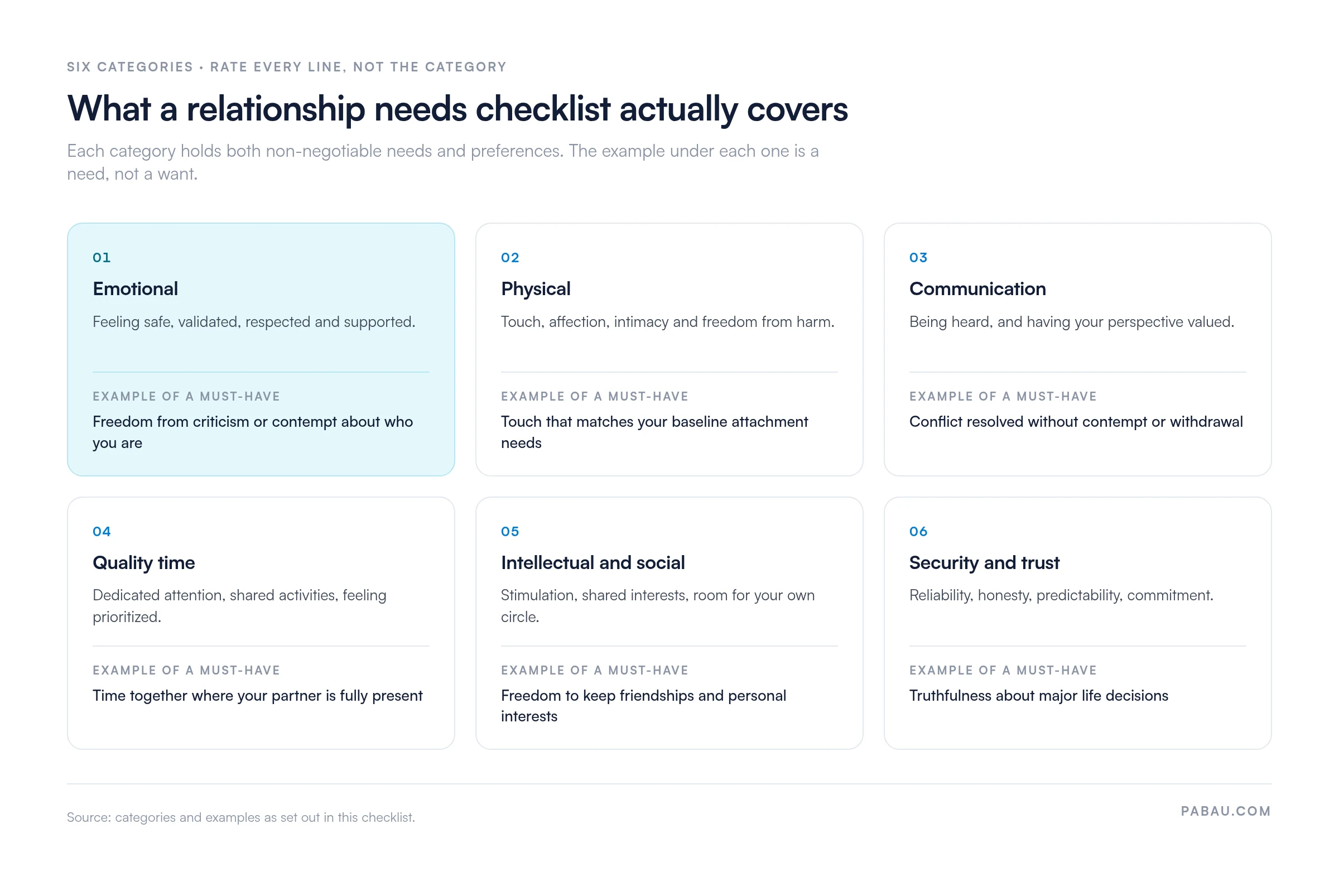
Under each category the checklist lists specific statements you rate on a scale: essential, important, preferred, or not required. That moves you from a broad heading to a single item you can put in front of your partner.
Building your own list, or filling in the template above, follows five steps:
The checklist does its best work when it forces you to rank. No relationship meets every need, every time. The aim is to keep your must-haves consistently honored, and to treat the rest as bonuses.
Rate each item on this four-level scale:
Most people end up with four to six items in the must-have band, and the rest stay negotiable. That ranking keeps you from leaving a supportive relationship over a missing nice-to-have. It also keeps you from staying in an unsupportive one because you never named what you needed.
Naming your needs is half the job. The other half is saying them in a way that invites understanding rather than defensiveness. This framework works in session and at home:
How do you tell whether your core needs are being satisfied? Look for these signs:
Mental health professionals reach for the checklist in four situations:
Administering and storing the checklist is where software for therapy practices earns its place. Sending it out as a digital form means the responses land on the patient’s record. This quarter’s answers then sit next to last quarter’s, with no search through paper files.
The structure mirrors the Sound Relationship House, the Gottman Institute’s model of what holds a couple together. Its foundation level, Build Love Maps, asks each partner to learn what matters most to the other. That means their worries, their goals, and the detail of their daily life. Our Gottman Method worksheets cover the same ground in a session-ready format.
The checklist usually goes out on paper at the end of a session, and the practice hopes it comes back. Often it does not, and when it does, the answers sit in a folder rather than beside the treatment note where the next conversation starts.
Practice management software like Pabau lets you send the checklist as a digital form before the appointment. Responses save straight to the patient record, so the completed checklist sits with your session notes instead of in a separate pile. Through the Client Portal, patients can open the form in their own time and come back to it between sessions.
That matters most for a tool designed to be repeated. Because each submission is stored and dated, you can put a patient’s ratings from six months ago next to today’s and show them what moved. The conversation then starts from a record rather than from recollection.

Pabau’s digital forms send the checklist ahead of the session and save every response to the patient record. Dated submissions sit alongside your notes, so progress is visible without a second system to maintain.

A relationship needs checklist is only worth the honesty you bring to it. Marking every line essential produces a document nobody can act on. Narrowing down to four or six genuine non-negotiables gives you something you can raise, defend, and return to.
The harder part comes after the rating. Saying a need out loud invites a response you may not want to hear. That is why the framework above spends as much time on the conversation as on the scoring. Treat it as a recurring check rather than a one-off audit, and both lists stay in step as the two of you change.
If you use the checklist with patients, keeping every version dated and attached to their record is what makes the comparison possible. Book a demo to see how Pabau handles digital forms and progress tracking for therapy practices.

Want structured exercises for the session itself? Couples therapy worksheet gives you prompts and exercises to run once both checklists are on the table.
Needs named, but boundaries still vague? Emotional boundaries worksheet helps separate what you need from what you will accept.
Does conflict derail the conversation every time? Fair fighting rules sets ground rules that keep a difficult discussion from turning into an argument.
Looking for the boundaries version of this exercise? Relationship boundaries checklist maps the limits that sit around the needs you have just ranked.
Running these assessments across a caseload? Psychology practice software keeps notes, forms, and progress tracking in one secure record.
The needs that come up most often are emotional safety, trust, respect, feeling heard, physical affection, quality time, and a sense of being valued. Emotional safety underpins the rest, because without it the other needs are hard to raise at all.
Fill the checklist in separately, then compare your must-have lists. Perfect alignment is rare. What matters is whether each of you is willing to prioritize the other’s core needs. A mismatch on must-haves often signals incompatibility, while a mismatch on nice-to-haves is usually negotiable.
Avoidance of the conversation is itself a signal. It may mean your partner feels defensive, unsafe, or unwilling to do emotional work. Individual therapy or couples counseling with a trained professional can create a safer setting for the discussion.
No. A checklist gives you clarity about where you stand today. What predicts success is whether both partners understand their needs, raise them without blame, and work toward meeting them. A couple with unmet needs who discuss them openly often fares better than a couple with aligned needs who never talk.