HEENT review of systems
A HEENT review of systems is a structured review of head, eye, ear, nose, and th...

1
Last Updated: Oct 14, 2026
A chronic kidney disease nursing care plan is a structured document that guides nurses through assessment, diagnosis, intervention, and patient teaching at every CKD stage. It turns KDIGO recommendations and NANDA-I nursing diagnoses into steps you can act on and document.
In day-to-day terms, the plan tracks fluid and electrolyte balance, blood pressure, and anemia. It also records what you taught the patient and when you referred them. The free template below gives nursing students, RNs, primary care teams, and nephrology practices one consistent framework for that work.
A ready-to-use care plan covering CKD staging, NANDA-I diagnoses, and fluid and electrolyte assessment. It also includes blood pressure and anemia checks, patient education checkpoints, and nephrology referral triggers.
Download template
A chronic kidney disease nursing care plan links NANDA-I diagnoses, assessment, interventions, and expected outcomes to the patient’s CKD stage, from G1 to G5.
Common NANDA-I diagnoses in CKD include Excess Fluid Volume, Risk for Electrolyte Imbalance, Imbalanced Nutrition, and Fatigue.
Core nursing work covers fluid and edema monitoring, potassium and phosphorus control, blood pressure, anemia, and teaching on diet and medicines.
KDIGO’s 2021 guideline sets a systolic target under 120 mmHg, using standardized office readings, for most adults with CKD who are not on dialysis.
Refer to nephrology once eGFR falls below 30, or when proteinuria persists despite ACE inhibitor or ARB therapy.
A nursing care plan for chronic kidney disease is a documentation framework that breaks CKD care into structured assessment and intervention steps. CKD is a progressive loss of kidney function, staged G1 to G5 by glomerular filtration rate (GFR).
As function falls, the risk of fluid overload, electrolyte problems, anemia, and cardiovascular complications climbs. Some patients will eventually need dialysis or a transplant. The care plan does three jobs:
If you need the full outcome vocabulary, a NOC outcomes reference list sits alongside this template. For students, the plan shows how pathophysiology turns into nursing action. For practice educators, it adapts to local protocols while staying faithful to KDIGO and NANDA-I.
Escalation is part of step five. If edema worsens, fluid restriction might tighten from 1.5 L to 1 L a day. The worked example below follows one finding through all five steps.
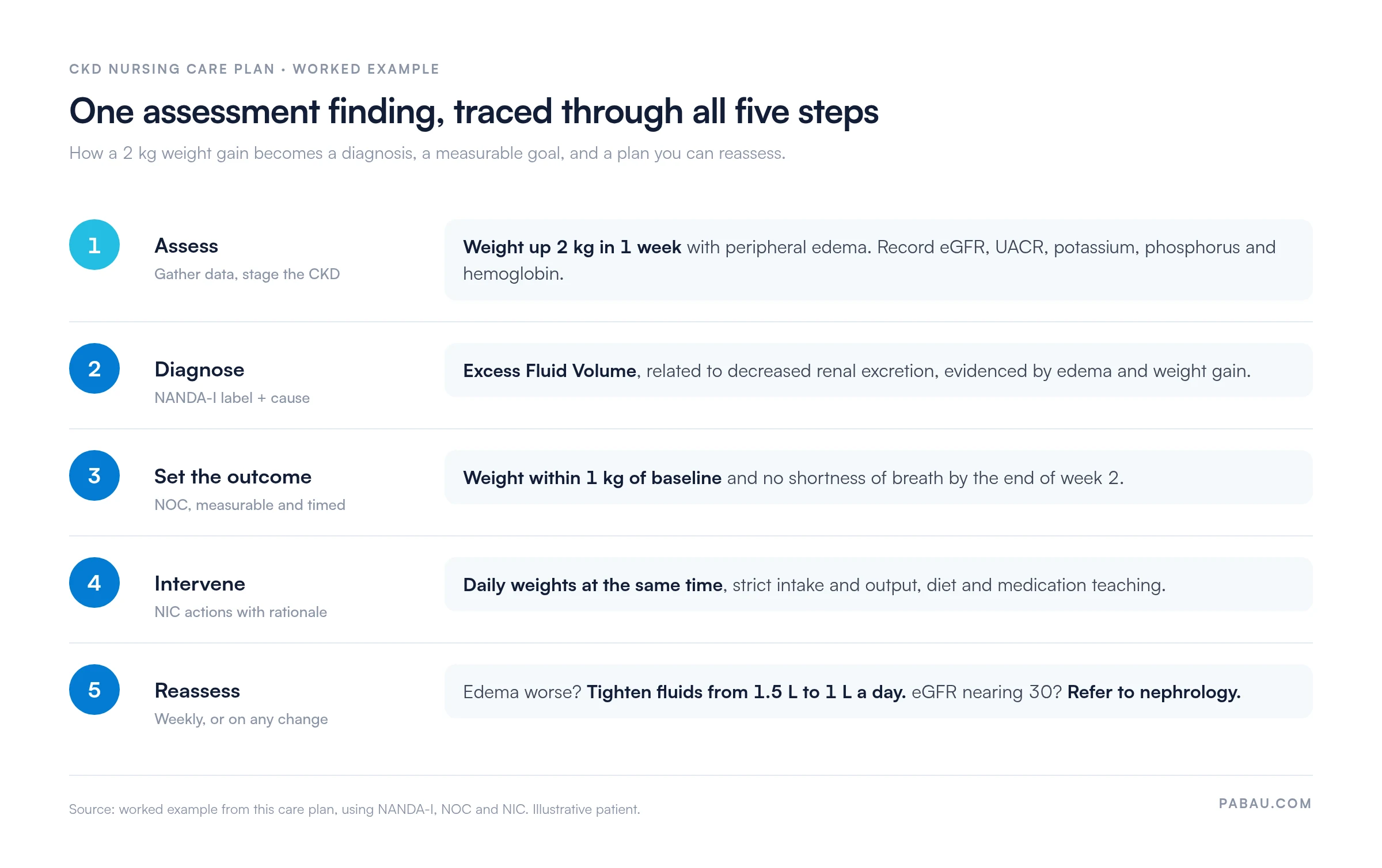
The plan is written for anyone who documents CKD care, from first-year students to case managers:
Standardization and compliance: A template built on KDIGO, NANDA-I, and ANA standards gives every entry the same structure. That makes it easier to meet HIPAA, GDPR, and CQC documentation expectations during an audit or inspection.
Less time on paperwork: Nurses fill in existing sections for assessment, diagnoses, interventions, and outcomes instead of starting from a blank page. The time saved goes back into direct patient care.
Consistent handovers: When the whole team uses the same framework, shift handovers reference the same diagnoses and intervention lists. Referrals carry a clear rationale, so specialists can follow the nurse’s reasoning.
Earlier warnings: A structured checklist picks up deterioration early, such as sudden weight gain, rising creatinine, or hyperkalemia. Trigger-based criteria like “refer to nephrology if eGFR < 30” bring specialists in on time.
Teaching value: Every intervention carries a rationale, so students and new nurses see the reasoning behind each clinical decision.
Nursing focus shifts as eGFR falls. The table maps each KDIGO stage to where your attention should go.
In G1 and G2, prevention leads: blood pressure, diabetes and lipid control, and dose checks for renally cleared drugs. In G3, the aim is to slow progression with ACE inhibitor or ARB therapy where proteinuria is present, plus early lifestyle teaching.
G4 brings preparation for dialysis or transplant. Management of anemia, bone-mineral disease, and fluid balance becomes more complex at this stage, and an anemia care plan can run alongside this one. In G5, dialysis or transplant care takes center stage.
These are the NANDA-I diagnoses that come up most often in CKD. Choose the ones the patient’s assessment supports:
When potassium, sodium, or fluid shifts dominate the picture, a dedicated fluid and electrolyte care plan adds detail. Patients losing weight may also need an imbalanced nutrition care plan.
Patient education is central to CKD nursing care. Patients need to spot warning signs, follow complex medication regimens, and change diet and lifestyle to slow progression.
For blood pressure, the current KDIGO (2021) guideline sets a systolic target under 120 mmHg for most non-dialysis CKD patients, measured with standardized office readings.
The core teaching topics are:
Patients with uncontrolled readings may need a separate hypertension care plan. To structure the sessions themselves, a nursing teaching plan records goals, methods, and how you checked understanding.
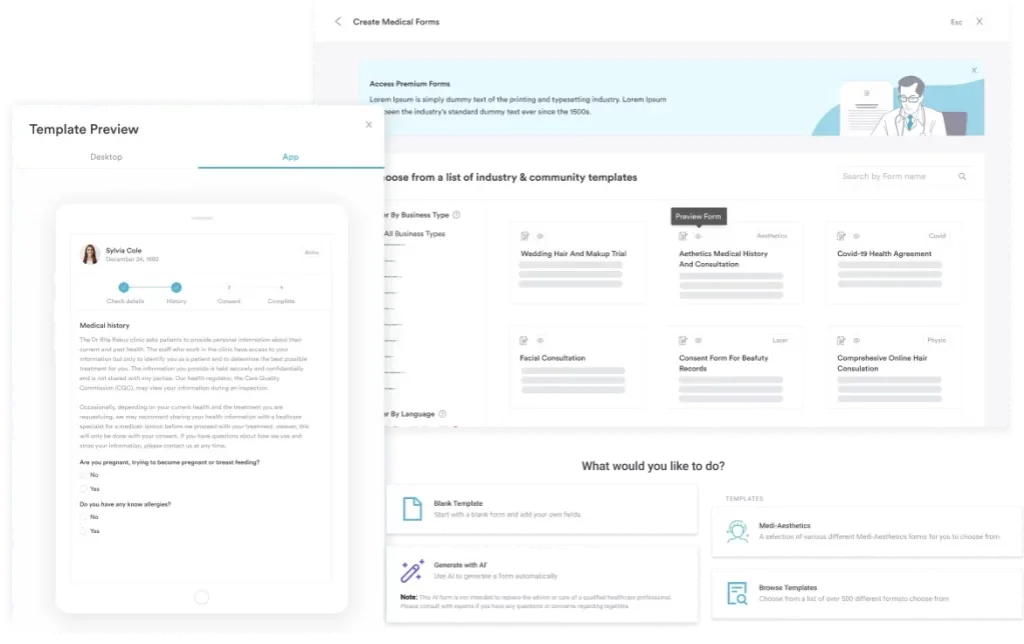
With faster digital intake forms, each education session gets logged the same way. The record shows what was taught, how well the patient understood, and any barriers to adherence.
Update the plan as the stage changes. Patients moving from G2 to G3 need more education and referral preparation. Patients nearing G4 or G5 need a discussion of hemodialysis, peritoneal dialysis, transplant, and advance care planning. Review the plan at least quarterly, or whenever lab results change significantly.
CKD care runs across several disciplines, and the nurse usually coordinates the referrals. Use these triggers:
In many practices, CKD care plans still live on paper or in scattered documents. Weights sit in one place, education notes in another, and referral letters get typed from scratch each time.
Pabau, the practice management platform we build, turns the care plan into a digital form stored in each patient’s record. Assessments, care plan updates, and education sessions sit next to appointments and treatment notes. Pabau Scribe, our AI scribe, drafts the note during the visit, so you spend the time on teaching rather than typing.
The result is a CKD record the whole team can read at handover. Reassessments are quicker because the last weight, goal, and intervention are already on screen.

Pabau’s digital forms and treatment notes keep CKD assessments, goals, and education sessions in each patient’s record. Your team spends less time on paperwork and hands over with the full picture.

A CKD care plan earns its keep in the weeks between appointments. A weight trend, an unmet goal, or an eGFR drifting toward 30 is only useful if someone acts on it.
So start with the stage, write outcomes you can measure, and set the reassessment date before you close the plan. The trade-off is a few extra minutes of documentation up front, in exchange for referrals that happen on time.
Download the template, adapt it to your patients and local protocols, and review it whenever the labs move. Book a demo to see how Pabau keeps CKD assessments, goals, and education notes together for your nursing team.

Caring for a patient with stones as well as CKD? Kidney stones nursing care plan covers pain control, hydration targets, and teaching for nephrolithiasis.
Need the right label for a new finding? Nursing diagnosis handbook lists NANDA-I diagnoses with defining characteristics you can match to assessment data.
Looking for intervention wording? List of nursing interventions gives ready-to-adapt NIC actions with rationales.
Want to map how CKD complications connect? Concept mapping nursing template helps students link diagnoses, findings, and interventions on one page.
Checking whether your plan worked? Evaluation nursing care plan shows how to judge each outcome and decide what to change next.
Common NANDA-I diagnoses in CKD are Excess Fluid Volume, Risk for Electrolyte Imbalance, Imbalanced Nutrition: Less Than Body Requirements, Fatigue, Anxiety, and Deficient Knowledge. Which ones apply depends on the patient’s assessment findings and CKD stage.
Acute kidney injury (AKI) develops suddenly and is often reversible, with a rapid rise in creatinine and possible hyperkalemia needing urgent dialysis. CKD is a slow loss of kidney function over months to years. It is managed with preventive care, medication optimization, and planned dialysis or transplant in later stages.
Nurses collect subjective data such as fatigue, nausea, dyspnea, adherence, and diet. They add vital signs, weight trends, edema, and labs including eGFR, UACR, potassium, phosphorus, and hemoglobin. Imaging and the CKD stage complete the picture and point to the right NANDA-I diagnoses.
Teach what CKD stages and eGFR mean, blood pressure targets, and limits on potassium, phosphorus, protein, sodium, and fluid. Cover medication adherence and which symptoms to report. Stress regular lab checks and nephrology visits, and offer coping strategies for a long-term condition.
Refer when eGFR falls below 30, or when proteinuria persists despite ACE inhibitor or ARB therapy. Hard-to-control blood pressure and electrolyte problems that resist conservative management also warrant referral. So does approaching the need for dialysis, at eGFR below 15.
The goals are to slow CKD progression through blood pressure and glucose control, and to prevent electrolyte imbalance, anemia, and bone disease. The plan also optimizes fluid and nutrition, improves adherence, prepares for dialysis or transplant, and supports quality of life.
Beyond the six core diagnoses, secondary ones include Ineffective Self-Health Management and Risk for Infection for patients on dialysis. Risk for Injury applies where medications raise the risk of harm.
Record subjective and objective findings, the CKD stage based on eGFR, and NANDA-I diagnoses with related factors and defining characteristics. Add NOC outcomes with timelines and NIC interventions with rationales. Then note the patient’s response and any changes to the plan.
Typical measures are protein of about 0.8 g/kg in CKD G3 to G5, limits on high-potassium foods, and fewer processed foods to cut phosphorus. Sodium stays under 2 g a day, and fluid is restricted in advanced CKD or dialysis. Calories must stay adequate to prevent malnutrition.
The template is an educational aid and does not process personal health data on its own. In clinical use, store patient information in a HIPAA-compliant (US) or GDPR-compliant (EU) system. Restrict access to authorized staff and follow your organization’s compliance protocols.