Anja Dodevska

Visual birth plan: Printable form and one-page summary guide
Download your free visual birth plan template A three-page PDF form with tick-bo...

2
Last Updated: Oct 29, 2026
Free PDF 3 pages, print-ready Clinician-reviewed
A nursing pharmacology cheat sheet is a printable study reference that lists the drugs you meet most often, grouped by class. This one covers 20 drugs across 10 classes, from analgesics and antibiotics to beta blockers and calcium channel blockers. Each line gives the drug, its indication and a typical dosage range, with a blank box for your own notes. It's built for student nurses and NCLEX candidates, and it doesn't replace prescribing information or current clinical references. The guide also explains how to study with it and how drug name endings reveal a class.
A three-page printable listing 20 common drugs across 10 classes, each with its indication and typical dosage. Blank boxes under every drug and a closing notes panel leave space for side effects and monitoring.
Start from scratch, or upload this PDF or any form you already use, and Pabau's AI Form rebuilds it with tick boxes, text fields and a signature. Attach it to the treatment once, and every patient gets it on time.
AI Form rebuilds the consent, history and aftercare forms you already use. You review each one, then publish.
Patients complete forms on their phone before they arrive, so the front desk stops retyping paper.
Every signed form is versioned and attached to the treatment record, ready when you need it.
Set how long a consent stays valid. Returning patients skip forms they have already signed.
Supports HIPAA and GDPR compliance AES-256 encryption 4.8 on G2 4.7 on Capterra Trusted by 4,000+ practices worldwide

The cheat sheet lists 20 common drugs across 10 classes, each with its indication and typical dosage.
A blank box under every drug gives you space to add side effects, monitoring and teaching points.
Drug name endings such as -olol, -pril and -statin signal the likely class at a glance.
Pharmacology sits under Physiological Integrity on the NCLEX-RN Test Plan, so expect it throughout the exam.
Use the sheet for active recall, then check every detail against current prescribing information.
A nursing pharmacology cheat sheet is a short reference that organizes high-yield drug information into a format you can scan in minutes. Most versions group medications by class, list prototype drugs and note what nurses need to monitor.
The National Council of State Boards of Nursing (NCSBN) lists pharmacological and parenteral therapies as a sub-category of Physiological Integrity. That’s one of the four Client Needs categories on the NCLEX-RN Test Plan. It explains why pharmacology turns up so consistently in exam preparation, and why a structured reference helps.
The free PDF runs to three pages and covers 10 drug classes, with two prototype drugs in each:
Each drug line gives the indication and a typical dosage range, followed by a blank box for your own notes. A notes panel closes the sheet. Leaving the side effects and nursing checks for you to fill in is deliberate, because writing them out is what builds recall.
The sheet works best as a recall tool that sits alongside your textbook and question bank. Use it in short, regular sessions rather than one long cram.
Once a class sticks, move the drugs you keep missing onto a pharmacology drug card for deeper notes.
Drug classifications give you a framework for predicting how a medication behaves, what it treats and what to watch for. Learning the class first makes the individual drugs far easier to remember.
Drug suffixes and stems are the endings and root segments in generic names that signal shared mechanisms. Recognizing them lets you guess a drug’s class from its name before you look it up.
Each ending also points you to that class’s main nursing check, so one glance at a name gives you a starting monitoring plan.
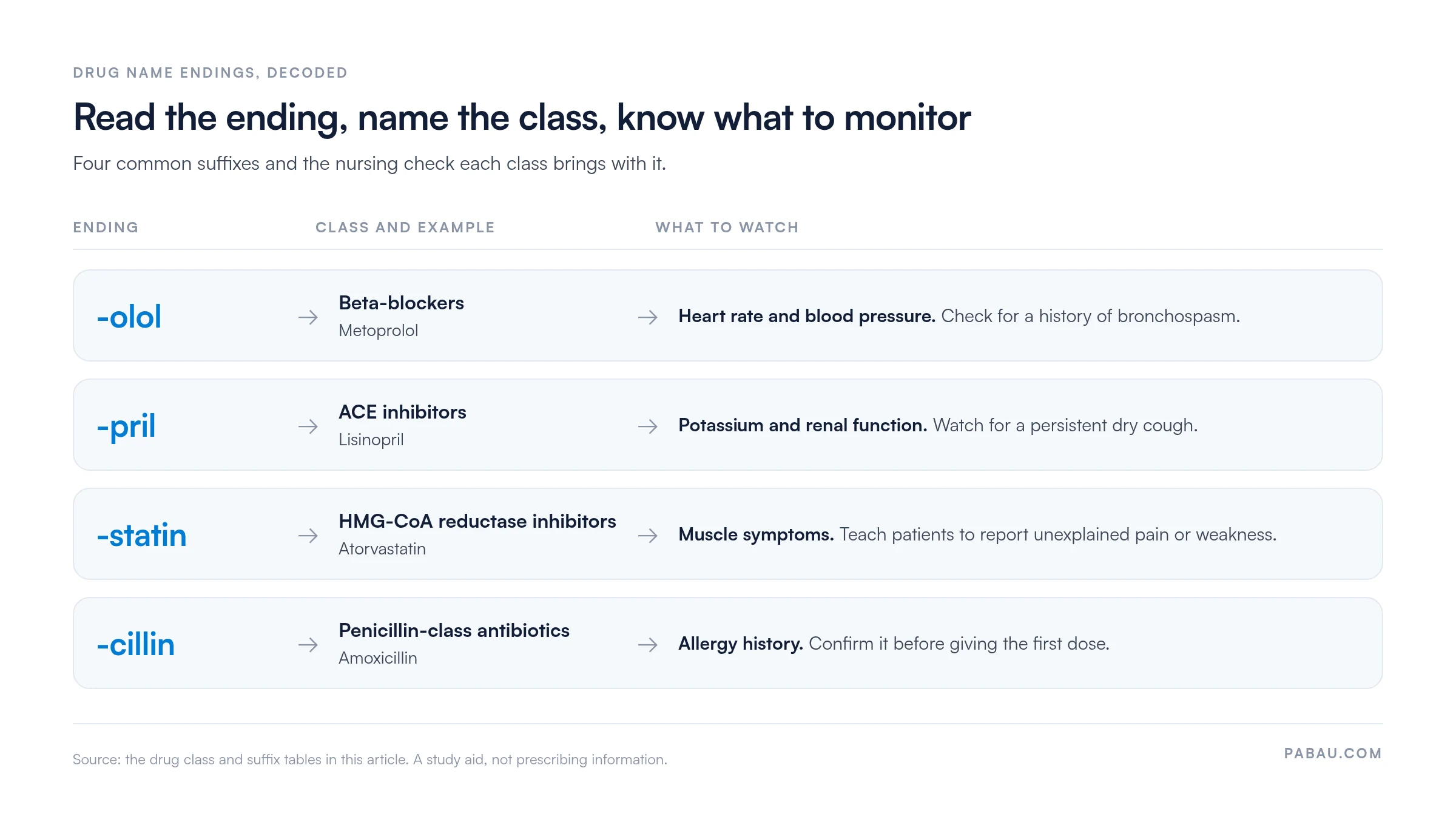
Four endings are only a start. Our medication suffix list covers a wider set for when your course moves past these classes.
Exam blueprints and course syllabi tend to revisit the same medications across multiple topics. A focused list of frequently tested drugs gives you a practical starting point, though no list covers every drug you’ll be asked about.
Blueprint Prep publishes a widely used “50 most common medications” resource for NCLEX candidates. It makes a useful companion to a class-based sheet. Use any list as a prompt for recall, and build your own notes around the drugs your course emphasizes.
IV solutions are classified by their tonicity relative to plasma, as isotonic, hypotonic or hypertonic. Normal saline is isotonic, which is why it’s a common reference point in fluid-balance questions.
For electrolyte ranges and imbalance signs, the fluid and electrolyte cheat sheet picks up where this list stops.
Memory aids work best when they’re built from the class names you already use. Create short phrases that pair each class with its signature suffix, then rehearse them until recall is automatic.
Pharmacology knowledge carries into practice, where medication records, allergy checks and administration schedules all need to be accurate. During a shift, the medication administration record is where that knowledge gets documented, dose by dose.
Once you’re qualified, the drug knowledge on this sheet gets applied to patient records rather than revision notes. In many practices, medication history, allergies and prescriptions still sit on separate paper forms or in separate systems.
Pabau, the practice management platform we build, keeps them on one patient record. Patients complete digital intake forms before the visit, so their medication history and allergies are on file early.
Our prescription management software records prescriptions against that same record. Compliance management keeps the documentation audit-ready, so the allergy history sits on the file the prescriber is working from.

Pabau puts intake answers, allergies and prescriptions on a single patient record. Your team checks one file before every dose or prescription.

Download the sheet, fill the blank boxes yourself and test from memory. The classes will stick far better than they would from a pre-filled list, because writing out side effects and teaching points is what builds recall.
The trade-off is coverage. Twenty drugs is a starting core rather than the whole exam. Add classes as your course reaches them, and check every dose against current prescribing information.
In practice, the same discipline applies to the medication record. Book a demo to see how Pabau keeps intake answers, allergies and prescriptions on one patient record.

Charting on clinical placement? Nurse charting cheat sheet covers what to document and how to phrase it.
Organizing a busy shift? Nursing brain sheet template keeps each patient’s priorities on one page.
Tracking a patient’s medications over time? Medication log template shows what to record for each medication.
This one lists 20 common drugs across 10 classes, with each drug’s indication and typical dosage range. A blank box under each drug holds your own notes on side effects and monitoring. It’s a study aid, not a substitute for prescribing information.
The NCLEX sets no fixed number of drugs to learn. Focus on high-yield drug classes and the medications your course emphasizes, rather than memorizing a long list.
Commonly tested classes include cardiovascular, antibiotic, and fluid and electrolyte medications. Check your exam blueprint and course materials for current priorities.