Despina Petrushevska

DASES: Drug Avoidance Self-Efficacy Scale
DASES at a glance and what it measures DASES stands for Drug Avoidance Self-Effi...

4
Last Updated: Oct 29, 2026
Free PDF 2 pages, print-ready Clinician-reviewed
A perfectionism worksheet is a self-reflection form with guided prompts that help patients explore perfectionistic thoughts, challenge them and plan small steps toward balance. The free two-page PDF asks patients to define perfectionism and test a recent perfectionist belief against the evidence. It then asks for three practical steps toward accepting imperfection and the people who can support them. It works best when a therapist introduces it in session and reviews the answers together. Pabau, the practice software we build for therapy teams, lets you send forms like this before a session.
A patient reflection worksheet with guided prompts to explore perfectionistic thoughts, challenge them and plan small steps toward balance. It closes with a support plan, a final reflection and space for notes.
Start from scratch, or upload this PDF or any form you already use, and Pabau's AI Form rebuilds it with tick boxes, text fields and a signature. Attach it to the treatment once, and every patient gets it on time.
AI Form rebuilds the consent, history and aftercare forms you already use. You review each one, then publish.
Patients complete forms on their phone before they arrive, so the front desk stops retyping paper.
Every signed form is versioned and attached to the treatment record, ready when you need it.
Set how long a consent stays valid. Returning patients skip forms they have already signed.
Supports HIPAA and GDPR compliance AES-256 encryption 4.8 on G2 4.7 on Capterra Trusted by 4,000+ practices worldwide

The worksheet has five sections: understanding perfectionism, challenging thoughts, embracing imperfection, seeking support and a closing reflection.
Its challenge prompts work like a CBT thought record, so patients weigh the evidence for and against a perfectionist belief.
It is a patient self-reflection form with no score, so it works best when a clinician introduces it and reviews the answers.
Treat completed worksheets as clinical records and check your HIPAA or GDPR obligations.
Pabau’s digital forms let you send the worksheet before a session and keep the answers in the patient record.
A perfectionism worksheet is a self-reflection form that helps patients define perfectionism, challenge perfectionistic thoughts, plan steps to embrace imperfection and identify support. It carries no score, so clinicians use it as a structured prompt rather than a diagnosis.
This two-page PDF splits that work into five sections. Each one asks open questions the patient answers in their own words:
The questions stay open on purpose. The answers give you material to explore together, such as where a standard came from or which tasks the patient puts off.
Perfectionism appears across work, study and relationships, and clinicians often see it alongside other presentations. Rigid perfectionism is frequently discussed in the context of obsessive-compulsive disorder, and the International OCD Foundation publishes resources for clinicians and families on the topic.
High standards and perfectionism part ways when a result falls short. Healthy striving can live with an imperfect outcome. Perfectionism tends to read it as failure, and the patient may then avoid the next attempt altogether.
CBT-based perfectionism work typically draws on thought records, cognitive restructuring and behavioral experiments. The Beck Institute describes thought records as a core CBT technique. The NICE guideline on generalized anxiety disorder recommends CBT as a treatment for anxiety.
The worksheet’s challenge section asks the same evidence questions in a single page. When one belief needs a fuller workup, the putting thoughts on trial worksheet builds the case for and against it in more detail.
Use the perfectionism worksheet in three stages: introduce it, complete it together, then review the results at the next session. This keeps the patient in control of the content while you guide the structure.
The plan below shows which sections belong to each stage, so you know what to cover in the room and what to send home.
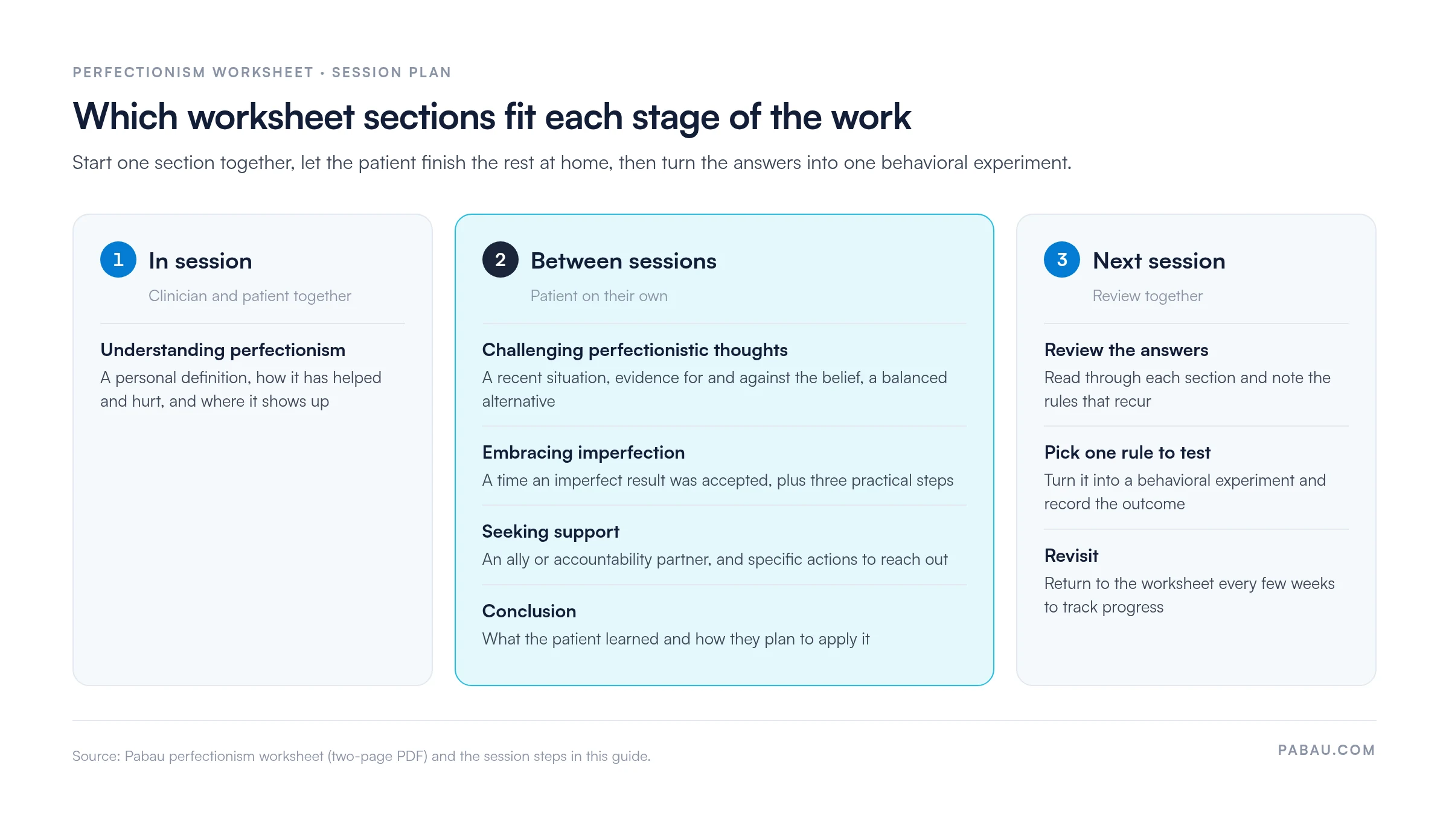
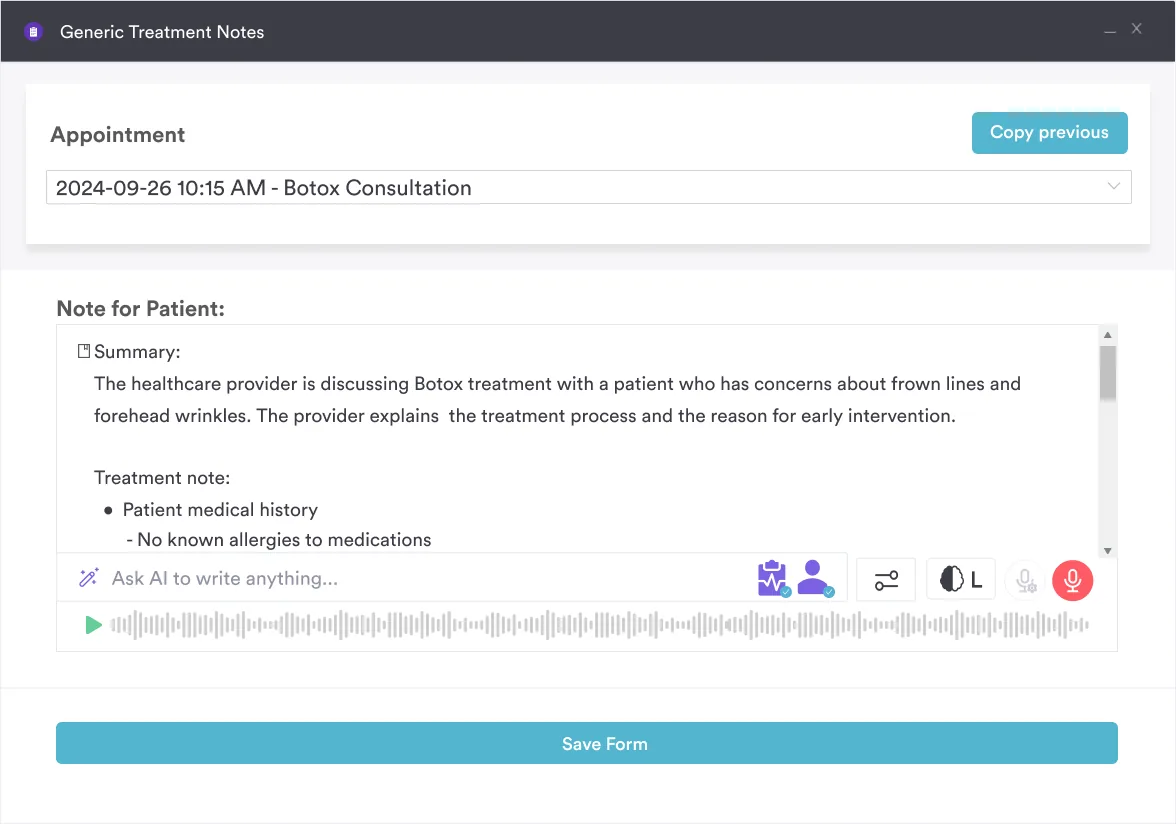
Adapt this sequence to your clinical judgment and to each patient’s pace. Pabau Scribe, our AI scribe, can support the session notes that sit alongside the worksheet, so the record of the work stays in one place.
Therapists, counselors, psychologists and coaches working with adults can use the worksheet as part of a guided program. Clinicians in private practice often set it as a short task between sessions because the PDF needs no special software.
It also suits group practices where several clinicians see patients with overlapping concerns. A shared template means every clinician prompts the same reflections, which makes progress easier to compare across the team.
Audit the worksheets your team already uses before you add a new one. Check which templates touch perfectionism, anxiety or self-criticism, and remove any that overlap. Patients respond better to one clear prompt than to three competing ones, and clinicians spend less time explaining which version to complete.
A written worksheet makes thinking patterns easier to track across weeks. Patients have something concrete to review when they feel stuck between sessions. Therapists gain a shared record of progress to discuss at the next appointment.
Structured forms also reduce the chance that important details slip through. Clinicians who already use a psychiatric evaluation template will recognize the same approach here.
Completed worksheets are clinical records, so they need the same storage and access controls as session notes. Data protection rules depend on where you practice. US clinicians need to check their obligations under HIPAA, while UK and EU therapists work under GDPR.
Keep completed copies with the patient’s notes in your practice system, not in personal email or unsecured folders. Many practices hold them in software built for therapists, where worksheets and session notes share one patient file.
Some therapists also bring in DBT skills, such as validation and acceptance, when patients feel ashamed of falling short. The evidence for combining the two in perfectionism work is still developing, so present this as an addition to CBT rather than a replacement.
The worksheet’s own instructions ask patients to be kind to themselves while they answer. A self-compassion journal extends that habit between sessions. Patients who learn to respond to a mistake with kindness often find it easier to test their rules, although results vary.
Most practices still print the PDF, hand it over and wait for a crumpled copy at the next appointment. The answers then get scanned, typed up or left in a folder away from the session notes.
In Pabau, you can send the worksheet as a digital form before the session, and the patient’s answers land in their record automatically. Your notes, the completed worksheet and the next behavioral experiment sit in the same place, with patient records software controlling who can see them.
That means the review stage starts with the answers already on screen, so session time goes on the conversation rather than the paperwork.

See how Pabau brings forms, session notes and patient records together, so your CBT tools sit inside the workflow you already use.

The worksheet earns its place when it ends in one specific experiment. Pick a single rule from the patient’s answers, agree a small test and review the result together. A page of honest answers that never turns into action is just another form to file.
Perfectionism often hides behind delay and avoidance. If putting tasks off is the main pattern, follow up with our procrastination worksheets in a later session.
Book a demo to see how Pabau sends the worksheet before a session and files the answers in the patient record.

Running group sessions? Group therapy informed consent explains how to document agreements before a group starts.
Working with repetitive thinking? Ruminating thoughts worksheet gives patients a structured page for thoughts that keep returning.
Tracking how patients see themselves? State self-esteem scale measures self-esteem at a single point in time.
Running a wider therapy practice? Psychology practice software covers the workflows that sit around patient sessions.
A perfectionism worksheet is a self-reflection form that helps patients define perfectionism, challenge perfectionistic thoughts, plan steps to embrace imperfection and identify support. Clinicians use it as a prompt for guided work, not as a diagnostic test.
Yes, the perfectionism worksheet PDF in this guide is free to download. It is a patient self-reflection form that works best when a clinician introduces it and reviews the answers. You can print it for in-person sessions or share it digitally.
Therapists, counselors, psychologists and coaches working with adults can use it. It is a patient self-reflection form that works best when a clinician introduces it and reviews the answers together. Use your professional judgment about whether it suits each patient.
No, a perfectionism worksheet supplements clinical work. It does not replace assessment, treatment planning or ongoing therapy. Patients with significant anxiety, depression or obsessive-compulsive symptoms may need specialist input alongside it.
Start by writing the perfectionist thought down in the patient’s own words. Then weigh the evidence for and against it, and test one rule through a small behavioral experiment. Review the outcome together and adjust the next step based on what the patient observed.