Journal prompts for mental health
Journal prompts for mental health are guided questions that help people process ...

2
Last Updated: Oct 13, 2026

The putting thoughts on trial worksheet is a CBT exercise that tests one automatic negative thought against the evidence for and against it.
The worksheet runs in four steps: name the thought, list the evidence for it, list the evidence against it, then write a balanced verdict.
Ask the client to rate how strongly they believe the thought before and after, so you can see whether the belief shifted.
Skip the exercise while a client is in crisis, and bring it out once they can hold a second perspective.
Practice management software like Pabau stores the completed worksheet in the client record, so the next session opens with it in front of you.
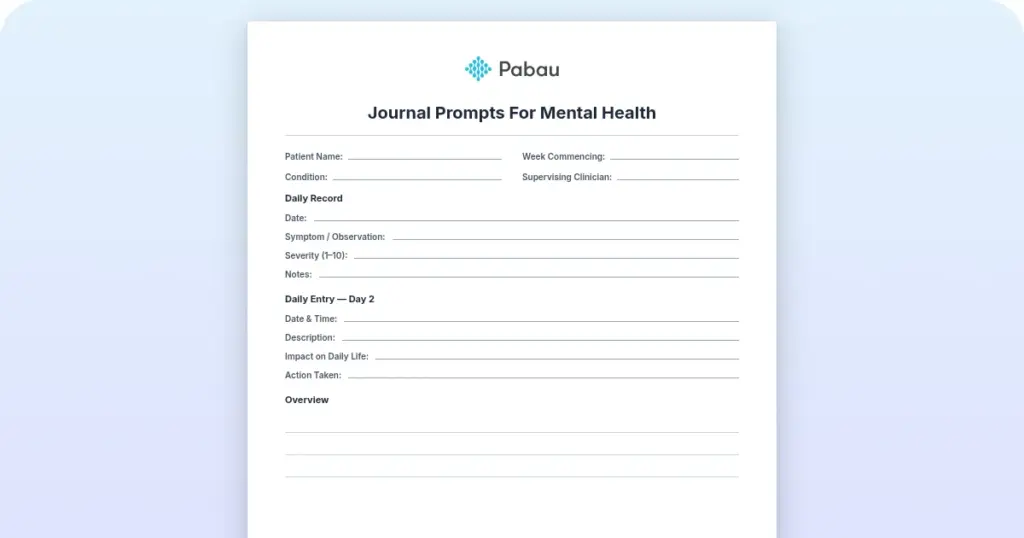
One printable page with space for the client’s details, the thought on trial, the evidence for and against it, and a balanced verdict. Print it for the room, or send it home as homework.
Download templateThe putting thoughts on trial worksheet asks a client to treat one anxious thought the way a court treats an accusation. They name the thought, list the evidence for it, list the evidence against it, then write a verdict they can defend.
That metaphor earns its place. It gives someone a way to argue with a belief without feeling like they are arguing with themselves. Whether it lands, though, comes down to the thought you pick and how specific that thought is.
The worksheet is above, free to download. What follows is how to run it, when to hold off, and the mistakes that stop it working.
It takes one automatic negative thought and makes it survive cross-examination. Automatic negative thoughts, known as ANTs, arrive fully formed and feel true on impact. The worksheet slows that moment down long enough for the client to check the evidence.
Each block on the page borrows a courtroom role. The case names the thought, the prosecution collects what seems to prove it, and the defense collects what contradicts it. Last comes the verdict, the balanced sentence the client walks out with.
Because the method targets thinking rather than a diagnosis, it travels well. Therapists use it in cognitive behavioral therapy (CBT), in work informed by dialectical behavior therapy (DBT), and in general talk therapy.
It suits several presentations in particular:
A thought record tracks patterns across a week. This worksheet stops on one thought and tests it properly.
A thought record worksheet captures the situation, the thought, the feeling, and what the client did next. Run it for a few days and the beliefs that keep showing up become obvious.
Putting thoughts on trial then picks one of those beliefs and spends a session on it. Most therapists use both, and the order matters. Track first, then prosecute the thought that keeps winning.
Both are cognitive restructuring exercises, so our cognitive restructuring worksheet is worth a look if you want the wider method first.
Three conditions decide whether this exercise helps or backfires. Run through them before the worksheet comes out of the folder.
Still forming a picture of a new client? A structured psychiatric evaluation template gathers the history and risk information you need before you start challenging beliefs.
The worksheet follows a four-step process, and you can run it in session or send it home as homework. The example below follows one client through all four sections.
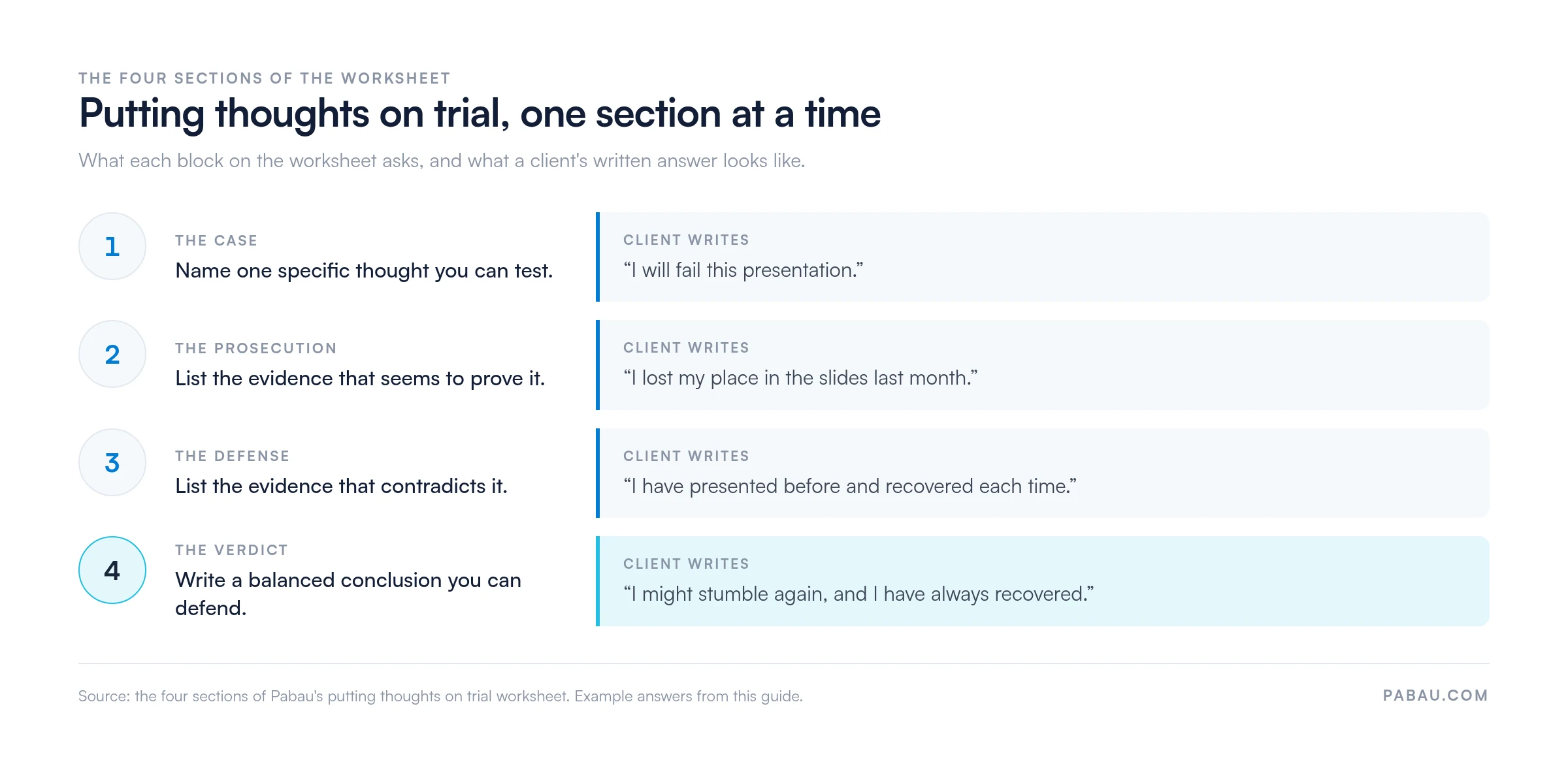
Ask the client what went through their mind, using their own words. You want a sentence that makes a claim, not a feeling.
“I will fail this presentation” works, because you can weigh it. “I feel awful” gives you nowhere to start. Write the thought into the case section exactly as the client said it. Tidying up their wording quietly changes the thought you are testing.
Ask for the evidence that seems to prove the thought true, and take it seriously. This is the prosecution section, and rushing it costs you the client’s trust.
Our client offers one line: “I lost my place in the slides last month.” That is a fact, so it goes on the page. Resist the urge to argue here. An objection you knock down now is one the client will hold on to in private.
This section is usually the harder one, so ask rather than tell. Open questions let the client find the counter-evidence themselves, which is what makes it stick.
After a few of those, our client lands on something usable: “I have presented before and recovered each time.”
The verdict has to be the most accurate sentence the evidence supports, not a positive affirmation. “I might stumble again, and I have always recovered” passes that test. “It will be fine” does not, and the client knows it.
Read the verdict back out loud before the session ends. If the client winces, the sentence has overshot the evidence, so trim it until they can agree with it.
Ask the client to rate how strongly they believe the thought, from 0 to 100, before you start and again at the verdict. That single number tells you whether the exercise moved the belief or only filled a page.
The worksheet leaves no box for it, so write both ratings in the margin. It takes ten seconds and it turns a subjective exercise into something you can track across sessions.
A belief that hardly shifts is useful information too. Usually it means the evidence lists were thin, or that the thought sits on a deeper core belief the client has not named yet.
When the rating stays high after a careful run, stop disputing and start testing. A behavioral experiment worksheet turns the belief into a prediction the client can check in the world. Ratings often move there when argument alone has stalled.
The technique looks simple, so it tends to fail without anyone noticing why. These four slips come up most often.
Paper works fine in the room. It gets awkward afterward. The completed sheet goes into a folder and the therapist retypes a summary into the notes. By the following week the client’s own wording is gone.
Practice management software like Pabau handles that differently. Digital forms let you build the worksheet’s four sections once, then assign it to a client from their own record. What they type comes back into that record, so the verdict they wrote is on screen when the next session opens.
For a solo counselor or a group practice, that is the difference between homework you can review and homework you have to reconstruct.
Pabau’s therapy practice management tools hold scheduling, notes, and payments in the same place, so the worksheet never sits in a separate system.
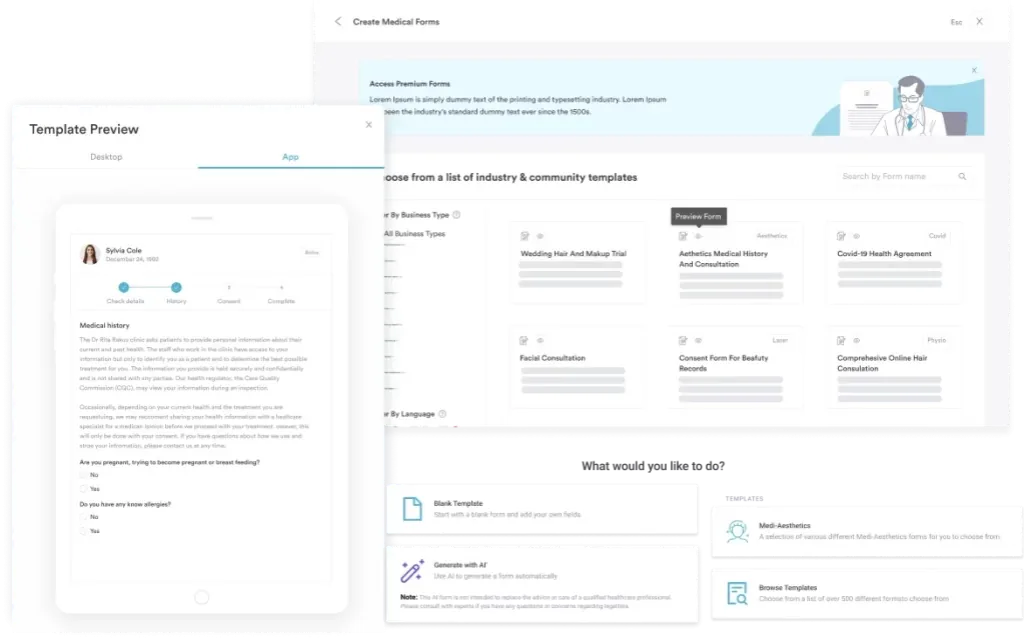

Assign worksheets from a client’s file, collect the answers digitally, and open the next session with their own words in front of you.

This worksheet is only as good as the thought you put into it. Pick one the client can test, let the prosecution speak first, and stop the verdict where the evidence stops.
Write the belief rating down both times. Over a few weeks those numbers show whether the technique is working for this client. If the rating barely moves, the thought is probably anchored to a core belief that needs its own session.
The admin around homework is where good therapy leaks time. Book a demo to see how Pabau assigns worksheets, stores what clients write, and keeps it beside your session notes.

Need to name the distortion first? Cognitive distortions worksheet helps clients label the thinking pattern before they argue with it.
Want a fuller tracking sheet? 7 column thought record follows a thought from the situation through to the balanced response.
Is the belief deeper than one thought? Core belief worksheet works on the rule sitting underneath the automatic thoughts.
Stuck on all-or-nothing thinking? All or nothing thinking worksheet gives clients a way to find the middle ground.
Prefer a structured five-column format? ABCDE CBT worksheet walks through activating event, belief, consequence, dispute, and effect.
Allow 15 to 20 minutes the first time, because you are teaching the format as well as running it. Once a client knows the four sections, most complete a round in around 10 minutes. Homework rounds are usually quicker still.
Stop disputing it and switch to problem solving. If the client genuinely did miss the deadline, the useful question is what happens next. Arguing against a fact costs you credibility and teaches the client that the technique is a trick.
Yes, and the courtroom framing tends to help, because most teenagers already know how a trial works from television. Keep the evidence lists to three or four items, use their own words on the page, and expect to run the first two rounds together.
No. Decatastrophizing asks what would happen if the feared outcome arrived, and how the client would cope with it. This worksheet asks whether the thought is accurate in the first place. Many therapists run the trial first, then decatastrophize the part that survives.