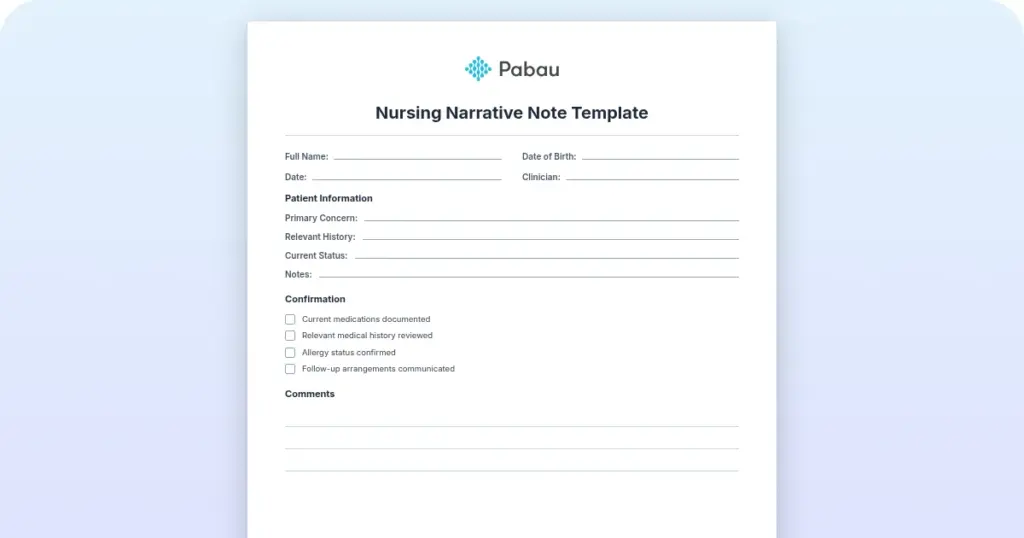
Nursing narrative note template
A nursing narrative note template is a structured PDF that guides you through re...

3
Last Updated: Oct 21, 2026
A patient follow up letter template lets your practice confirm a patient’s next appointment in writing and recap the visit that led to it. It covers the reason for follow-up, symptoms, medication, the treatment plan, and what the patient should do before they come back.
Without a standard letter, follow-up depends on whoever remembers to write or call. The free download below is that letter, ready to complete and send. This guide adds the questions for the contact itself, email and call scripts, and a pre-contact checklist.
A follow-up letter you complete and send to the patient to confirm their follow-up appointment. It has fields for the reason for follow-up, a summary of the previous visit, symptoms, medication, the treatment plan, and instructions.
Download template
A patient follow up letter confirms the next appointment in writing and recaps the last visit, so the patient knows why they are coming back.
Each contact should cover the reason for follow-up, recovery progress, medications, red-flag symptoms, and the next action with a date.
Email suits routine check-ins, while a short call script keeps phone contact focused on the same clinical checkpoints.
For Medicare transitional care management, CMS expects contact within two business days of discharge and a visit within seven or 14 days.
Practice software such as Pabau can send follow-up forms after each appointment and file every reply in the patient record.
A patient follow up letter is a written message from your practice that confirms a follow-up appointment and summarizes the visit behind it. It tells the patient why they are coming back, which symptoms to watch, and how to take their medication until then.
The letter also creates a record. If a patient complains or a regulator asks how post-treatment contact was handled, a copy shows what the patient was told and when. Recovery questions for the contact itself can borrow from patient reported outcome measures, which turn “how are you feeling?” into a score you can compare between contacts.
The five steps below follow the order most practice teams work through a follow-up contact. Record the answers on a post-treatment follow-up form, and adapt the wording to your specialty and local regulatory requirements.
Keep the completed form with the patient record. Storing it in the same system as the clinical notes means the next clinician sees the full history without searching. If the patient’s medicines have changed since the visit, update the list with a medication reconciliation form before you close the contact.
Where the next action is another appointment, the downloadable letter handles the paperwork. Fill in the reason, the visit summary, symptoms, medication and plan, then send it to confirm the date.
Private practices and GPs send them after diagnostic visits and treatment changes. Med spas and skin practices send them after injectable and laser treatments, where early signs of a reaction need prompt review.
Wellness and mental health practices use them to keep contact between sessions structured. Dermatology practices use them to track recovery after minor procedures. Each setting uses the same core structure with different clinical prompts.
A consistent template makes follow-up auditable. When every contact is recorded in the same structure, your team can show what was checked and when, which supports clinical governance and inspection readiness.
It also saves time. Staff stop reinventing the questions for each patient. A new team member can run a follow-up call from the template without shadowing a colleague first.
Not every follow-up is a phone call. Email works well for routine check-ins, and a short script keeps phone contact focused. Both should follow the same clinical checkpoints as the letter.
A routine check-in email needs four parts:
For a call, open by confirming the patient’s identity and the procedure, then ask about symptoms and medication. Close by agreeing the next step. Write the outcome into the record before ending the call.
A checklist turns the template into a quick pre-contact review. It helps a clinician confirm the essentials without reading the full form each time.
Discharge follow-up has its own timing. CMS Transitional Care Management (CPT 99495 and 99496) expects interactive contact within two business days of discharge. A face-to-face visit then follows within 14 days for moderate complexity, or within seven days for high complexity.
Confirm the current requirements with your regulator before relying on any specific window. The timeline below shows how those deadlines line up after discharge.
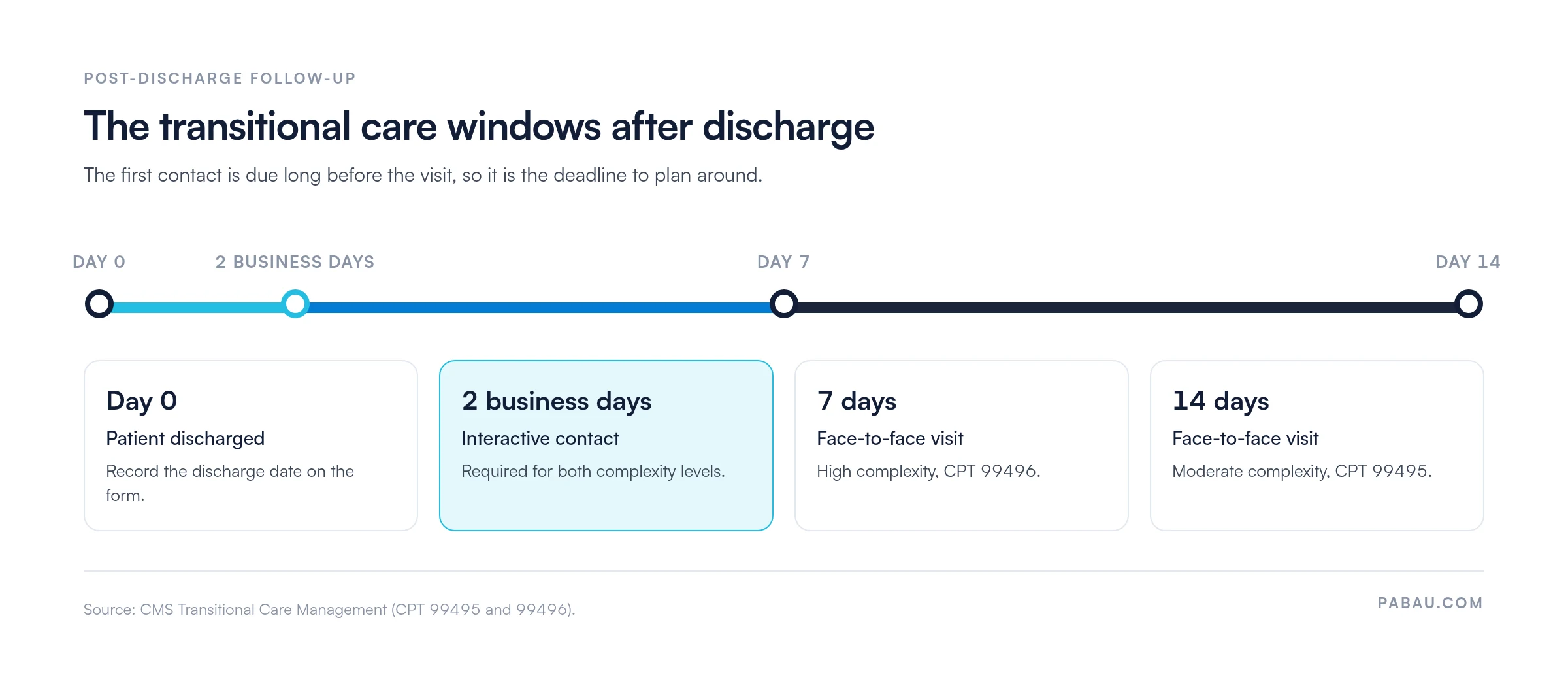
Record the discharge date in the letter’s visit summary, so whoever makes the contact can see each deadline. A patient discharge form captures that date alongside the aftercare plan you will check against.
For patients who miss or cancel an appointment, the letter doubles as a re-engagement message. Record the attempt, the outcome, and the rebooking date, so the next follow-up does not start from scratch.
A protocol sets out who makes each follow-up contact, when, and through which channel. Without it, the letter template is a document nobody owns. Write the protocol once, then review it each time your services change.
For each type of follow-up, the protocol should name:
Keep your language plain. Patients recall follow-up instructions more reliably when they are written at a simple reading level and avoid unexplained clinical terms.
Keep contact personal and clinically relevant. A message that names the procedure and asks a specific question gets a better response than a generic check-in.
Without software, follow-up usually runs from a spreadsheet or a diary, with staff phoning patients one by one. The answers end up on paper or in an inbox, away from the clinical notes.
In Pabau’s practice software, the follow-up letter and automated aftercare messages go out after the relevant appointment. Each letter is stored in the patient record, with a log of who created and sent it. Patients complete any follow-up form online, and their answers land next to the treatment notes.
The same digital forms handle paperless patient intake before the visit. Your team spends its time on the clinical checks and the escalations, rather than on chasing replies.

Pabau sends follow-up letters, forms and aftercare messages after each appointment. Every reply is saved to the patient record, so no check-in depends on memory.

Start with the questions, then decide who owns each contact and when it happens. A template with no named owner tends to sit unused, however good its questions are.
If you see patients after a hospital discharge, build the two-business-day contact into your protocol first, because it is the shortest window. Other contacts can follow the intervals your clinical lead sets.
Once the questions are fixed, the remaining work is sending them on time and filing the answers where clinicians will see them. Book a demo to see how Pabau sends follow-up letters automatically and keeps every reply in the patient record.

Sending a patient home after a procedure? Patient discharge instructions covers what to put in writing before the first follow-up call.
Planning the discharge itself? Discharge planning checklist lists the steps to complete before the patient leaves.
Need a record of a full course of care? Treatment summary gives the next clinician the whole picture in one document.
Writing up the follow-up visit? Chart note template shows what to include in the note, with examples.
Choosing where these records live? Best clinical documentation software compares the tools practices use to store notes and forms.
A patient follow up letter is a written message that confirms a patient’s next appointment and summarizes the visit behind it. It also covers symptoms to watch, medication, and the treatment plan.
It should include the reason for contact, recovery progress, medications and aftercare, any red-flag concerns, and the next action with a date. Record each item in the patient file.
The interval depends on the procedure and the clinical risk, so set it in your protocol with your clinical lead. After a hospital discharge, CMS transitional care management expects contact within two business days.
Set rules in your practice software so that a follow-up task or message is created after each relevant appointment. Review the automated messages regularly so clinical content stays accurate.