Medication tracker template: Free PDF for clinicians and caregivers
A medication tracker is a form that records each medication a patient takes, whe...

3
Last Updated: Oct 12, 2026
A chart note is the record a clinician writes after each patient encounter. It captures what the patient reported, what you found, what you concluded, and what happens next. The next clinician reads it before seeing that patient. An auditor, insurer, or court reads it if your care is ever questioned.
The rule that matters most is simple. Write the note the same day, and sign it before anyone relies on it. A late or vague note leaves your reasoning undefended and your colleagues guessing. The free template below gives you every field, and the examples show how they read in four specialties.
A structured chart note with fields for patient details, chief complaint, medical history, physical examination, assessment, diagnosis, and treatment plan. Print it for paper charts, or use its fields to build a digital form for your specialty.
Download template
A chart note records one patient encounter, from the chief complaint and exam findings to the assessment, diagnosis, and plan.
SOAP, DAP, and narrative notes are formats for writing a chart note, while a progress note is a shorter follow-up entry.
Write the note the same day, use objective language, record relevant negatives, and sign it with your credentials.
Fix errors with a dated, initialed amendment, and never delete or overwrite the original entry.
Retention periods depend on where you practice, so check your state law or NHS schedule before destroying records.
Every visit, call, or procedure that changes a patient’s care gets its own chart note. It is the official record of what the clinician observed, how they read those findings, and what they decided. Chart notes are legal medical records.
They also carry continuity of care. The next clinician should be able to follow your reasoning and pick up where you left off, without phoning you first.
You’ll write them in every setting, from primary care and mental health practices to physical therapy, dermatology, and nursing. They support compliance with HIPAA in the US, GDPR in the UK and Europe, and local rules. They are also your first line of defense in an audit.
The structure stays the same across specialties, even when the depth and vocabulary change. Here is what each field captures, using a knee pain visit as the running example.
People often use “SOAP note” and “chart note” as if they mean the same thing. They don’t, quite. A chart note is the clinical record of an encounter. SOAP (Subjective, Objective, Assessment, Plan) is one format for writing it.
SOAP is the most common format, and these SOAP note examples show it across specialties. Other formats include DAP notes, narrative notes, and focus charting. Pick the one your team will use consistently.
For follow-up visits, a dedicated progress note template keeps entries short without dropping the fields that matter.
Each example uses the same core fields, trimmed to what that setting needs. Patient names are fictional.
Patient: Jane Smith, 52, presenting for a hypertension check and fatigue.
Chief complaint: “Feeling more tired than usual, especially in the afternoon.” Blood pressure check as part of the annual review.
History: Fatigue began 3 weeks ago. No fever or weight loss. Sleeping 6 to 7 hours nightly, less than usual. Current medications are amlodipine 5mg daily and metformin 500mg twice daily. Allergy: penicillin (rash).
Examination: BP 148/92 (elevated), HR 78, normal weight. No anemia on inspection. Thyroid not palpably enlarged.
Assessment: Fatigue, possibly from hypothyroidism or anemia. BP remains elevated despite current therapy.
Plan: Complete blood count and thyroid function tests. Increase amlodipine to 10mg. Review in 2 weeks. Patient advised to keep a sleep diary.
Inpatient notes are usually written per shift, so they lead with what changed. Good nursing documentation also records who was told and when.
Patient: Robert Jones, 68, admitted after hip replacement surgery, Day 1.
Shift note: Overnight pain 4/10, managed with acetaminophen. Mobilized to bedside chair with physical therapy. Urinary catheter draining clear yellow urine. Dressing clean, dry, and intact. Vital signs stable. Patient alert, wife at bedside, mood improved since admission.
Plan: Continue analgesia schedule and encourage fluids. Physical therapy twice daily. Reassess catheter tomorrow for a removal trial.
Patient: Maria Garcia, 45, referred for knee pain after a marathon.
Subjective: Anterior knee pain, worse with stairs and lunging. Pain 6/10 today. Wants to return to running within 6 weeks.
Objective: Knee extension deficit 5°. Single-leg squat shows valgus collapse. VMO weakness noted. Pain-free range of motion to 85° flexion. Quadriceps strength 4/5.
Assessment: Likely patellofemoral pain syndrome from deconditioning after the race. Quadriceps and hip abductor weakness contributing. Good prognosis with targeted strengthening.
Plan: 1. VMO strengthening (short-arc quads, clamshells). 2. Hip abductor work (side-lying leg lifts). 3. Core stability. 4. Return-to-run protocol from Week 3 if pain-free. Recheck in 2 weeks.
Patient: Alex Chen, 34, new patient for individual therapy.
Chief concern: Anxiety and insomnia following job loss 2 months ago. Denies suicidal ideation. No prior mental health treatment.
Risk assessment: Low current risk. Sleep deprivation is a concern, so referred to primary care for a sleep evaluation. Strong family support. Denies substance use.
Assessment: Adjustment disorder with anxiety. Situational triggers (financial stress, identity loss) are manageable with cognitive-behavioral intervention.
Plan: 1. Weekly cognitive behavioral therapy (CBT) using thought records and graded exposure to job-search tasks. 2. Psychoeducation on sleep hygiene. 3. Primary care referral for sleep assessment. 4. Safety plan reviewed. Next session in 1 week.
Writing the note is only one stage. In a working practice, it passes through six, and each one has its own failure point. The diagram below follows a single note from intake to retention.
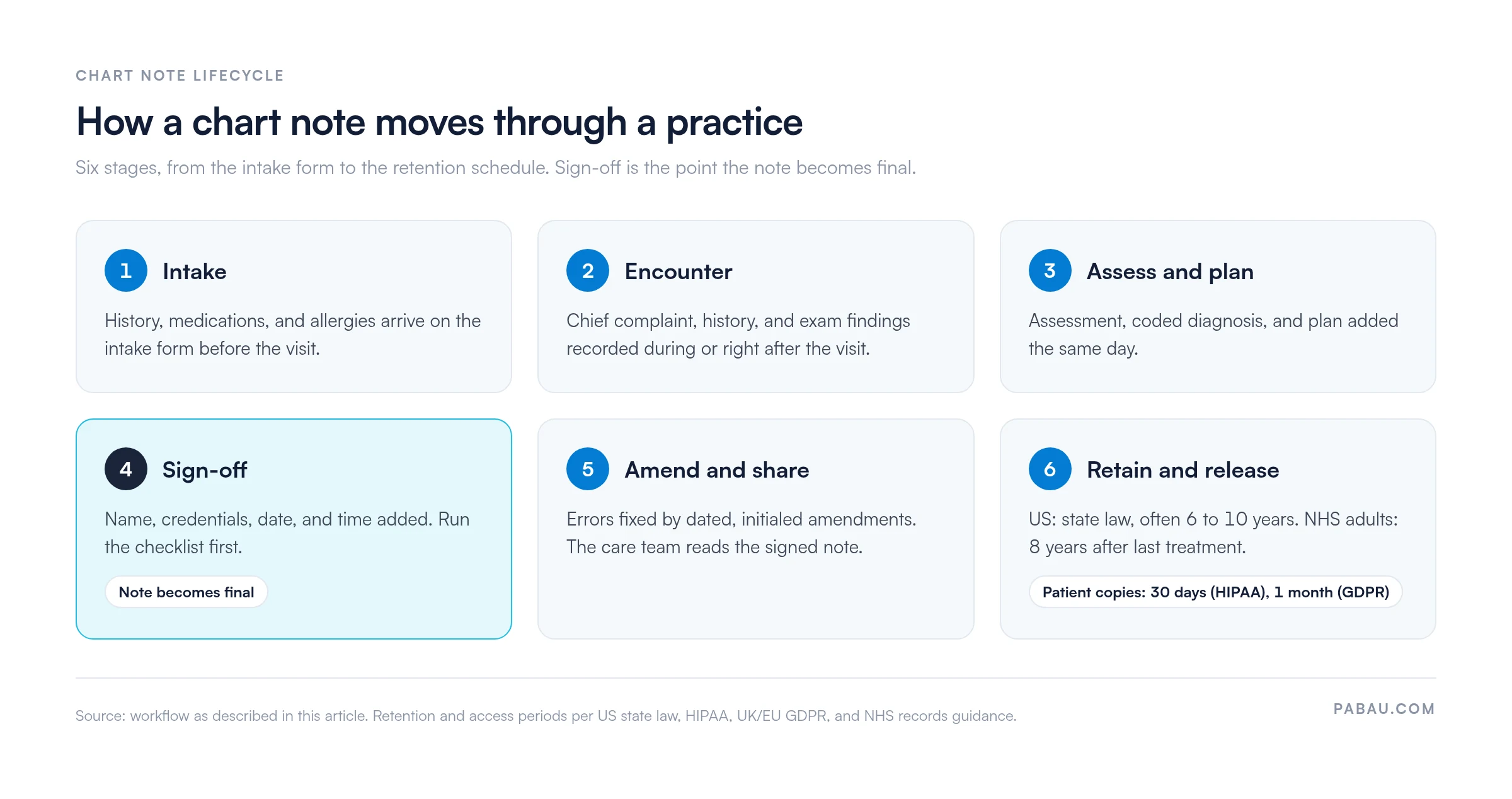
The first stage decides how much typing the rest takes. When history, medications, and allergies arrive through intake software for practices, the clinician confirms them instead of re-asking.
Stages 2 and 3 should close the same day. Sign-off follows, and after that the note is shared with the care team and used for billing. From then on, nobody edits the original. Corrections become amendments, and the record sits in storage until its retention period ends.
Thirty seconds here saves an awkward amendment later. Check each point before you add your signature.
Most weak notes aren’t wrong, exactly. They’re just hard to defend. These are the patterns reviewers flag, along with the fix for each.
On paper, chart notes drift. Fields get skipped, signed copies end up in the wrong folder, and finding last month’s exam means searching filing cabinets.
Pabau, an all-in-one practice management system, lets you build your chart note as a digital form with the fields your specialty needs. Clinicians document in the patient’s record during or right after the visit, and the whole care team sees the latest note.
Pabau’s client records and digital forms keep notes in each patient record with a clear audit history, supporting your HIPAA and GDPR obligations. Whether you run a solo practice or a multi-location group, medical records management in one system means less time chasing paperwork.

Pabau’s digital forms and client records keep every chart note in the patient file with a clear audit history. Your team opens the latest note from the record, not a filing cabinet.

A good chart note is one a colleague can act on without calling you. If it says what you found, what you think it means, and what happens next, it protects the patient and you.
Start with the template and cut the fields your specialty never uses. Then run the sign-off checklist on every note for two weeks, until it becomes habit. The trade-off is a minute or two per note now, in return for a record that holds up for years.
Is finding old notes now the slow part? Book a demo to see how Pabau keeps signed notes ready for the next visit.

Want cleaner data before the visit? Patient intake software collects history, consent, and questionnaires online, so chart notes start with accurate data.
Managing several practitioners or locations? Medical records management keeps every clinician’s notes in one patient record, so the next visit starts with the full history.
Writing a follow-up rather than a full note? Progress note template gives you a shorter structure for established patients.
Prefer charting around one problem at a time? DAR notes template shows how the Data, Action, Response format works in practice.
Comparing tools for your notes? Clinical notes software covers what to look for in a system that stores and shares clinical notes.
US retention is set by state law, often 6 to 10 years. HIPAA’s 6-year rule covers compliance documentation, not medical records. NHS adult records are generally kept 8 years after last treatment, and GP records 10 years after death. Records for children are usually kept longer.
Yes. Under HIPAA, you must respond within 30 days, with one 30-day extension allowed. Under UK and EU GDPR, the deadline is one month. Limited exceptions apply, such as information likely to cause the patient serious harm.
No. A chart note is the record of any encounter. A progress note is a shorter follow-up entry updating ongoing treatment, usually for established patients.
Any clinician treating the patient can document within their scope of practice. Scribes and students may draft entries, but the treating clinician reviews and signs them before the note is final.
It’s the working assumption auditors, insurers, and courts apply to medical records. Care you gave but never charted is hard to prove. So record each assessment, intervention, and conversation that shaped the plan.