Gout diagnosis criteria: The 2015 ACR/EULAR scoring checklist
Gout diagnosis criteria are the structured rules clinicians use to decide whethe...

1
Last Updated: Oct 19, 2026
The scapular assistance test is a manual examination in which the clinician supports the shoulder blade while the patient raises the arm. A positive result means that help eases pain or improves range. That points to scapular positioning as one contributor to the symptoms.
Physical therapists and other musculoskeletal clinicians use it inside a wider shoulder assessment, usually for suspected subacromial pain or rotator cuff dysfunction. One test rarely settles a diagnosis. This one tells you whether the scapula is worth treating, which shapes the scapular stabilization exercises you prescribe next.
A one-page form covering patient details, the objective, and the full test procedure. It also carries a positive or negative result selection, space for notes, and the clinician’s name, license number and signature.
Download template
The scapular assistance test checks whether supporting the shoulder blade changes pain or range during arm elevation.
A positive result means assistance eases pain or improves range, while a negative result shows no meaningful change.
Published work reports a positive response across a range of shoulder disorders, and more often with scapular dyskinesis.
Record the hand placement, the force applied, the patient’s response and your interpretation every time you test.
Pabau stores the completed form on the patient record, beside the treatment notes from the same visit.
The scapular assistance test is used to find out whether scapular positioning contributes to a patient’s shoulder symptoms. The clinician stabilizes or guides the shoulder blade during active movement, then notes whether pain eases or the arc of movement improves.
The rationale is biomechanical. Scapular upward rotation, driven partly by the serratus anterior and lower trapezius, contributes to clearance under the acromion during elevation. When that control is altered, the subacromial space can narrow, so the test explores whether a better scapular position changes symptoms.
Accurate hand placement depends on a few landmarks. Locate them before you start, so the assistance you give is the same from one session to the next.
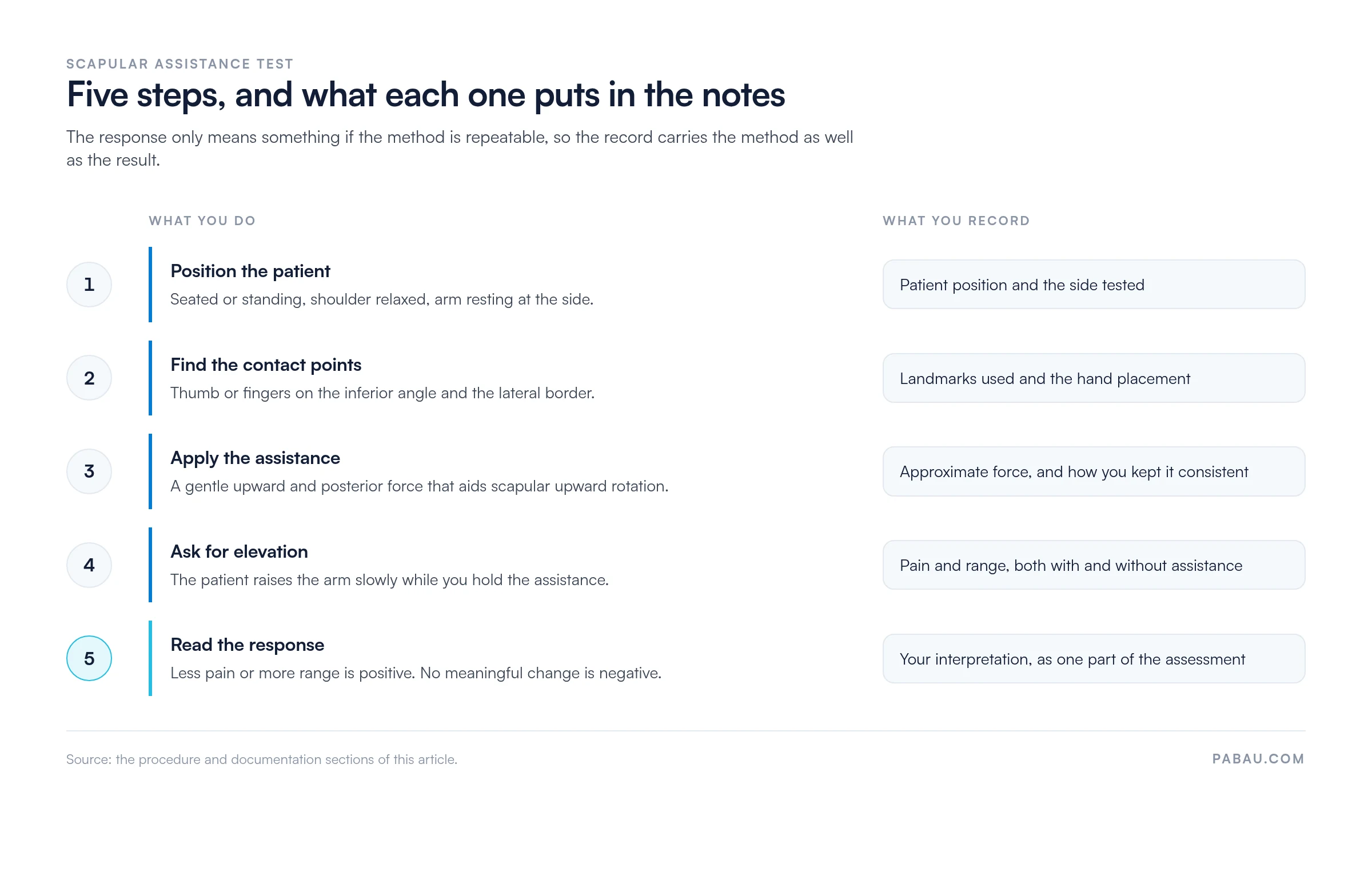
Explain the test to the patient first, so they know to report any change in pain during the movement. Keep the sequence the same each time to make the results comparable.
Each of those five steps should leave its own line in the notes. The diagram below pairs them up.
A positive scapular assistance test means the assisted movement reduces or removes the patient’s pain, or improves their range. A negative result means the assistance makes no meaningful difference to symptoms.
A positive result is one piece of information. It suggests scapular positioning may contribute to symptoms, which is a reason to examine the scapula further and weigh it in your plan.
The test has been studied in shoulder populations. Published work reports that a positive response appears across a range of shoulder disorders, and more often in patients with scapular dyskinesis. For that reason, read it alongside the history, the rest of your shoulder exam and the functional findings.
For specific sensitivity and specificity values, check the original studies directly, including the PubMed record for PMID 30268967. Do not rely on secondary summaries for those figures.
Clinicians often confuse these two tests, but they answer different questions. The scapular assistance test supports upward rotation, while the scapular retraction test examines posterior tilt and retraction.
Measuring scapular position is a separate question from testing the response to assistance. The lateral scapular slide test records distance at set degrees of abduction, so the two sit well together in one examination.
A positive result tends to prompt you to look at scapular control alongside the shoulder. The conditions below are the ones clinicians most often weigh when they see it.
Use the result to shape the next step rather than to label the patient. Your broader history and examination should drive the diagnosis.
Clear documentation lets the next clinician repeat the test the same way. On paper or in software for physical therapists, record enough detail to show what you did and what the patient reported.
Common mistake: writing “positive SAT” without the assisted range and the symptom change. On its own, that phrase leaves the next clinician with no method to repeat.
The downloadable form gives you a structured place to record each part of the test. Complete it during the assessment, or file it in the patient record straight afterward.
Use it in this order, so the record matches what happened in the room:
If your practice runs digital intake and documentation, the assessment can sit with the rest of the patient’s forms. In Pabau, the practice management platform we build, digital forms land straight in the patient record.
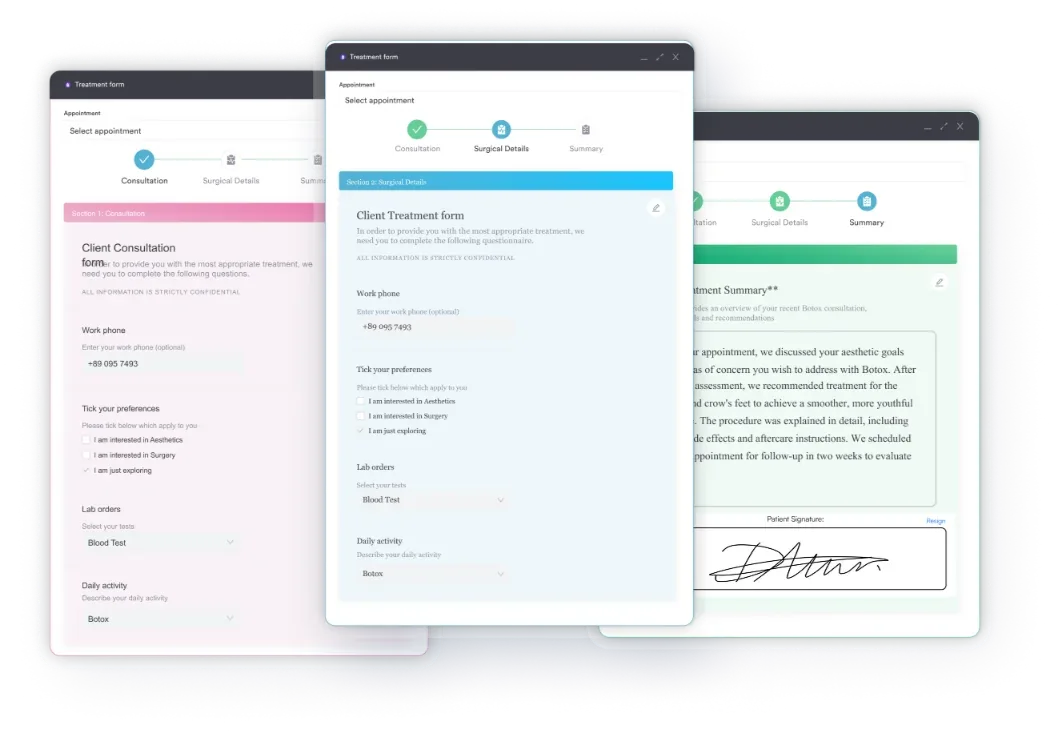
A standard form makes sure every test is recorded with the same elements. That consistency helps when you review progress across sessions or hand the case to a colleague.
Consistent records also support audit and clinical governance. When a reviewer can see the position, the force and the response, the reasoning behind your treatment is easier to follow.
Pro tip: Repeat the test with the same hand placement at each follow-up. A change in response is far more useful when the method has not changed.
The test also works well in combination with other shoulder special tests. Reviewing several findings together gives you a more reliable picture than any single one. For the broader family of tests, see the original studies.
Most practices record a shoulder assessment in whichever place is nearest. Some of it goes onto a paper form in a folder. The rest lands in free text in the notes, or in a spreadsheet kept for outcome tracking.
Pabau holds the assessment as a structured form on the patient’s own record. You build the scapular assistance test once, with fields for side, hand placement, force, and the response with and without assistance. Every clinician who opens that patient then fills in the same boxes.
The form sits beside the treatment notes, the before-and-after photos and the next appointment, so nobody hunts for a scanned PDF. When you repeat the test in six weeks, the earlier entry is one scroll away, and the comparison takes seconds.

Pabau’s digital forms turn the scapular assistance test into a reusable form that files itself in the patient record. Your team records the same fields every visit, so follow-up comparisons take seconds.

The value of the scapular assistance test is in what it changes about your plan. When assistance relieves the pain, scapular control belongs in the treatment. When the response is unchanged, you have ruled out one line of treatment and saved the patient several weeks.
Either way, the result is only as good as the record behind it. Write down the placement, the force and the range, and your six-week comparison means something. Leave those out, and you are starting again.
Set the form up once and the discipline looks after itself. Book a demo to see how Pabau keeps shoulder assessments, treatment notes and follow-up appointments on one patient record.

Need another shoulder test with a form? Shoulder depression test walks through the procedure, the interpretation and a printable template.
Checking for anterior instability? Shoulder relocation test explains why resolving apprehension, rather than pain, is the positive sign.
Found winging alongside the pain? Scapular winging exercises sorts medial from lateral winging and gives the progressions for each.
Hearing a click over the scapula? Snapping scapula syndrome test sets out the full exam sequence and the imaging rules.
Ruling out an acromioclavicular problem? Cross arm test covers the passive adduction maneuver and how to read the pain response.
The scapular assistance test is a manual examination in which the clinician assists scapular upward rotation during arm elevation. The clinician then notes whether pain or range changes with the assistance.
A positive result means the assisted movement reduces pain or improves range. It is one finding to weigh alongside history and other tests, not a standalone diagnosis.
No, the test does not confirm a diagnosis on its own. Clinicians use it as one component of a multi-test shoulder assessment.
No, the two tests examine different scapular movements. The scapular assistance test supports upward rotation, while the scapular retraction test examines posterior tilt.