Scapular assistance test: Procedure, interpretation and free template
The scapular assistance test is a manual examination in which the clinician supp...

1
Last Updated: Oct 19, 2026
The internal rotation lag sign is a shoulder test for the subscapularis. It checks whether the patient can hold the arm off the lower back once the examiner releases the wrist. A lag is the hand drifting back toward the lumbar region, and it points to a possible subscapularis tear rather than a confirmed one.
This guide covers the five-step technique, how to read each result, and what to write in the notes. It also sets the test against the lift-off and belly press. The free assessment template below carries the same fields.
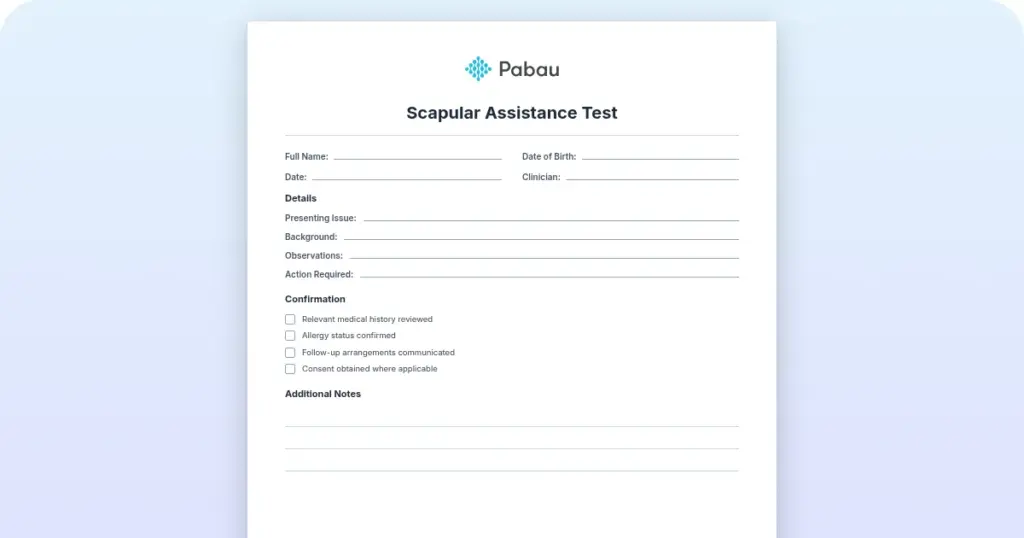
The form prints the purpose of the test and the full technique. It then gives you fields for the patient and examiner details, the result, the degree of lag, and your notes. Print it, or attach it to the patient record.
Download template
The internal rotation lag sign tests whether the subscapularis can hold the arm off the lower back unaided.
The examiner lifts the forearm away from the back, then releases the wrist while still supporting the elbow.
A lag is the hand drifting back toward the lumbar region once the patient takes over.
A positive result suggests a possible full-thickness subscapularis tear and calls for further assessment.
Record the side tested, the degree of lag, and any pain or guarding that limited the test.
To perform the internal rotation lag sign, place the patient’s hand against the lumbar region and lift the forearm away from the back. Then release the wrist while you keep supporting the elbow. Follow the same sequence every time, so results stay comparable between visits.
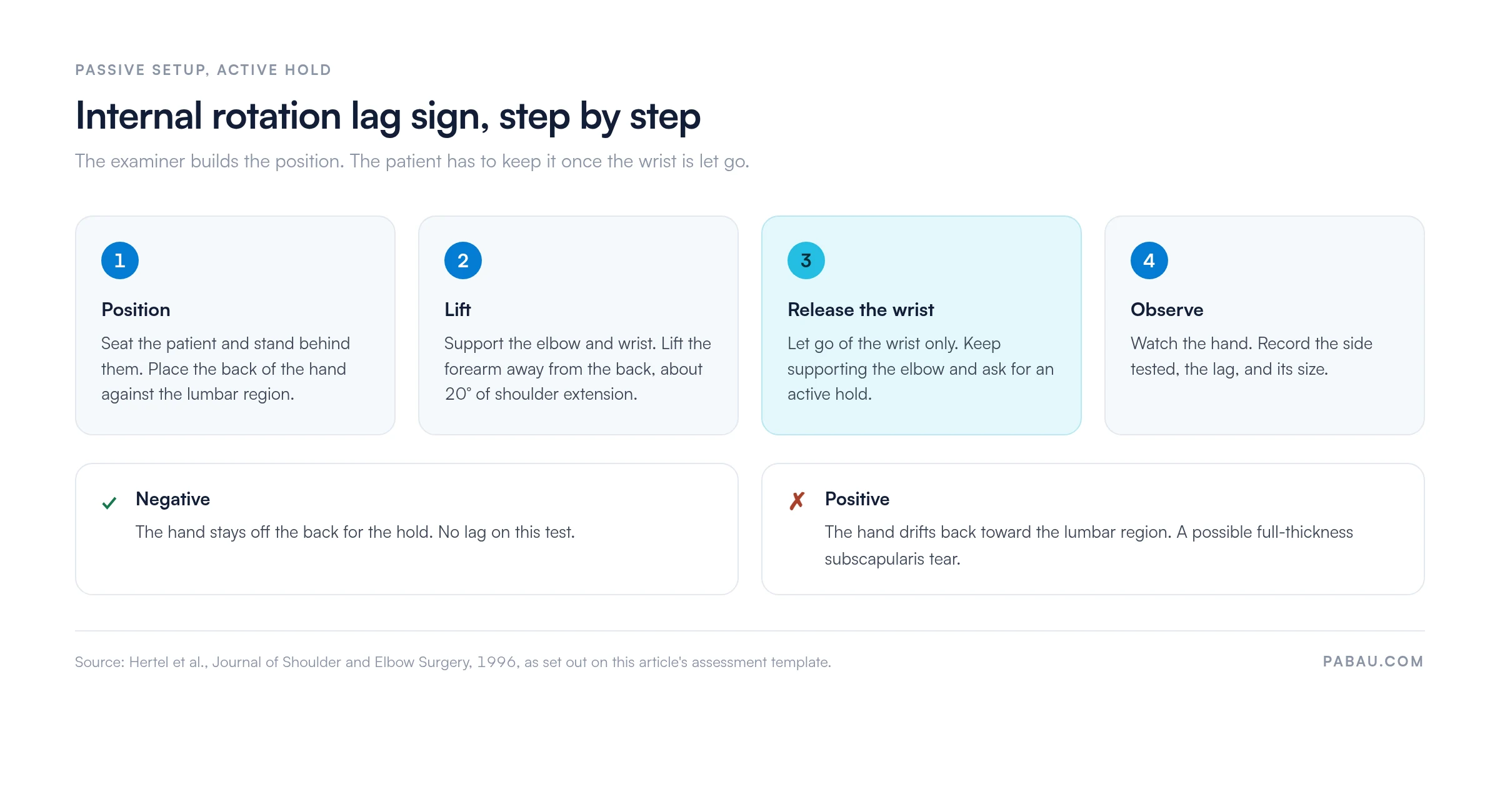
Pain and guarding can change the result, so note them rather than reading a single finding in isolation. Where time allows, test the other shoulder as a comparison.
The subscapularis is the largest rotator cuff muscle and the main internal rotator of the shoulder. The internal rotation lag sign targets this muscle directly.
The test relies on the difference between passive and active movement. The examiner positions the arm, so the joint carries the load, and then the patient must hold it alone. A weak or torn subscapularis often fails at that active step, which lets the hand drift back toward the back. That drift is the lag.
A positive internal rotation lag sign means the patient could not keep the hand off the back after the wrist was released. Use the table below to structure your interpretation.
A positive result is a reason to investigate further, not a finding to act on alone. Imaging and specialist review are the usual next steps, and referral decisions should follow your scope of practice and local pathways.
Hertel and colleagues described the test in 1996. Their paper, "Lag signs in the diagnosis of rotator cuff rupture", appeared in the Journal of Shoulder and Elbow Surgery. Reported sensitivity and specificity vary between studies and patient groups, so check the original paper before quoting figures in a report or case note.
Treat the internal rotation lag sign as one indicator among several, alongside history, strength testing, and imaging where indicated.
Several subscapularis tests share a clinical purpose, so the choice depends on the position you want to load. The lift-off test asks the patient to push the hand away from the back under their own power. The belly press test suits a shoulder that cannot reach behind the back at all.
Using more than one test gives a broader picture than any single result, so compare findings across tests rather than relying on one.
The internal rotation lag sign belongs to a family of lag tests, with each one targeting a different part of the rotator cuff.
The external rotation lag sign uses the same passive-then-active logic at the back of the cuff. Pair it with the infraspinatus test when the drop sign is hard to read.
Hornblower’s sign completes the set by loading teres minor in abduction and external rotation. For a technique reference with grading detail, see Physiopedia’s page on this test.
Test both shoulders in the same session and record the results side by side. A one-sided finding is easier to interpret with the opposite shoulder as a reference. Keep the position identical at every visit, because small differences in arm position can change the result. Build the setup into your intake checklist so every clinician follows it.
Good documentation records what you did, what you saw, and what you decided next. Record these items each time you run the test.
A searchable physical therapy EMR keeps each result with the patient record, so the next clinician can see what has changed. Professional bodies such as the American Physical Therapy Association set documentation expectations, so check your notes against your local requirements.
Most practices run this test on paper. The sheet is filled in by hand, left in a tray, and scanned into the patient file days later. By the time the patient returns, the previous lag is somewhere in a PDF nobody wants to open.
Pabau, the practice management software we build, stores the same form as a digital questionnaire. Set the lag sign fields up once as digital intake forms, and every clinician records the result the same way.
Each completed form saves to the patient record with the date and the clinician who ran the test. At the follow-up visit, the earlier lag sits on the same screen as today’s. You can see whether the shoulder has improved without opening a scanner or a filing cabinet.

Pabau turns your assessment templates into digital forms that save straight to the patient record. The last result is on screen the moment the patient returns.

A lag tells you the subscapularis could not hold a position the examiner handed it. That is worth acting on. It is still not a diagnosis, so the finding belongs next to the history, the strength testing, and any imaging you order.
What separates a useful result from a vague one is how you record it. Note the side, the size of the lag, and the pain or guarding that shaped the test. The next clinician can then repeat it the same way and compare.
Download the template above to standardize the test on paper. Book a demo to see how Pabau keeps the same fields on the patient record instead.

Want the counterpart at the back of the cuff? External rotation lag sign test covers the technique, the grading, and how far the accuracy figures stretch.
Not sure which shoulder test to reach for? Shoulder special tests sets the main tests side by side with their sensitivity and interpretation.
Need the full examination around this one finding? Shoulder exam walks through observation, movement, and special testing in the order you would run them.
Suspect instability rather than a cuff tear? Shoulder relocation test explains how to confirm anterior instability after a positive apprehension test.
Want another free shoulder assessment form? Shoulder depression test includes a downloadable template for recording cervical and brachial plexus findings.
A positive result means the hand drifted back toward the lower back once the examiner released the wrist. The subscapularis could not hold the position on its own. That suggests a possible full-thickness subscapularis tear, so the usual next steps are imaging and specialist review.
The subscapularis, the largest rotator cuff muscle and the main internal rotator of the shoulder. The lift-off and belly press tests load the same muscle in different positions, so clinicians often run more than one.
The examiner creates the position here, and the patient only has to hold it. In the lift-off test the patient produces the movement, pushing the hand away from the back. The belly press test suits a shoulder that cannot reach behind the back at all.
No. It is one indicator among several, and reported sensitivity and specificity vary between studies and patient groups. Read it alongside the history, strength testing, and imaging where that is indicated.
Record the side tested, the patient’s position, whether a lag was present, and how large it was. Add any pain or guarding that limited the test, the comparison with the other shoulder, and the next step you agreed.