Scapular assistance test: Procedure, interpretation and free template
The scapular assistance test is a manual examination in which the clinician supp...

1
Last Updated: Oct 19, 2026
Gout diagnosis criteria are the structured rules clinicians use to decide whether a patient’s symptoms meet the threshold for gout. The 2015 ACR/EULAR set is the current standard. They are classification criteria rather than diagnostic criteria, so they support a clinical diagnosis instead of replacing it.
The framework applies once a peripheral joint or bursa has been affected. It then scores eight criteria spread across the clinical, laboratory, and imaging domains. A total of 8 points or more classifies the patient as gout, and identifying monosodium urate (MSU) crystals does the same without any scoring.
Many patients present with a painful, swollen first toe. The diagnosis is often made by a primary care physician, advanced practice clinician, or rheumatologist before any crystal analysis is done. Below you will find the framework, the workup, the differential diagnosis, and a checklist your practice can download.
The checklist runs through patient details, the entry criterion, the sufficient criterion, and all eight scored criteria with their point values. It closes with the total score, the classification decision, and fields for the clinician’s name and license number.
Download template
The 2015 ACR/EULAR criteria apply only after a peripheral joint or bursa has been affected.
MSU crystal identification in synovial fluid is a sufficient criterion that confirms gout outright.
Serum urate is scored in bands from below 4 to 10 mg/dL or more. 6.8 mg/dL is the saturation point for MSU crystals, not a scoring cut-off.
Serum urate can be normal during an acute flare, so a normal result does not rule gout out.
Pabau, the practice management platform we build, records each scored criterion in the patient file.
The 2015 ACR/EULAR gout classification criteria are a two-stage system from the American College of Rheumatology and the European League Against Rheumatism. Neogi and colleagues published them in Annals of the Rheumatic Diseases in 2015 (74:1789-98). They were built to select patients for research, so they support clinical judgment rather than replace it.
The entry criterion is a clinical gate, not a score. A patient must have had an episode of swelling, pain, or tenderness in a peripheral joint or bursa before the scoring applies. Axial symptoms alone do not pass this gate, so record the affected joint explicitly.
Identifying MSU crystals is the sufficient criterion, and it is the most reliable confirmation available. Crystals appear as needle-shaped, negatively birefringent structures under polarized light microscopy. Synovial fluid analysis requires arthrocentesis, which is not always feasible in primary care, so the scoring exists for patients who cannot be aspirated.
When no crystals are found, the clinician scores the three domains below, which contain eight scored criteria. Four criteria sit in the clinical domain, two in the laboratory domain, and two in imaging.
Two of the eight criteria can subtract points. A serum urate below 4 mg/dL scores -4, and an aspirate that tests negative for MSU crystals scores -2. The highest achievable total is 23 points, and 8 points is enough to classify the patient as gout.
The chart below puts all eight criteria on the same scale. You can see at a glance which ones carry the most weight, and which two can pull a total back down.
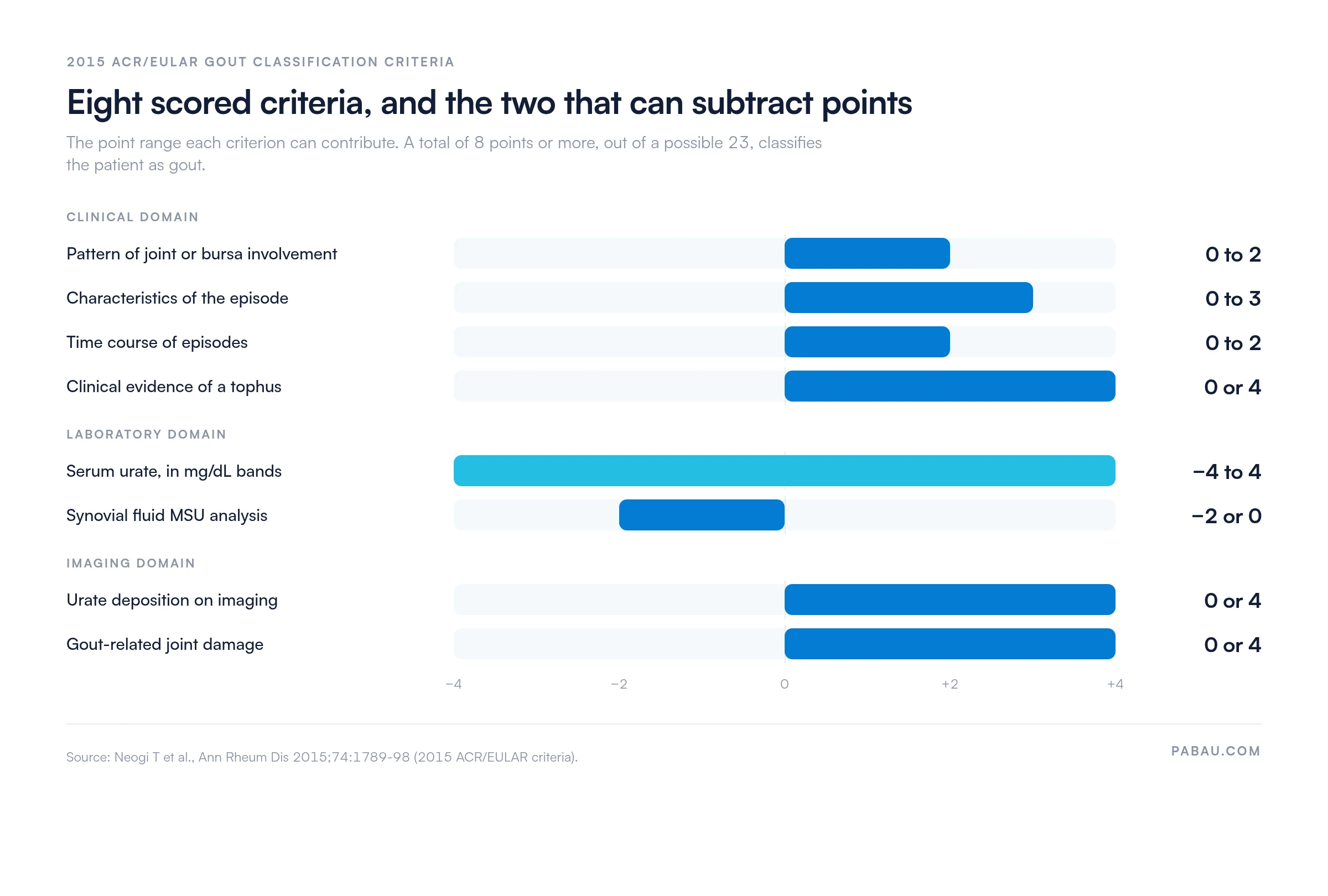
Check the point values against the source paper before you enter a score in a patient record. A transcription error in a point value is a patient safety issue.
The main laboratory tests for gout are serum urate, synovial fluid crystal analysis, renal function, and sometimes a 24-hour urine urate. Serum urate is the most common first test, but it does not confirm gout by itself because many people with high urate never develop gout.
A normal serum urate during an acute flare does not exclude gout. The acute-phase response can lower urate transiently, so a test taken during a flare may read falsely normal. Repeat the measurement once the flare has settled before reaching a conclusion.
Several conditions can look like gout, and septic arthritis is the most urgent to exclude. A hot, swollen joint with fever needs joint aspiration and culture before gout is considered. Pseudogout (calcium pyrophosphate deposition), rheumatoid arthritis, and cellulitis are the other common mimics.
Write down which mimic you considered and what ruled it out. A structured clinical evaluation template keeps that reasoning next to the score rather than in a separate note.
The downloadable checklist turns the framework above into something your team can complete during the consultation. It covers the entry criterion, the sufficient criterion, the eight scored criteria, and the differential flags, so the reasoning is recorded alongside the score. It sits next to the broader history and physical form rather than replacing it.
Start the checklist at the first consultation, before any treatment decision is made. Complete the entry criterion first, because the scoring does not apply without it. Then record aspiration results if they are available, score the remaining criteria, and sign off the classification.
The finished score belongs in the patient record, next to the intake forms your practice already collects. Filing it there means the follow-up urate test lands in the same place as the reasoning it is meant to settle.
Record a repeat serum urate once the flare has settled if the first result was taken during the attack. A normal reading during a flare can lead to a missed diagnosis, so note the timing of every urate test on the form.
Once gout is classified, the 2020 ACR guideline recommends treating acute flares with colchicine, NSAIDs, or corticosteroids, and the choice depends on comorbidities. The same guideline supports starting urate-lowering therapy in selected patients, with a serum urate target of below 6 mg/dL. Lower targets are sometimes used for tophaceous disease.
Doses and treatment decisions should follow the current guideline and local formulary rather than this article. Febuxostat carries an FDA boxed warning for cardiovascular risk, so check that warning before choosing it.
Most practices score gout on a printed sheet or a PDF, then scan the result into the patient file. The total survives, but the evidence behind each criterion does not. A clinician reviewing the case a year later sees a number and none of the working that produced it.
In Pabau, the criteria become a medical form attached to the patient record. Each criterion is its own field, so the entry criterion, the point values, and the classification decision are all stored as data. The urate result and the score it produced stay in one file.
Treatment notes, consent forms, and the follow-up appointment live in that record too. When the patient returns for a repeat urate test, the original scoring form opens next to the new result. No one has to rebuild the case from memory.

Pabau turns your gout scoring checklist into a medical form that files itself against the patient record. Lab results, treatment notes, and the follow-up appointment sit in the same file, so the reasoning behind a classification is still there months later.

Treat the 2015 ACR/EULAR criteria as a structured way to show your reasoning, not as the diagnosis itself. Aspirate the joint whenever you can, because MSU crystals settle the question in a single step.
Where aspiration is not possible, score the eight criteria and record what each one rested on. A documented total of 8 or more holds up on review. A borderline total tells you to repeat the urate once the flare has settled, rather than commit to urate-lowering therapy.
The checklist above keeps that reasoning in one place. Book a demo to see how Pabau stores a completed gout assessment in the patient record alongside lab results and follow-ups.

Need another scored assessment your team can complete at the chairside? COWS assessment template shows how a points-based instrument is laid out for documentation.
Want structured clinical forms that file themselves? Patient intake software outlines how structured clinical forms are completed and stored.
Recording the repeat urate at follow-up? Progress notes template gives you a consistent structure for what changed between visits.
Identifying MSU crystals in synovial fluid under polarized light microscopy is the gold standard test for gout. It needs joint aspiration, which is not always feasible, so the 2015 ACR/EULAR scored criteria exist as an alternative.
Yes, gout can be classified without aspiration when the 2015 ACR/EULAR criteria are scored correctly and reach 8 points or more. The score is a classification tool, so clinical judgment still applies.
No single serum urate level confirms gout. The 2015 criteria score urate in bands, with 6 mg/dL the lowest band that adds points. 6.8 mg/dL is the saturation threshold for MSU crystal formation.
Yes, serum urate can be normal during an acute flare, so a normal result does not rule gout out. Repeat the test once the flare has settled and consider crystal analysis.