Black box medication list
A black box medication list is a clinical reference of drugs that carry an FDA b...

Last Updated: Oct 14, 2026
A newborn head circumference chart plots a baby’s head measurement against age-based percentiles, so you can see whether brain growth is on track. At birth, a term baby’s head usually measures 33 to 35 cm. The WHO median is 34.5 cm for boys and 33.9 cm for girls.
A reading below the 3rd percentile or above the 97th needs a closer look. So does a head that crosses percentile lines between visits.
This guide gives the WHO reference values by sex, the measuring technique, and the corrections you need for babies born early. It’s written for practitioners in maternity units, neonatal intensive care units (NICUs), and pediatric primary care.
A printable form with a reference-values table for the WHO or INTERGROWTH-21st figures your practice uses, plus where each one came from. It also has a dated log for every measurement and a notes page.
Download template
Head circumference tracks brain growth, so it’s measured at birth and at every well-baby visit to catch hydrocephalus, microcephaly, or macrocephaly early.
Boys’ heads run slightly larger than girls’, by 0.6 cm at birth on the WHO median. Always plot a reading on the chart for the baby’s sex.
WHO standards cover birth to 2 years and CDC charts cover 2 to 20 years, the sequence the American Academy of Pediatrics recommends.
A head circumference above the 97th percentile (macrocephaly) or below the 3rd (microcephaly) needs further investigation and often specialist referral.
Preterm babies start on INTERGROWTH-21st or Fenton charts, then move to WHO standards using corrected age until about 24 months.
Head circumference (HC), also called occipitofrontal circumference (OFC), is the distance around the widest part of a baby’s head. It reflects brain growth and intracranial volume. A term newborn’s HC usually falls between 33 and 35 cm (13 to 14 inches). It then grows by roughly 2 cm a month over the first three months.
An abnormal HC can be an early sign of hydrocephalus (excess cerebrospinal fluid) or birth trauma. It can also signal microcephaly, an unusually small head linked to reduced brain growth. Practitioners also use HC when screening for congenital infections (the TORCH group), chromosomal abnormalities, and metabolic disorders. In primary care, plotting HC on standardized growth charts shows which infants have left their expected path and need review.
HC readings also feed clinical audit, early intervention programs, and pediatric continuity of care. In Pabau, the practice management platform we build, digital intake forms can be configured to record HC at each visit. The readings then sit together in one patient record, ready for the next review.

A percentile is only as good as the measurement behind it. Take HC as part of the full well-child exam, which a pediatric checklist keeps in one standardized record. Then follow these steps for each reading:
The table below gives WHO Child Growth Standards head circumference-for-age values for boys and girls, from birth to 12 months. Measurements are in centimeters, rounded to one decimal place.
These values describe term-born infants. WHO publishes the full standards through age 5, with HC growth slowing after 12 months. To plot a reading, find the infant’s age on the x-axis and HC on the y-axis, then note the nearest percentile line.
Boys measure 0.6 to 1.2 cm larger than girls at the median, so the normal band shifts by sex as well as by age. To turn a single reading into an exact percentile, a pediatric growth chart calculator plots HC alongside weight, length, and BMI.
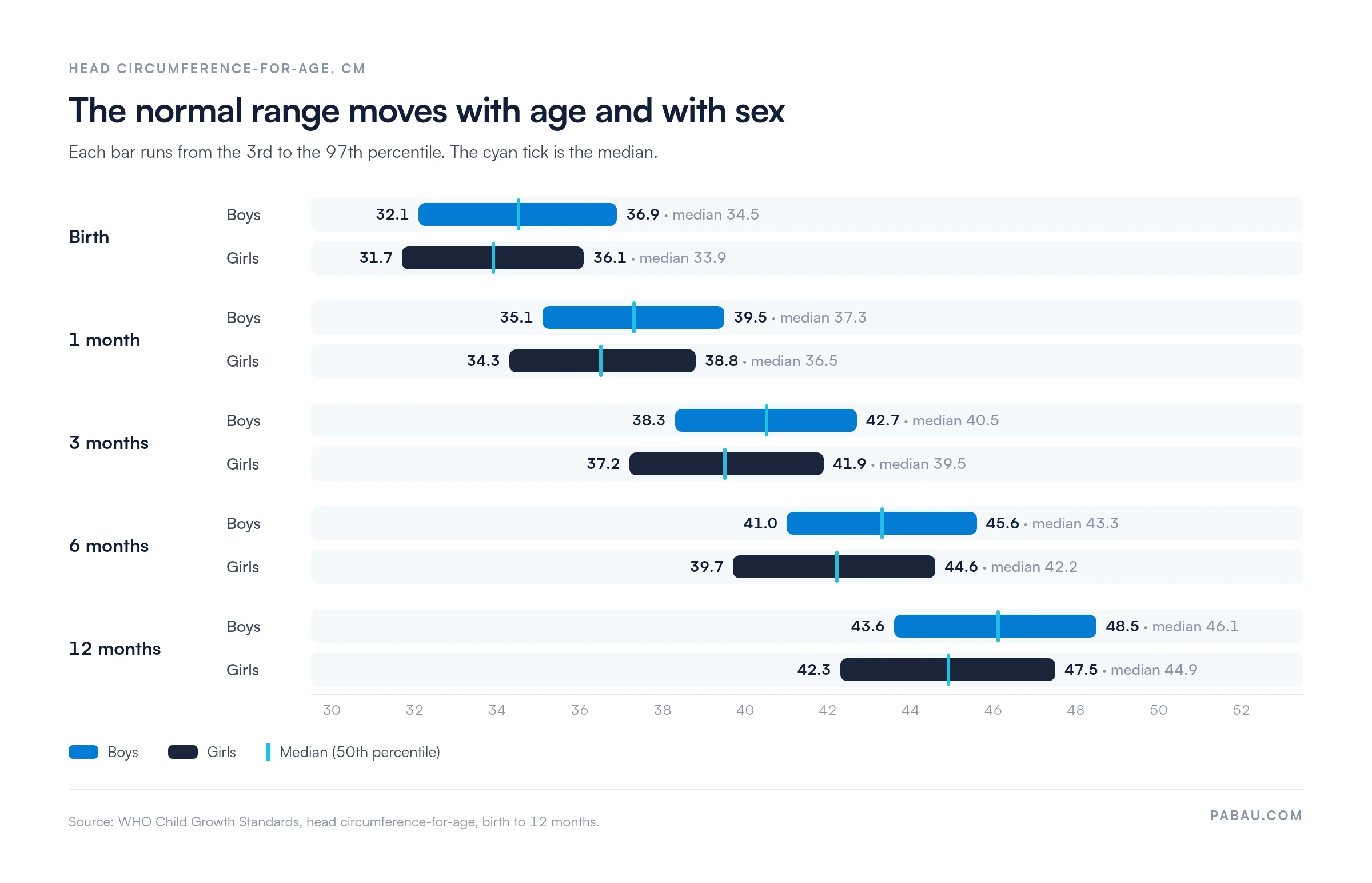
Two reference sets dominate clinical practice: the WHO Child Growth Standards and the CDC 2000 growth charts. The American Academy of Pediatrics recommends WHO standards from birth to 24 months, then CDC charts from 2 to 20 years. That sequence uses the strongest evidence for each age range.
Clinical recommendation: For term newborns, use WHO Child Growth Standards, with CDC growth charts as the secondary reference after age 2. For preterm infants, start on INTERGROWTH-21st until 64 weeks postmenstrual age. After that, plot on WHO standards using corrected age. Many US neonatal units use the Fenton preterm growth chart for the first stage instead.
A percentile shows where an infant’s measurement sits within the reference population. The 50th percentile is the median for that age. The 3rd and 97th percentiles mark the outer limits of the normal range.
Preterm infants need adjusted interpretation. A baby born at 28 weeks’ gestation isn’t developmentally equal to a term newborn at birth, and their brain growth follows a different path.
Corrected age calculation: Subtract the number of weeks born early from the baby’s chronological age. The result is corrected age, also called adjusted age. For example, a baby born at 28 weeks arrived 12 weeks early. At 26 weeks old, their corrected age is 14 weeks, or about 3 months. Use corrected age for HC percentiles until about 24 months.
INTERGROWTH-21st standards: These curves are stratified by gestational age and give the most accurate HC norms for preterm infants. Practice management software with measurement tracking can record HC at every visit, so growth trends stay together in one patient record.
At birth, head circumference usually exceeds chest circumference by about 1 to 2 cm. Comparing the two is a standard part of the newborn exam. In asymmetric intrauterine growth restriction (IUGR), the head is relatively spared, so the difference is often larger than usual.
Macrocephaly (HC above the 97th percentile) needs clinical assessment for hydrocephalus, benign familial macrocephaly, or an intracranial mass. Evaluate fontanelle tension, head growth rate, and developmental milestones. Order neuroimaging if the clinical findings are concerning.
Microcephaly (HC below the 3rd percentile, or well below the expected trajectory) suggests reduced brain volume. Investigate congenital infection (Zika, CMV, toxoplasmosis), genetic abnormality, or metabolic disorder. Refer to neurology or developmental pediatrics for further evaluation and an early intervention eligibility assessment.
Red flags that need same-day pediatric or neurology assessment:
HC measurement starts before birth, on the routine obstetric ultrasound (typically at 18 to 22 weeks’ gestation), and continues through labor and delivery assessment. Prenatal HC helps estimate fetal age, detect growth restriction, and identify congenital abnormalities.
Fetal HC measurement technique: HC is measured on an axial ultrasound view at the level of the thalamus and cavum septum pellucidum. The trace follows the outer edge of the skull (calvarium). It feeds the estimated fetal weight and helps assess disproportionate growth. Standard fetal biometry references, such as Hadlock or the INTERGROWTH-21st fetal growth standards, guide interpretation by gestational week.
Why fetal HC context matters: Prenatal HC gives a baseline for postnatal assessment. A normal prenatal HC followed by rapid growth after birth points to different biology than prenatal growth restriction followed by catch-up. Each pattern shapes counseling about prognosis. Digital medical records that hold your HC measurements across visits keep that history in one place for obstetric and pediatric teams.
Many pediatric and family practices still log HC on paper growth charts or in free-text notes. Spotting a downward drift then means flipping back through months of visits.
With Pabau, HC becomes a field in your intake or visit forms, so each reading lands in the patient record with its date. Measurement tracking plots the readings across visits, so the trend sits beside the clinical notes. Pabau Scribe, our AI scribe, can draft the visit note while you focus on the baby.
Scheduling, reminders, and billing run in the same system, which is why practices choose Pabau as all-in-one primary care software. Keep the downloadable chart for paper workflows, or rebuild its fields as a digital form. Either way, the growth history is ready at the next well-baby visit and complete when you refer a baby to a specialist.

Pabau records head circumference in your visit forms and plots each reading across visits beside the clinical notes. Your team sees the growth trend without digging through paper charts.

A single HC reading tells you little. The trend across visits, plotted on the right chart for the baby’s sex and corrected age, is what catches hydrocephalus or slowing brain growth early.
So measure the same way every time and use WHO standards for term babies. Move preterm babies onto WHO curves with corrected age once they leave INTERGROWTH-21st or Fenton. Careful technique adds a minute to each visit, but that minute is what makes the percentile worth trusting.
Pabau helps you record HC at each visit in the patient record, so the trend is there when you need it. Book a demo to see how it fits your well-baby visits.

Checking neurological development at the same visit? Infant reflexes chart lists seven primitive reflexes and the ages when each one integrates.
Monitoring newborn jaundice? Infant bilirubin chart sets out phototherapy thresholds by gestational age and hour of life.
Need normal vital sign ranges too? Pediatric vital signs chart gives normal ranges by age for quick comparison during the exam.
Advising parents on feeding? Infant milk intake chart covers typical daily volumes and feeding frequency from birth to 12 months.
Plotting weight and length alongside HC? Pediatric growth chart calculator turns weight, height, BMI, and head circumference into percentiles.
Normal term newborn head circumference ranges from 33 to 35 cm (13 to 14 inches) at birth. The WHO median is about 34.5 cm for boys and 33.9 cm for girls.
Measure HC at birth (within 24 hours), at hospital discharge, and at every well-baby visit. Those fall at 2 weeks, 1 month, 2 months, 4 months, 6 months, 9 months, 12 months, and annually thereafter. Measure more often (every 2 to 4 weeks) for infants with abnormal HC or conditions that need close monitoring.
Macrocephaly (HC above the 97th percentile) may result from hydrocephalus, benign familial macrocephaly, bleeding in the brain, an intracranial mass, or a metabolic disorder. Clinical assessment of fontanelle tension, growth rate, and neuroimaging is essential to determine the underlying cause.
Premature infants need corrected age (chronological age minus weeks born early) and a preterm reference such as INTERGROWTH-21st, stratified by gestational age. At birth, a 28-week infant’s HC is about 8 cm smaller than a term newborn’s. That’s roughly 26 cm at 28 weeks vs about 34 cm at term on Fenton or INTERGROWTH newborn charts.
WHO Child Growth Standards, based on international cohorts of breastfed infants, are recommended from birth to 2 years. CDC 2000 charts are used from 2 to 20 years. The American Academy of Pediatrics recommends this sequence, and WHO standards are considered more representative of optimal infant growth.
Be concerned if HC is above the 97th percentile or below the 3rd, or if it crosses downward through percentile lines. Other warning signs are a bulging fontanelle, seizures, developmental delay, or an asymmetric head shape with slowing HC growth. These findings warrant same-day evaluation by pediatrics or neurology.