Newborn feeding schedule: How much and how often by week
A newborn feeding schedule is a framework for how often and how much a baby eats...

Last Updated: Oct 13, 2026

An infant milk intake chart gives clinicians age-specific reference ranges for breast milk and formula, from birth through 12 months.
Newborns feed 8-12 times a day at the breast, or every two to three hours on formula at 1-3 oz per bottle.
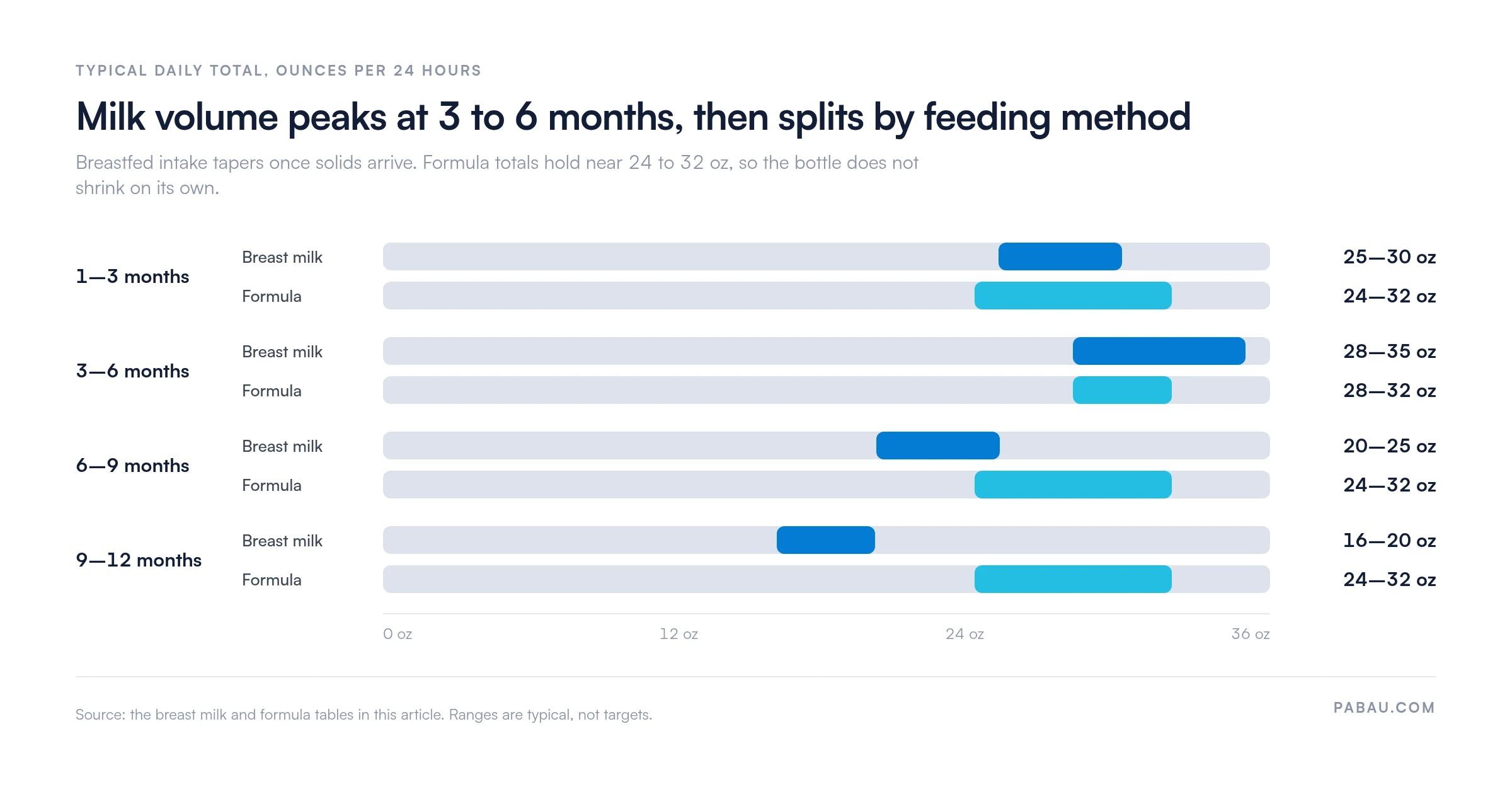
Daily volume peaks around 3-6 months. Breastfed intake then tapers as solids arrive, while formula totals hold near 24-32 oz.
Hunger and fullness cues beat a fixed schedule, so teach parents to read rooting, hand-to-mouth movements, and satiety signals.
Practice management software like Pabau stores the chart, the feeding note, and the growth measurements on one patient record.
A one-page reference for consultations. It carries breast milk and formula volumes by age, from birth to 12 months. You also get feeding frequency, hunger and fullness cues, and readiness signs for solid foods. Print it for the parent and file a copy in the patient record.
Download templateHow much milk a baby needs changes every few weeks, and parents ask about it at almost every well-baby visit. A breastfed newborn feeds 8-12 times a day. Daily intake peaks near 28-35 oz at 3-6 months, then tapers once solid foods start.
This chart sets out those ranges by age, for breast milk and for formula. It covers feeding frequency, hunger and fullness cues, and the shift to solid foods. Use it to counsel parents and document the guidance in the same appointment.
An infant milk intake chart is a clinical reference tool that breaks down breast milk and formula consumption by age, from birth through 12 months. It records the volume taken per feeding, in ounces or milliliters, and the typical number of feedings per 24 hours.
The chart does three jobs. It reduces uncertainty for new parents, gives you a documented baseline for growth monitoring, and helps you catch feeding concerns early. According to the CDC infant nutrition guidance, feeding amounts are approximate, and babies vary by appetite, weight, and metabolic needs.
Treat the figures as educational rather than diagnostic. A parent with a specific worry still needs a conversation with their own clinician about their baby’s feeding.
The newborn period runs on frequent, cluster-based feeding. Breastfed babies typically feed 8-12 times per day. Formula-fed babies eat every two to three hours, which works out to roughly 6-8 feedings per 24 hours. Volumes start small and climb quickly.
Key point: A newborn’s stomach holds approximately 5-7 mL (about a teaspoon) at birth. It grows to 1-2 oz by one week and 3-5 oz by one month. That is why frequent, smaller feedings are typical. Encourage parents to feed on demand from responsive feeding cues rather than a strict schedule, especially for breastfed infants.
Pair the chart with a newborn exam template at the first visit. Feeding method, weight, and physical findings then land in the record together, which makes the two-week check far quicker.
Breastfed infants regulate intake well when they feed on demand. Volume per feeding climbs over the first months, and total daily intake settles around 25-35 oz by 6 months. Once solid foods start, the share of calories coming from breast milk falls steadily.
These amounts are averages drawn from clinical observation. Exclusively breastfed babies need no supplemental water. Keep comprehensive clinical records of the weight trajectory alongside the feeding data, so you can confirm adequate milk transfer.
Formula-fed infants take more predictable volumes on a steadier schedule than breastfed babies. A common guideline is 2.5 oz per pound of body weight per day, spread across 6-8 feedings. Volume per feeding and the gap between feedings both grow with age.
Formula preparation follows the manufacturer’s instructions and FDA guidance every time. Watering down formula to stretch a tin raises the risk of inadequate calories and nutrients, so tell parents plainly not to do it.
Put the two tables side by side and the trajectories separate. Breastfed volume tapers after 6 months, while formula totals sit near 24-32 oz until someone reviews the bottle.
Early hunger cues show up well before crying does. Teach parents to watch for these signs:
Fullness cues are just as readable, and they mark the end of the feeding:
Crying is a late hunger cue. Parents who respond to the early signs get calmer feedings, and the baby learns to self-regulate sooner. It also takes some pressure off a new mother watching the clock.
The American Academy of Pediatrics (AAP) recommends starting solid foods around 6 months, once the baby shows developmental readiness. That means sitting upright with minimal support, losing the tongue-thrust reflex, and reaching for food. Before 4 months, breast milk or formula alone covers growth and development.
Milk intake does not stop when solids begin. It declines gradually as more calories come from food. At 6 months, breast milk or formula may still supply 70-80% of total calories. By 12 months, that share is closer to 50%.
Record the date solids were introduced and how the baby handled them. The next appointment then starts from a known point rather than from the parent’s recollection.
During the appointment: Walk parents through the range for their baby’s age and the expected feeding frequency, with the chart printed or on screen. Say plainly that the figures are guidelines rather than prescriptions, and that variation between babies is normal.
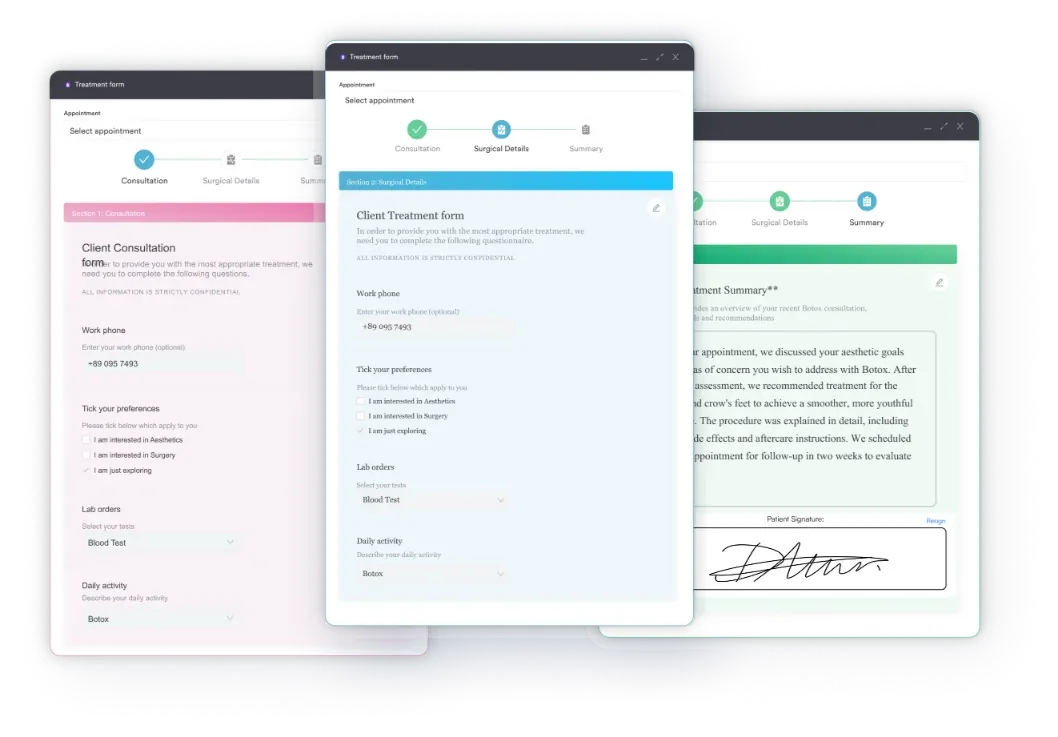
Documentation: Record the feeding method (breast, bottle, or mixed) and the baseline guidance you gave. Note any concern that affects feeding, such as low milk supply, tongue tie, or reflux. Digital intake forms can capture the feeding history before the appointment starts.
Follow-up: At the next visit, compare weight gain against the chart’s age band. Poor gain can point to insufficient intake, and rapid gain can point to overfeeding. Refer for lactation or nutrition support when the numbers do not add up.
Practices running on primary care practice software can attach the chart to the well-baby visit template. Every clinician then gives the same guidance and records it the same way.
Milk intake data alone does not confirm adequate nutrition. Growth monitoring does. WHO and CDC growth charts plot weight, length, and head circumference against age. A baby taking textbook volumes but gaining poorly may have an absorption or metabolic problem that needs pediatric assessment.
Plot each visit’s weight on a WHO breastfed growth chart to confirm that intake is turning into steady gain. The breastfed curves differ from formula-fed references, so match the chart to the feeding method.
Tie the feeding guidance to the measurements at every visit. Document the volumes you discussed, then plot weight, length, and head circumference. A pediatric vital signs chart keeps those readings in one format visit after visit, which makes the trend easy to read.

Most practices hand the chart over as a printout and write one line in the notes. The parent loses the paper, the note says “feeding advice given”, and the next clinician starts the conversation from scratch.
Practice management software like Pabau attaches the chart to the well-baby visit template. It then goes out with the visit summary instead of in a bag. The feeding method, the volumes you discussed, and the growth measurements are stored on the same patient record.

Automated recalls bring the family back for the next weight check, and the record shows who gave which guidance and when. Every Pabau subscription includes every feature, so a small family practice gets the same documentation tools as a large group.

Pabau’s clinical templates and patient records help pediatric and family practices share feeding guidance and track growth data. Documentation stays on one secure record.

The ranges in this chart answer the question parents actually ask, but the value comes from using them the same way every time. Print it, walk the parent through the band for their baby’s age, and write down what you told them.
Remember that the numbers are typical rather than targets. A baby feeding outside the range who gains weight steadily is usually fine. A baby inside the range who is not gaining needs a closer look. Book a demo to see how Pabau keeps the chart, the feeding note, and the growth data on one record.

Need the vital signs beside the feeding volumes? Pediatric vital signs chart gives you age-banded reference ranges for heart rate, respiratory rate, and blood pressure.
Documenting the first newborn visit? Newborn exam template walks through the head-to-toe check and leaves room for feeding history and weight.
Want a fuller pediatric assessment framework? Pediatric assessment explains how to structure the examination and what to record at each stage.
Checking growth against blood pressure percentiles? Pediatric blood pressure chart sets out percentile thresholds by age, height, and sex.
Keeping the immunization schedule in the same record? Immunization record form captures doses, dates, and lot numbers for every well-baby visit.
Newborns typically take 1.5-3 oz per feeding in the first week, feeding 8-12 times daily, for roughly 15-30 oz per day. By 2 weeks, this increases to 2-4 oz per feeding. Amounts vary from baby to baby. Weight gain and wet diapers (6 or more per day by day 5) tell you more than absolute volume.
A 2-week-old typically feeds 8-12 times per day for 10-15 minutes per breast, taking approximately 2-4 oz per feeding. Total daily intake is often 15-25 oz. Breastfed babies do not need to hit a volume target. Look instead for weight gain of roughly 0.5-1 oz per day after the first week, plus steady wet and dirty diapers.
The AAP recommends starting solid foods around 6 months, once the baby shows developmental readiness. Readiness means sitting with minimal support, losing the tongue-thrust reflex, and reaching for food. Do not introduce solids before 4 months. Breast milk or formula stays the primary source of nutrition through 12 months.
Look for steady weight gain of 0.5-1 oz per day in the first month, then 4-7 oz per week. Six or more wet diapers and two or more stools a day are reassuring after the first week. Alert behavior between feedings helps too, as does breast fullness easing after a feed. Ask your pediatrician or a lactation consultant if you are worried.
Early hunger cues such as rooting, hand-to-mouth movements, and increased alertness appear before crying. Crying is a late hunger sign. Responding to the early cues reduces distress and helps the baby learn to self-regulate. Not all crying means hunger, since babies also cry from discomfort, tiredness, and overstimulation.