Getting along with siblings worksheet
A getting along with siblings worksheet is a printable that helps children and t...

2
Last Updated: Oct 23, 2026
A pediatric checklist is a structured form clinicians use to document a child’s health at each well-child visit in one standardized record. It covers growth, vital signs, the physical exam, developmental milestones, behavioral screening, immunizations, and safeguarding concerns. Working from the same list every visit means no assessment area gets skipped, from the newborn period through adolescence.
Behavioral screening is where most of the scoring happens. Practices pair the checklist with validated parent questionnaires. The main ones are the Pediatric Symptom Checklist (PSC-35), its 17-item short form (PSC-17), and the Preschool Pediatric Symptom Checklist (PPSC). Milestones are usually tracked against the CDC’s developmental milestones, and consistent records also support EPSDT well-child documentation for Medicaid-eligible children.
Below you’ll find a free, printable visit checklist and the scoring cutoffs for each symptom checklist by age. A step-by-step workflow shows how to run screening in your practice.
A one-page well-child visit checklist with patient details, pre-visit safety checks, and steps for growth, feeding, sleep, milestones and immunizations. It closes with caregiver and safeguarding notes, a section for incomplete items, and clinician sign-off.
Download template
A pediatric checklist records growth, vital signs, the physical exam, milestones, behavioral screening, immunizations, and safeguarding in one standardized record.
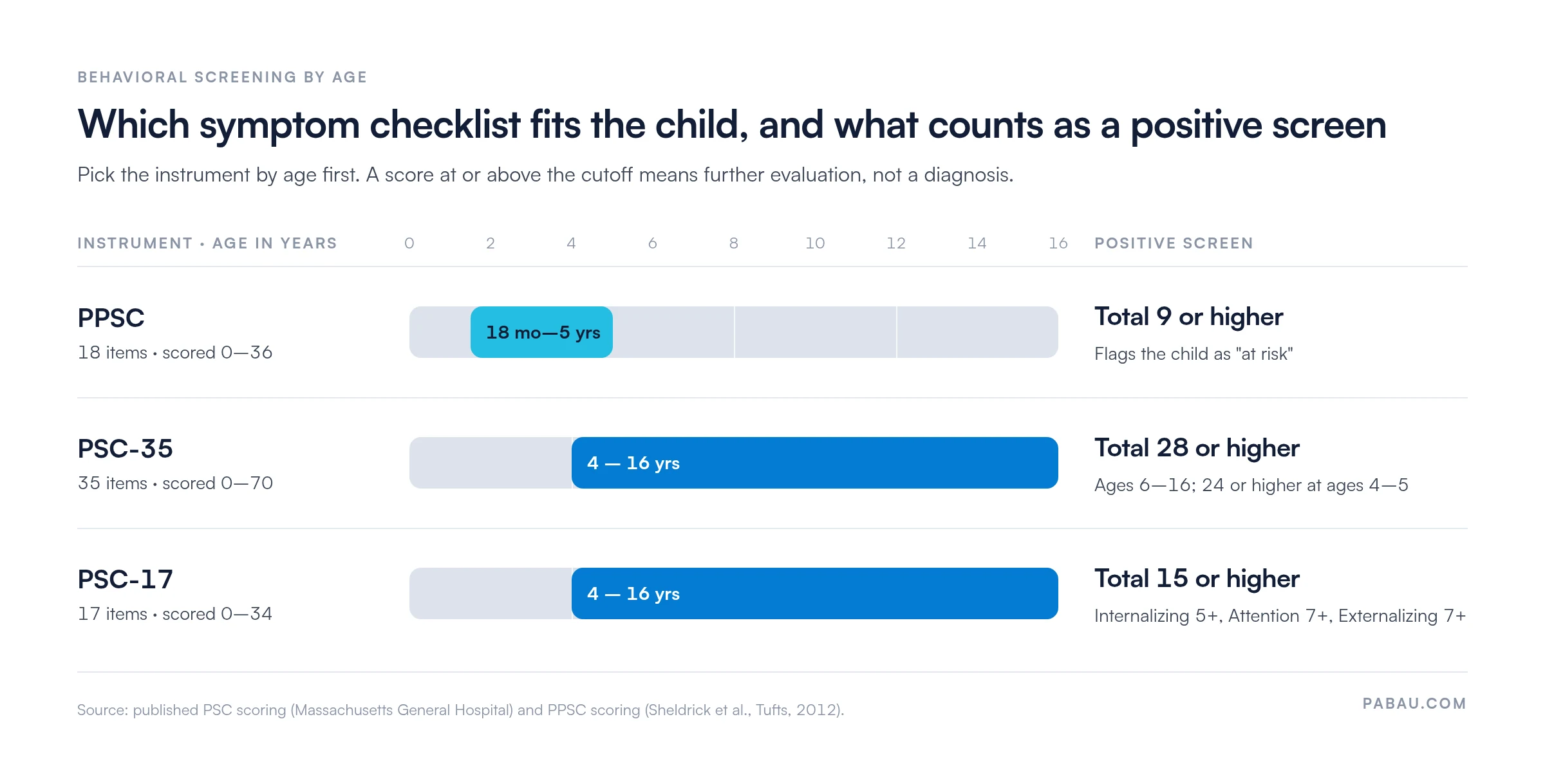
The PSC-35 and PSC-17 screen children aged 4-16, and the 18-item PPSC covers 18 months to 5 years.
Each instrument has its own cutoff: PSC-35 28 or higher (24 at ages 4-5), PSC-17 15 or higher, and PPSC 9 or higher.
A positive screen triggers further evaluation and a documented referral, never a diagnosis on its own.
Digital forms in Pabau let parents complete screening questionnaires before the visit, with answers stored in the patient record.
A pediatric checklist does two jobs. It standardizes how routine well-child findings are recorded, and it builds screening for behavioral, emotional, and developmental concerns into every visit. A complete checklist captures:
Growth values mean little until they are plotted, so many practices keep a pediatric growth chart alongside the checklist. Percentile shifts between visits are often the first sign that a child needs a closer look. Weight checks also prompt a question from parents of infants about which diaper size fits at that stage.
Regulatory and payer rules drive much of this structure. In the United States, EPSDT (Early and Periodic Screening, Diagnostic, and Treatment) requires comprehensive developmental and behavioral screening for Medicaid-eligible children.
The AAP/Bright Futures periodicity schedule calls for developmental surveillance and a psychosocial/behavioral assessment at every well-child visit. Standardized developmental screening is scheduled at 9, 18, and 30 months, and autism screening at 18 and 24 months. A structured checklist shows these steps happened and records the result in the chart.
Pediatric clinicians draw on several checklist types. Each one serves a distinct purpose and age band, and only the symptom checklists produce a validated score.
The validated instruments are free to obtain. The PSC is free and in the public domain, owned by Massachusetts General Hospital. The PPSC is free to use as part of the Survey of Well-being of Young Children, developed at Tufts Medical Center. Use them word for word, because rewording items or changing cutoffs breaks the validation.
The Pediatric Symptom Checklist (PSC-35) is a 35-item, parent-completed behavioral and emotional screening instrument for children aged 4-16. It is free to use and widely adopted in pediatric primary care, mental health services, and school-based health programs.
How it works: parents rate 35 statements about their child on a three-point scale: Never (0), Sometimes (1), or Often (2). Totals range from 0 to 70. A score of 28 or higher for ages 6-16, or 24 or higher for ages 4-5, indicates psychosocial impairment and warrants further evaluation.
Scores below the cutoff suggest the child is functioning within typical limits. A positive screen is not a diagnosis. It signals that further assessment is needed.
The PSC-17 is a 17-item version of the PSC-35 for the same age range (4-16 years), built for busy primary care visits. It uses the same 0-2 scoring and groups items into three subscales:
A total of 15 or higher is a positive screen. The published subscale cutoffs differ by domain: Internalizing 5 or higher, Attention 7 or higher, and Externalizing 7 or higher. Subscale scores show which domain needs follow-up. The PSC-17 takes 2-3 minutes to complete, compared with 5-10 minutes for the PSC-35.
The Preschool Pediatric Symptom Checklist (PPSC) is an 18-item parent questionnaire for children aged 18 months to 5 years. It was developed by Sheldrick and colleagues at Tufts, building on the PSC. It captures behavioral and emotional concerns in the preschool years, when early intervention is most effective.
Parents answer each item Not at all (0), Somewhat (1), or Very much (2), for a total of 0 to 36. A total of 9 or higher flags a child “at risk” for further evaluation. Practices use the PPSC at well-child visits, preschool health screenings, and early intervention intake.
Each instrument has its own age band and cutoff. The chart below lines all three up, so you can pick the right form before the visit.
A physical exam checklist walks the clinician through the examination from head to toe, so no system is overlooked. A complete pediatric exam includes:
Age-specific items include fontanelle assessment and hip dysplasia screening in infants, and pubertal development in adolescents. For the full exam sequence and what changes at each age, see our guide to the pediatric physical examination.
The CDC’s “Learn the Signs. Act Early.” program publishes evidence-based milestones across four domains: social/emotional, language/communication, cognitive, and movement/physical development. A milestones section lets clinicians record which skills a child has reached and which need follow-up.
Clinicians use this framework at each well-child visit to check for typical development. When a child is not meeting age-expected milestones, further evaluation may be warranted. Referral goes to early intervention for children under 3, or to special education services (age 3 and older).
Screening works best when each step has an owner, from the pre-visit form to the referral note:
Digitizing the checklist reduces transcription errors, flags blank sections before the form is submitted, and leaves an audit trail for quality reviews.
On paper, the PSC-17 gets handed over in the waiting room, scored by hand, and scanned into the chart later. Pediatric visits are short, so a form finished during the visit eats into exam time.
Pabau, the practice management platform we build, turns the checklist and screening questionnaires into digital intake forms. Automated workflows send the right form to parents ahead of the appointment. Completed answers land in the child’s record, dated and ready for the clinician to review.
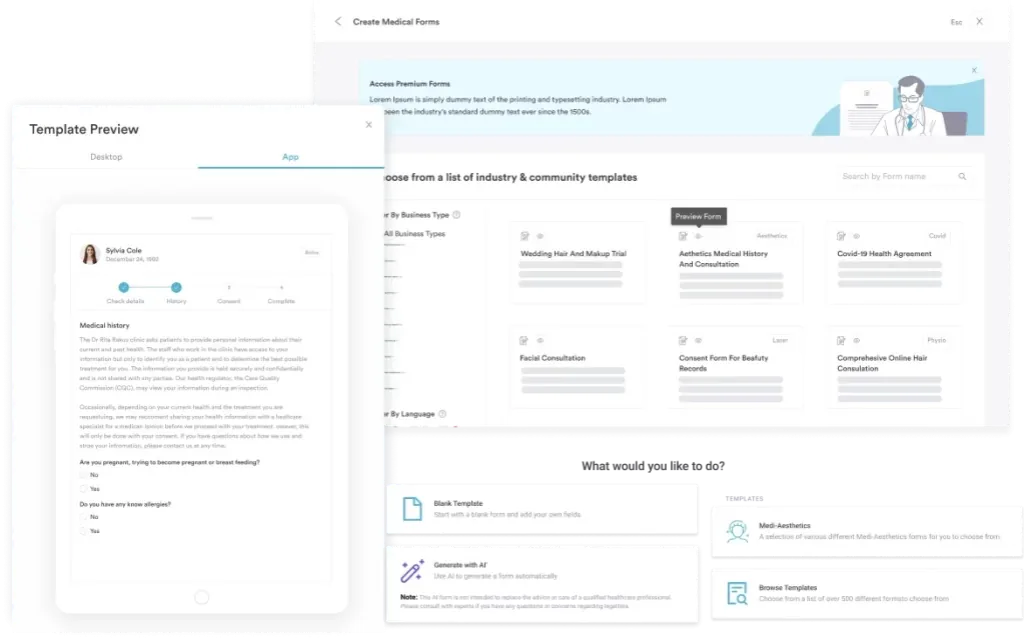
The clinician opens the child’s medical records with the parent’s responses already there, then scores and documents the result in the same place. The same system handles scheduling, billing, and charting, which is why family and pediatric practices run it as their primary care software. Stored, signed checklists support documentation for EPSDT and AAP recommendations.

Pabau sends pediatric checklists and screening questionnaires to parents before the appointment and stores their answers in the patient record. That leaves the visit for examining the child.

A checklist only pays off when the screening behind it is scored correctly. Match the instrument to the child’s age, apply that instrument’s own cutoff, and treat every positive result as a reason to evaluate, not a diagnosis.
Start with the downloadable checklist for the visit itself, then add the PSC-17 or PPSC as a pre-visit form. The trade-off is setup time now for shorter, better-documented visits later. Book a demo to see how Pabau gets parent screening forms completed and filed before the child arrives.

Want the full assessment framework? Pediatric assessment walks through history, observation, and exam findings by age.
Need a structured symptom review? Pediatric review of systems template gives you a system-by-system checklist to pair with the exam.
Unsure what counts as normal vitals? Pediatric vital signs chart lists expected heart rate, breathing rate, and blood pressure ranges by age.
Tracking vaccines at each visit? Immunization record form keeps doses, dates, and catch-up needs in one place.
Screening for sleep problems too? Pediatric sleep questionnaire helps you flag sleep-disordered breathing and poor sleep habits.
A pediatric checklist standardizes well-child assessment so growth, development, behavior, and exam findings are recorded the same way at every visit. It builds validated screening into routine care and supports EPSDT and AAP documentation. It also leaves a record for continuity of care and quality improvement.
The PSC is a free, 35-item parent questionnaire that screens children aged 4-16 for behavioral and emotional problems. Each item is scored 0-2. A total of 28 or higher for ages 6-16, or 24 or higher for ages 4-5, warrants further evaluation.
The PSC-17 uses the same 0-2 scoring as the PSC-35, for a total of 0-34. A total of 15 or higher is a positive screen. Its three subscales have their own cutoffs: Internalizing 5, Attention 7, and Externalizing 7, each at or above that score.
The Preschool Pediatric Symptom Checklist covers children aged 18 months to 5 years. It has 18 items scored 0-2, for a total of 0-36. A total of 9 or higher flags the child as at risk and calls for further evaluation.
Use the CDC milestones across four domains: social/emotional, language/communication, cognitive, and movement/physical. Age-banded milestones show quickly whether a child is on track. They also show when further evaluation or developmental screening is needed.
Yes. The PSC is free and in the public domain, owned by Massachusetts General Hospital. The PPSC is free to use as part of the Survey of Well-being of Young Children from Tufts Medical Center. Use both instruments unmodified to keep their validation.