ADHD Cleaning Checklist
An ADHD cleaning checklist is a cleaning list built for adults with ADHD. In oth...

3
Last Updated: Oct 12, 2026

Somatic experiencing is a body-based trauma therapy that helps the nervous system finish the survival response trauma interrupted.
Six techniques carry the work: titration, pendulation, resourcing, tracking, grounding, and discharge.
Exercise choice follows the client’s current state, so ground a hyperaroused client before you attempt any pendulation.
The exercises suit PTSD, anxiety, burnout, and chronic pain when paced to the client’s window of tolerance.
Pabau’s digital forms and Pabau Scribe, our AI scribe, record nervous system responses without pulling you out of the session.
Step-by-step protocols for grounding, body scan, pendulation, titration, and discharge work. Each exercise carries prompts for the client’s response and space for your session notes.
Download templateSomatic experiencing exercises are body-based practices that help a client’s nervous system finish the survival response trauma interrupted. The client tracks sensation instead of retelling the story. You pace the work to what their body can hold that day.
This guide covers the core techniques, how to adapt them by presentation, and what to record afterward. The worksheet above turns the same material into a protocol sheet you can keep open during a session.
Somatic experiencing (SE) is a trauma therapy developed by Peter Levine and taught worldwide by Somatic Experiencing International. It treats trauma as an unfinished physiological event rather than a memory that needs retelling.
When something threatening happens, the autonomic nervous system mobilizes defensive energy. A healthy recovery discharges that energy through shaking, crying, or a shift in breathing. If the discharge is cut short, the activation stays in the body.
Stored activation is what clients describe as hypervigilance, numbness, chronic pain, or anxiety with no obvious trigger. SE exercises give the nervous system a safe route to finish what it started, at a pace it can tolerate.
The nervous system moves between two broad states. Activation is sympathetic arousal, which shows up as fight, flight, or high alert. Calm is the parasympathetic side, where rest, digestion, and social engagement happen.
Polyvagal theory, developed by Stephen Porges, describes the vagus nerve as the main signaling route between brain and body. Trauma disrupts that signaling, and the system gets stuck in hyperarousal or in shutdown.
SE exercises let the client meet activation at a dose they can handle. Titration and pendulation keep the work inside the window of tolerance. The nervous system processes the threat without tipping back into shutdown.
Three techniques carry most of a session. Grounding, tracking, and discharge support them, and all six appear in the worksheet.
Titration breaks trauma exposure into doses the nervous system can metabolize. Rather than asking a client to recount the whole event, you invite them to notice the first sensation that arises. A slight tension in the chest is enough. Then you pause there.
Pendulation teaches resilience by moving attention between resource states and activation. A client might notice calm in their feet, shift to tightness in the shoulders, then return to the feet. That rhythm builds a felt sense that activation passes.
Resourcing anchors places of safety, strength, or steadiness inside the client’s body or memory. The nervous system returns to those anchors during triggering moments. A resource might be a trusted person, a safe place, or the feeling of the floor underfoot.
Telehealth tools make it easy to review this resource with clients face to face online.
Pacing changes with the presentation. A hypervigilant client needs different handling than one sitting in freeze-state depression. Here is how the protocols shift by condition.
Start every session by reading the client’s state. Are they hyperaroused, with agitation, rapid speech, and restlessness? Or are they in shutdown, with flat affect and slow, disconnected speech? The answer decides which exercise you open with.
Ground a hyperaroused client first. Pendulation in the opening minutes of a session with someone in high arousal usually backfires. Keep each exercise to 5 to 15 minutes unless the client already knows the work well.
Close every session with grounding and resourcing, never with unresolved activation. Then write the note while the detail is fresh, because sensation-level observations fade fast. Record five things:
Those five fields turn a subjective session into something you can compare week to week. Most mental health practice software lets you build them into a custom form, so the same prompts appear every time.
It is worth capturing the client’s own words too.
Grounding anchors the nervous system in present-moment safety and interrupts dissociation. The five-senses technique, usually called 5-4-3-2-1, is the easiest place to start:
Run it slowly. The pace matters more than the count, and a rushed round rarely settles anyone. If the client speeds up, name it and start the step again.
A body scan teaches interoceptive awareness, which is the ability to sense internal states. Invite the client to close their eyes and move attention slowly from the feet upwards. Ask where there is ease, and where there is holding.
Once they have found one area of ease and one of mild activation, add pendulation. “Notice the ease in your feet. Now shift to the tightness in your chest. Now back to your feet.”
That rhythmic shifting is where the change happens. The system learns it can tolerate activation, because it can always come back to safety. Three or four rounds is plenty in an early session.
Some of this work is safe for self-practice, including grounding, gentle body scans, and resourcing. Discharge work, titration of traumatic activation, and pendulation with unprocessed trauma need a trained SE practitioner in the room.
If a client is in acute crisis, having active flashbacks, or dissociating severely, refer them on. The SE practitioner directory lists certified therapists by location. Self-guided exercises help, but they do not replace trauma-focused therapy.
Most therapists write SE notes after the client has gone, from memory. The technique, the dose, and the body’s answer are the first details to fade. What survives is a general impression, which is hard to compare against last week.
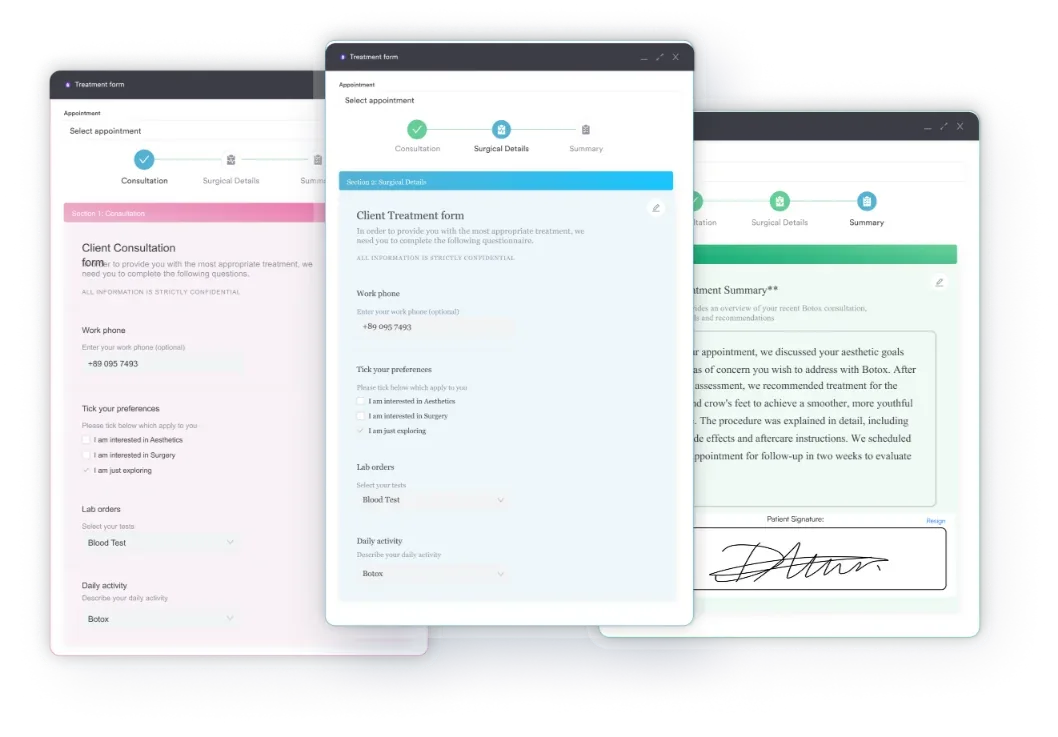
Practice management software like Pabau keeps that record in one place. You can build your own tracking fields into a session form, so baseline state, technique, response, and closing state are captured in a few taps.
Pabau Scribe, our AI scribe, drafts the narrative note from the session itself, so you can stay with the client rather than the keyboard. That AI clinical documentation lands in the client record beside consent forms, photos, and appointment history.
The result is a trail you can actually read back. Over ten sessions you can see which exercises settle a client fastest.

Pabau’s digital forms and AI scribe capture nervous system responses while you work. Your notes stay accurate to the session, and you finish the day without a documentation backlog.

This work rewards patience more than technique. A well-paced grounding round does more for a dysregulated client than an ambitious pendulation they are not ready for.
Pick two exercises you can run confidently and use them until the pacing feels automatic. Add the rest from the worksheet as you go. Your own notes will tell you which ones your clients respond to.
The trade-off worth remembering is speed. Slowing down in the room usually means fewer sessions overall. Book a demo to see how Pabau keeps your session records in step with the work you do with clients.

Need a measure of how clients relate to their bodies? Objectified body consciousness scale gives you a scored baseline before you start somatic work.
Working with a client who cannot name what is missing? Unmet emotional needs worksheet surfaces the needs sitting underneath the activation you meet in session.
Is your client’s sleep still wrecked? Insomnia severity index scores sleep disruption, which often tracks with unresolved nervous system arousal.
Want another way to map emotional states? emotional vibration scale assessment measures emotional states across a spectrum, from fear and despair to joy and gratitude.
Client ambivalent about body-based work? Motivational interviewing cheat sheet gives you prompts for the conversation that comes before the exercise.
Somatic experiencing exercises are body-based practices that help release trauma stored in the nervous system. They include grounding, body scanning, pendulation, and discharge work. Peter Levine developed the approach, which restores the nervous system’s own capacity for self-regulation rather than reprocessing memories.
Talk therapy works through narrative and cognitive reprocessing. Somatic experiencing works directly with the body’s physiological response. It treats trauma as incomplete nervous system activation, so the focus is on completing the discharge through trembling, breathing changes, or muscle unwinding.
Grounding, gentle body scans, and resourcing are generally safe to practice alone. Titration of traumatic activation and discharge work are safer with a trained practitioner, especially with severe PTSD or complex trauma. Speak to a certified SE therapist if you are carrying significant unresolved trauma.
Pendulation means moving awareness rhythmically between a calm, resourced state and an area of activation or mild discomfort. It teaches the nervous system that activation is not permanent, because attention can always return to safety. Regular practice builds capacity for processing harder material.
It depends on trauma severity and the individual client. Some people notice shifts within three to six sessions, while others work for 12 to 24 weeks. The pace follows the nervous system’s capacity, not a fixed protocol length like CBT.