Treatment summary
A treatment summary is a written record of what care was delivered during an epi...

3
Last Updated: Oct 16, 2026

A medical examination report records a person’s physical and mental health status for DOT, occupational, or legal purposes.
Form MCSA-5875 is the official DOT medical examination report, and only FMCSA-certified examiners may complete it.
A compliant report covers personal history, examination findings, vision and hearing tests, and a medical conditions checklist.
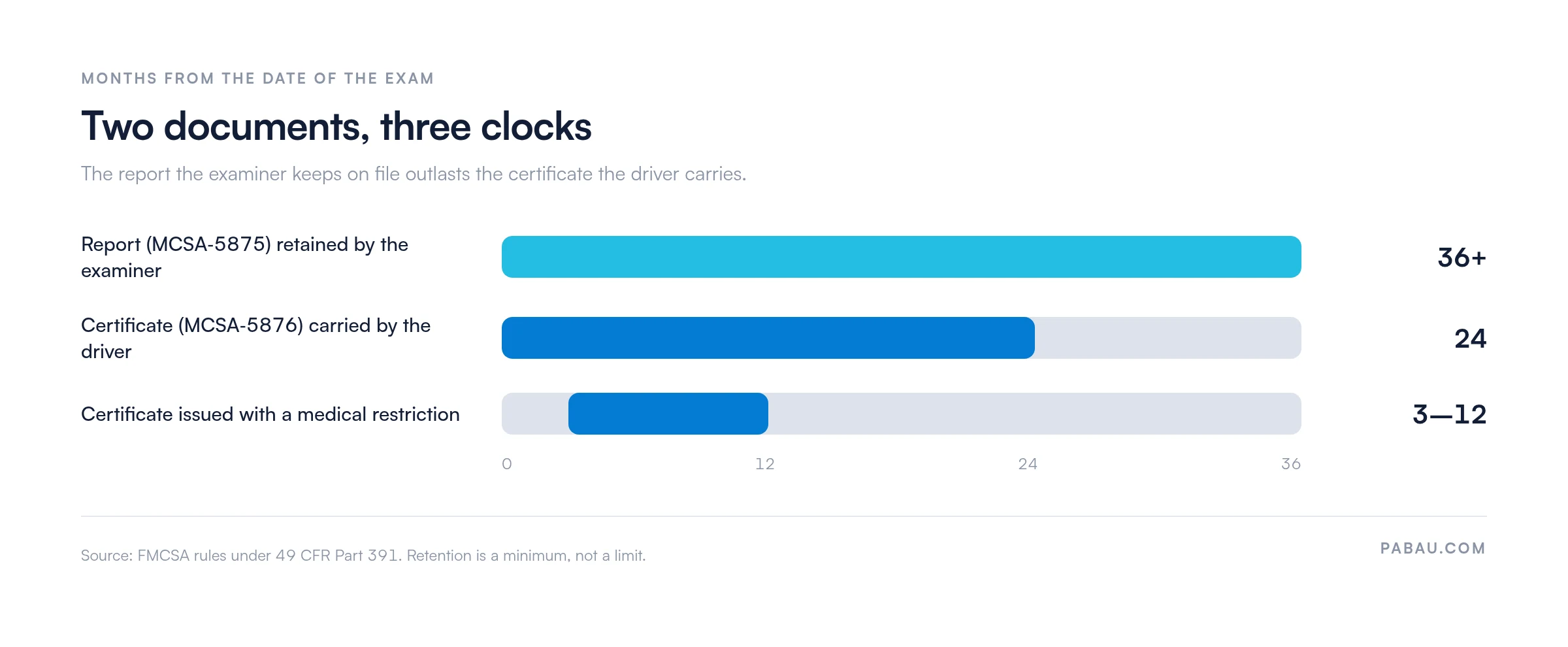
The examiner keeps the report for at least three years, while the driver’s certificate lasts up to 24 months.
Practice management software like Pabau stores completed reports in the client record and tracks expiring certifications.
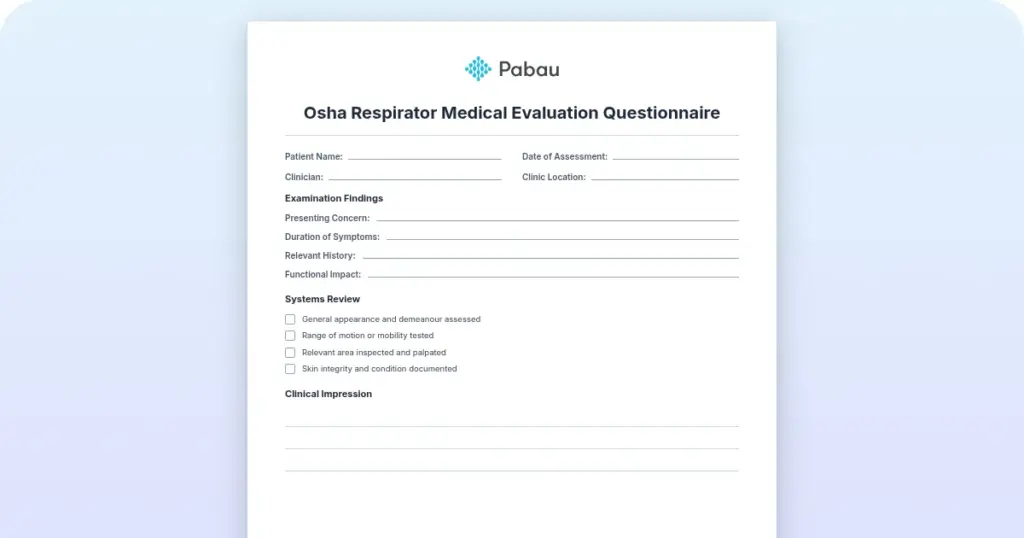
A comprehensive form for documenting psychiatric assessments, occupational health evaluations, and clinical examinations. It includes personal history, examination findings, risk assessment, and examiner determination sections.
Download templateA medical examination report is a structured clinical document completed by a licensed examiner to record a person’s physical and mental health status. Occupational health teams, DOT medical examiners, and independent assessors all use one to create a standardized record of findings and recommendations.
The sections below cover what the form has to contain, how to complete each part, and how it differs from the certificate the driver carries. The history questions can be collected in advance through patient intake software, so the appointment itself is left for the examination.
A medical examination report documents the results of a clinical assessment performed by a qualified healthcare provider. It works as objective evidence of a person’s health status. Practices use it for occupational clearance, legal proceedings, insurance evaluation, and regulatory compliance. For a routine consultation, a general medical report template records the diagnosis and treatment plan instead.
The most widely recognized format in North America is Form MCSA-5875. That is the official report required for commercial motor vehicle drivers under 49 CFR Part 391.
Beyond DOT compliance, the same report is used in occupational health, independent medical assessments, pre-employment screening, and fitness-for-duty evaluations. The form does three jobs at once.
The structure varies slightly between DOT exams, occupational health assessments, and independent evaluations. All of them carry the same core sections.
Each section stays objective and measurable, and each one ties back to the purpose of the assessment. That purpose might be employment fitness, regulatory compliance, or a clinical reference for later.
Accurate completion protects both the clinician and the examinee. Follow these five operational steps.
Document findings while the examinee is still in the room. Notes taken during the exam carry more weight than a version reconstructed afterwards.
Using centralized patient records removes the risk of a lost form and keeps examination data for the full retention period. For DOT exams that period runs to a minimum of three years.

A DOT exam produces two related documents. One is the Medical Examination Report (MCSA-5875), and the other is the Medical Examiner’s Certificate (MCSA-5876). The difference decides who holds which document, and for how long.
The MCSA-5875 is the detailed internal record. The MCSA-5876 is the certification the driver carries. Both have to be completed for a valid DOT medical certification.
The two documents also run on different clocks, and the record you keep on file outlasts the certificate you hand over.
Where the report goes depends on the context. For a DOT exam, file the MCSA-5875 in the examiner’s records and give the certificate to the driver. The result also goes to the National Registry of Certified Medical Examiners. State DMV requirements vary, so check the process where you practice.
Medical examination reports carry sensitive health information covered by HIPAA and state privacy laws. Store originals in a locked cabinet, or in a secure electronic system with access limited to clinical staff.
HIPAA also requires encryption for electronic records and an audit trail of every access. Compliance management software holds that audit trail and flags records due for secure destruction. Retention runs to a minimum of three years for DOT exams, and longer for occupational health records depending on local law.
The form suits any assessment where a third party needs evidence of someone’s fitness. That covers several roles.
All of them need the same thing from the paperwork, which is a consistent record another professional can read months later.
Clinical completeness: A template keeps a section from being skipped. The fixed order walks the examiner through a systematic assessment, so a finding is less likely to go unrecorded.
Regulatory defense: Documented evidence of a thorough examination protects the examiner and the organization if a result is later disputed. The form becomes an auditable record of what was checked.
Consistency across your team: When every examiner uses the same form, documentation quality stops depending on who ran the exam. New staff learn what is expected quickly, and experienced staff hold the same standard.
Time savings: Pre-printed or digital forms cut the administrative load. Clinicians spend their attention on the examination rather than on deciding what to write down.
Data portability: Findings captured in a standard format move into the patient’s wider record, an insurance submission, or a legal bundle without reformatting. The same holds for clinical progress notes written to a fixed structure.
Occupational health teams and DOT examiners often run several examinations a week on paper. Reports get misfiled, expiry dates live in a separate spreadsheet, and the findings never reach the patient’s wider record.
Practice management software like Pabau stores each completed report in the client record. The examination then sits with the patient’s history instead of in a filing cabinet. Automated reminders go out before a certification expires. Structured medical forms make sure no section is left blank.
You also get an audit trail showing who completed each section and when. So when an inspector or an attorney asks for a report from two years ago, you search for the patient rather than the cabinet.

Manage examination reports, automate compliance reminders, and centralize clinical records in one secure platform.

Download the form, then adapt it to the exams you actually run and to your state’s rules. The sections are the straightforward part. What separates a defensible report from a disputed one is recording each finding while the examinee is still in the room.
Then decide where the finished report lives and who watches the expiry date. A certification can lapse quietly, and the examiner is the one holding the record when it does. Book a demo to see how Pabau stores completed examination reports and warns you before a certification runs out.

Running a full head-to-toe assessment? History and physical form gives you the longer structure that a fitness-for-duty exam usually sits inside.
Need the history section on its own? Family medical history form collects the background questions before the appointment starts.
Recording vitals for several examinations a day? Vital signs record keeps readings in one place so trends stay readable.
Asked to certify fitness in writing? Medical certificate template covers the shorter statement an employer or school expects.
Sending records to an insurer or attorney? Medical release form documents the consent you need before a report leaves the practice.
A medical examination report is a clinical document that records the results of a health assessment. A licensed physician or medical examiner completes it, documenting findings, clinical observations, and a professional determination on fitness for duty, occupational clearance, or regulatory compliance.
For DOT exams, only medical examiners listed on the FMCSA National Registry of Certified Medical Examiners can complete Form MCSA-5875. In other occupational or clinical contexts, a licensed physician, nurse practitioner, or physician assistant may complete the report. It depends on your jurisdiction and the purpose of the exam.
For DOT exams, the maximum validity period is 24 months for drivers meeting all FMCSA medical standards. Drivers with certain conditions, such as insulin-treated diabetes, heart conditions or neurological disorders, may be certified for 3, 6, or 12 months. Non-DOT occupational health exams vary, so check your organization’s policy and applicable state law.
MCSA-5875 is the Medical Examination Report, a detailed clinical record kept by the medical examiner. MCSA-5876 is the Medical Examiner’s Certificate, a simpler document given to the driver certifying they passed the exam. Both are required for a valid DOT medical certification.
Yes. The template above is available as a free PDF download, suitable for occupational health, clinical assessment, and independent medical evaluation contexts. The official FMCSA MCSA-5875 form is available on the FMCSA website for commercial driver exams.
Store originals in a locked cabinet, or in a secure encrypted electronic system with restricted access. HIPAA requires encryption of electronic records, audit trails, and secure destruction after the retention period. That period is a minimum of three years for DOT exams, and longer for occupational records depending on jurisdiction.