HIPAA compliant texting: What you can send patients & how to communicate securely
HIPAA compliant texting is possible when a text holds no protected health inform...

Last Updated: Oct 16, 2026

A family medical history form records hereditary conditions and genetic risk across three generations, parents, siblings, and grandparents at a minimum.
First-degree relatives (parents, siblings, children) are the clinical priority. Second- and third-degree relatives add depth to inheritance patterns.
Paper forms create a hidden cost: staff retype every response into the record. For a practice seeing 20 to 30 patients a week, that can add up to 200-plus hours a year of transcription time.
Collecting family history through digital intake forms, like those in practice management software such as Pabau, drops the data straight into the patient record with HIPAA-aware storage built in.
A printable health assessment document that records inherited and genetic health conditions across three generations of a patient’s family, including parents, siblings, grandparents, aunts, uncles, and children.
Download templateA family medical history form is a structured clinical document that captures hereditary health patterns and genetic risk factors across a patient’s biological relatives. Providers use this data at intake to decide which patients need earlier screening, preventive care, or a specialist referral.
Rather than relying on patient recall in the room, a completed family history form arrives before the visit, giving clinicians time to spot at-risk patterns and plan the assessment. The free printable template above works as a PDF you can hand out or email. The sections below cover what to document and how to turn it into usable clinical data.
Family history is one of the strongest predictors of common chronic disease, including heart disease, type 2 diabetes, several cancers, and mental health conditions.
For clinicians, a documented family medical history drives three decisions.
Without a structured family history, these signals stay hidden until late-stage disease. With a completed form, clinicians catch hereditary risk during intake, when intervention does the most good.
A complete family medical history form covers three generations and the conditions that change clinical management. Three-generation documentation, the patient plus parents, siblings, grandparents, aunts, and uncles, is the standard most guidelines point to, because it is deep enough to reveal inheritance patterns a single generation would hide.
Use this checklist as a list of family medical history items to capture for each relative.
The form works best when it prompts specific follow-up questions: “What was the age at diagnosis?” “Is your parent still living?” “Have any genetic tests been done?” Those details turn a checklist into data a clinician can act on.
Public tools like the CDC’s free My Family Health Portrait let patients build a history at home, but the output does not flow into your patient record. Getting the data into the record automatically is the step that saves your team time.
The template supports two workflows: pre-visit completion by the patient, or in-visit documentation by a clinician. Either way, the goal is the same, a completed history in the record before clinical decisions get made.
Using digital intake forms automates steps 1 through 4: the patient completes the form online before the appointment, and the data flows straight into the patient record, so no one retypes it.

Software designed for GP practices can attach this form to the consultation record automatically.
Not every condition carries the same hereditary weight. Focus the form on diseases with strong genetic components or early-onset variants that change how you manage the patient. The column that matters most is the last one: the specific follow-up question that tells you whether a family history should change your plan.
For each condition, capture three data points: the relative and their relationship, their age at diagnosis, and their current status. That specificity lets clinicians calculate actual risk rather than defaulting to generic screening intervals.
The core form works across most practices, but different specialties lean on different sections. Tailoring the template to your setting yields better data and less wasted attention on questions that do not apply. A respiratory or pulmonology practice, for example, might pair the intake with an ineffective airway clearance nursing care plan for active pulmonary patients.
By tailoring the form to your specialty’s priorities, you cut irrelevant questions and focus the patient’s attention on what matters most for their care. A pulmonology practice tailoring the form this way might also keep a respiratory failure nursing care plan template on hand for active cases.
Most practices still use a printable PDF or paper form. Digital collection solves the efficiency problem baked into paper workflows, as the comparison below shows.
The efficiency cost is easy to underestimate. For example, a practice collecting family history from 20 to 30 patients a week can lose four to six hours a week to manual transcription. Over a year, that adds up to 200-plus hours of staff time spent retyping data a digital form would have captured once.
Pabau, an all-in-one practice management system, turns family medical history collection from a paper-to-EMR chore into an online step patients complete before they arrive. They fill in the form through their patient portal.
Customizable form fields. Build a family medical history form that matches your specialty: include only the relative categories and condition types you need, and reorder sections to fit your workflow. A mental health practice leads with psychiatric history. A fertility practice leads with reproductive history. The template adapts, so you are not printing a different form for every use case.
Pre-visit completion. Send the form to patients by email or SMS when they book. They complete it at home, in their own time, with the chance to check details with family members first. The clinician logs in, sees the completed history before the patient arrives, and spends the appointment on care rather than data entry.
Direct patient record integration. When the patient submits the form, their family history is instantly available in Pabau’s unified patient record. No transcription, no handwriting to decipher, no lost pages. The clinician reviews it, flags hereditary risks, and documents clinical impressions in one place.
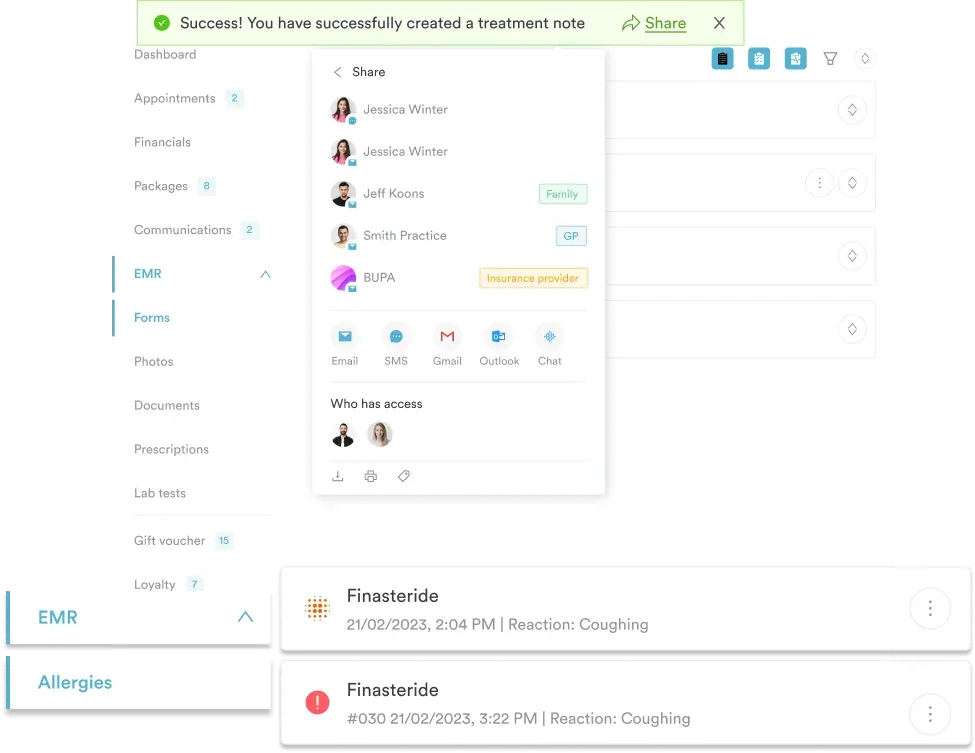
AI-assisted documentation. Pabau Scribe, our AI scribe, works alongside family history intake: as the clinician reviews the form and asks follow-up questions.
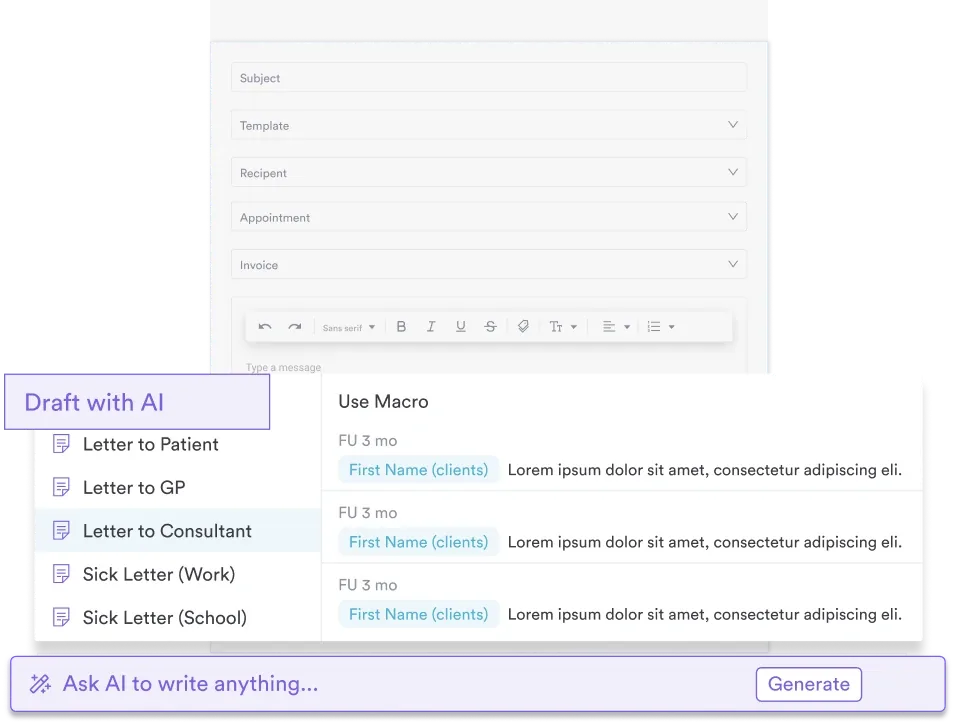
Compliance built in. Family medical history is protected health information (PHI) under HIPAA and personal data under GDPR. Pabau’s forms are HIPAA-aware and GDPR-aligned: data is encrypted in transit and at rest, access is role-based and logged, and retention is configurable. Compliance is part of the system, not something you bolt on afterward.
Collecting detailed family health information raises privacy and consent obligations. Meeting them protects your practice and builds patient trust.
Patient consent. Get explicit consent before collecting family medical history. A simple statement works: “We collect family health information to identify hereditary risks and guide your care. It is stored securely and protected like all your health information.” Document that consent in the chart.
PHI classification. Family medical history is protected health information under HIPAA. Even though it describes relatives, once it is in the patient’s record it carries the same confidentiality as the patient’s own data. Staff follow the same access controls whether they are handling the patient’s diagnosis or their mother’s.
Data security and secure storage. Forms containing names, ages, and diagnoses of relatives are sensitive PHI. Store them securely. On paper, that means locked files with access limited to clinicians and front desk. Digitally, it means encryption in transit (HTTPS) and at rest, on a HIPAA-aware platform like Pabau that logs access and enforces role-based permissions.
Retention and destruction. State law, not HIPAA, sets medical record retention periods, typically six to 10 years depending on the state and patient age. Once that period expires, destroy records securely: shred paper forms, and use certified data deletion for digital records. Document the destruction for audit purposes.
Patient access rights. Patients have the right to request and review their record, including family history. Be ready to provide it. Pabau’s medical forms management lets patients view their own submitted forms through the portal, which supports transparency.
A completed family medical history form gives clinicians the context to practice preventive medicine, catching hereditary risk during intake instead of after disease develops. The free template above is a solid starting point for any practice.
Paper forms and static PDFs solve the form itself but leave the efficiency problem in place. Staff still retype every response, paper piles up, and digital storage stays fragmented.
Collecting the same data through digital intake forms clears that burden. Patients complete the form before the appointment, the data flows into the record automatically, and your clinical team has the family history in front of them before the visit begins.
Book a demo to see how Pabau’s customizable digital forms turn patient intake and family history collection into one compliant, practice-wide workflow.

Need to map a patient’s assessment data? nursing concept map template helps you structure assessment data into a coherent, visually linked clinical picture.
Documenting a hereditary condition like cystic fibrosis? Cystic fibrosis ATI template breaks down how a genetic diagnosis shows up in a patient’s chart.
Need a workflow for after the visit? Discharge planning checklist carries the same structured, digital-first approach into care after intake.
Need a report sheet for cardiac patients? CVICU report sheet is a free three-page template with 13 sections and cardiac fields you fill in by hand.
A family medical history form is a clinical document that records hereditary conditions, genetic predispositions, and health patterns across a patient’s biological relatives, typically parents, siblings, grandparents, aunts, uncles, and children. Clinicians use it to spot inherited disease risk and adjust screening, prevention, and treatment.
Yes. The template at the top of this page is a free family medical history form you can download as a PDF, print, or send to patients before their visit. It covers first-, second-, and third-degree relatives and the conditions that most often change clinical management.
Update the record every two to three years during routine visits, or immediately when a relative is diagnosed with a significant condition such as cancer, heart disease, diabetes, or a mental health disorder. A new diagnosis in the family can change the patient’s own risk profile and warrant clinical action.
An adopted patient can complete the form with whatever they know from their adoptive family, and add biological information if it becomes available through adoption records or DNA testing services. Label each source clearly and note in the chart when biological history is unavailable, so clinicians understand where the information came from.
For prenatal and fertility care, the form should capture three generations of reproductive history: birth defects, intellectual disability, recurrent miscarriage, stillbirth, and ethnic-specific genetic conditions, plus whether the parents are related. Concerning patterns are a prompt to offer genetic counseling and carrier screening.
A general patient intake form captures the individual patient’s own medical history, medications, and symptoms. A family medical history form captures relatives’ conditions and hereditary patterns. Both matter: the intake form answers what the patient’s health status is, while the family history form answers what inherited risks they carry.
Digital family history forms auto-populate EHR fields when the platform supports structured form capture, as Pabau’s digital forms do. The patient completes the form online and the data flows straight into their record without manual transcription, which cuts errors and saves staff time.
Prioritize conditions with strong hereditary components and clinical consequences: heart disease, stroke, type 2 diabetes, cancer (breast, colon, ovarian), high cholesterol, mental health disorders (depression, bipolar disorder, schizophrenia), autoimmune diseases, and dementia or Alzheimer’s disease. Also record sudden or early deaths in relatives, which often signal hereditary risk.