GLP-1 diet plan
A GLP-1 diet plan is a structured eating framework for patients taking semagluti...

2
Last Updated: Oct 13, 2026

A pre-employment medical exam is a health assessment a candidate completes after a conditional job offer, to confirm they can do the role safely.
Standard components include vital signs, medical history, a physical examination, vision and hearing screening, laboratory tests, drug screening, and TB testing.
Under the ADA the exam must follow the offer, stay job-related, and be applied to every candidate for that role.
A diagnosis alone cannot disqualify anyone, and results live in a separate medical file rather than the personnel record.
Practice management software like Pabau collects the intake form, stores the results securely, and generates the fitness-for-duty letter.
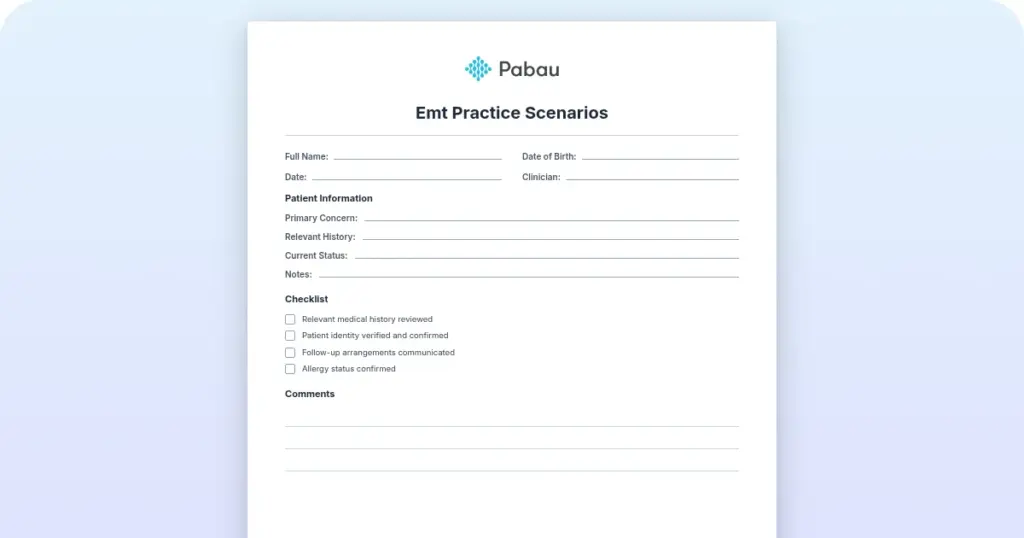
The form covers patient demographics, medical history, vital signs, physical examination findings, and laboratory results. It also captures immunization verification, drug screening results, and the signed fitness-for-duty determination.
Download templateA pre-employment medical exam is a health assessment a candidate completes after the employer extends a conditional job offer.
It confirms the person can perform the essential functions of the role safely.
This guide covers what the exam includes and what the ADA permits at each stage of a hire. It also shows how an occupational health practice documents the outcome without retyping it into a letter.
It is a structured evaluation by a licensed provider that decides whether a candidate meets the medical and physical requirements of a specific role. It happens after a conditional job offer, never before.
The exam differs from a routine annual physical in scope and purpose. Rather than assessing overall health, it asks whether the candidate’s health affects their ability to do this job safely. A construction role may call for cardiovascular and joint assessment, while a data entry role may call for visual and ergonomic assessment.
A routine physical uses a general history and physical form instead, with no reference to a particular job. That is the practical difference between the two documents.
The exam also creates a baseline health record. It protects employer and employee by documenting health status at hire. Findings stay confidential and sit in a separate file, apart from the personnel record, under HIPAA and other privacy rules.
Components vary by industry and job category, but most exams include the same standard elements:
The combination depends on industry standards and employer policy. Patient intake software captures the medical history in a structured format before the visit, so the appointment starts with the questionnaire already answered.
The form is built for occupational health practices, healthcare employers, and HR teams running standardized screening. Work through it in five steps:
Most employers order a 5-panel drug test at step four, and DOT-regulated roles require one. Expanded panels apply where the employer’s policy or the hazard profile calls for them.
One compliance point governs the last step. The employer receives the outcome as a short medical clearance letter, not a copy of the clinical findings. The candidate keeps a copy of the full form.
The form suits any team that signs off on fitness for duty:
The form is role-agnostic. Adapt the physical demands section to the essential job functions you are actually screening against.
Consistency and compliance. One form means every candidate for a role meets the same criteria, which is what makes a decision defensible if it is challenged.
Legal protection. Documentation shows that the fitness decision rested on clinical findings tied to essential job functions. That is the evidence a disability discrimination claim tests.
Less administrative work. Pre-printed sections and checklists cut the time a clinician spends writing during the exam, so more of the appointment goes to the candidate.
Audit readiness. Complete records support workplace safety audits, OSHA compliance reviews, and occupational health surveillance obligations.
A health baseline. Recording status at hire makes later work-related changes visible, which supports workers’ compensation claims and re-evaluations.
Put every “fit with restrictions” finding in writing, and name the duty the candidate cannot perform. A vague restriction such as ‘avoid heavy lifting’ invites a dispute later. Write ‘unable to lift over 25 lbs repeatedly’ or ‘no climbing or work at height, due to vertigo history’ instead. Send the same wording to the employer and the candidate.
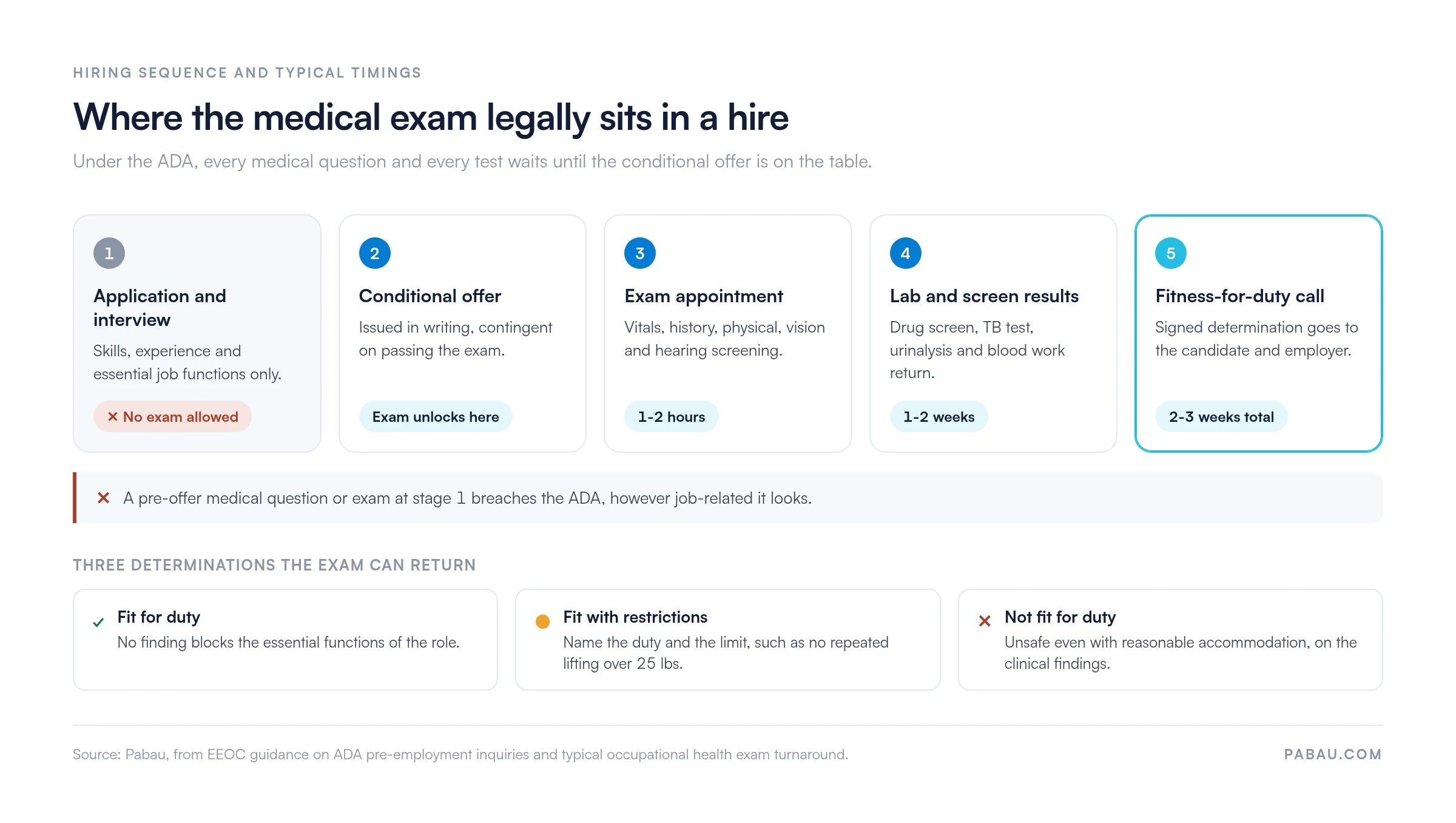
Under the Americans with Disabilities Act, employers may conduct medical exams only after making a conditional job offer. Pre-offer medical inquiries are prohibited. Four rules follow from that:
Timing is where the sequence matters most, because the same question is illegal one stage earlier and routine one stage later. The chart below places the exam in the hiring sequence and shows how long each stage usually takes.
For healthcare workers, CDC vaccination recommendations include hepatitis B, MMR, varicella, influenza, and pertussis. An employer may hold a candidate out of a clinical role for not meeting them. The requirement has to apply to every candidate for that role.
Work through this checklist before you send the first candidate for an exam:
Keeping that record audit-ready is its own job. Compliance management tools log who accessed a result and when, which is the evidence an inspector asks for.
Most occupational health practices run screening on paper. The candidate fills in a history form in the waiting room. The clinician writes findings onto a second form, and someone types a fitness letter afterward. Every one of those hand-offs is a chance to lose a result or file it in the wrong place.
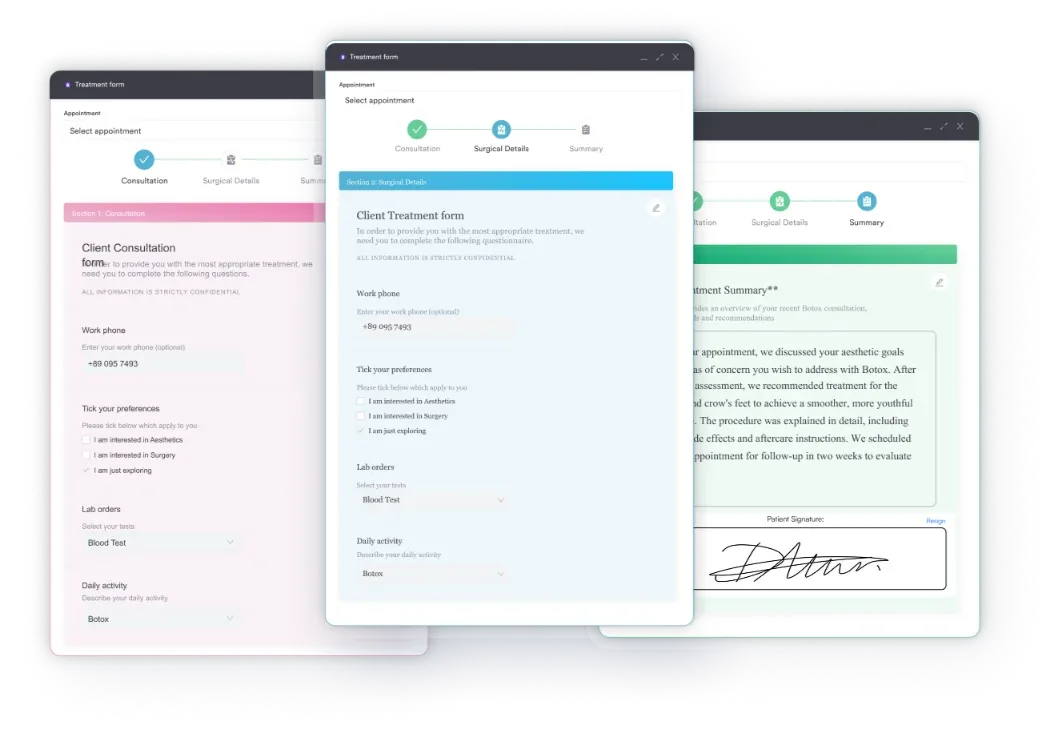
Practice management software like Pabau collapses that into one record. The candidate completes the history online before the appointment. The clinician records findings against the same record, and the letter generates from what was documented.
The outcome is throughput. A practice gets through more candidates in a day, with fewer transcription errors and a record that survives an audit. That is what keeps employer contracts renewing.

Pabau collects the candidate’s history online, stores the exam results in access-controlled storage, and generates the fitness-for-duty letter from what you documented. Book a demo to see the whole screening workflow in one place.

The exam earns its keep when it answers one question. Can this person perform this role safely, with accommodation where that applies? A form that records the answer and the findings behind it is what holds up when a decision is challenged.
Two failures account for most of the legal risk. An exam ordered before the conditional offer is a breach that no amount of documentation repairs. Results filed in the personnel record are the second. Get the timing and the storage right, and the rest is routine clinical work.
Use the free template above to put every candidate for a role through the same process. Book a demo to see how Pabau turns a completed exam into a stored record and a signed fitness-for-duty letter.

Digitizing your paper forms first? Medical forms at your healthcare practice explains how digital forms replace paper questionnaires and capture data more accurately.
Need to release results to the employer? Medical release form gives you the authorization document that has to sit behind any disclosure.
Writing the fitness letter itself? Medical certificate template gives you a format the employer can act on without seeing clinical detail.
Collecting history before the appointment? Family medical history form covers the hereditary section that most screening questionnaires handle badly.
Comparing documentation systems? Clinical documentation software walks through what to look for before you move screening records off paper.
A pre-employment medical exam is a health assessment carried out after a conditional job offer. It confirms the candidate can perform the essential functions of the job safely. Most exams cover vital signs, medical history, a physical examination, laboratory tests, drug screening, and TB testing.
No. Under the ADA, employers may conduct medical exams only after a conditional job offer is made. Pre-offer medical inquiries and exams are prohibited, and they may amount to disability discrimination.
“Fit for duty” means no finding blocks the candidate from performing the essential functions of the role. “Fit with restrictions” means they can work within stated limits, such as no lifting over 25 lbs. “Not fit for duty” means they cannot perform the role safely, even with reasonable accommodation.
Yes. Under HIPAA and the ADA, results must be kept confidential and stored in a separate medical file. They never go into the personnel record, and supervisors do not see them without the employee’s consent.
Most exams take one to two hours, depending on the role and the components required. Laboratory and drug screen results usually take one to two weeks to return. The full process, from appointment to final determination, normally closes within two to three weeks.
No. The ADA prohibits disqualifying a candidate on a diagnosis alone. The employer must show the person cannot perform the essential job functions, even with reasonable accommodation. A diabetes diagnosis disqualifies nobody by itself. The exam has to assess whether that candidate’s diabetes management affects safe performance in this specific role.