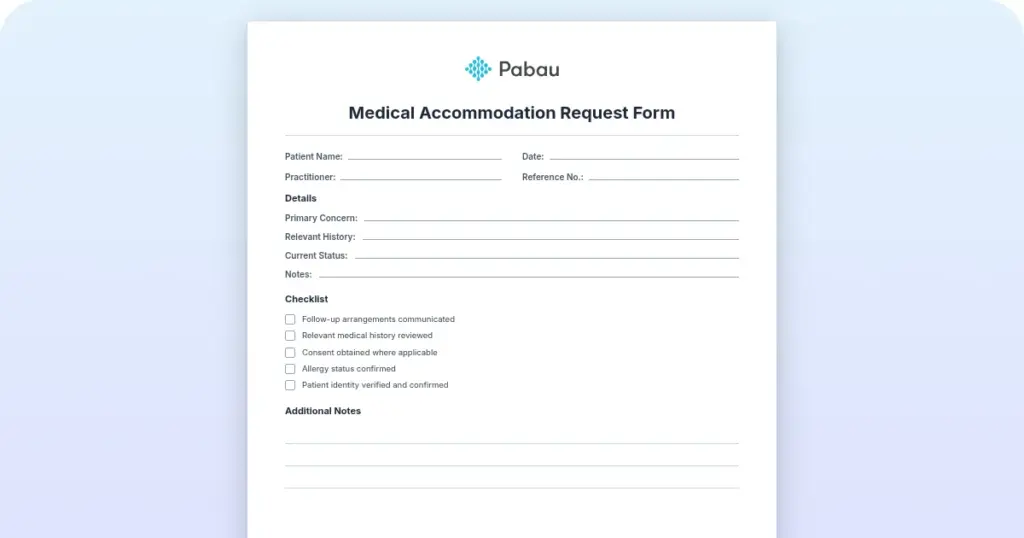
Medical accommodation request form
A medical accommodation request form is how an employee and their healthcare pro...

1
Last Updated: Oct 7, 2026
An LSA audit checklist is a structured list of the controls, records, and corrective actions your organization must evidence during a compliance audit. “LSA audit” has no single official definition. The term is used loosely for a local or internal compliance audit, and your funder or regulator sets its scope.
The checklist walks your team through five areas: Scope, internal controls, documentation, risk, and corrective action. Run it before an external audit to find weak controls early, or use it on its own as an internal governance review. This guide covers what goes in it, how to run it, and when a different audit applies instead.
A fill-in compliance audit checklist with sections for audit scope, internal controls, documentation evidence, and risk evaluation. It closes with a corrective action plan that records owners and completion dates for each finding.
Download template
An LSA audit checklist is a compliance documentation framework that organizations use to verify adherence to regulatory standards, internal control requirements, and audit procedures.
The checklist covers five core audit areas: Compliance requirements, internal controls review, documentation evidence, risk assessment, and corrective action planning.
There is no defined LSA audit standard, so set the checklist’s scope from your funder’s or regulator’s requirements. Single Audits, LPAs, and ISO audits each differ in scope and required evidence.
Using a structured checklist reduces compliance risk, keeps you audit-ready, and gives auditors clear evidence that your governance and controls work.
An LSA audit checklist guides your organization through a structured review of its governance, internal controls, and adherence to applicable regulations. “LSA audit” is used loosely for a local or internal compliance audit, with no standard regime behind the name. Your funder or regulator sets the scope, and the checklist adapts to it.
Some institutions use the same initials for a narrower review. Florida International University, for example, runs a required Laboratory Self Audit (LSA) for its academic and research labs. If that is the review you face, follow your institution’s own form.
For a general compliance audit, the checklist breaks the process into five actionable sections:
Working through the same sections every time keeps each audit consistent, and every finding arrives with supporting evidence.
Organizations subject to federal funding, grant oversight, or regulatory compliance may need an LSA or equivalent compliance audit. This typically includes healthcare practices, educational institutions, and nonprofits receiving federal funds. It also covers organizations subject to the Single Audit Act (31 U.S.C. 7501) and 2 CFR Part 200 Subpart F.
Even when no audit is mandated, an internal review against a structured checklist tells leadership whether governance frameworks work as intended. It also shows whether your risk controls hold up under testing.
A complete LSA audit checklist addresses five core compliance areas.
Follow these five operational steps to put the checklist to work in your organization.
Before the audit begins, gather evidence in three categories: Policy documents, operational records, and transaction samples.
If clinical documentation falls inside your audit scope, sample patient records as well. Our medical chart audit guide explains how to pick and score that sample.
An internal controls review examines whether preventive and detective controls are designed and operating effectively. Every control needs three elements: A documented policy, evidence that staff understand and follow it, and examples of the control working as intended.
Common control review areas include the following:
Public companies test these same controls under federal securities law. Our Sarbanes-Oxley compliance checklist shows how that more formal review is organized.
When an audit identifies a deficiency, document it clearly and respond promptly.
LSA audit checklists differ from Single Audits, LPA (Layered Process Audit) checklists, and ISO audit frameworks in scope, regulatory trigger, and evidence requirements.
Use an LSA audit checklist when your organization faces local compliance requirements or internal governance reviews. If federal funding triggers the audit, you will need a Single Audit instead, which follows GAGAS and 2 CFR Part 200. For ongoing operational process audits, an LPA checklist may fit better than a formal compliance audit. The decision runs in a fixed order, shown below.
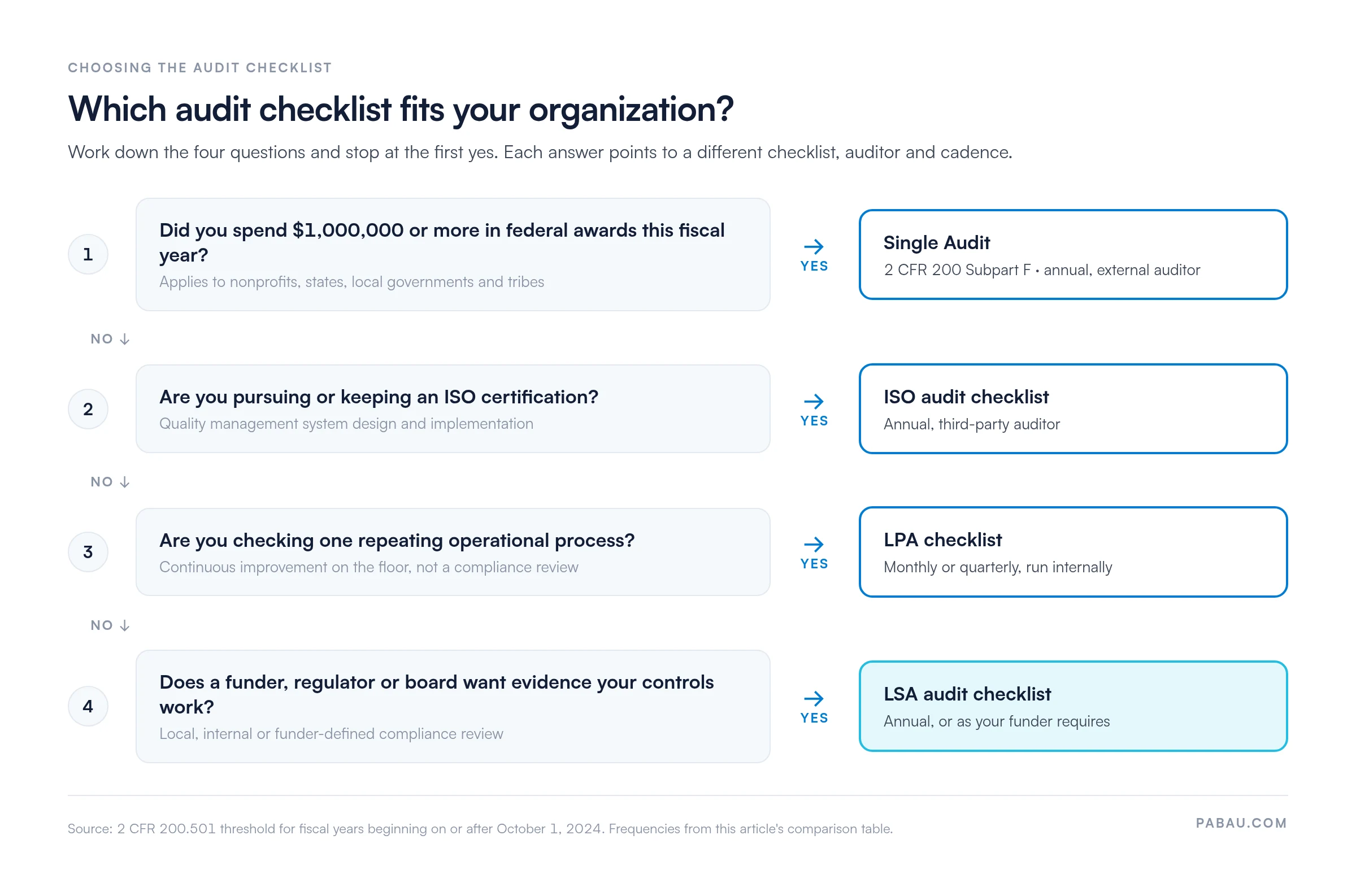
A well-run audit needs planning. Start the checklist six to eight weeks before the audit date to leave time for evidence gathering, staff interviews, and corrective action planning.
Store your checklist and supporting evidence in one central location, such as a shared drive, audit management software, or a compliance system. That way, audit leads can access it and auditors can review it during fieldwork. Assign clear ownership for each section, set deadlines for evidence submission, and track completion status weekly.
Document every finding with specific evidence (copies of policies, transaction samples, email exchanges, meeting notes) rather than generic statements. This shows auditors that you have investigated thoroughly and gives management usable data for corrective action. Practices that hold patient data should also run a HIPAA risk assessment alongside the audit, since it tests the security controls in more depth.
After downloading the template, follow these steps to tailor it to your organization.
Check how long your funder or regulator expects you to keep the file before you archive it. If it holds patient records, medical record retention periods apply as well.
Without a shared system, building an audit file is slow manual work. Someone exports reports, digs signed consent forms out of shared drives, and asks staff to confirm who approved what. That collection work can swallow most of the six-to-eight-week run-up.
Pabau, the practice management platform we build, keeps that evidence where the work already happens. Patients sign consent and intake forms digitally, and the forms are stored on their record. Treatment notes are time-stamped, and role-based permissions control which staff can view or change each record.
When an auditor asks for access controls or a sample of signed consents, you pull them from one system instead of five. Our compliance software for practices page shows how permissions and time-stamped documentation work together.

Pabau stores signed forms, time-stamped treatment notes, and role-based staff permissions in one system. When the auditor asks, the evidence is already dated and in one place.

Run the checklist before anyone asks for it. A team that treats it as an internal review six to eight weeks out finds weak controls while there is still time to fix them. The alternative is reading about them in the auditor’s findings.
The trade-off is effort up front. Evidence gathering alone takes two to four weeks, so give every section an owner on day one. And if your federal spending crosses the Single Audit threshold, treat this checklist as preparation for that audit, not a substitute for it.
Book a demo to see how Pabau keeps signed forms, treatment notes, and staff permissions ready for your next audit.

Auditing internal controls at a public company? Sarbanes-Oxley compliance checklist walks through the control areas a SOX review tests.
Working on a defense contract? CMMC compliance checklist covers the cybersecurity controls that certification requires.
Need a written privacy policy for your audit file? HIPAA compliance policy template gives you a starting document to adapt.
Auditing clinical records too? Medical chart audit explains how to sample and score patient charts.
Testing your data security controls? HIPAA risk assessment shows how to find and rate risks to patient data.
A Single Audit (2 CFR Part 200 Subpart F) is a federal compliance audit. It is required when an organization spends federal funds at or above the threshold, currently $1,000,000 a year. An LSA audit checklist is a broader compliance tool for local, state, or internal governance reviews, with no defined LSA standard behind it. Single Audits are externally conducted. LSA checklists can be internal or external, depending on the funder.
Frequency depends on your funding source and regulatory requirements. If you spend federal funds at or above the Single Audit threshold, annual audits are mandatory. For internal governance reviews or compliance with grant requirements, annual or biennial audits are common. Check your funder’s audit requirements.
Yes. An LSA audit checklist can be used for internal compliance reviews. However, if federal funds or a specific funder require an external audit, you must engage a qualified auditor. Internal reviews complement formal audits by identifying issues before external fieldwork begins.
Document the deficiency clearly, identify its root cause, and develop a corrective action plan assigning responsibility and a completion date. Re-test the corrective action to confirm it is effective. Include the finding and management’s response in the audit report for transparency to the funder or audit committee.
The template is a starting point for internal compliance reviews. If you must undergo a federal Single Audit, the external auditor follows GAGAS (Generally Accepted Government Auditing Standards) and designs their own audit procedures. Use the template as a foundation, and adapt it to your auditor’s requirements and your funder’s compliance obligations.