OSHA respirator medical evaluation questionnaire
The OSHA respirator medical evaluation questionnaire is the mandatory health for...

3
Last Updated: Oct 15, 2026
An antenuptial agreement template is a pre-drafted legal document that two people complete before they marry. It sets out how assets, debts, and financial obligations are handled if the marriage ends in divorce or death. Working from a template gives both parties a clear framework to negotiate against. Every jurisdiction still imposes its own validity requirements, from full financial disclosure to notarization. The file below is a drafting aid, not a substitute for legal advice. This guide explains what to include, what makes an agreement enforceable, and how to download your free copy.
A fillable agreement outline with party details, an effective date, purpose, obligations, payment and consideration, confidentiality, termination, governing law, and a two-party signature block. Prepare your asset and debt schedules as attachments and reference them from the agreement.
Download template
An antenuptial agreement is a contract between the two prospective spouses only, signed before the wedding, covering their marital financial arrangements.
Full financial disclosure of all assets and debts is required for enforceability, and concealment is the most common reason US courts void prenuptial agreements.
Child custody and child support cannot be settled in a prenuptial agreement under US law, because courts decide both at the time of divorce.
Practice owners can file executed agreements and disclosure schedules in practice management software like Pabau, so every signature date stays evidenced.
An antenuptial agreement is a contract between two people who intend to marry, signed before the ceremony, that governs their financial arrangements. “Antenuptial” and “prenuptial” name the same instrument. Antenuptial is the preferred term in South Africa and in formal US drafting. Prenuptial dominates everyday usage in the United States and the United Kingdom.
The difference is regional rather than legal. In South Africa, the contract is signed before a notary and registered with the Deeds Office before the wedding. Couples who skip that step are married in community of property by default, which shares all assets and debts equally. In the United States, state family law governs the agreement, and about half of US jurisdictions have enacted the Uniform Premarital Agreement Act.
Agreements vary by scope and by jurisdiction. Which type fits your situation decides what the document needs to cover.
A well-structured agreement covers seven core areas. Leave one out and opposing counsel has something to attack if the document is ever challenged.
One subject must never appear in a US prenuptial agreement: child custody and child support. Courts settle both at the time of divorce under the best-interest-of-the-child standard. A clause that tries to predetermine custody or support is void and unenforceable.
A completed form is not automatically enforceable. Courts examine how the agreement was made, not only what it says. Five requirements recur across US jurisdictions, and most are codified in the Uniform Premarital Agreement Act (UPAA). Roughly half of US jurisdictions have adopted it, some 29 states plus the District of Columbia.
Timing draws more challenges than any other requirement, so it helps to see the deadlines laid against the wedding date.
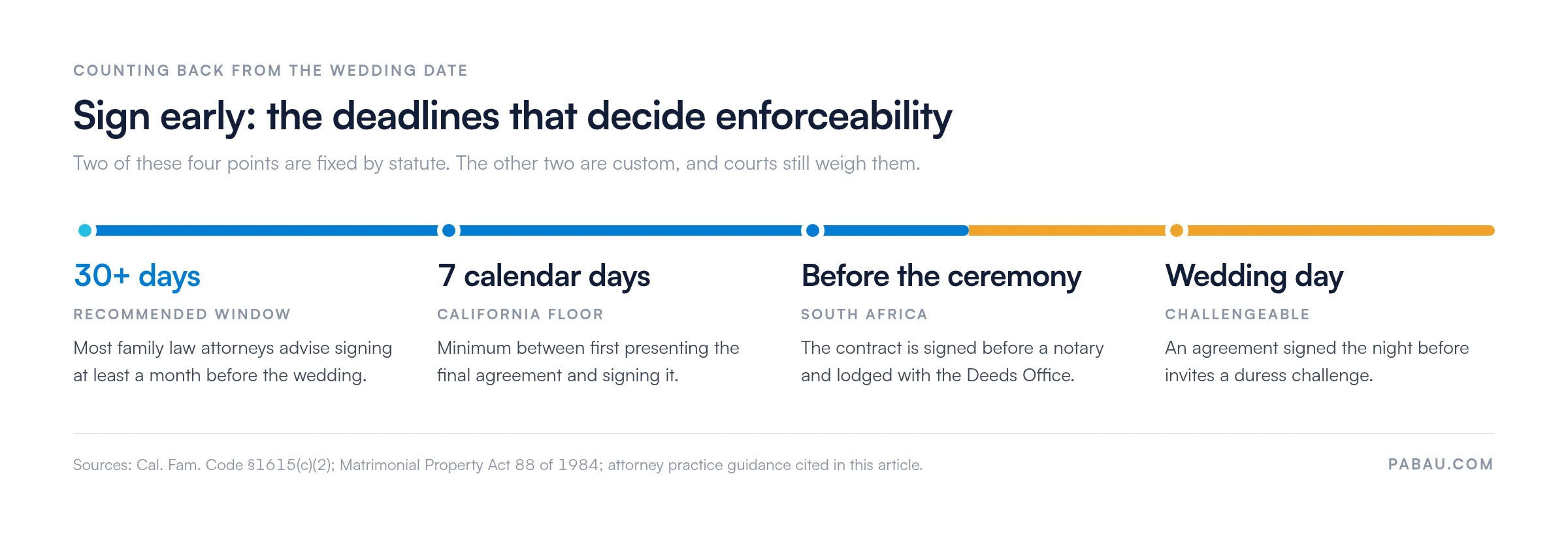
California is a community property state, so assets and debts acquired during marriage are split 50/50 by default. An agreement signed there must satisfy the California Family Code, which runs stricter than most states in four ways.
Other community property states, among them Arizona, Nevada, Texas, and Washington, offer similar opt-out mechanisms with different procedural requirements. Read your own state’s current family code before you rely on a generic form. California also imposes a fiduciary duty between spouses under Family Code Section 721, which shapes how candid the disclosure has to be.
The file is an agreement outline. It gives you the party details, the clause headings, and the signature block, and it walks both parties through each section in order. The asset and debt schedules are pages you prepare separately and attach. Follow these five steps to complete it correctly.
Complete your financial schedules before you draft the clauses. Knowing the exact figures on both sides keeps vague wording such as ‘approximately’ or ‘estimated value’ out of the document. Courts read that wording as a sign the disclosure was inadequate.
The outline suits any couple who want their financial arrangements settled before the wedding. It also suits practice owners who need a consistent structure for the agreements their business signs.
A fixed structure protects both parties from leaving out a clause that matters. The benefits carry past the document itself.
Legal clarity from the outset. Defining property rights before the wedding heads off expensive litigation over what each side thought had been agreed. Courts are readier to enforce agreements that are comprehensive, clearly drafted, and fully disclosed. A practice that already works from a non-disclosure agreement template will recognize the pattern. The clause headings sit in a fixed order, the fields are blank, and the signature block records who agreed to what.
Reduced dispute risk. An agreement that pre-settles property division narrows what a contested divorce can argue about. A court can refuse to enforce an agreement the signer did not execute voluntarily. Giving both parties time to read the terms and negotiate changes is a practical safeguard.
Consistency for practice operators. Owners who handle legal agreements regularly get more from a standard form than from drafting each one fresh. The same clause headings, in the same order, make a missing field obvious before anyone signs.
A postnuptial agreement covers the same subject matter but is signed after the marriage has taken place. The differences show up in timing, enforceability, and practical use.
South Africa’s route after the wedding runs through the courts. Section 21 of the Matrimonial Property Act 88 of 1984 lets spouses apply jointly for leave to change their matrimonial property system. The court grants it only where there are sound reasons, the creditors have had notice, and nobody is prejudiced. That is a heavier process than signing an antenuptial contract before the ceremony.
A downloadable outline suits couples with straightforward finances: no children from previous relationships, modest assets, no business ownership, and no complex debt. Both parties should still have the completed document reviewed by a licensed family law attorney before signing.
Hire an attorney to draft from scratch where either party holds significant business interests, an investment portfolio, or a trust structure. The same applies with premarital children, or with assets in more than one jurisdiction. Counsel also matters where one party is considerably wealthier, since courts scrutinize heavily asymmetric agreements for duress.
Whichever route you take, the signed original and its schedules need a home that records when they were filed. Practices that already run patient record management can apply the same filing rules to their own contracts. Keep one dated record, and limit access to the people who need it.
Most practices keep legal paperwork in three places at once. The signed PDF sits in a shared drive, the email thread proves it was sent, and the review date lives in someone’s calendar. When a dispute or an inspection arrives, reassembling that history takes hours.
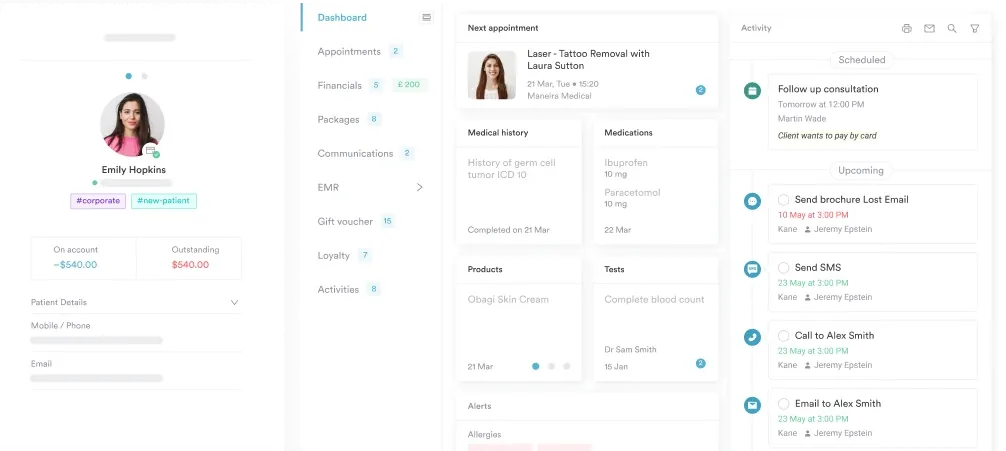
Pabau holds the document, its audit trail, and the follow-up task on one record. Forms are issued, signed electronically, and filed against the person they belong to, with the date stamped as it happens. The compliance tools track which documents are current and which are due for review.
Your team can then produce the paper trail on demand instead of searching inboxes for it. In a dispute the argument is usually about when a document was signed and by whom. A dated record answers that in seconds.

Pabau’s digital forms capture signatures, file each document against the right record, and flag what is due for review. Your team can evidence when a document was issued, signed, and stored, without searching a shared drive.

The template does the easy part. What decides whether a court enforces the agreement is the disclosure behind it and the date on the signature page.
So treat the download as a drafting aid. Build both financial schedules first, attach them to the agreement, give each party their own attorney, and sign well clear of the wedding. An agreement assembled that way is rarely tested, and one signed in a hurry usually is.
For practices that handle signed agreements as part of their own operations, the same discipline applies to storage. Book a demo to see how Pabau files signed documents against the right record and keeps every date evidenced.

Need another agreement your practice can hand over? Non-disclosure agreement template explains when a practice needs one and what belongs in it.
Setting terms before work starts? Client agreement template sets out the terms a practice agrees with the people it works for.
Releasing records to a third party? Authorization for release of confidential information covers the consent wording a disclosure needs.
Filing signed paperwork by hand? Clinical documentation software looks at what changes when documents are captured and stored digitally.
An antenuptial agreement template is a pre-structured legal document couples complete before marriage. It defines asset ownership, debt responsibility, property division rules, and spousal support terms. The clause-by-clause framework reduces the risk of omitting an enforceable provision. It still has to be adapted to the applicable jurisdiction and reviewed by a licensed attorney before execution.
A DIY antenuptial agreement can be legally enforceable if it meets the jurisdiction’s requirements. Those are voluntary execution, full financial disclosure, adequate timing before the wedding, and proper witnessing or notarization. Enforceability becomes uncertain when either party lacked independent legal advice or the financial schedules were incomplete. Signing under time pressure just before the ceremony has the same effect.
Yes, an antenuptial agreement and a prenuptial agreement are the same legal instrument. “Antenuptial” is used in South Africa and in formal US legal drafting; “prenuptial” is the common usage in the United States and United Kingdom. Both refer to a contract signed before marriage that governs financial arrangements between the parties.
Most family law attorneys recommend signing at least 30 days before the wedding to avoid any suggestion of duress. California sets a floor of seven calendar days between presenting the final agreement and signing it. In South Africa, the contract must be signed before a notary and registered with the Deeds Office before the ceremony.
Child custody and child support cannot be addressed in a prenuptial agreement under US law. Courts determine both at the time of divorce using the best-interest-of-the-child standard, and any prenuptial clause attempting to predetermine those terms is void. Agreements also cannot include provisions that incentivize divorce, waive rights to domestic violence protections, or violate public policy.