Need to belong scale (NTBS): Free PDF and scoring guide
The need to belong scale is a 10-item self-report questionnaire that measures ho...

1
Last Updated: Oct 22, 2026
An intake note is the clinical record a therapist or counselor writes at the start of a patient’s care. It captures demographics, the presenting problem, relevant history, risk, and initial goals. Most practices complete it during or just after the first session, and every later progress note is measured against it.
Intake notes differ from progress notes because they are written once, at the start of the therapeutic relationship, rather than after each session. Headway’s guidance describes intake assessments as generally taken at the beginning of a therapeutic relationship. The note is repeated only when a patient’s situation changes significantly or considerable time has passed.
Below you’ll find a free downloadable template, a completed example, and what each section of a complete intake note should contain. Use them so your team documents new patients consistently.
A structured intake note template covering patient demographics, medical history, presenting complaints, and initial assessment findings. Adapt it for your therapy and counseling intake sessions.
Download template
An intake note records a new patient’s demographics, presenting problem, history, risk, and initial goals.
Intake notes are completed at the start of care and repeated only when circumstances change significantly.
Risk assessment belongs in every intake, whatever the presenting concern.
Patient information can come straight from the intake form, but risk, mental status, and diagnosis need the clinician’s own assessment.
Practice software such as Pabau carries pre-session intake form answers into the patient record, so nobody retypes them.
An intake note is the first clinical record of who the patient is and why they are seeking care. It also captures what the clinician understood at the outset. It sits alongside counselor intake forms, which the patient completes, and progress notes, which follow each session.
The note matters because every later decision traces back to it. Treatment plans, diagnostic impressions, and risk judgments all start from what was recorded at intake. A thin intake shows up later as vague goals, or as a covering clinician with no safety context to work from.
A complete therapy intake note covers the same core sections, whatever the modality. Each one answers a question the next clinician will need answered.
Not every section is written from scratch in the room. Patient information can come straight from the intake form the patient completes before the session. That form often seeds the presenting problem and history too. Mental status, risk, and the diagnostic impression come only from the clinician’s own assessment, as the breakdown below shows.
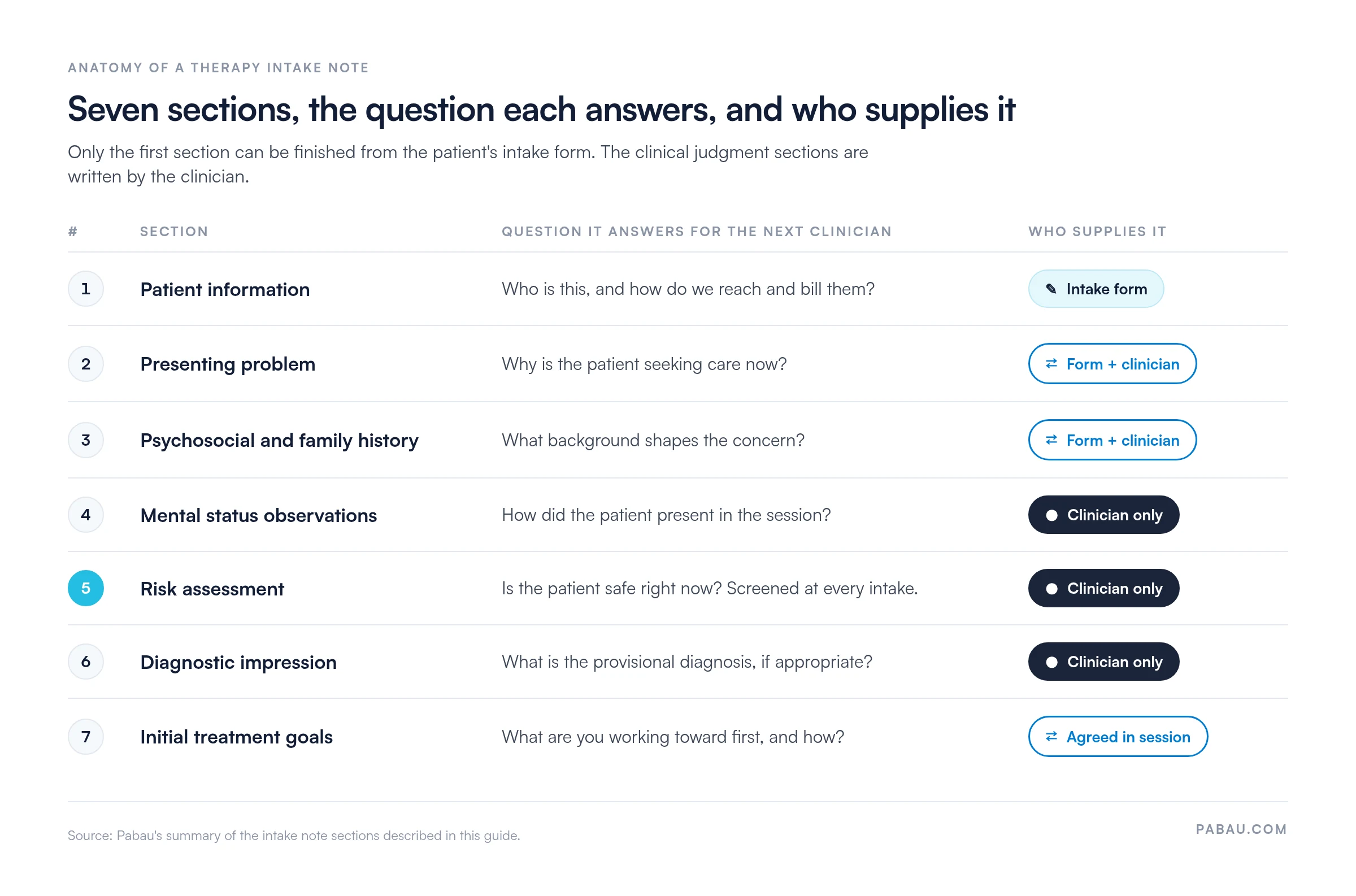
The clinician-only sections carry the most weight, so a structured tool keeps them consistent. A mental status exam template standardizes your observations. A suicide risk assessment checklist makes sure no screening question is skipped.
Use the template below to capture each section in a fixed order. A consistent structure lets a covering clinician read the record quickly.
The template follows the structure described above, so you can complete each section at intake and adapt the wording to your own practice. Your professional judgment and your state licensing board’s documentation rules still decide the final content.
A completed intake note reads as a short clinical narrative, with full sentences in each field. In the presenting problem field, a clinician might record the patient’s own words, the onset, how long the issue has persisted, and what changed recently.
Good intake documentation starts before the session and finishes soon after it. Work through the four stages in order so no detail is left to memory.
Once the note is signed, the goals it records become the starting point for an individualized treatment plan.
An intake note is written once at the start of care, while a progress note is written after each session. Keeping the two distinct avoids duplicated or contradictory records. From the second session on, a psychotherapy progress note records what changed against the intake baseline.
Requirements shift with setting. A private therapy practice may focus on the presenting problem and goals. A psychiatric service will place more weight on diagnosis and medication history. School counseling and applied behavior analysis (ABA) settings often add developmental and educational context.
Before adopting any template in full, check your state licensing board’s rules. Also check your professional body’s documentation standards, such as those from the American Psychological Association.
Many therapy practices still collect intake paperwork on paper or in a separate form tool. Someone then retypes the answers into the record before the clinician starts the note, and that copying is where demographic and insurance errors creep in.
With Pabau’s digital forms, patients complete intake paperwork before the first session. Their answers land in the patient record, so the intake note starts with information already captured.
Customizable note templates sit in the same platform as scheduling and records, so every clinician follows one intake structure. Pabau also handles simpler therapy practice management from booking to billing, so the intake connects to every appointment and invoice that follows.

Pabau’s digital forms collect intake answers before the first session and file them in the patient record. Your clinicians start the intake note with demographics and history already in place.

Start with the template, then make it yours. Add the fields your licensing board and payers expect, and decide in advance which sections the patient completes on the intake form. That leaves the session for what only you can document: risk, mental status, and a working diagnosis.
A thorough intake takes longer to write on day one. Every progress note, treatment plan, and handover after it reads more clearly as a result. Book a demo to see how Pabau moves intake answers into the patient record before your first session starts.

Need a deeper history section? Psychosocial assessment template structures the social, family, and environmental history behind the presenting problem.
Writing notes after the intake? BIRP notes walks through the behavior, intervention, response, and plan format with examples.
Prefer the SOAP format? SOAP note for counseling includes a free template and two completed examples.
Want a shorter session note? DAP note template covers the data, assessment, and plan format, with a cheat sheet.
Gathering a full background? Biopsychosocial history collects biological, psychological, and social history in one form.
An intake note is the initial clinical record created at the start of a patient’s care. It captures demographics, presenting problem, history, risk, and initial goals.
Include patient information, presenting problem, psychosocial and family history, mental status observations, risk assessment, diagnostic impression, and initial treatment goals. Adjust detail to your setting.
An intake note is written once at the start of care, while a progress note is written after each session. Intake notes are repeated only when the patient’s situation changes significantly.
Record only the family mental health history relevant to the presenting problem and risk. Note the source of information and avoid speculative detail.