Montgomery-Åsberg Depression Rating Scale (MADRS)
The Montgomery-Åsberg Depression Rating Scale (MADRS) is a clinician-administer...

2
Last Updated: Oct 6, 2026
BIRP notes are a four-part progress note format that therapists and mental health clinicians use to document a session. The letters stand for Behavior, Intervention, Response, and Plan.
Each section answers one question: what you observed, what you did, how the patient reacted, and what happens next. Written well, the note keeps care consistent from one session to the next. It also gives a payer the evidence of medical necessity it needs before reimbursing the visit.
The free template below puts those four sections on a single page, ready to print or copy into your records system.
A one-page BIRP note with fields for the session date and the patient’s name, gender, and date of birth. It gives you writing space under Behavior, Intervention, Response, and Plan, plus a clinician name and signature line.
Download template
BIRP stands for Behavior, Intervention, Response, and Plan, a four-part progress note format used in therapy and behavioral health.
Behavior records what you observe, Intervention what you did, Response how the patient reacted, and Plan the next steps.
Payers read the note as evidence of medical necessity, so name specific techniques and observable changes instead of writing “therapy provided.”
BIRP suits intervention-heavy settings, while SOAP remains the most widely used progress note format in behavioral health overall.
Pabau, the practice management platform we build, keeps BIRP notes in the patient record next to the appointment and invoice they support.
A BIRP note is a structured progress note you write after each therapy session. It sits in the patient’s record alongside the intake assessment and treatment plan. Read in sequence, the notes show how each session moves the patient toward the goals in that plan.
The acronym breaks down into four parts:
SOAP notes (Subjective, Objective, Assessment, Plan) organize a session around what the patient reports and what you measure. BIRP organizes it around what you did and how the patient responded. DAP notes (Data, Assessment, Plan) are shorter still, folding behavior and response into a single Data section.
The Behavior section records what you see and hear from the moment the patient arrives. That covers nonverbal communication, affect, energy level, and the concerns they bring. Keep it to observable facts and the patient’s own words, and save interpretation for later in the note.
Include in this section:
Precise descriptors make this section faster to write and easier to audit. Our list of mood words for documentation gives you ready terms for affect and presentation.
Payers and auditors read this section to confirm that your interventions matched the patient’s presentation. A patient presenting with severe anxiety and insomnia justifies a different level of care than one describing mild situational stress.
The Intervention section names the therapeutic techniques and approaches you used in the session. This is where you show your clinical reasoning and support medical necessity for billing.
Record specific techniques rather than generic summaries, for example:
Payers (insurance companies) need to see evidence-based interventions matched to the diagnosis. Writing “therapy” or “counseling” isn’t enough. Name the modality and the technique so your clinical decision-making is visible.
The Response section documents how the patient reacted to your interventions during the session. It shows engagement, progress, and readiness for the next therapeutic step.
Describe observable changes or reactions:
This section tells the story of progress. Payers and auditors look here to judge whether the patient is benefiting from treatment and whether session intensity or frequency should change.
The Plan section sets out what happens next: goals for the following session, homework, referrals, and any changes to the treatment plan.
Document clearly:
A completed note is the quickest model for your own. Here are two worked examples from different clinical presentations.
Behavior: Patient presented with visible tension in shoulders and neck. Anxious affect, fidgeting with hands throughout session. Reports sleep disruption (4–5 hours nightly) and persistent worry about work performance and relationships. Stated: “I can’t turn my brain off.” No acute safety concerns noted.
Intervention: Psychoeducation on anxiety physiology and the worry cycle. Taught diaphragmatic breathing technique and practiced once in session. Introduced cognitive monitoring and identified three catastrophic thoughts (“I’ll fail my presentation,” “Nobody really likes me,” “Something bad will happen”). Used Socratic questioning to examine evidence for and against these thoughts. Assigned daily worry log.
Response: Patient engaged in breathing exercise and noticed a shift in body tension. Recognized pattern of catastrophizing when stressed. Initially resistant to challenging thoughts (“But what if I do fail?”) but softened after exploring realistic probabilities. Committed to completing worry log and agreed to practice breathing twice daily. Left session noticeably calmer than on arrival.
Plan: Continue cognitive restructuring focused on perfectionism beliefs. Introduce scheduled worry time to contain rumination. Patient to track sleep and anxiety intensity on a 0–10 scale. Refer to primary care physician for sleep assessment. Next session: explore core beliefs underpinning perfectionism. Frequency: weekly 50-minute sessions.
Behavior: Patient arrived 10 minutes late, appeared withdrawn and flat in affect. Made minimal eye contact. Reported increased isolation (has not left home in five days) and canceled plans with a friend yesterday. States: “Nothing feels worth doing.” Energy and motivation markedly low. No suicidal ideation at present; passive wish to “not be around” acknowledged.
Intervention: Motivational interviewing to explore ambivalence about activation despite low mood. Validated difficulty in taking action when depressed. Normalized that motivation often follows behavior, not vice versa. Identified small, achievable activities (e.g. 10-minute walk, texting one friend). Reviewed values clarification exercise to link activity to meaning. Discussed barriers to sleep and nutrition.
Response: Initially dismissive of activity suggestions (“I won’t enjoy it anyway”). Gradually opened up in the values conversation and named the importance of relationships and being a “good friend.” Agreed to text a friend and take one short walk this week. Showed slight uplift when discussing shared interests. Expressed willingness to reconsider a medication consultation with primary care physician.
Plan: Behavioral activation with small, meaningful activities. Continue motivational work around change readiness. Refer to primary care physician to reassess antidepressant efficacy and sleep medication. Increase session frequency to twice weekly for support during low-motivation period. Risk monitoring: safety plan reviewed and updated. Next session: review activity completion and consolidate progress on values work.
Three structured formats dominate mental health documentation. The right one depends on your clinical setting, your payers, and how your team works.
BIRP is strongest in intervention-heavy settings, such as intensive outpatient programs, because it puts the interventions you delivered at the center of the note. SOAP remains the most widely used format in behavioral health overall, and it’s the usual choice in medical practices, med spas, and IV therapy practices.
If a payer or supervisor expects a different structure, our SOAP note template and DAP note template cover the same session in those formats.
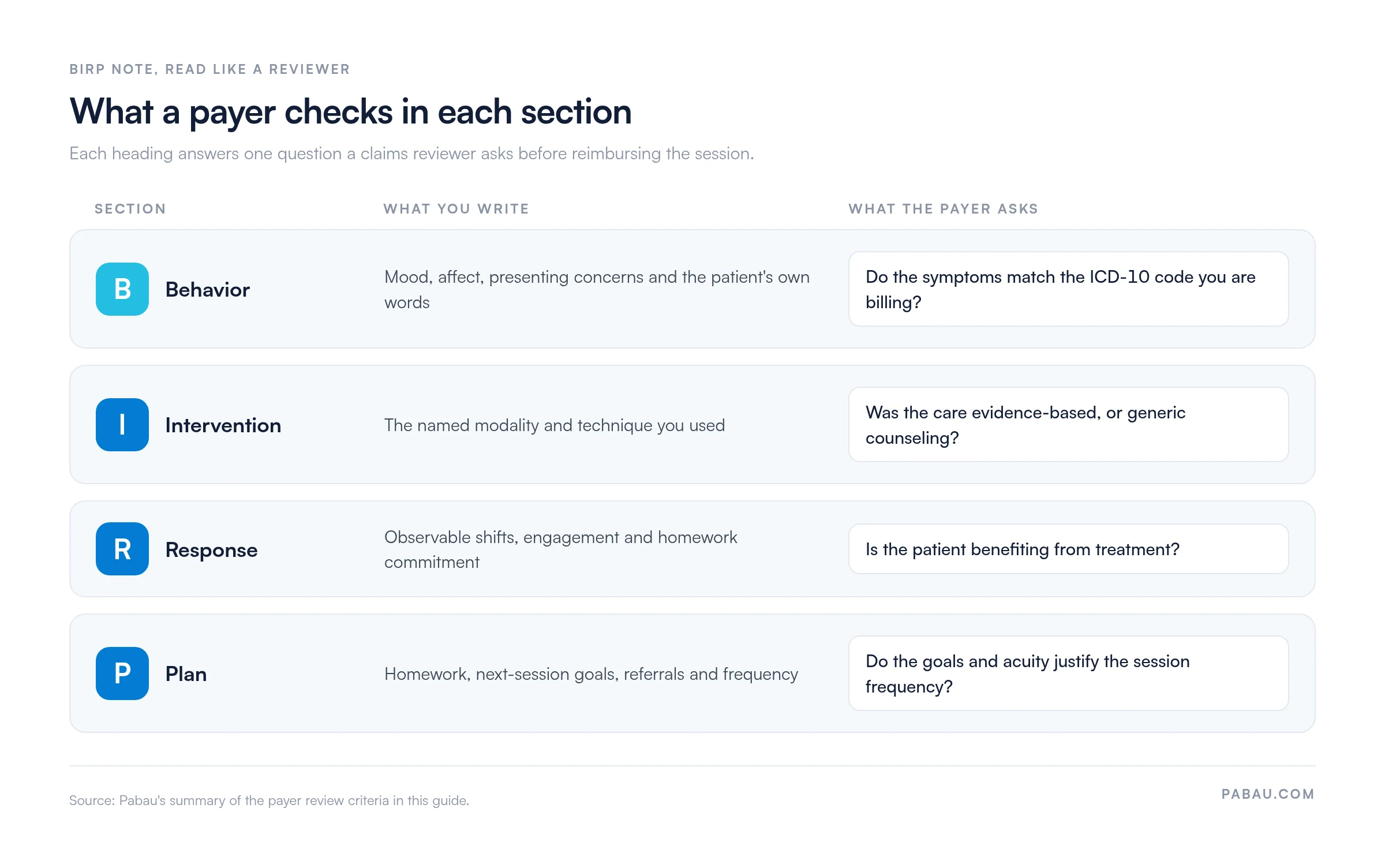
Your note is the evidence behind every claim you submit for a therapy session. When a payer reviews it, they’re checking that the service was medically necessary and matched the patient’s presentation.
Payers look for:
Each heading maps to one of those questions, as the diagram below shows.
Vague lines such as “Therapy provided,” “Client doing well,” or “Continue current plan” give a reviewer nothing to verify, and they invite denials. The table below rewrites each one using the anxiety session from Example 1.
| Section | Vague line | Line a reviewer can verify |
|---|---|---|
| Behavior | “Client doing well.” | Visible shoulder tension and fidgeting. Reports 4–5 hours of sleep nightly. No acute safety concerns. |
| Intervention | “Therapy provided.” | Socratic questioning on three catastrophic thoughts. Taught diaphragmatic breathing and practiced it once in session. |
| Response | “Engaged well.” | Resisted challenging thoughts at first, then softened after reviewing realistic probabilities. Committed to a daily worry log. |
| Plan | “Continue current plan.” | Weekly 50-minute sessions. Next session targets perfectionism beliefs. Referred to primary care physician for sleep assessment. |
The claim itself has its own rules on codes and submission. Our guide to insurance billing for therapists walks through the process your notes support.
A thorough note for a 50-minute session can take 10 to 20 minutes to write. That’s time clinicians rarely budget for. These habits shorten it without thinning the clinical detail.
Many therapists write notes in one tool, keep their schedule in another, and attach documentation to claims by hand. Pabau’s software built for therapists keeps the note, the appointment, and the invoice in one patient record.
You can set up the BIRP format in Pabau’s customizable note templates, so every clinician on your team writes to the same four headings. Pabau Scribe, our AI medical scribe, drafts the note from your session summary for you to review and approve.
Because medical records management sits in the same system as scheduling, you open the patient, review their history, and start writing on one screen.

Pabau’s customizable note templates and Pabau Scribe help you finish BIRP notes sooner. Each note sits next to the appointment and invoice, ready when a payer asks for it.

A BIRP note does two jobs. It tells you where you left off when the next session starts, and it shows a payer why the session was necessary. The four headings help with both, but only when each one holds specifics.
Start with the free template, write the note the same day, and name the technique in every Intervention section. As your caseload grows, the minutes spent on each note matter more than the choice of format. Book a demo to see how Pabau helps therapists draft, store, and bill BIRP notes from one patient record.

Want a goal-led alternative? GIRP note template opens each note with the treatment goal the session served.
Need prompts while you write? Therapy progress notes cheat sheet gives you quick prompts for any progress note format.
BIRP stands for Behavior, Intervention, Response, Plan. It is a four-part structured documentation format therapists and mental health clinicians use to record session content, clinical decisions, and progress.
Start by documenting the patient’s behavior and presentation (Behavior), then record the specific interventions you used (Intervention). Note how the patient responded (Response), and outline treatment goals and homework for continuity (Plan). Write the note soon after the session, using your template as a structure guide.
The Behavior section documents observable facts: mood and affect, energy level, speech rate, eye contact, and presenting concerns. It also covers recent stressors and adherence to prior homework or the treatment plan. Avoid interpretation and stick to what you observe rather than your judgments.
BIRP notes are a type of progress note. They record session content and progress toward treatment goals. Other progress note formats (SOAP, DAP, narrative) exist. BIRP is widely used in behavioral health, especially in intervention-heavy settings, though SOAP remains the most common format overall.
Yes. The free BIRP notes PDF template near the top of this page is ready to print and use in your practice. You can also adapt it into your practice management system.