Antipsychotic medication list
An antipsychotic medication list is a structured reference that organizes psychi...

2
Last Updated: Oct 13, 2026

An individualized treatment plan is a clinical document you and the patient build together, setting goals, interventions, and review dates.
Every plan needs six parts: assessment, diagnosis, SMART goals, interventions, a progress monitoring schedule, and discharge criteria.
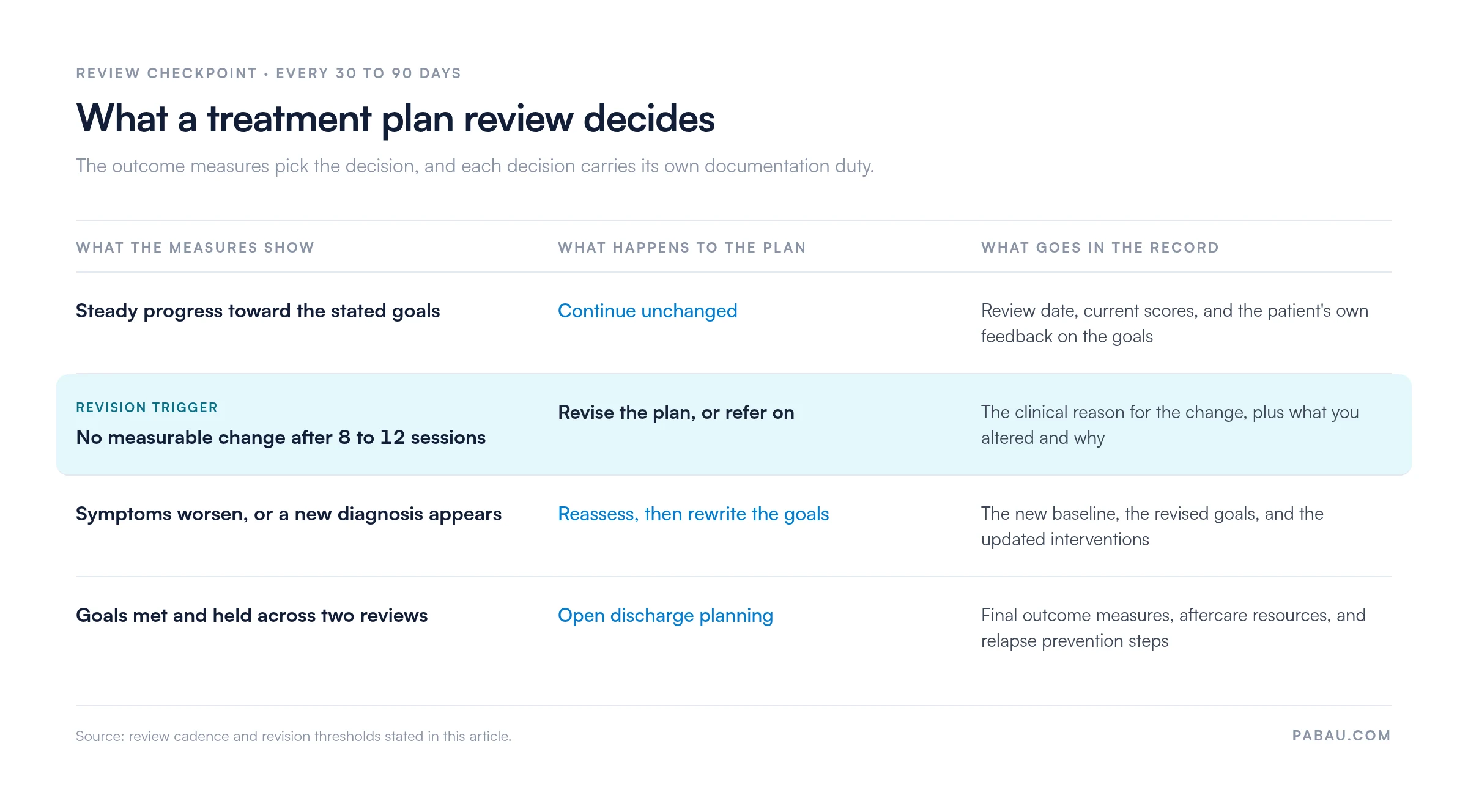
Review the plan every 30 to 90 days, and revise or refer when 8 to 12 sessions bring no measurable change.
Structured plans satisfy CMS, state licensure, and Joint Commission requirements, and they hold up when a reviewer asks for them.
Practice management software like Pabau keeps the plan, its review dates, and its outcome scores in one client record.
A six-section plan covering assessment and history, diagnosis, SMART goals, interventions, progress review dates, and discharge criteria. It suits mental health, therapy, and general practice settings.
Download templateAn individualized treatment plan is a clinical document that sets one patient’s goals, the interventions you’ll use, and the dates you’ll measure progress.
You and the patient write it together, so it reflects their history, preferences, and priorities rather than a standard protocol.
The first draft is the easy half. Plans go stale when no rule says what each outcome score should trigger at the next review. This guide gives you the six sections, a five-step writing workflow, two worked examples, and a decision table for every review point.
An individualized treatment plan starts from one patient’s history, preferences, cultural context, and stated goals. A standardized protocol starts from the diagnosis alone, which is the whole difference between the two.
The document does two jobs at once. It guides your clinical decisions, and it evidences compliance with HIPAA, CMS, and state licensure requirements when a reviewer asks.
Treat it as a living document. You review it on a set schedule, update it as the patient progresses, and revise it when their needs shift. Structured templates cut the writing time, which matters when documentation load is one of the clearest drivers of therapist burnout.
Every plan carries the same six sections. Between them they cover assessment, direction, and measurement, which is exactly what a reviewer reads for.
Five steps, in order. Each one feeds the next, so jumping ahead usually means rewriting.
The six sections stay the same across specialties. What changes is the clinical content, the measurement tool, and the discharge threshold.
Patient: 28-year-old with generalized anxiety disorder and secondary insomnia. Goals: reduce anxiety to a GAD-7 score of 7 or below, sleep six or more hours nightly, and return to work. Interventions: weekly cognitive-behavioral therapy, sleep hygiene coaching, and progressive muscle relaxation. Timeline: a 12-week course reviewed every four weeks. Discharge criterion: a sustained GAD-7 score under 5, independent sleep practice, and stable employment. Aftercare: monthly maintenance sessions and psychoeducational material on anxiety relapse.
Patient: 42-year-old in recovery from alcohol use disorder. Goals: reach 90 days sober, attend three Alcoholics Anonymous meetings weekly, and repair family relationships. Interventions: twice-weekly individual therapy using motivational interviewing and relapse prevention, a psychiatric evaluation for co-occurring depression, and peer support groups. Timeline: a six-month intensive phase, then monthly sessions. Discharge criterion: six or more months sober, employment, an active peer support network, and family engagement in therapy. Aftercare: ongoing peer support, periodic check-ins, and a written relapse protocol.
Recovery work carries documentation demands of its own, so a dedicated substance abuse treatment plan gives you fields the general template leaves out.
A plan you never revisit stops describing the patient in front of you. The review schedule keeps it accurate, and the outcome scores decide the next move.
The table below sets out the four decisions a review can produce, and what each one obliges you to write down.
Session-by-session detail belongs in the notes rather than in the plan. A psychotherapy progress notes template keeps the two documents from blurring into one.
Any clinician delivering ongoing therapeutic or medical care. The settings below are the ones where a written plan is expected rather than optional.
Practices carrying large therapy caseloads usually move the plan off paper, into therapy practice management software that stores it with the client record.
Structured planning earns its documentation time back in five places.
Track review dates and plan revisions in a dedicated field or tag inside your practice management software. Audit preparation then takes minutes, and you can see at a glance which patients need a protocol change or a referral.
Regulatory frameworks require an individualized plan for most licensed therapeutic and medical services. CMS mandates them for behavioral health, and state licensing boards expect documented evidence of personalized assessment. Store the documents with the same access controls you apply to the rest of the record.
Four barriers come up again and again, and each one has a practical fix.
Right now the plan probably lives in a word processor file or a paper folder. The assessment sits in one place, the goals in another, and the next review date lives in someone’s head.
Practice management software like Pabau keeps all three in the client record. Digital forms capture the biopsychosocial assessment before the first session, so the goals you write rest on structured answers rather than recall. Pabau Scribe, our AI scribe, drafts the session note, which leaves you the judgment calls instead of the typing.
Review dates become scheduled tasks rather than good intentions. Outcome scores sit beside the goals they measure, so a 30-day review takes minutes. When an auditor asks for the plan, its revisions, and the reasoning behind them, all three are already together.

Pabau stores the plan, its review dates, and its outcome scores in the client record. Digital forms capture the assessment at intake, so writing measurable goals takes minutes.

Writing the first plan is the easy half. The plan earns its keep at the review point, where the scores either justify continuing or tell you to change course.
So set the rule before you need it. Decide now what a flat score after 12 sessions will trigger, and write that criterion into the plan itself. That one line separates a document a reviewer trusts from one they question.
Download the template, adapt the six sections to your patient population, and put the review dates somewhere they cannot be missed. Book a demo to see how Pabau keeps treatment plans, review dates, and outcome scores in one client record.

Working from a psychology caseload? Psychology treatment plan template narrows the six sections down to the fields a psychologist fills in.
Planning care for an ADHD diagnosis? ADHD treatment plan covers the goals, accommodations, and review points specific to attention disorders.
Managing a mood disorder long term? Bipolar treatment plan sets out episode monitoring alongside the medication adherence goals that go with it.
Need a plan for acute risk? Mental health safety plan gives you the warning signs, coping steps, and contacts to agree with the patient.
Writing up the sessions themselves? Therapy progress notes cheat sheet keeps each note focused on what changed since the last visit.
It is a clinical document that a clinician and patient write together. It records the presenting problem, the diagnosis, the treatment goals, the chosen interventions, the progress monitoring method, and the discharge criteria. It works as both a clinical guide and a compliance record.
Every 30 to 90 days for most plans. The right frequency depends on the patient’s acuity and how fast their presentation is changing. Acute and crisis situations need review sooner. Record every review date and every modification in the patient record.
SMART goals are specific, measurable, achievable, relevant, and time-bound. Instead of “reduce anxiety”, a SMART goal reads “client will score 7 or below on the GAD-7 within 12 weeks of weekly therapy”. That makes progress objective and trackable.
Licensed mental health clinicians, addiction specialists, occupational and physical therapists, and medical providers running ongoing treatment all must document one. CMS, state licensure boards, and accreditation bodies such as the Joint Commission and CARF require them for most therapeutic and medical services.
Yes. The structure stays the same across populations — assessment, goals, interventions, monitoring, and discharge. The clinical content is what changes. A mental health plan differs from a substance abuse or physical therapy plan in its interventions, measurement tools, and discharge criteria. The template on this page adapts across mental health, therapy, and general practice settings.
No measurable progress after 8 to 12 sessions is the signal to revise the plan. Reassess the diagnosis, the engagement level, and the fit of the treatment. Consider adding interventions, changing the frequency, consulting a colleague, or referring to specialist care. Then update the plan to record the change and the clinical reasoning.