Anja Dodevska

Event booking form
What is an event booking form? An event booking form is a structured document th...

Last Updated: Nov 12, 2026
Free PDF 5 pages, print-ready Clinician-reviewed
An independent living skills checklist is a structured self-assessment that records how well a person manages everyday tasks without support. This template covers three areas: general life skills such as hygiene, dressing and decision-making, emergency and safety skills, and nutrition and dietary skills. Each of its 31 items is a first-person statement, rated from “Can do fine without support” to “Doesn't apply to me”. Occupational therapists, special educators and care coordinators use the results to spot where support is needed and to track progress between reviews. It does not cover money management, transport, community access or employment.
A five-page checklist with 31 items across general life skills, emergency and safety skills, and nutrition and dietary skills. Each item is rated on a five-option support scale.
Start from scratch, or upload this PDF or any form you already use, and Pabau's AI Form rebuilds it with tick boxes, text fields and a signature. Attach it to the treatment once, and every patient gets it on time.
AI Form rebuilds the consent, history and aftercare forms you already use. You review each one, then publish.
Patients complete forms on their phone before they arrive, so the front desk stops retyping paper.
Every signed form is versioned and attached to the treatment record, ready when you need it.
Set how long a consent stays valid. Returning patients skip forms they have already signed.
Supports HIPAA and GDPR compliance AES-256 encryption 4.8 on G2 4.7 on Capterra Trusted by 4,000+ practices worldwide

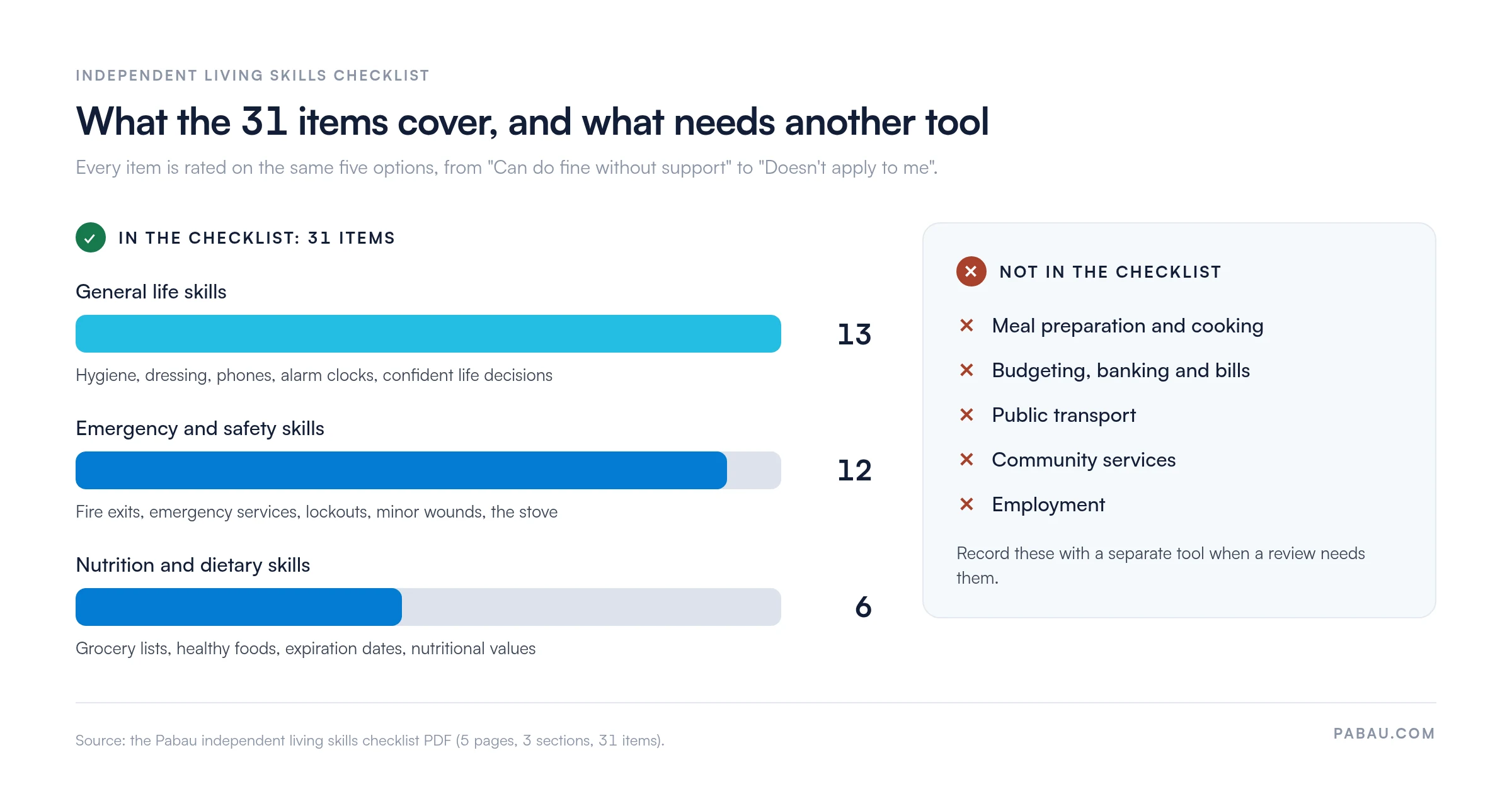
The checklist has 31 first-person items in three sections: general life skills, emergency and safety skills, and nutrition and dietary skills.
Each item is rated on five options, from “Can do fine without support” to “Doesn’t apply to me”.
It has no items on money management, transport, community access or employment, so pair it with other tools when those matter.
Pabau, the practice software we build, lets teams complete the checklist as a digital form and keep it in the patient record.
An independent living skills checklist is a rating tool that records how a person performs essential daily tasks. Medicare’s CMS survey glossary splits those tasks into personal care and activities related to independent living, such as preparing meals and managing money.
This template focuses on personal care and daily routines, home safety and emergencies, and food choices. Meal preparation, money management and transport use fall outside it.
Occupational therapists use the broader ADL and IADL framework from the American Occupational Therapy Association (AOTA) as a reference point for these domains.
A checklist like this one works as a practical working document, not a substitute for a standardized, validated instrument. Where only basic self-care matters, the Katz ADL index gives a shorter, scored alternative.
Several roles use the same checklist for different purposes. The list below shows the most common users and what they typically record.
The template groups 31 items into three sections, so reviewers can look at related tasks together. Every item carries its own five-option rating, so strong hygiene scores cannot mask a person who forgets to turn off the stove.
The nutrition section is about food knowledge and choices, not cooking, so it holds no meal preparation tasks. The form also has no items on budgeting, banking, bills, public transport, community services or employment. If your review needs those areas, record them with a separate tool. The chart sets the 31 items against the areas they leave out.
Start with a short conversation about the person’s goals before you rate a single item. Scores are more useful when they reflect what the person does in their own environment, not what the reviewer assumes they can do.
Teams often find that the notes matter as much as the rating. A short, dated comment about a specific task makes the next review far more useful than a rating alone.
For transition-age young people, the checklist often feeds into planning meetings. Under IDEA, transition planning must appear in the individualized education program (IEP) by age 16, and some states set an earlier starting age. Confirm the rule for your state before you use the checklist as evidence in a plan.
Use the safety and nutrition sections to set concrete goals, such as building a weekly grocery list or knowing when to call emergency services. Those goals are easier to track than broad aims like “become more independent”. Transport, money and work skills need a separate tool, because this checklist does not cover them.
Autistic adults vary widely in their strengths and support needs, so no single checklist score describes a person. Treat each rating as a snapshot of one situation. Record the conditions in which a skill was observed, such as a noisy shop or a familiar kitchen.
Where a person finds routines or sensory demands difficult, note the adjustments that help. Examples include written steps, a fixed shopping list or a quieter time of day. Repeated over time, those notes show which adjustments let the person complete a task on their own.
This checklist is a structured observation tool, not a validated clinical test. It does not replace standardized instruments built for formal assessment. The Canadian Occupational Performance Measure (COPM) and the Assessment of Motor and Process Skills (AMPS) are two examples.
The Kohlman Evaluation of Living Skills reaches the areas this form leaves out. A KELS assessment scores 17 items across self-care, safety and health, money management, transportation and telephone, and work and leisure.
Completing the checklist does not, on its own, meet the documentation requirements of Medicaid waiver services or any insurer. Check payer and funder rules before you rely on it for funding decisions.
Pabau’s digital forms let teams complete the checklist on a tablet or laptop and store the results against the right patient record. Scores stay in one place, so the next reviewer sees the previous ratings without searching through paper files.
Pabau’s medical records keep dated checklist results next to care notes and goals. Teams can compare reviews over time and share the record with other members of the care team, subject to their permissions. Rehab teams that also run Pabau as their physical therapy EMR see those reviews beside their treatment notes.

Pabau’s digital forms let patients and staff complete the checklist on a tablet. The patient record keeps each dated review next to care notes and goals.

This checklist earns its place as a quick, self-rated picture of personal care, home safety and food knowledge. It is strongest when the person rates themselves and a practitioner checks those ratings against what they see. Repeat it at a set interval, and the changes between reviews tell you more than any single score.
Its limits are just as clear. Money, transport, community access and work sit outside it, so a full independence review needs a second tool for those areas. Book a demo to see how Pabau keeps checklist results, care notes and goals together in one client record.

Want a broader daily living screen? ADL assessment tool covers a structured review of activities of daily living.
Choosing software for an OT caseload? Occupational therapy EMR guide sets out what an OT practice needs from its records system.
An independent living skills checklist is a rating tool that records how well a person performs daily living tasks. This template covers general life skills, emergency and safety skills, and nutrition and dietary skills.
Occupational therapists, special educators, care coordinators and disability support workers are typical users. Non-clinicians should use it as a guide, not a clinical diagnosis.
Yes, the safety and nutrition sections can feed transition goals. It has no employment, community or money items, so add a separate tool for those. Check your state’s IDEA transition rules for when planning must start.
No. It is a structured observation tool. Standardized instruments such as the COPM or AMPS remain the right choice for formal clinical assessment.