Stroke impact scale: Free PDF, scoring and MCID by domain
The stroke impact scale (SIS) is a 59-item questionnaire in which stroke survivo...

2
Last Updated: Oct 13, 2026

The global deterioration scale, also called the Reisberg scale, stages dementia across seven levels of cognitive and functional decline.
Stages 1 to 3 sit before dementia, stage 5 is where living alone stops being safe, and stage 7 means total care.
Medicare hospice eligibility is judged on the FAST scale, not the GDS. FAST stage 7C or beyond plus qualifying comorbidities is the named threshold.
Score the scale from a clinical interview and an informant report, then write down the specific deficits you observed.
Practice management software like Pabau keeps every dated stage in the client record, so comparing this visit with the last one takes seconds.
All seven stages on one page, with the cognitive and functional criteria for each one. There is space for the informant’s report, the deficits you observed, and a dated stage score you can compare at the next visit.
Download templateThe global deterioration scale is a seven-stage rating tool for the severity of primary degenerative dementia. A clinician scores it from 1, meaning no impairment, to 7, meaning very severe decline. The score comes from an interview with the patient and with someone who knows them well.
Primary care physicians, occupational therapists, geriatric nurses, and psychiatrists all use it. One agreed stage number sets realistic therapy goals and shows when supervision has to increase. It also gives care planning a shared vocabulary.
This guide walks through each stage, how to score and administer the scale, and where the GDS stops being the right tool. It also covers what to write in the note. A stage number without the observed deficits behind it rarely survives a hospice or payer review.
The global deterioration scale rates the severity of primary degenerative dementia, most often Alzheimer’s disease. It measures observable change in two things: cognition, and activities of daily living, known as ADLs.
Dr. Barry Reisberg and colleagues at NYU School of Medicine published it in 1982. You will also see it called the Reisberg scale. The original 1982 paper still defines the stage criteria in use today.
Some dementia measures look only at memory. The GDS follows the whole arc of decline: memory, orientation, language, and eventually motor control. That breadth is why primary care practices, geriatric outpatient clinics, occupational therapists, and hospice teams all reach for it.
Psychiatry practices record it too, usually inside the psychiatry EMR software that already holds mood and medication history.
Each stage names a characteristic set of deficits and a level of functional loss. Read them as a trajectory. They tell you where the patient sits today, and what supervision or intervention that position calls for.
Staging this way lets you say precisely which abilities remain. Labels such as “early” or “advanced” leave the next clinician guessing. Families often absorb a printed dementia stages chart faster than a stage number on its own.
The scale is clinician-administered and needs clinical training. It isn’t a questionnaire for patients or family members to complete on their own.
Practices usually fold the scale into a broader geriatric or occupational therapy assessment rather than booking it as a visit of its own. Where a payer covers a comprehensive geriatric assessment carried out by an assessment team, that work is billed under S0250.
The stage number does more than support a diagnosis. It shapes therapy goals, caregiver education, and the timing of conversations nobody wants to have too late.
Therapy planning: A stage 4 patient often does well with memory aids and a simplified daily routine. A stage 6 patient needs full supervision and changes to the home environment. The stage tells the therapist which of those two conversations to have.
Family discussions: “Your father is at stage 5” lands more clearly than “moderate dementia”. It explains why supervised medication and help with bathing are now necessary, without asking the family to interpret a clinical adjective.
Tracking progression: Reassess annually, or sooner if the family reports a change. Two dated stages show whether decline is stable or moving. Automated workflows can flag a changed stage and prompt a medication review, a care plan update, or a change of care setting.
Stage 7 is where end-of-life planning conversations usually start. Medicare and the National Hospice and Palliative Care Organization name a threshold that sits on a different tool. That tool is the Functional Assessment Staging Test, or FAST.
Hospice eligibility in dementia rests on FAST stage 7C or beyond, together with qualifying comorbidities. Aspiration pneumonia, sepsis, pyelonephritis, and pressure ulcers are the usual examples. GDS stage 7 correlates closely with that point, but it is not the named clinical or legal test.
So document both. Record the GDS stage, the FAST substage, and the specific losses you observed on the day. That combination is what a hospice medical director and a payer reviewer look for in the chart.
Two areas deserve notes of their own once stage 7 arrives. Weight loss and swallowing difficulty belong in a nutrition assessment form. Pain has to be read from behavior once speech has gone, which is the job the Abbey pain scale does.
Some stage 6 patients decline fast. Serial documentation is what lets you see that coming, rather than reacting to a crisis admission.
Three staging tools turn up regularly in practice. Knowing what separates them saves you from staging the same patient twice.
The GDS is the most common of the three in general practice and occupational therapy. One stage is easy to communicate and easy to track. FAST came from Reisberg too, and the two run in parallel in Alzheimer’s disease. Its substages are what hospice paperwork turns on.
The clinical dementia rating goes deeper, scoring domains separately, but it takes more training and mostly lives in research and memory clinics. Shorter cognitive tests such as the mini-mental state examination measure impairment without staging it, so they complement the GDS rather than replace it.
Occupational therapists use the stage to match intervention to remaining capacity. A stage 3 patient benefits from cognitive aids and environmental cues. A stage 5 patient needs adaptive equipment and supervision. A stage 7 patient needs total care, positioning for comfort, and support for the people providing it. Comparing a result against earlier sessions is quicker when software for psychology practices holds the history.
Pair the stage with a scored functional measure. An ADL assessment tool shows which specific tasks have slipped, while occupational therapy software keeps both results attached to the treatment note.
That pairing also matters for reimbursement. Payers often want evidence of functional decline before they approve further therapy. Send the stage and the ADL findings with the prior authorization form.
A stage number on its own is hard to defend six months later. Your progress note needs the stage, the date, and two or three specific observations underneath it.
“Stage 6. Unable to recall spouse’s name. Unaware of the current month. Needs prompting for toileting.” That takes seconds to write and tells the next clinician exactly what changed. The habit behind safer clinical notes applies here: record what you saw, not the conclusion you drew from it.
Then make the trend visible. Clinical dashboards that plot the stage over time make a steep decline obvious at a glance. A stable score reads as reassurance that the current plan is holding.
In most practices the stage ends up in a free-text note, or on a paper form in a folder. Comparing today’s assessment with last year’s then means reading back through months of notes, and the comparison quietly stops happening.
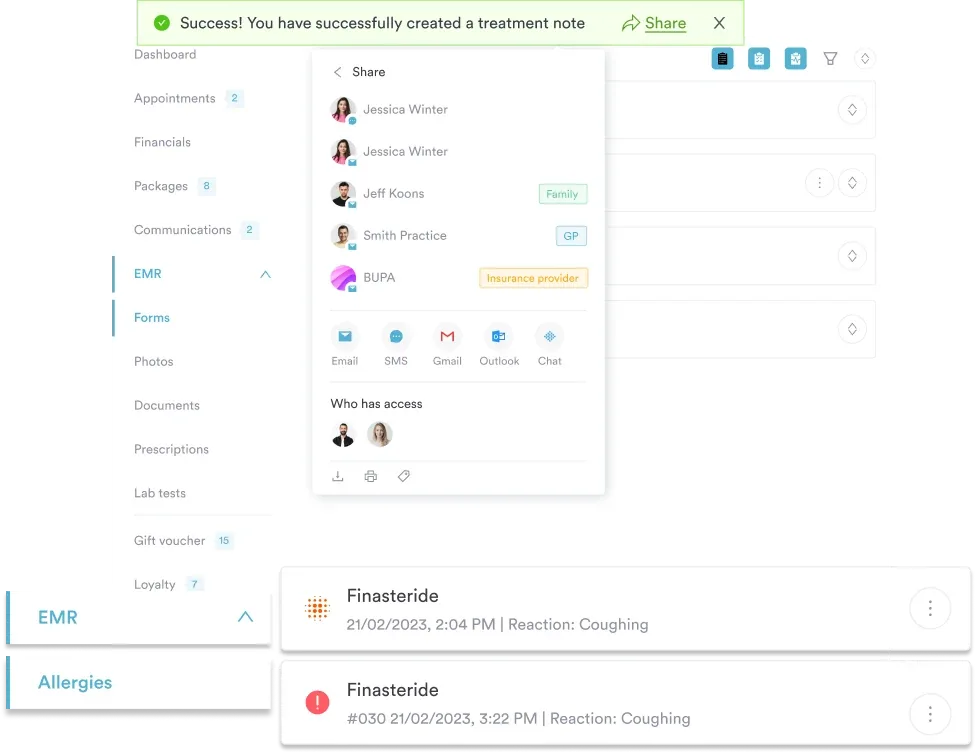
Pabau, an all-in-one practice management system, stores the scale as a structured field on a digital form inside the client record. Each assessment is dated and sits with the treatment notes, photos, and medication history for the same patient. Nothing has to be copied between systems.
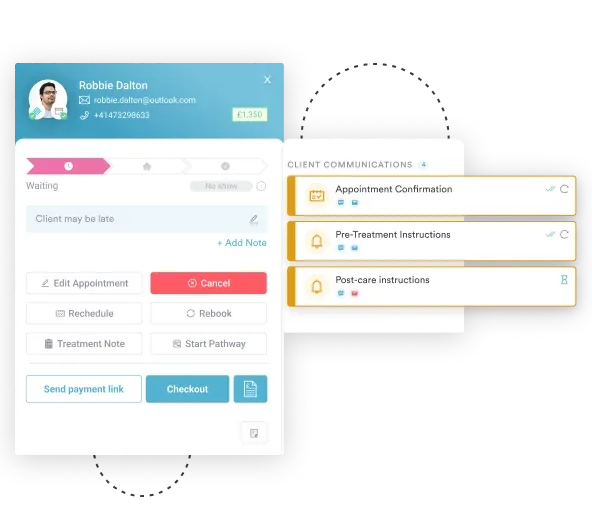
From there the follow-up runs itself. A workflow can schedule the next reassessment, remind the family caregiver, and flag the record when the stage changes. When a hospice referral or a payer review comes up, the dated history is already in one place, ready to share with the referring physician.
The outcome is a shorter admin trail and a longitudinal record you can trust. Your team spends its time on the assessment itself, not on reconstructing what the last one said.

Pabau stores each dated GDS stage on a digital form inside the client record, then automates the reassessment reminder. Your staging history stays comparable over time and ready for a hospice referral or a payer review.

The scale earns its keep on the second assessment, not the first. One stage describes today. Two dated stages describe a direction of travel, and that is what changes a care plan, a therapy goal, or a conversation with the family.
Keep the FAST distinction straight and you’ll save yourself a rejected referral. Stage 7 opens the hospice conversation. FAST 7C plus qualifying comorbidities is what the paperwork turns on, so record both.
The form above is ready to print and use at the next assessment. Store the completed stages somewhere they can be compared, and the scale stops being a snapshot. Book a demo to see how Pabau keeps dated dementia staging, therapy notes, and reassessment reminders in one client record.

Looking for software built for behavioral health? mental health software guide compares platforms for recurring sessions, standardized assessments, insurance billing, and privacy rules.
Need another cognitive domain covered? visual spatial test covers choosing the right instrument, administering it cleanly, and interpreting a low score.
Need a quick mindset reset between sessions? 10 10 10 worksheet has clients list ten items they desire, are grateful for, and enjoy doing.
Need a broader personality assessment tool? 16pf questionnaire covers 16 primary personality factors and five global factors for therapy and coaching settings.
Looking for patient-facing activity material? Dementia worksheets collects structured exercises you can use in sessions and send home with the family.
The global deterioration scale is a seven-stage clinical rating tool developed by Dr. Barry Reisberg. It tracks cognitive and functional decline in dementia, from normal aging at stage 1 to total care at stage 7.
A clinician interviews the patient and an informant who knows them well. You assess memory, orientation, ADL ability, and behavioral change, then assign the single stage from 1 to 7 that fits best.
A trained clinician does. That includes primary care physicians, geriatricians, occupational therapists, neuropsychologists, and psychiatrists. It calls for clinical judgment, so it is not a self-administered screening tool.
Stage 7 means very severe decline. Vocabulary is limited to approximately six words or fewer, continence and ambulation are lost, and the patient needs total care. Hospice conversations usually begin here, though Medicare eligibility is judged on the FAST scale.
Reisberg developed both, and they progress in parallel in Alzheimer’s disease. The GDS covers all dementia types, while FAST is Alzheimer’s-specific and emphasizes function. Medicare hospice criteria name FAST stage 7C or beyond plus comorbidities, not a GDS stage.
Yes, in the sense that trained clinicians usually agree on the same stage. Evidence reviews still call for further psychometric testing, so record the specific deficits behind the stage. Serial assessments then show whether decline is stable, slow, or rapid.