GLP-1 diet plan
A GLP-1 diet plan is a structured eating framework for patients taking semagluti...

2
Last Updated: Oct 13, 2026

The 16pf questionnaire measures 16 primary personality factors and five global factors, using the factor-analytic method Raymond Cattell developed from the 1940s onward.
Clinicians administer the questionnaire, convert responses into sten scores on a 1-10 scale, and read the full profile of factor clusters rather than any single trait in isolation.
A free PDF template or open-source version suits familiarization and in-house documentation, but reportable clinical results require the licensed 16pf Fifth Edition from Pearson or Talogy.
Practice management software like Pabau lets you send the questionnaire before the appointment, record responses, and store the scored profile in the patient record.
16pf questionnaire template
A print-ready personality assessment form covering all 16 primary personality factors and 5 global factors. Use it to structure a 16pf assessment, familiarize clients with the format, and record responses inside therapy, counseling, coaching, and occupational settings.
Download templateThe 16pf questionnaire is a self-report personality assessment that measures 16 primary personality factors and five global factors. Psychologist Raymond B. Cattell built it from decades of factor-analytic research. Psychologists whose practices add aesthetic services will need charting and checkout tools, which vary across platforms in our list of software for med spas.
This guide shows you how to administer, score, and interpret the 16pf questionnaire in practice, including a clinician’s cheat sheet for reading factor clusters and an honest look at which versions you can actually use. Download the free template above to get started.
The 16pf questionnaire is a self-report personality test that scores an individual across 16 primary personality factors derived from empirical factor analysis.
Rather than relying on clinical observation alone, the 16pf personality test asks clients to respond to a set of multiple-choice items, mapping their answers onto scales for distinct 16pf dimensions: warmth, reasoning, emotional stability, dominance, liveliness, rule-consciousness, social boldness, sensitivity, vigilance, abstractedness, privateness, apprehension, openness to change, self-reliance, perfectionism, and tension.
Those 16 primary factors combine into five global factors: extraversion, anxiety, tough-mindedness, independence, and self-control. These broad dimensions align conceptually with the Big Five personality test used across psychology research, which the 16 Personality Factor Questionnaire helped inspire.
The instrument reports sten scores (standard ten scores, scaled 1-10), so clinicians can read a personality profile quickly and share results in a consistent format across settings.
Use the licensed 16pf Fifth Edition when you need reportable, norm-referenced results, and a free template or open-source version when you only need to structure an assessment or familiarize a client. The definition-only pages that dominate this search rarely spell out the difference, so the table below sets out what each option gives you.
Raymond B. Cattell created the 16pf questionnaire from the 1940s onward, using factor analysis of hundreds of personality descriptors. Cattell’s theory of personality distinguished surface traits from deeper source traits, and his analysis identified 16 source traits that explained how people behave across situations.
Maurice Tatsuoka and Herbert Eber contributed to earlier editions, notably co-authoring the fourth-edition handbook in 1970. Cattell then developed the Fifth Edition, published in 1993, together with A. Karen Cattell and Heather E. P. Cattell, and it became the current validated standard.
What sets Cattell’s trait theory apart from surface-trait approaches is its focus on the underlying source traits that generate observable behavior patterns. That depth is what makes the 16pf useful in clinical settings, where understanding root personality patterns rather than surface symptoms informs treatment planning.
Storing completed assessments in patient management software keeps every score searchable within the patient’s record.
Each of the 16 primary factors is bipolar, so clients score along a spectrum from low to high. The table lists every factor with its low-score and high-score descriptors.
Knowing what each factor measures is only half the task; a profile makes sense only when you read the factors together, against the client’s wider context. With the framework clear, the next decision is a practical one—how to capture those responses efficiently.
Many practices rebuild the 16 factors as a structured digital form, so scoring stays consistent and every result saves straight to the patient record.
Administer the 16pf questionnaire in a quiet, private space and allow 30 to 50 minutes for completion, depending on the client’s reading speed. A calm setting keeps clients focused through the full set of 16pf test questions.
Instructions. Give clients clear framing: “This questionnaire asks you to describe yourself across many dimensions. There are no right or wrong answers, so respond honestly based on how you actually are, not how you think you should be.” Genuine self-reflection is what makes the results usable.
Response format. Clients choose from three or four options per item, such as agree, uncertain, or disagree. Each item probes a personality trait, and responses aggregate into factor scores. The official 16pf manual and answer sheet standardize this process for the commercial edition.
Data recording and security. Store completed questionnaires securely. That way you can track personality changes across a course of therapy or coaching instead of filing loose paper.
Scoring converts raw item responses into sten scores, a standardized scale from 1 to 10 where 5.5 is the population mean:
The commercial Fifth Edition uses standardized scoring tables or software to convert raw scores. For practices already using AI patient intake tools, automated scoring cuts manual calculation errors and speeds up result delivery. Once scored, results plot as a personality profile: a graph showing each factor on the 1-10 sten scale.
Read the full profile before drawing conclusions, because a single high or low factor in isolation can mislead.
The value of the 16pf is in the clusters: combinations of factors that, read together, point to a working hypothesis you can test in session. Use the five global factors to summarize the profile and to communicate it simply with clients and other providers.
The cheat sheet below pairs common factor clusters with the clinical hypothesis they suggest and where to look next. Treat every row as a starting point for inquiry, not a diagnosis. The 16pf measures personality traits, not psychopathology, so clinical judgment and a full assessment always come first.
Finally, link the profile back to the client’s presenting concerns. If they report difficulty with conflict, examine dominance (E) and warmth (A) to see whether low dominance (passivity) or high vigilance (suspicion) is driving it.
The 16pf assessment supports several pathways at once. Organizations also use it for leadership development, team building, and talent management, which is why the same instrument turns up across clinical, coaching, and occupational settings.
The Fifth Edition is published and distributed by Pearson Assessments and Talogy, whose 16PF business descends from IPAT through OPP and PSI before the 2022 rebrand to Talogy. Practitioners must follow the proper licensing and administration protocols when using the commercial version.
The reliability and validity of the 16pf are well documented in the psychological literature: internal consistency shows alpha coefficients in the acceptable-to-good range across factors, and test-retest reliability holds up well over short intervals of two to three weeks. Construct validity rests on decades of factor-analytic research and correlation studies linking factor scores to behavioral outcomes and clinical diagnoses. Reading change across appointments depends on consistent recording, which psychology practice software enforces.
Weighing the strengths and weaknesses of the 16pf keeps interpretation honest.
Modern researchers also tend to favor the Big Five model that the 16pf helped inspire, though practitioners continue to use the 16pf in applied work.
Practice management software like Pabau brings 16pf administration into one place. Build the questionnaire as a digital form, send it to clients ahead of the appointment, and store the scored profile directly in the patient file. That keeps assessment data next to clinical notes, so you can reference it during sessions instead of hunting across tools.
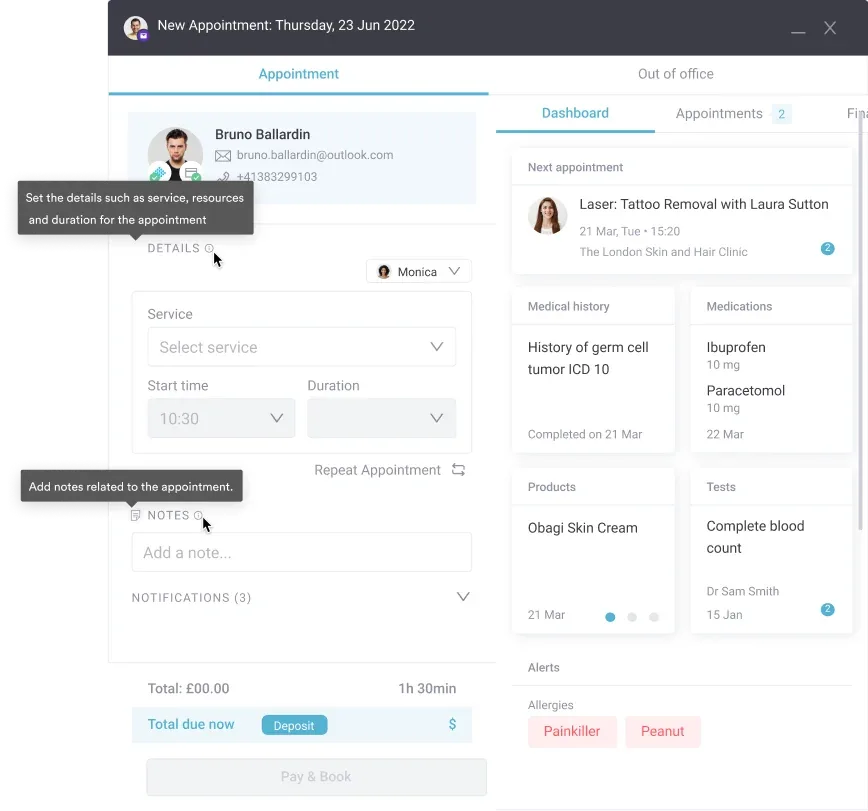
Capturing assessment data digitally reduces transcription errors and keeps the record consistent across sessions. Link personality profile results to your SOAP notes, so you can document how interventions influence the concerns a client first came in with.

Pabau’s digital forms and integrated client records make personality assessment workflows frictionless. Distribute questionnaires, store results, and track outcomes all in one platform.

The 16pf questionnaire gives clinicians a reliable, evidence-based read on personality traits across 16 factors and five global dimensions. Its strong psychometric track record and versatility across therapy, counseling, career coaching, and organizational work keep it in use, even as the Big Five model it inspired has become the research default.
Whichever version you use, keeping administration, scoring, and results in one system reduces admin and protects the data. Download the free template above to start structuring personality assessment into your workflow.

Working with clients who struggle to name what they feel? The color your feelings worksheet pairs simple coloring exercises with reflection questions clients can use in session or at home.
Personality profiles often surface body-image themes worth a dedicated tool. The body acceptance worksheet gives clients thought-challenging exercises and self-compassion practices to work through between sessions.
Need to turn trait-level insights into observable behavior data? An ABC behavior chart logs antecedent-behavior-consequence sequences in clinical and educational settings.
The 16pf questionnaire assesses personality traits across 16 primary dimensions, supporting clinical diagnosis, treatment planning, couples therapy, career assessment, and occupational talent management. It is used in mental health, coaching, organizational development, and research settings.
The 16pf Fifth Edition contains 185 items, each using a three- or four-point response scale. The full questionnaire typically takes 30 to 50 minutes to complete, depending on reading speed.
A free 16pf questionnaire PDF template or an open-source version (such as openpsychometrics.org) is fine for familiarization and in-house documentation, but neither is the validated commercial instrument. Reportable clinical results require the licensed Fifth Edition through Pearson Assessments or Talogy.
The 16pf remains in active use across clinical, coaching, and occupational settings, even though many researchers now favor the Big Five model it helped inspire. Its factor structure is considered dated in academic circles, yet its detailed 16-factor profile still gives practitioners more granularity than broader tests.
The 16pf questionnaire measures personality across 16 continuous dimensions using factor analysis and yields quantitative sten scores. The MBTI sorts personality into four binary preferences (16 discrete types). The 16pf is grounded in empirical trait research, while the MBTI is based on Jungian type theory. Both are used in applied settings but rest on different models.
Yes. Licensed mental health professionals (therapists, counselors, psychologists, coaches) can administer and interpret the 16pf questionnaire when properly trained. The Fifth Edition requires purchasing administrator materials from Pearson or Talogy.
Item responses are summed into raw scores for each of the 16 factors, then converted to sten scores (1-10 scale) using standardized norms. Scoring tables or automated software (via Pearson or an integrated assessment platform) perform these calculations to produce a personality profile.