Getting along with siblings worksheet
A getting along with siblings worksheet is a printable that helps children and t...

2
Last Updated: Oct 23, 2026

The Geriatric Depression Scale is a yes/no screening tool for adults aged 65 and over, first published by Yesavage and colleagues in 1983.
On the GDS-15, 0 to 4 is normal, 5 to 8 is mild, 9 to 11 is moderate, and 12 to 15 is severe.
The GDS-30 uses different cutoffs: 0 to 9 is normal, 10 to 19 is mild, and 20 to 30 is moderate to severe.
A raw score of 12 is severe on the GDS-15 and only mild on the GDS-30, so always record which version you used.
Practice management software like Pabau scores the questionnaire, files it in the patient record, and schedules the follow-up the band calls for.
A scoring guide for reading GDS questionnaire answers in older adults. It sets out the cutoff bands for each version and the severity each total score falls into.
Download templateGeriatric depression scale scoring turns a page of yes/no answers into a severity band and a clear next step. One point goes to every answer that points toward depression, and the total decides what happens next.
The GDS is the most widely validated depression screening tool for older adults. It runs in primary care, in mental health services, and in long-term care.
The arithmetic is simple. The cutoffs are the part worth checking twice, because the 15-item and 30-item versions read the same raw total very differently.
The Geriatric Depression Scale is a self-report screening questionnaire built for older adults. Yesavage and colleagues published it in 1983, and it has been studied steadily ever since.
Unlike general depression scales, it asks plain yes/no questions about mood over the past week. That format keeps it usable for patients with limited literacy or mild cognitive decline.
The scale is tuned to how depression presents late in life. Physical symptoms, social isolation, and cognitive change can all mask emotional distress in an older patient.
A positive screen does not diagnose anything. It tells you to run a fuller clinical assessment and, where the score is high, a psychological evaluation. Where that assessment needs a graded severity score, clinician-rated MADRS scoring covers 10 interview items, each from 0 to 6.
Four versions let you trade comprehensiveness against the time you have. Choose by setting, by how long the appointment runs, and by what you need the result for.
The GDS-15 is the version most practices use, because it balances sensitivity against the time it takes. The GDS-30 gives more detail for a baseline or a complicated case.
The GDS-4 and GDS-5 suit a routine office visit or a nursing home screening round, where research on ultra-brief screens supports a shorter first pass.
Scoring is one point per answer that indicates depression, and the total maps onto a severity band. The band decides the next clinical step, so the cutoff you apply matters as much as the count.
One point is awarded for each “yes” answer that indicates depression. A total of 5 or more calls for follow-up.
Anything in the 9 to 15 range needs a same-day conversation about risk. A validated hopelessness measure such as the Beck Hopelessness Scale can give that conversation a scored starting point, alongside the clinical interview. Where the patient describes intent or a plan, a suicide safety plan belongs in the record before they leave.
The long form uses a wider range and its own cutoffs. Score 0 to 9 as normal, 10 to 19 as mild, and 20 to 30 as moderate to severe.
The clinical actions in the GDS-15 table still apply. Read them against these bands rather than the short form’s.
A total on its own is not enough to act on. The same number lands in a different band depending on which version produced it, as the chart below shows.
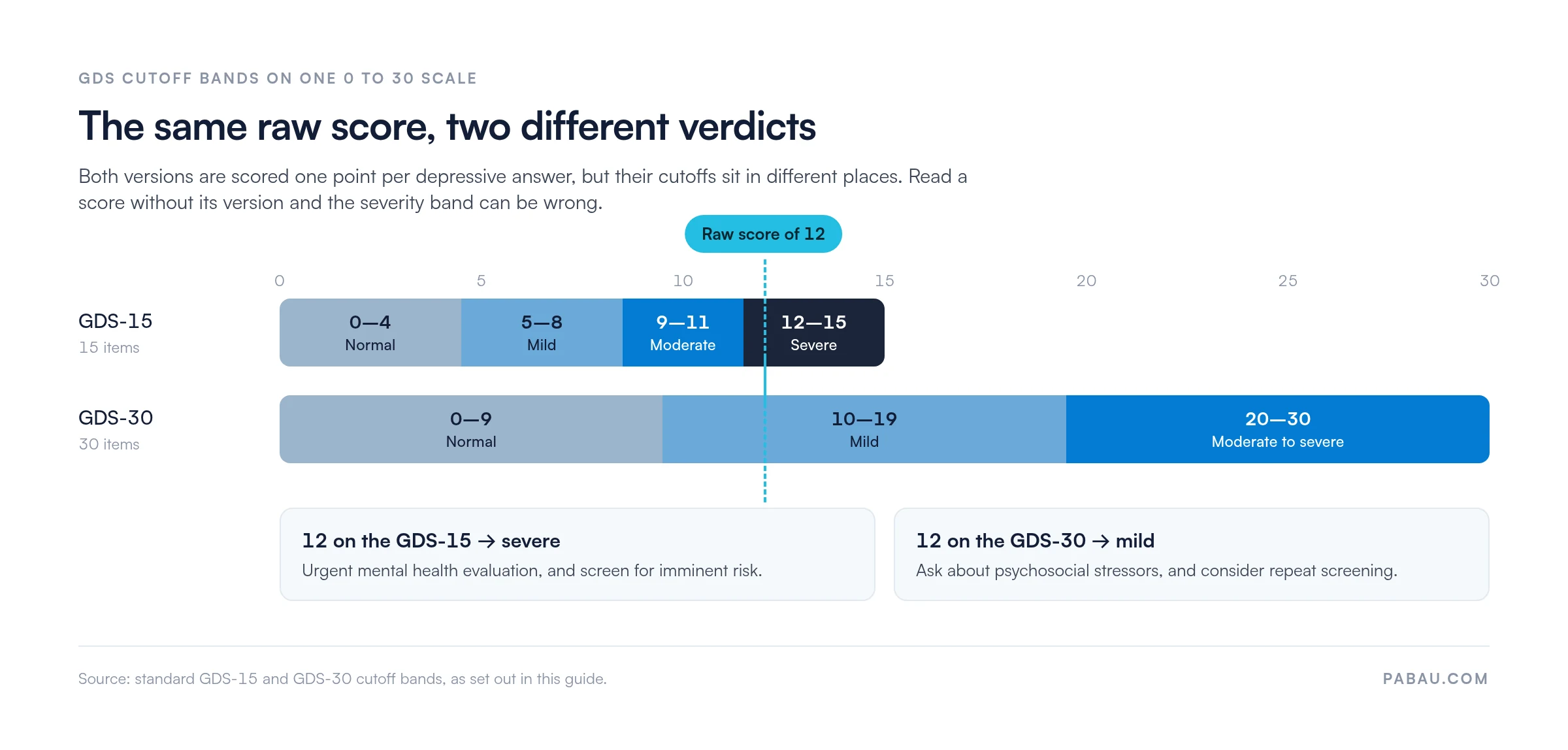
A 12 is severe on the GDS-15 and mild on the GDS-30. Write the version beside the score every time, and the next clinician reads it correctly.
Administration needs little training, but it does need consistency. Read the questions the same way each time, and this year’s score is comparable to last year’s.
The GDS-15 usually takes 5 to 10 minutes. Its yes/no format asks less of the patient than a scaled-response instrument, so it suits mild to moderate cognitive impairment.
Record the raw score, the version, and your clinical impression together. Practices screening at volume keep that in a mental health EMR rather than a paper chart, so the next clinician sees the history.
The GDS has been studied for four decades. Internal consistency, measured as Cronbach’s alpha, runs from 0.80 to 0.94 across studies, which counts as strong.
Reported sensitivity and specificity for major depression sit at 84 to 86% for the GDS-15. The GDS-30 is reported at 80 to 100%, depending on the population and the setting.
It holds up across community, primary care, acute hospital, and long-term care populations. Calculators such as MDCalc’s GDS-15 tool now handle the arithmetic, and the scale exists in more than 40 languages.
The GDS is not validated for severe cognitive impairment, or for patients who cannot engage with a self-report questionnaire. Both limits matter in a nursing home population.
Depression in dementia often shows up as irritability, apathy, or physical complaints rather than sadness. The GDS can under-detect those presentations.
For moderate to severe dementia, the Cornell Scale for Depression in Dementia (CSDD) is the validated choice, because it draws on an informant. In a general medical setting, PHQ-9 scoring works well, though it is not geriatric-specific.
Language matters too. Use a validated translation whenever the patient’s first language differs from the version you are administering.
On paper, the GDS is scored by hand, the total goes into the notes, and the recall date depends on someone remembering it. The score gets captured. The follow-up often does not.
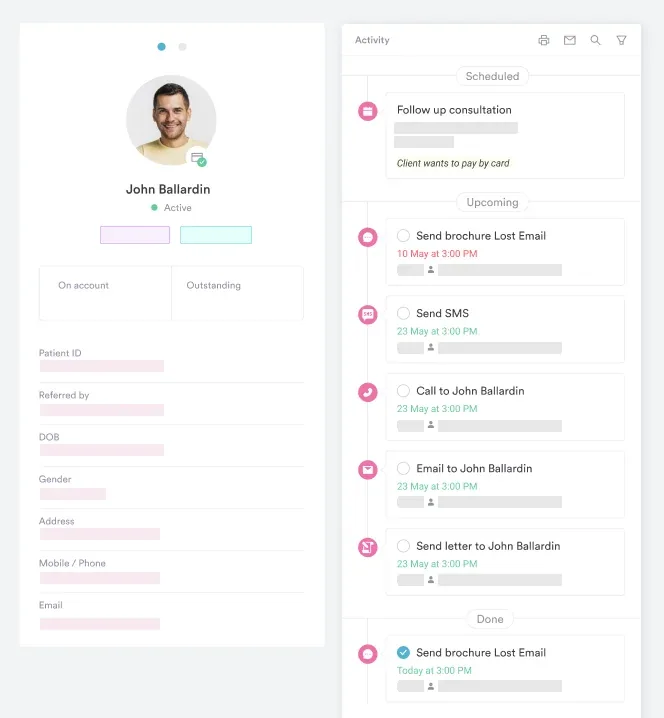
Practice management software like Pabau removes those steps. The questionnaire goes out as a digital form, the answers save into the patient record, and the total arrives without transcription.
The result then sits beside the appointment history and the clinical notes, because Pabau is therapy practice management software rather than a standalone assessment tool. Automated workflows handle the chasing from there.
A positive screen can flag for clinician review, and the repeat date can be set the moment the score is filed. Every result carries a date, a version, and a documented action.

Pabau sends the GDS as a digital form, files the score in the patient record, and sets the repeat screening date for you.

Pick one version and stay with it. Consistency across visits is what makes a change in score mean something, and switching between the GDS-15 and GDS-30 destroys that comparison.
The trade-off worth remembering is that a short screen buys speed at the cost of detail. The GDS-15 finds most cases in a 10-minute slot. The GDS-30 tells you more about the patients you already suspect.
Whichever you use, the score is only worth the action that follows it. Book a demo to see how Pabau files GDS results and schedules the recall without anyone chasing it.

Screening a younger adult? Depression self-assessment covers PHQ-9 scoring and the severity bands that go with it.
Need a second depression measure? The Beck Depression Inventory explains how that scale is scored and what each range means.
Comparing rating scales? The Major Depression Inventory walks through its scoring and how clinicians read the result.
Working with a dementia patient? The 7 stages of dementia chart shows how the condition progresses, which shapes how you screen for mood.
Score in the severe band? The suicide safety plan template gives you a structure to complete with the patient before they leave.
The GDS is a 30-item or 15-item self-report screening tool developed by Yesavage et al. in 1983 to detect depression in older adults aged 65+. It uses simple yes/no questions about mood and feelings over the past week, making it accessible across cognitive and literacy levels. It is not a diagnostic instrument but a validated screening tool that prompts further clinical evaluation.
One point is awarded for each “yes” answer indicating depression. Total score interpretation: 0-4 normal, 5-8 mild depression, 9-11 moderate depression, 12-15 severe depression. Scores of 5 or above warrant clinical follow-up.
A GDS-15 score of 5 or higher indicates at least mild depression. Scores 9-11 suggest moderate depression requiring referral; scores 12-15 indicate severe depression warranting urgent mental health evaluation and risk assessment.
GDS-30 contains 30 items and takes 15-20 minutes; GDS-15 contains 15 items and takes 5-10 minutes. Both are valid. GDS-15 suits busy primary care settings; GDS-30 provides detail for baseline or complex cases. Score thresholds differ: GDS-30 uses 0-9 normal, 10-19 mild, 20-30 moderate-severe ranges.
The GDS is not validated for severe cognitive impairment or dementia. In mild-to-moderate cognitive decline, it may still apply if the patient can engage with yes/no questions. For moderate-to-severe dementia, use the Cornell Scale for Depression in Dementia (CSDD), which relies on informant input rather than self-report.
GDS-15 administration takes 5-10 minutes; GDS-30 takes 15-20 minutes. Actual time varies with patient cognition, hearing, and communication clarity. The ultra-brief GDS-4 and GDS-5 take 1-2 minutes and suit routine office screening when time is limited.