Mood Disorders Questionnaire Scoring
Mood disorders questionnaire scoring checks three answers on the Mood Disorder Q...

2
Last Updated: Oct 19, 2026

The Major Depression Inventory is a 10-item self-report questionnaire that measures depression severity using ICD-10 and DSM-IV diagnostic criteria.
MDI scores range from 0-50; the Bech 2015 LEAD standardization bands are 0-20 (no or doubtful depression), 21-25 (mild), 26-30 (moderate), and 31-50 (severe).
MDI items directly map to clinical diagnostic criteria, making it valuable for structured assessment in primary care and psychiatric settings.
Pabau’s digital forms enable automated MDI delivery pre-appointment, response capture, and score logging directly into patient records for longitudinal outcome tracking.
Major Depression Inventory
A ready-to-use 10-item self-report depression assessment covering mood, guilt, suicide ideation, and physical symptoms. Clinically validated for ICD-10 and DSM-IV diagnostic alignment.
Download templateThe Major Depression Inventory (MDI) is a short, clinically validated tool that helps mental health professionals systematically assess depression severity in adults. Developed by Per Bech at the WHO Collaborating Centre for Mental Health, the MDI measures the 10 core symptoms of a major depressive episode according to both ICD-10 and DSM-IV diagnostic frameworks.
As a result, that dual alignment makes it useful for practitioners who need a quick, evidence-based screening instrument that bridges international diagnostic standards.
The Major Depression Inventory is a self-report questionnaire consisting of 10 items that assess depression symptoms experienced over the previous two weeks. Unlike clinician-administered tools, the MDI allows patients to complete the form independently, making it practical for busy clinical settings where time and resources are limited.
Notably, the tool’s design reflects the diagnostic logic of both the International Classification of Diseases, 10th Revision (ICD-10) and the Diagnostic and Statistical Manual of Mental Disorders, 4th Edition (DSM-IV).
Each item targets a specific symptom cluster: mood disturbance, guilt, sleep disruption, interest loss, concentration problems, energy levels, appetite changes, psychomotor symptoms, and suicide risk. In short, this targeted approach keeps the assessment comprehensive without excessive length.
Because it’s in the public domain and free to use, the Major Depression Inventory fits naturally into psychology practices, therapy practices, and psychiatry settings without licensing barriers. In fact, NHS Lothian and multiple academic centers use it routinely for screening and outcome measurement.
First, understanding the MDI’s structure is essential for proper administration and interpretation. Each of the 10 items targets a key diagnostic feature of major depressive disorder.
Each item uses a 0-5 response scale, reflecting symptom frequency and severity. Patients rate how often they experienced each symptom over the two-week assessment window, with anchors ranging from “not at all” (0) to “constantly” (5). This digital form structure maps directly to Pabau’s intake form engine, allowing practices to deploy the MDI as an automated pre-appointment questionnaire.
Scoring the Major Depression Inventory is straightforward: simply sum all 10 item responses (range 0-50). Overall, the total score directly translates to a depression severity category and clinical action.
Under the Bech 2015 LEAD standardization, a score of 21 or above is considered a probable indication of clinical depression according to both diagnostic systems. However, the MDI should never be used as a standalone diagnostic tool. It is a screening and severity-measurement instrument that must always be combined with clinical judgment and full diagnostic assessment.
Where the referral question reaches beyond symptom severity, the Thematic Apperception Test asks patients to build stories from ambiguous picture cards. The template’s interpretation step links those narrative themes to clinical interview data and symptom questionnaires before a diagnostic impression is formed.
Psychologists often assign tools like this through psychology practice software, tracking completion between sessions.
One of the MDI’s primary strengths is its explicit alignment with diagnostic criteria. The International Classification of Diseases, 10th Revision (ICD-10) defines major depression based on the presence of depressed mood or anhedonia plus additional symptoms from a defined symptom list. The MDI’s 10 items directly map to these ICD-10 criteria.
Similarly, the DSM-IV framework requires five or more symptoms from a specified list during a two-week period for a major depressive episode diagnosis. In addition, the MDI questionnaire covers all nine DSM-IV symptom clusters: mood, guilt, sleep, interest, concentration, fatigue, appetite, psychomotor changes, and suicidality.
This dual alignment supports psychiatry EMR workflows, where practitioners need clear documentation that ties assessment instruments back to formal diagnostic standards.
The Major Depression Inventory is appropriate for use in multiple clinical settings:
The MDI’s brevity (10 items, 2-5 minutes completion time) and public-domain status make it especially practical for high-volume settings where clinician time is precious and licensing costs must be minimized.
The MDI has been extensively validated in peer-reviewed studies. Specifically, internal consistency (Cronbach’s alpha) typically ranges from 0.85 to 0.92, indicating that all 10 items measure a coherent construct. Likewise, test-retest reliability is robust, with correlations above 0.80 over short intervals.
Sensitivity and specificity for detecting major depressive disorder are both approximately 86% at the cutoff score of 26. In other words, the MDI correctly identifies about 86% of people with true depression (true-positive rate) and correctly rules out a similar proportion of people without depression (true-negative rate).
Compared to a clinician diagnostic interview, the MDI shows good concurrent validity, though as noted, it is not a replacement for comprehensive clinical assessment.
Practitioners often wonder how the MDI compares to other widely-used depression measures. Here’s a brief comparison:
The MDI’s major advantage is its brevity combined with dual ICD-10/DSM-IV alignment. The PHQ-9, while equally brief and free, is more US-centric in its development. By comparison. The Hamilton Rating Scale (HAM-D) remains the gold standard in research but requires clinician training and administration time.
While the MDI is a valuable tool, practitioners should be aware of its constraints:
Manual paper-based MDI administration creates friction in modern practices. Pabau’s digital forms module lets practices deploy the MDI as an automated pre-appointment intake form, sent via email or SMS link to patients before their appointment. Consequently, responses populate the patient record automatically, eliminating manual data entry and ensuring scores are logged longitudinally for outcome tracking.
Clinicians can set conditional logic to flag high-severity scores (e.g., MDI ≥31) in the appointment dashboard, prompting immediate clinical review before the session begins.
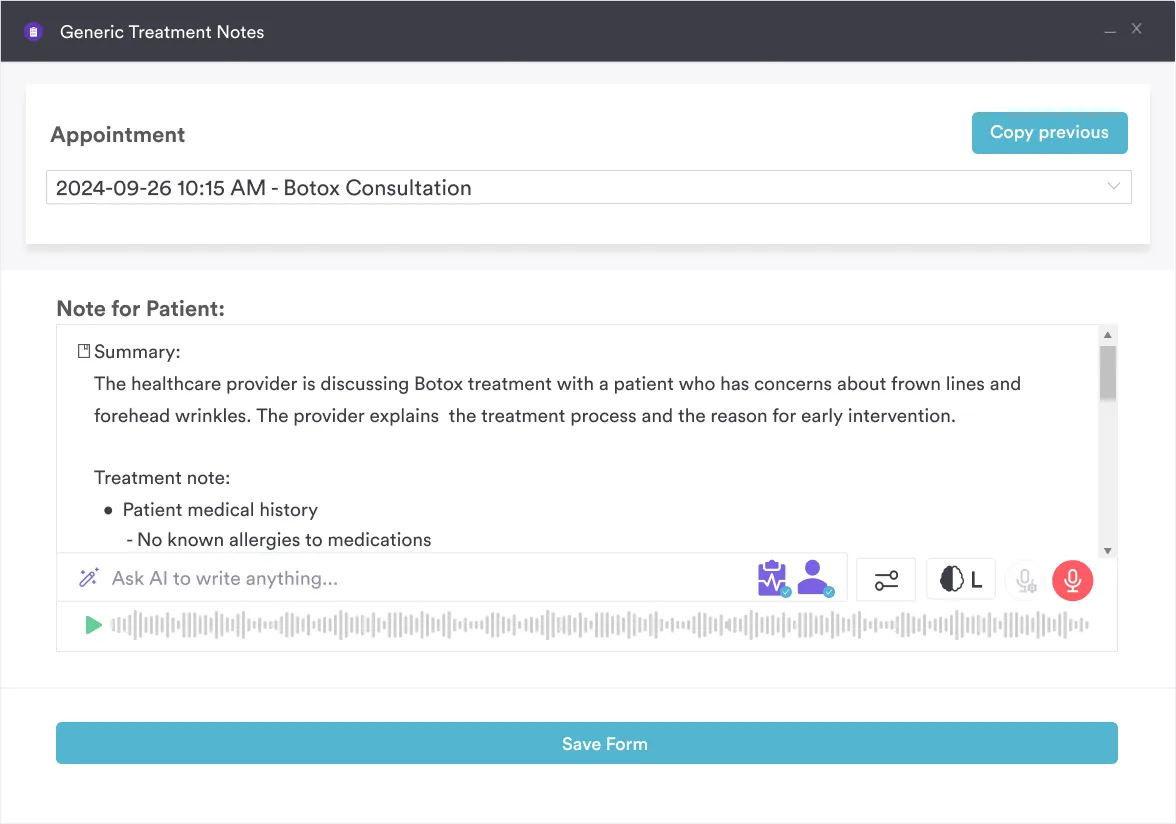
Pabau Scribe, our AI scribe, integrates MDI responses into automated clinical note generation.
The MDI covers core depression symptoms but does not assess comorbid anxiety. Practitioners managing complex psychiatric presentations often combine the MDI with the Beck Anxiety Inventory or a GAD-7 assessment template for comprehensive mood and anxiety assessment. For geriatric populations, the Geriatric Depression Scale may be more appropriate due to age-specific symptom presentation and somatic focus differences.
Additionally, baseline and longitudinal MDI scores provide valuable data for monitoring treatment response. Repeat assessments at 4-6 week intervals during treatment help clinicians evaluate whether a given therapeutic approach (medication, psychotherapy, lifestyle intervention) is producing measurable symptom improvement.
Where medication forms part of that plan, pharmacy technician worksheets drill days supply calculation and refill timing for the staff who handle prescriptions. They include the rule that most insurance plans permit a refill once 80% of the days supply has elapsed.
The Major Depression Inventory is a time-efficient, evidence-based screening tool that bridges international diagnostic standards and delivers meaningful clinical data in under five minutes. Ultimately, its public-domain status and dual ICD-10/DSM-IV alignment make it ideal for psychiatry and mental health practices seeking structured, validated assessment.
By integrating the MDI into your clinical workflow via Pabau’s digital forms, you reduce administrative friction while keeping longitudinal symptom tracking and treatment decisions well-informed.
The Major Depression Inventory is a 10-item self-report questionnaire used to screen for and measure the severity of depressive symptoms. It was developed by Per Bech at the WHO Collaborating Centre for Mental Health and aligns with both ICD-10 and DSM-IV diagnostic criteria for major depressive disorder.
Yes, the MDI is free and in the public domain for clinical use. No licensing fees or permissions are required. This makes it practical for any clinical setting, from private practices to large healthcare systems.
An MDI score of 31 or above indicates severe depression and requires urgent clinical evaluation and intensive treatment planning. Scores of 26-30 indicate moderate depression; 21-25 indicate mild depression; 0-20 suggests no or doubtful depression.
Both the MDI and PHQ-9 are brief, free, self-report depression tools with similar administration times (2-5 minutes). The key difference is diagnostic alignment: the MDI explicitly covers both ICD-10 and DSM-IV criteria, while the PHQ-9 is based primarily on DSM-IV. Both are equally valid for screening and severity measurement in most populations.
No. The MDI is a screening and severity-measurement instrument, not a diagnostic tool. A positive MDI score (≥21) indicates probable depression but must always be followed by comprehensive clinical assessment, including detailed history, functional impact, and safety evaluation before confirming a major depressive disorder diagnosis.