SIBO diet food list template
A SIBO diet food list sorts foods by their fermentable carbohydrate (FODMAP) con...

1
Last Updated: Oct 6, 2026
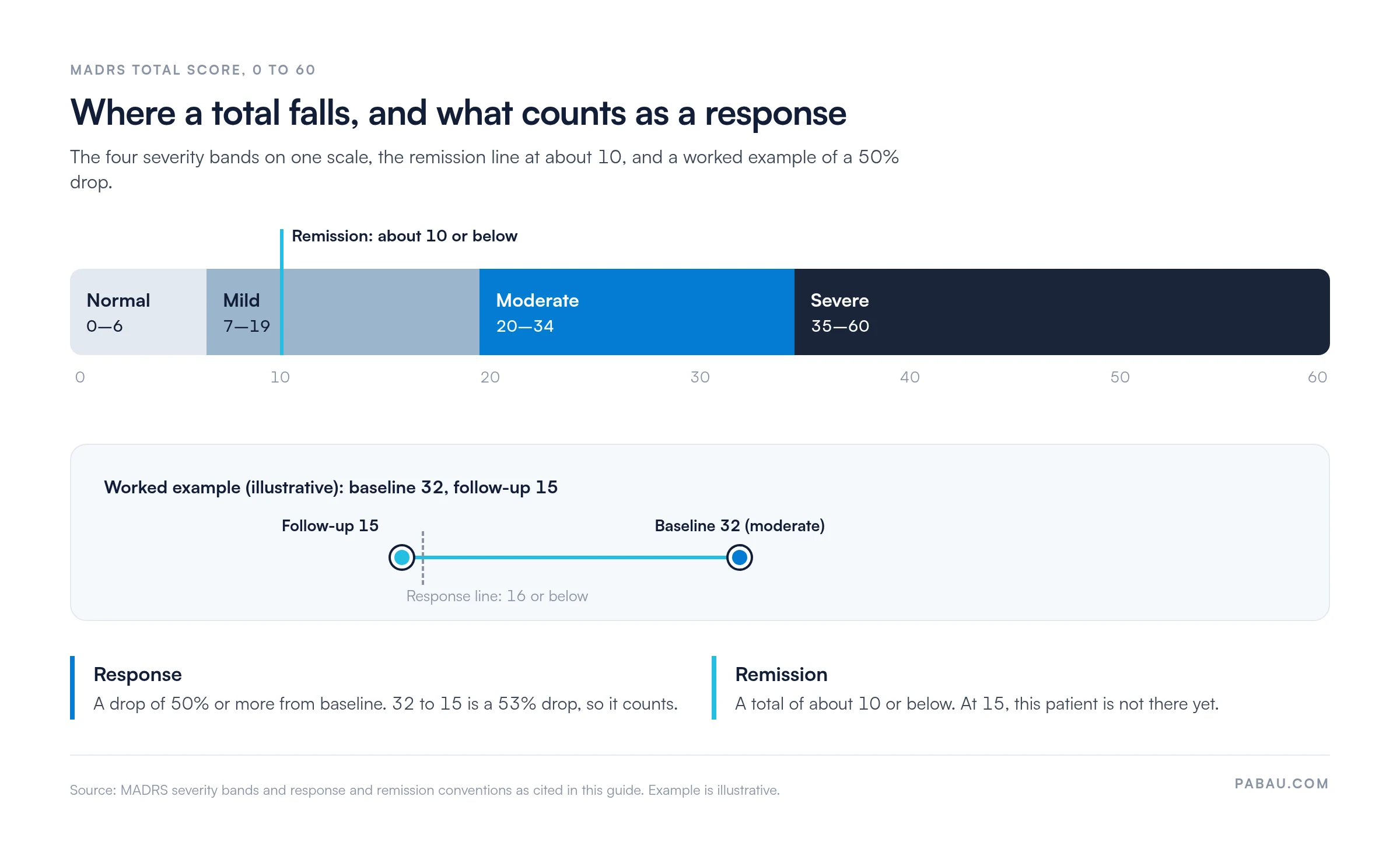
The Montgomery-Åsberg Depression Rating Scale (MADRS) is a clinician-administered, 10-item scale that measures depression severity and tracks how it changes with treatment. Each item is scored 0-6, so totals run from 0 to 60. A total of 0-6 is normal, 7-19 mild, 20-34 moderate, and 35-60 severe.
Stuart Montgomery and Marie Åsberg published the scale in 1979 and built it to pick up change during antidepressant treatment. It has since become a gold standard in depression research and routine psychiatric care. Clinical response usually means a drop of 50% or more from baseline, and remission a total of about 10 or below.
This guide gives you a free MADRS PDF, plus how to administer it, score it, and act on the result.
A ready-to-use clinician-rated form covering all 10 MADRS items, from apparent sadness to suicidal thoughts, with 0-6 scoring for each. Print it, or complete it digitally in your practice management system.
Download template
The MADRS is a clinician-rated, 10-item scale scored 0-60, where 0-6 is normal, 7-19 mild, 20-34 moderate, and 35-60 severe depression.
Clinical response means a drop of 50% or more from baseline, and remission usually means a total of about 10 or below.
The scale is sensitive to antidepressant treatment change, which makes it a strong fit for trials, inpatient psychiatry, and routine treatment monitoring.
Item 10 covers suicidal thoughts, so a score of 3 or above calls for a formal suicide risk assessment rather than reliance on the total.
Pabau, the practice management platform we build, stores completed MADRS forms in the patient record and prompts each re-assessment.
The Montgomery-Åsberg Depression Rating Scale is a 10-item, clinician-administered scale that rates the severity of depressive symptoms and tracks their change with treatment. It was first published in 1979 in the British Journal of Psychiatry. Montgomery and Åsberg designed it to detect the effects of antidepressant medication, including shifts that other scales might miss.
Unlike self-report questionnaires such as the PHQ-9, the MADRS is clinician-rated. A trained mental health professional runs a structured interview and scores each of the 10 items on a severity scale.
The items cover apparent sadness, reported sadness, inner tension, reduced sleep, reduced appetite, concentration difficulties, lassitude, inability to feel, pessimistic thoughts, and suicidal thoughts. Total scores range from 0 to 60, and higher scores mean more severe depression.
The MADRS is widely used as a primary outcome measure in depression research. It is included in the Clinical Data Interchange Standards Consortium (CDISC) Questionnaires, Ratings and Scales standards. It is also cataloged in the NIH Federal Interagency Traumatic Brain Injury Research (FITBIR) data dictionary. Both are markers of wide research use and data standardization.
Each MADRS item is scored on a 0-6 scale with defined severity anchors. The clinician combines observation with the patient’s reported symptoms to pick the score that best fits the current severity of that symptom.
Each item has anchor descriptions at 0, 2, 4, and 6, with the odd numbers used for scores that fall between two anchors. That keeps scoring consistent across clinicians and visits. A score should reflect the predominant state of that symptom over the past week.
The MADRS is given through a structured clinical interview. Unlike self-report scales, it takes training and clinical judgment to score accurately. These six steps keep administration reliable.
Avoid over-interpreting small score fluctuations of 1-2 points. Clinical response is conventionally defined as a reduction of 50% or more from baseline, and remission as a total score of about 10 or below.
The MADRS total score ranges from 0 to 60. Standard severity bands help clinicians read what a score means and plan treatment around it.
These cut-offs are clinical guidelines, not absolute thresholds. Clinical context, suicide risk, functional impairment, and patient preferences should guide treatment decisions alongside the score.
Response and remission are separate tests, and a patient can pass one without the other. Take a baseline of 32, in the moderate band, that falls to 15 at follow-up. That 53% drop meets the response rule, but 15 still sits above the remission line, as the scale below shows.
Item 10 (suicidal thoughts) must be assessed carefully and never read in isolation. Scores of 0-2 run from enjoying life to weariness of life with only fleeting suicidal thoughts. A score of 4 means the patient feels probably better off dead and has common suicidal thoughts. Suicide is considered as a solution, but without specific plans. A score of 6 means explicit plans or active preparation for suicide.
Any score of 3 or above warrants immediate escalation to a formal suicide risk assessment. Use a validated tool, such as the Columbia-Suicide Severity Rating Scale. From there, decide on safety planning, hospitalization, or emergency psychiatric consultation.
The MADRS is not a suicide risk assessment tool on its own. Use it to identify and monitor suicidal thoughts as a symptom of depression, but never let the score alone drive risk conclusions. Read item 10 separately at every visit, because a falling total can hide a rising suicide score. Always combine the MADRS with a clinical interview, a safety assessment, and the patient’s protective and risk factors.
The right depression scale depends on the clinical setting and what you need to measure. The MADRS is clinician-administered and particularly useful for research and inpatient monitoring. Here is how it compares with common alternatives.
Each of these scales suits a different setting. The MADRS stands out for its sensitivity to antidepressant-induced change and is widely used as a primary outcome measure in antidepressant trials.
If a trial protocol calls for the HAM-D, our guide to Hamilton depression scale scoring covers its cut-offs. For patients who report symptoms between visits, the Beck Depression Inventory adds a self-rated view alongside your MADRS ratings.
The MADRS fits any clinical context where you need an objective measure of depression severity and treatment response.
The MADRS is less useful for quick screening in busy primary care, where the PHQ-9 questionnaire is faster. It earns its time when you need a detailed, clinician-led assessment and systematic treatment monitoring.
The PDF you downloaded above is ready to use. Here is how to fit it into your clinical workflow.
The MADRS has been validated extensively over four decades. Its psychometric strength shows in its wide research use and its inclusion in clinical data standards.
Inter-rater reliability: Studies report high inter-rater reliability (intraclass correlation coefficients typically above 0.8), making it suitable for multi-site trials. Different clinicians rating the same patient tend to produce consistent scores.
Test-retest reliability: Scores stay stable over short intervals when the patient’s clinical state has not changed. That supports its use for tracking genuine symptom change rather than measurement error.
Sensitivity to change: The MADRS is designed to be sensitive to antidepressant-induced change and is widely used as a primary outcome measure in antidepressant trials.
CDISC QRS inclusion: The MADRS is included in the Clinical Data Interchange Standards Consortium (CDISC) Questionnaires, Ratings and Scales standard. That supports harmonized data collection across clinical trials.
NIH FITBIR data dictionary: Individual MADRS items, such as suicidal thoughts and reduced sleep, are cataloged in the FITBIR data dictionary. That reflects their use in neuropsychiatric research.
On paper, the MADRS creates admin around every score. Someone files the form, someone remembers when the next one is due, and someone copies totals into a spreadsheet to graph them. Pabau’s therapy practice management software takes those jobs off the team.
You build the MADRS once as a digital form, and each completed form lands in the patient’s record next to the appointment and progress note. Pabau’s psychiatry EMR software keeps every past score on that record, so the treatment trajectory is there at the next visit. Automated reminders prompt both you and the patient when the next re-assessment is due.
Reporting pulls scores across your patient base, so you can see who has reached response and who has stalled. Pabau Scribe, our AI scribe, drafts the clinical note from the interview itself. Psychologists get the same setup in our psychology practice software, with assessments stored through Pabau’s medical records management.

Store completed MADRS forms in the patient record, send re-assessment reminders automatically, and report on treatment outcomes in Pabau.

Reach for the MADRS when the question in front of you is whether treatment is working. Its 10 items and 0-60 range make it a widely used standard for measuring depression week by week. The 50% response rule then gives you a clear point to decide whether to stay the course or change plan.
The trade-off is time and training. A self-report tool is faster for screening, so save the MADRS for patients whose care you are actively adjusting. And read item 10 on its own every time.
Score the baseline at the first visit and book the next assessment before the patient leaves. Book a demo to see how Pabau keeps every MADRS score, reminder, and progress note in one patient record.

Need a structured way to document the full assessment? Psychiatric evaluation template gives you a complete intake and assessment framework to use alongside the MADRS.
Want a better structure for the interview behind the score? Psychiatry interview guide covers question flow and documentation for psychiatric assessments.
Looking for a self-report measure between visits? Major Depression Inventory lets patients rate their own symptoms.
Assessing depression in older adults? Geriatric Depression Scale uses a simple yes/no format built for older patients.
Need to measure anxiety and stress too? DASS-21 guide scores depression, anxiety, and stress in one 21-item questionnaire.
The MADRS is a 10-item, clinician-administered rating scale that measures the severity of depression symptoms. Developed in 1979, it is sensitive to antidepressant treatment effects and is widely used in clinical research and routine psychiatric practice.
The MADRS is clinician-administered and has 10 items, while the PHQ-9 is a 9-item patient self-report. The MADRS is more sensitive to medication-induced change and is preferred in research. The PHQ-9 is quicker and more common in primary care screening.
A total MADRS score of 35-60 indicates severe depression. Scores in this range typically warrant psychiatric evaluation, antidepressant treatment, and possibly inpatient care if safety is at risk.
No. The MADRS is designed as a clinician-administered scale. A separate patient self-rated version (MADRS-S) exists, but it is a distinct instrument with its own scoring and interpretation.
Re-assessment frequency depends on clinical context. In acute treatment or research, weekly or biweekly is standard. In maintenance therapy, monthly or every three months is typical. Set an interval that fits your treatment protocol and document it in the care plan.
Yes. The MADRS PDF at the top of this page is free to download, print, and use with your patients.