GLP-1 diet plan
A GLP-1 diet plan is a structured eating framework for patients taking semagluti...

2
Last Updated: Oct 13, 2026
A sepsis nursing care plan is the structured record of what you assessed, which nursing diagnoses apply, and which interventions you carried out. Sepsis causes a death somewhere in the world every 2.8 seconds, so recognition and treatment are counted in minutes.
The template below is a printable checkbox form built around three NANDA-I diagnoses: decreased cardiac output, hyperthermia, and ineffective protection.
This guide walks through the assessment, the hour-1 interventions, the goals worth measuring, and the documentation an audit will ask for. The clinical guidance follows current Surviving Sepsis Campaign guidelines.
A printable clinical form with patient information, an infection and medical section for exam, lab, and imaging findings, and a sepsis symptom checklist. Three diagnosis sections follow, each with symptom checkboxes, assessment and intervention guidance, and a notes area, plus a physician sign-off page.
Download template
A sepsis nursing care plan records what was assessed, which nursing diagnoses apply, and which interventions were carried out.
The downloadable form covers three NANDA-I diagnoses: decreased cardiac output, hyperthermia, and ineffective protection.
Each diagnosis section pairs a symptom checklist with assessment and intervention guidance and a free-text notes area.
The Surviving Sepsis Campaign hour-1 bundle drives the interventions you record, from blood cultures and lactate to fluids and vasopressors.
Timestamped notes on bundle elements, vital signs, and reassessment support handover and quality audits.
The care plan sits where the guideline meets the bedside. It sets out assessment, nursing diagnosis, intervention, and evaluation in one document, using NANDA-I labels the whole team recognizes.
The plan does four jobs at once. Recognition comes first, using qSOFA, SIRS, or organ failure criteria. Nursing actions then tie back to evidence-based bundles. The multidisciplinary team gets one set of terms for the patient’s problems, and the finished record stands up to compliance and quality review.
That structure connects bedside judgment to structured documentation, so no step is missed during the critical early hours. The downloadable form covers the assessment and intervention halves of it. Planning and evaluation stay in your own care plan record.
Recognition is where the plan earns its place, so assessment comes first. Nursing assessment for sepsis combines two screening tools with objective data, so organ dysfunction is caught early. The foundation is vital signs, mental status, laboratory values, and the qSOFA and SIRS criteria.
The qSOFA (quick SOFA) score has three components: altered mentation, systolic BP ≤100 mmHg, and respiratory rate ≥22. A score of ≥2 identifies a high-risk patient.
SIRS criteria capture the inflammatory response, but they are not specific to sepsis. They are temperature above 38°C or below 36°C, heart rate above 90, respiratory rate above 20, and WBC above 12 or below 4.
A digital record can run automated workflows in the background. They flag a qSOFA of 2 or more, or a rising lactate, so reassessment happens before the next scheduled round. Mental status changes, including confusion, disorientation, and lethargy, are hallmark sepsis indicators and belong in the first minutes of your assessment.
Sepsis undermines oxygen delivery in two ways, and both show up at the bedside. For oxygenation, watch for SpO2 below 94%, PaO2 below 80 mmHg, a climbing respiratory rate, accessory muscle use, and new confusion.
Perfusion shows up as lactate above 2 mmol/L, mottled or cool skin, delayed capillary refill, and urine output below 0.5 mL/kg/h.
Each pattern changes what you do next. Falling oxygenation means sitting the patient upright, adding supplemental oxygen, checking arterial blood gases, and preparing for ventilation if the work of breathing climbs.
Poor perfusion means repeating lactate, completing fluid resuscitation, tracking urine output, and getting a vasopressor ready.
Once the assessment is done, the findings need a label. NANDA-I (North American Nursing Diagnosis Association-International) supplies the standardized language for that.
The downloadable form is built around three of its diagnoses. Each one opens with a symptom checklist, then gives assessment and intervention guidance and a notes area.
Choosing between labels is a skill of its own. The nursing diagnosis handbook walks through the diagnosis types and how the statement itself is written.
Sepsis-induced myocardial depression, vasodilation, and hypovolemia leave the heart unable to meet metabolic demand. The checklist in this section records the signs of circulatory compromise.
Assessment: look for signs and symptoms of cardiac and circulatory compromise. Monitor hemodynamic parameters, including central venous pressure, pulmonary artery diastolic pressure, and pulmonary capillary wedge pressure. Review laboratory data for elevated cardiac markers.
Intervention: give fluid resuscitation and prescribed medication, which usually means antibiotics and vasopressors. Anticipate adjunctive therapy where it is indicated. Mechanical support such as an intra-aortic balloon pump is occasionally considered in refractory cases. Keep meeting the patient’s oxygen demand throughout.
Infection drives an inflammatory response that pushes core temperature above the normal range. The checklist records the features that travel with it.
Assessment: take the temperature rectally for the most accurate reading. Assess neurological state as well, because uncontrolled hyperthermia can cause brain damage.
Intervention: provide a cool environment and tepid baths. Give antipyretics such as acetaminophen as prescribed, and record the temperature response in the notes area.
Ineffective protection describes a reduced ability to guard against internal or external threat. In sepsis it comes from immunosuppression, poor nutrition, and broken skin, all of which leave the patient open to further infection.
Assessment: monitor closely for signs that sepsis is progressing, leukocytosis included. Manage risk factors carefully in patients immunosuppressed by cancer, HIV, or the treatment for either. Give the same attention to patients who are immobile or have open wounds.
Intervention: encourage rest. Avoid invasive procedures such as catheterization, injections, and rectal or vaginal procedures wherever possible. Move the patient toward high-protein, nutrient-dense food. Teach the patient and the family about infection control and management.
Two more diagnoses turn up often and have no section of their own. Sepsis also produces impaired gas exchange (NANDA-I 00030) and ineffective peripheral tissue perfusion (NANDA-I 00204) in many patients.
Record those findings, and the actions you took, in the notes area under the closest diagnosis or in your progress notes.
Once the diagnoses are named, the interventions run against a clock. Evidence-based nursing intervention in sepsis centers on the Surviving Sepsis Campaign hour-1 bundle. These time-sensitive actions are the foundation of the sepsis response and belong within 60 minutes of recognition.
Recording when each element was completed matters almost as much as doing it, which is why some teams track the bundle in compliance management software.
Document each bundle element with a timestamp, and record the reason for any delay. A record that shows cultures drawn at 22:08 and antibiotics started at 22:15 proves the order of events. That evidence supports quality improvement audits and gives the next shift a clear handover.
An intervention without a target is hard to evaluate on the next round. SMART goals give each nursing diagnosis a measurable endpoint, which tells the team whether the patient is improving.
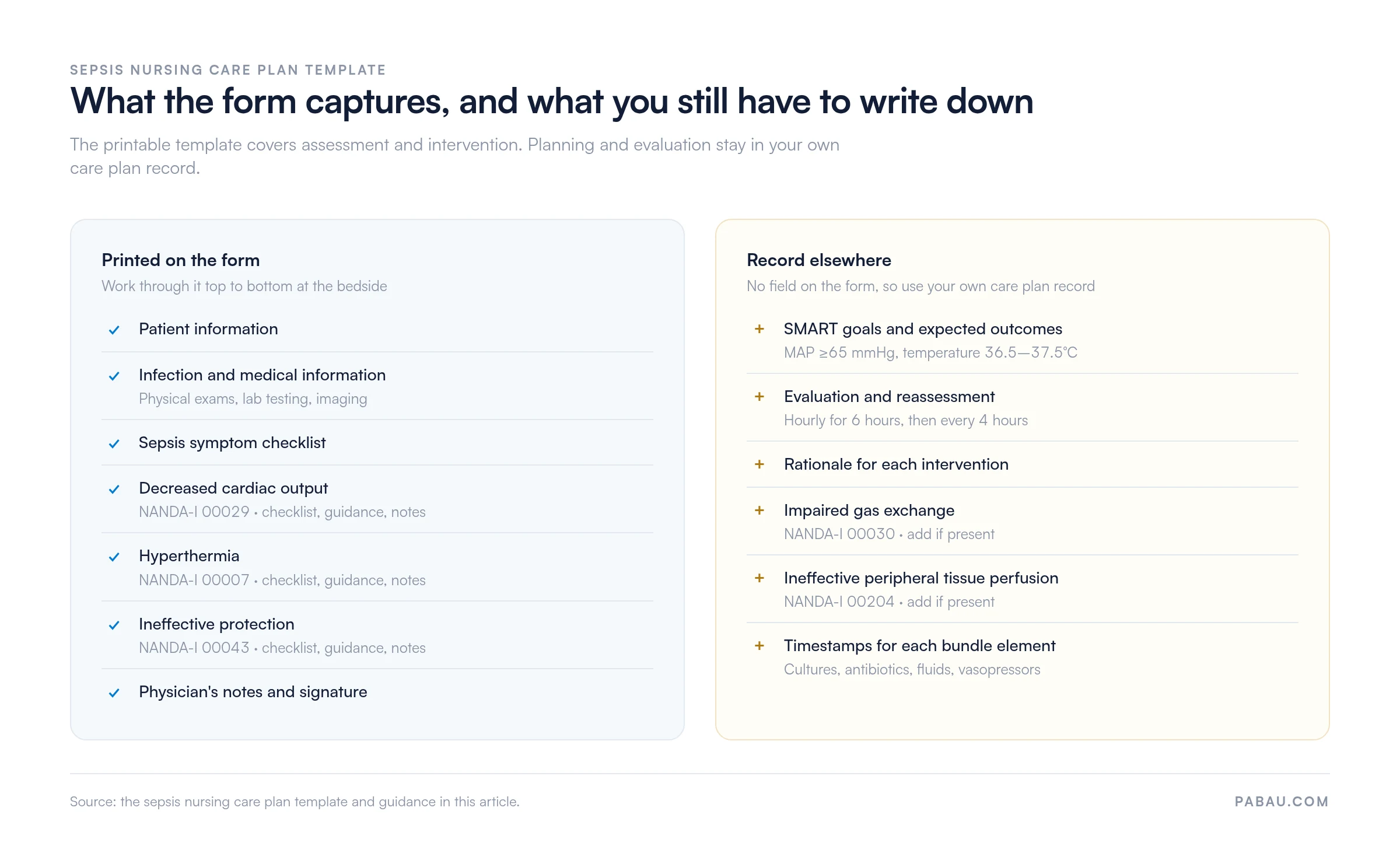
The downloadable form has no goals field. Keep these targets in your own care plan record, and use the notes area for the readings behind them.
Reassess these outcomes hourly for the first 6 hours, then every 4 hours as the patient stabilizes. If a goal is not met, escalate the intervention and update the plan with the medical team. Escalation usually means more vasopressor, another fluid bolus, or transfer to ICU.
Septic shock is hypotension that persists after fluid resuscitation. It is defined by a lactate above 2 mmol/L, plus a systolic BP below 90 mmHg or a MAP below 65 mmHg. Mortality is around 40% without immediate treatment, so the care plan tightens. It adds vasopressor management, shorter reassessment intervals, and preparation for ICU transfer.
Additional nursing diagnoses: decreased cardiac output becomes the priority, and risk for multi-organ dysfunction and risk for acute kidney injury are usually added. The second of those drives hourly urine output monitoring.
The vasopressor role: start the norepinephrine infusion per protocol and titrate to a MAP of 65 mmHg or more. Watch for extravasation, which is why a central line is preferred, and assess for peripheral vasoconstriction and tissue ischemia.
Escalation criteria: if MAP stays below 65 mmHg on norepinephrine, the prescriber adds vasopressin, then epinephrine if the target is still missed. Consider ICU admission at that point if the patient is not already there.
With the clinical content covered, here is the form itself. It is a printable clinical record you work through from top to bottom as you assess the patient.
Most of it is checkboxes and short free-text fields, so it can be completed at the bedside and kept with the chart.
The form has no rationale column, no expected outcomes field, and no evaluation section. Keep SMART goals and the evaluation record in your own care plan documentation, and use the notes areas for timestamps.
The split below shows what the paper covers and what you still have to write down.
Holding the same form in patient intake software lets the whole team update one document as the shift goes on.
Filling the form in is one job. Making the record defensible is another. Sepsis documentation carries clinical and legal weight. The record has to show that the hour-1 bundle was attempted, that deterioration was recognized, and that escalation happened on time.
Three questions should be answerable from the notes alone. When was sepsis recognized? Which bundle elements were completed, and at what time? What did reassessment find?
Run through this list before the record leaves your hands:
Documentation format: pair a structured flowsheet or protocol checklist with narrative progress notes that explain your reasoning. A note reading “qSOFA 2, lactate 3.1, hour-1 bundle started 14:00, cultures drawn 13:55 before antibiotics” satisfies an audit. The narrative that follows it tells the next clinician what you expect to happen and when to escalate.
Three mistakes turn up again and again. Bundle elements get recorded without a time. A delay is logged without the reason for it. Reassessment findings are written up at the end of the shift, from memory.
You can drill the first two out of a team. The third is a system problem, and it disappears once medical records management stamps every entry as it is made.
A printed care plan does its job at the bedside, then stops. Once the sheet is filed, the next shift has to find it, read the handwriting, and work out which entries are current. Observations logged on a separate flowsheet have to be cross-checked by hand.
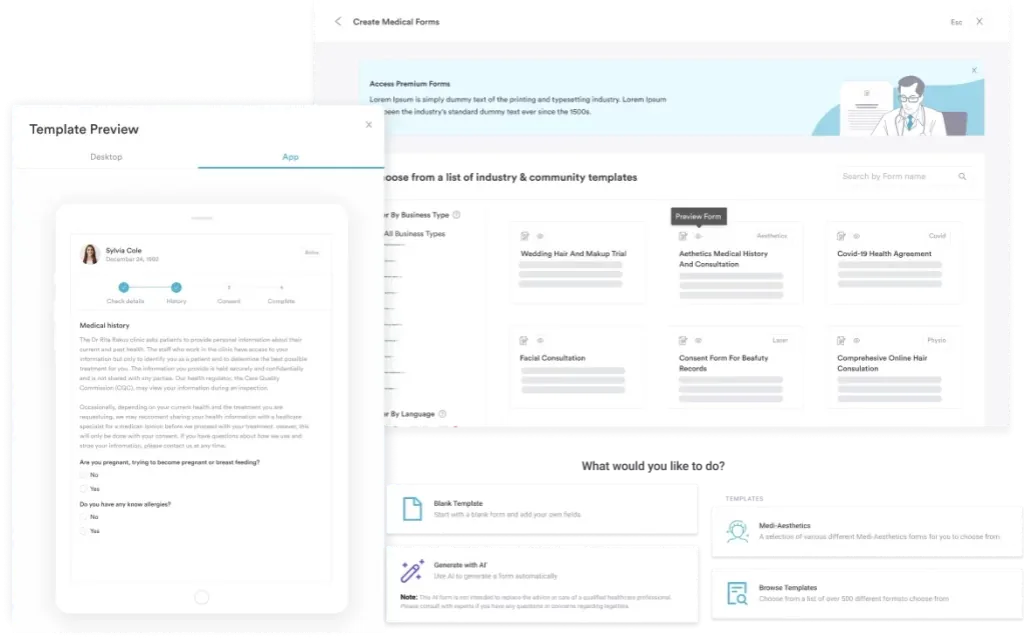
Pabau holds those same sections as a digital form on the patient’s record. Staff complete the checklists on a tablet, and every entry is stamped with the time and the person who made it. Custom fields carry the assessment and intervention notes, so each record reads the same way.
Automated workflows chase the next reassessment before it is overdue, and medical records management keeps the completed form with the rest of the patient’s chart. Whoever is on shift opens one current version of the care plan, so nobody documents from memory or from a photocopy.

Pabau’s digital forms and medical records keep structured care plans on the patient record, timestamped and searchable. Staff complete them on any device, so the next shift always opens the current version.

Sepsis care is judged on what happened in the first hour, and on whether the record can show it. A form that matches how a team already assesses a patient gets completed. One that asks for columns nobody has time to fill gets abandoned halfway through the shift.
So print the template, work through the three diagnosis sections at the bedside, and use the notes areas for timestamps and reassessment findings. Keep SMART goals and evaluation in your own care plan record, because this form does not ask for them. Then hand the physician’s page over for sign-off.
Book a demo to see how Pabau keeps structured clinical forms current, timestamped, and searchable on the patient record.

Want the wider documentation rules? Nursing documentation covers the principles, best practices, and legal requirements behind a defensible chart.
Not sure which NANDA-I label fits? Nursing diagnosis handbook explains the four diagnosis types and how to write the diagnosis statement.
Handing a deteriorating patient over? SBAR nursing handoff template gives you a script for escalating a sepsis concern in under a minute.
Building your assessment routine? Nursing assessments walks through head-to-toe and focused assessment, including what to record at each step.
The nurse assessing the patient fills in the checklists, the guidance sections, and the notes. Every nurse on shift adds to it as findings change. The final page belongs to the treating physician, who writes recommendations, signs, and dates the form.
The thresholds printed on the form are adult values. Pediatric vital sign ranges shift with age, so pair the form with your own pediatric sepsis screening tool and adjust the checklists before use.
No. A protocol tells the team what to do for any patient with sepsis. The care plan records what was assessed, decided, and done for this patient. Most units run both, and the plan is the part an auditor reads.
Bundle elements recorded without a time, delays logged without a reason, and reassessment written up from memory at the end of the shift. Each one weakens the same record. Write the time next to the entry as you make it.
Yes. Adapt the checklists and the assessment and intervention guidance to your own protocols, formulary, equipment, and escalation pathway. The three diagnosis sections and the notes areas stay useful whatever local thresholds you work to.