Vasodilators medication list
A vasodilators medication list is a clinical reference that groups vasodilator d...

1
Last Updated: Oct 7, 2026
An evaluation form for employee performance is a structured document that practice managers use to rate staff against set criteria.
It records the evidence behind each rating and the goals you and the employee agree on. In a healthcare practice, the form covers clinical competency, patient care, compliance, teamwork, and attendance.
The free template below fits seven sections onto two printable pages, from employee details and a five-point rating scale to goals and signatures. Use it for annual reviews, 30/60/90-day probationary reviews, or documenting a performance concern.
A two-page PDF with employee and review-period details, a five-point rating scale, and five healthcare performance criteria. It also includes manager feedback, an optional self-assessment, a goal-setting plan, and signature lines.
Download template
An employee evaluation form rates staff against set criteria and records the evidence behind each rating, so the review holds up if it’s challenged.
The core sections are employee details, a rating scale, performance criteria, manager feedback, an optional self-assessment, goals, and signatures.
Healthcare practices should rate clinical competency, consent and charting accuracy, and patient safety alongside communication and attendance.
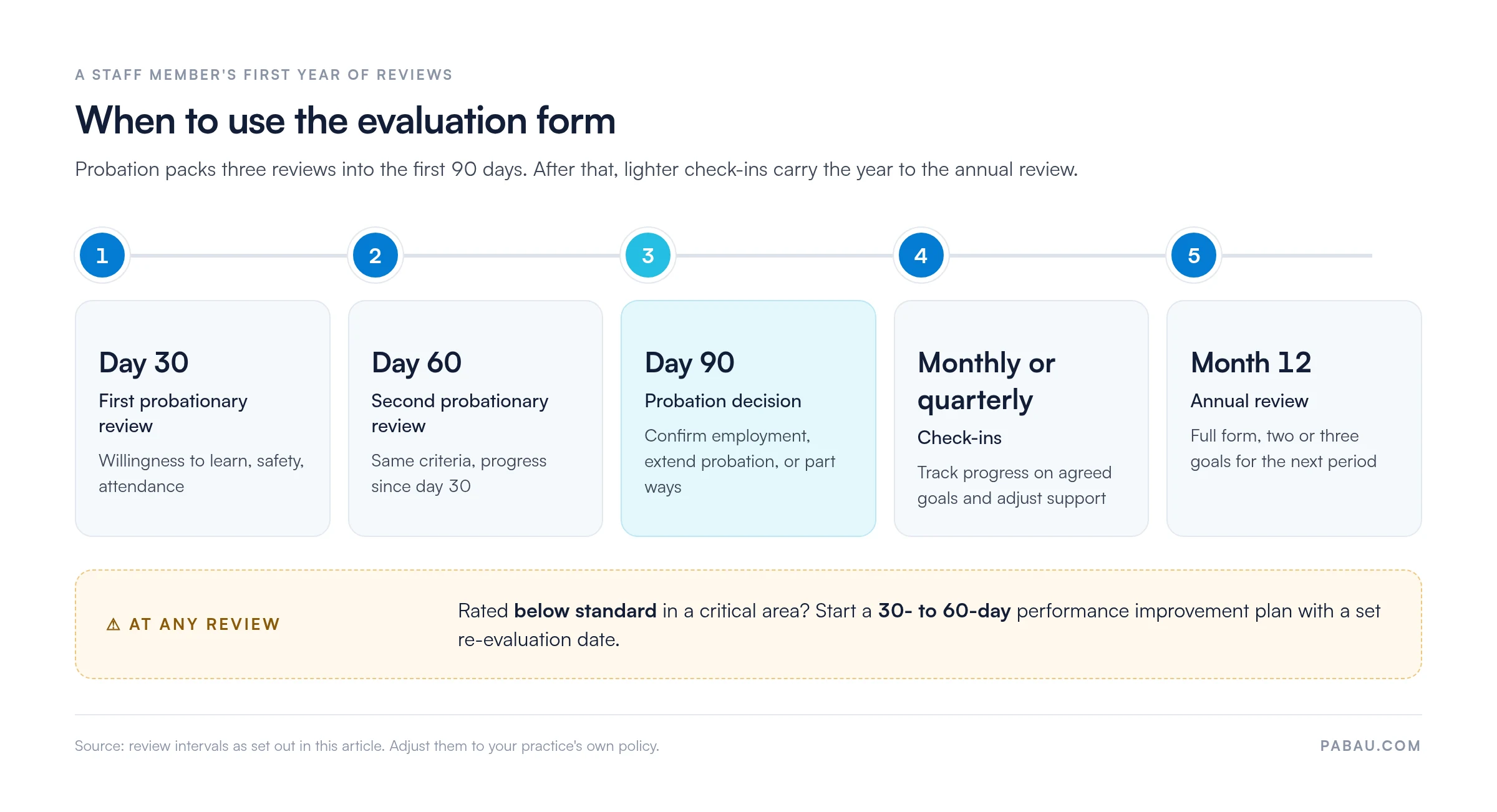
New hires need faster feedback, with probationary reviews at 30, 60, and 90 days before you confirm or extend their employment.
Pabau’s staff management software tracks attendance, holds signed evaluations in each staff file, and turns follow-up goals into tasks with due dates.
An employee evaluation form is a standardized document that records a manager’s assessment of a staff member’s performance against defined criteria. It gives you an objective record to support promotion, pay, disciplinary, and termination decisions.
A complete evaluation form covers five core areas that keep reviews consistent and defensible across your team. The template splits them into seven numbered sections.
Generic HR templates skip the clinical and compliance skills that matter most in a healthcare practice. Build your form around these five categories:
A five-point rating scale gives every evaluator the same language and shows staff exactly what each score means. The template uses this scale:
Leave “not assessed” ratings out of any overall average. Scored as a 1, a criterion that doesn’t apply to the role drags down a strong employee’s result.
Avoid vague comments like “satisfactory” or “good.” They lack the detail you need if an evaluation later supports a disciplinary or termination decision.
Follow these nine steps to keep each review fair and consistent:
New staff need a faster feedback cycle. Many practices hold probationary reviews at 30, 60, and 90 days, so problems surface early while onboarding is still underway.
Use the same criteria as the annual review, but adjust your expectations, because new hires are still learning your protocols and patient workflows. Weight willingness to learn, safety adherence, attendance, and cultural fit most heavily. At the 90-day mark, decide whether to confirm employment, extend probation, or part ways.
Pair the check-ins with a clear employee handbook, so new hires know your policies and success criteria from day one. The timeline below shows how these reviews fit into a staff member’s first year.
A performance review only works if it leads to action. After the meeting, document these four follow-ups:
Apply criteria consistently: Use the same form and scale for everyone in the same role. Inconsistent standards expose your practice to discrimination claims, a risk EEOC guidance flags.
Avoid protected-class language: Never rate based on age, race, gender, disability, religion, or marital status. Evaluate job performance only.
Keep evaluation data secure: Store evaluations in a locked cabinet or an access-controlled digital system, separate from patient records. In the UK, GDPR applies to staff records like these.
Document performance concerns promptly: Don’t save problems for the formal review. If attendance or compliance issues come up mid-year, address them straight away and record the conversation on an employee counseling form.
In many practices, signed evaluations sit in a filing cabinet and attendance lives in a separate timesheet. Follow-up dates stay in the manager’s head. When a review is questioned months later, pulling that evidence together takes hours.
Pabau’s staff management software keeps that evidence together. Clock-ins and hours worked are tracked as they happen, so attendance ratings rest on records rather than memory. You can upload the signed form to the staff member’s file, next to their contracts and qualifications.
Agreed goals become tasks with an owner and a due date, and the Team Report brings hours and performance metrics into one view. Because it all runs inside Pabau’s practice management app, rotas, permissions, and staff records stay connected to the rest of your practice.

Pabau tracks attendance, stores signed evaluations in each staff file, and turns follow-up goals into tasks with due dates. Your reviews stay consistent and easy to defend.

A form only protects you if you use it the same way every time. Pick one scale, rate everyone in the same role against it, and write down the example behind each score.
Start with new hires, because the 90-day decision is where missing documentation hurts most. Once probationary reviews run smoothly, roll the same form into your annual cycle.
The trade-off is time. A thorough review takes an hour of preparation and an hour of conversation, and that is far cheaper than defending an undocumented decision. Book a demo to see how Pabau keeps staff records, attendance, and review follow-ups in one place for your practice.

Review flagged a serious problem? Performance improvement plan template for healthcare staff sets out SMART goals, support, and milestone dates for staff who fall below standard.
Need to record a concern between reviews? Employee counseling form: A free template and guide shows how to document a performance conversation so it holds up later.
Evaluating a team lead or manager? Leadership assessment template rates 20 leadership statements across decision-making, team skills, and emotional intelligence.
Setting expectations for new hires? Employee handbook template for healthcare practices covers the policy sections a generic template leaves out.
Seeing the same issues across the team? Healthcare worker burnout solutions explains how small practices take workload out of the day without an HR department.
Include specific examples rather than general impressions. Instead of “great communication,” write “explained a complex treatment plan to a nervous patient, who asked clarifying questions and left feeling confident.”
Once a year is standard for a full review. Many practices add quarterly check-ins, or monthly feedback for new hires and staff on performance improvement plans.
A simple form works better. Aim for five to seven core criteria rather than 20 subcategories, because managers complete shorter forms more consistently.
They are the same document under different names. “Appraisal” is common in UK healthcare settings, while US practices tend to say “evaluation.” Both assess staff performance over a defined period.
Yes, for the core criteria like communication, attendance, and teamwork. Then customize the role-specific sections, such as clinical skills for practitioners and administrative skills for the front desk.
Make it optional but encouraged. When staff rate themselves and managers review those ratings together, both sides usually agree faster on performance and development needs.