Positive self-talk worksheet
A positive self-talk worksheet is a structured therapeutic tool that helps indiv...

Last Updated: Oct 13, 2026
A one-on-one employee meeting template is a structured agenda that gives managers the same framework for every individual conversation with a team member. It covers the opening check-in, goal progress, two-way feedback, blockers, and action items in one document.
For practice managers juggling schedules, compliance, and staff engagement, that structure turns an informal catch-up into a documented touchpoint. Expectations get clearer, and so does the record of what was agreed.
Gallup reports 19% less turnover on teams whose members had discussed their progress with a manager in the past six months. That finding holds in workplaces already sitting at moderate to high engagement. The full write-up is in Gallup’s work on turnover.
This guide gives you the free template, walks through each section of the agenda, and shows how to adapt it for a healthcare team.
A ready-made structure for one-on-one employee meetings, with sections for the opening check-in, progress review, feedback exchange, goal tracking, blockers, and action items. Written for healthcare practice managers.
Download template
A one-on-one employee meeting template is a structured agenda covering the check-in, goal progress, two-way feedback, blockers, and action items.
Holding 1:1s weekly, or every two weeks, supports engagement and retention on practice teams that carry a high burnout risk.
Healthcare teams should adapt the agenda for HIPAA-aware note-taking, clinical KPIs, and the shift patterns their staff work.
Pabau’s team management features keep 1:1 action items, staff notes, and follow-ups in one system the whole practice can see.
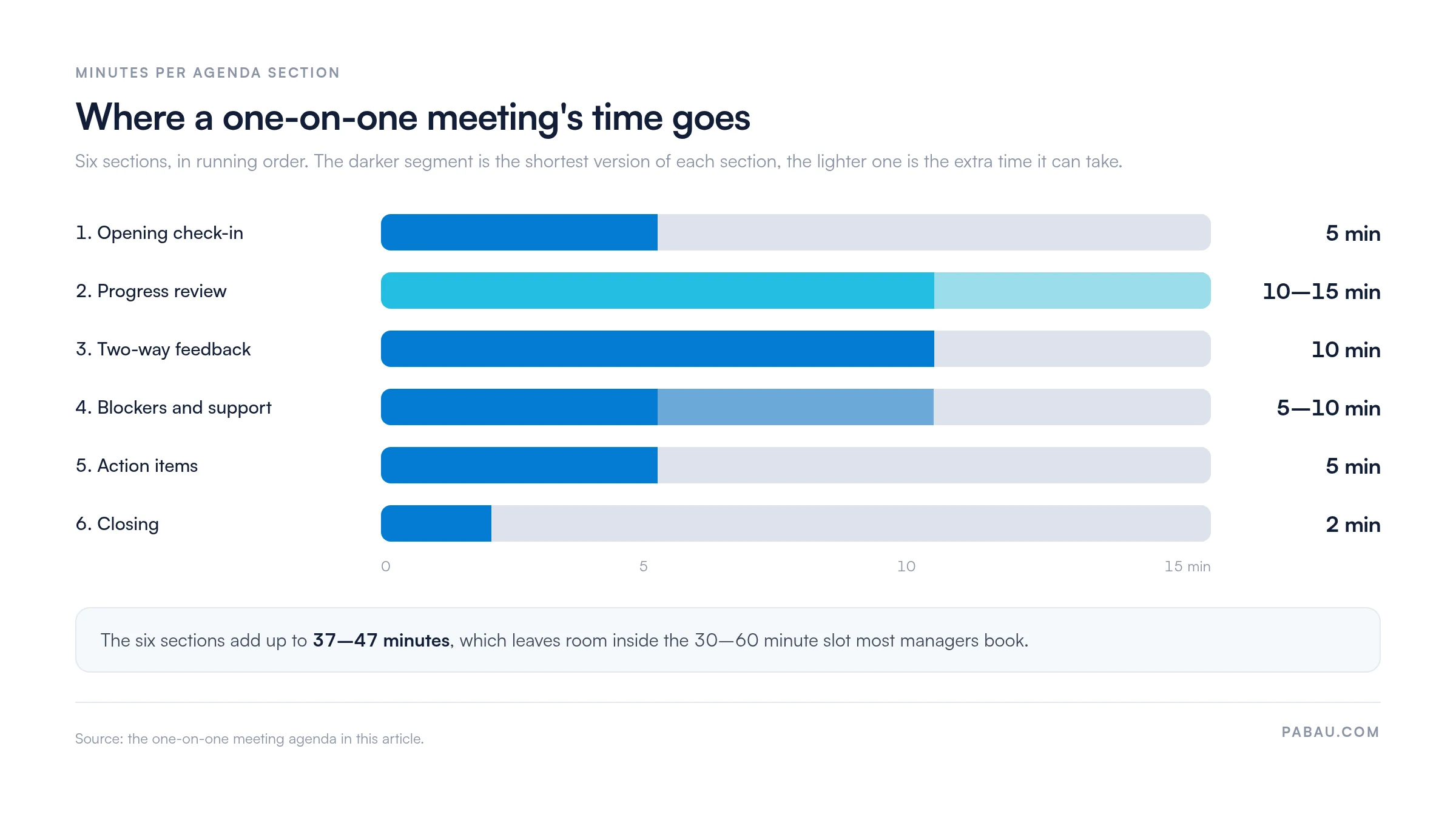
A strong one-on-one follows a predictable flow: Opening warmth, progress review, two-way feedback, and clear next steps. The full agenda fits inside 30 to 60 minutes and keeps manager and employee aligned on priorities.
Those six sections are not split evenly. The progress review takes the largest share, and the closing takes the smallest, which is worth knowing before you shorten a meeting.
The first meeting carries the most weight. A new hire is still forming their impression of you and the practice. Set a warm, unhurried tone and make it safe to ask questions.
Check the new hire has read the practice handbook before you meet. The first 1:1 then covers their questions instead of policy basics.
A template is only worth having if managers use it every time. Four habits make the difference between a meeting that moves work forward and a standing appointment nobody prepares for.
Spend five minutes before each meeting on the person’s goals, recent projects, and the feedback from your last 1:1. Open a blank copy of the template and note one topic you want to raise. Showing up prepared signals respect for their time.
Weekly, or once every two weeks, is the professional standard. Monthly leaves problems to sit too long. CIPD’s evidence review on productive meetings warns that poorly planned meetings wear down employee wellbeing, so a short prepared 1:1 beats a long vague one.
Staff on rotating shifts or part-time hours need the cadence agreed in advance. Fit it around their pattern rather than yours, and it will survive a busy month.
Treat the template as a guide you can step away from mid-conversation. The structure holds the meeting together, and your tone makes it safe. Use “we” language: “Let’s look at your goals.” A manager who talks for 80% of the meeting learns very little.
Take notes during the meeting, or ask the employee to take them and review the notes together afterwards. Write down the action items, the decisions, and any sensitive topic that came up.
Store those notes in HIPAA-compliant software for practice managers, never in a loose email thread. A meeting notes template keeps the format the same week to week. The record then supports any performance conversation later, and it protects both of you.
At the formal review, those notes feed straight into a staff rating form instead of a hazy recollection of the year.
Healthcare staff work under pressures other teams do not carry. Patient outcomes depend on coordination, shift patterns fragment the week, and regulation adds a documentation burden. Adapt the agenda to match.
HIPAA-aware note-taking: Never write patient names, identifiers, or clinical detail into 1:1 notes. Where the conversation touches a patient concern, describe it functionally instead. “Discussed workflow for high-volume appointment slots” says enough.
Clinical KPIs in goal tracking: Staff goals usually tie to a measurable metric, such as appointment adherence, patient satisfaction scores, protocol compliance, or shift coverage. Put those numbers in the progress-review section so the goal reads as patient care rather than an arbitrary target.
Shift patterns and part-time hours: Frequency has to be realistic for how the person works. A part-time practitioner might sit down with you every other week, or join a monthly team check-in instead. Agree the pattern together and put it in both calendars.
Wellbeing focus: Burnout in healthcare is widespread, so use the opening check-in deliberately. “How is your workload feeling?” “Have you taken your breaks this week?” “What support do you need?” Ask the wellbeing question first, every time, so it sits inside the meeting.
In most practices the 1:1 notes live wherever the manager happened to type them. A notebook, a personal drive, an email to themselves. Come the next meeting, nobody can say what was agreed, and the same blocker gets raised twice.
Practice management software like Pabau keeps that trail in the system your team already works in. Action items become assigned tasks with owners and due dates. Staff notes sit against the right person, behind role-based permissions, so a manager can reread last month’s conversation before the next one starts.
Because scheduling lives in the same place, you can book the next 1:1 around the shifts your team is working. The outcome is simple: Fewer follow-ups lost between meetings, and a documented record when a performance conversation needs one.

Pabau’s team management tools turn 1:1 action items into assigned tasks and store staff notes securely against each team member. Scheduling sits in the same place, so the next meeting fits the shifts your team works.

The agenda is the easy part. Two factors decide whether 1:1s work. One is holding them when the week gets busy. The other is whether last month’s action items are still visible when you sit down again.
Download the template, adapt it to your practice, and commit to a cadence you can defend. The trade-off is 45 minutes of clinical time per person, every two weeks. Practices that pay it tend to keep the staff they worked hard to hire.
Ready to stop tracking staff actions in a notebook? Book a demo to see how Pabau keeps 1:1 notes, task assignments, and follow-ups in one place your managers share.

Need a record of what was agreed? Performance improvement plan template picks up where a 1:1 uncovers a problem that repeat conversations have not fixed.
Want quick updates to stop landing in DMs? Staff management software keeps day-to-day messages and schedules visible across the practice.
Running annual reviews as well as 1:1s? Annual review template turns a year of meeting notes into one structured performance conversation.
A core template covers six sections: Opening check-in, progress review, and two-way feedback, then blockers, action items, and a short closing. Give every action item an owner and a due date. The meeting takes 30 to 60 minutes. Adapt each section to your practice’s priorities.
Weekly, or once every two weeks, is the professional standard. Weekly is worth protecting for new starters, through onboarding, and after a significant change to someone’s role. Monthly is too infrequent to catch a problem early.
Use the same flow every time: Welcome and wellbeing check-in, progress against goals, feedback in both directions, blockers, agreed action items, and a closing comment. The structure fits 30 to 60 minutes, and you can shorten sections when the week is tight.
A one-on-one is a regular check-in between manager and employee on goals, feedback, and development. A supervision meeting is more formal and focuses on clinical oversight, compliance, or regulatory requirements. Healthcare settings often combine the two, layering supervision into a regular 1:1 as needed.
Open questions work best. “How are you feeling about your workload?” “What is blocking you right now?” “What do you need from me to succeed?” “What feedback do you have for me?” Avoid yes or no questions, and let a silence sit. Employees often share the deeper concern after a pause.
Regular 1:1s clarify expectations, clear obstacles, and build psychological safety. They also show that the manager cares about the person’s growth. Engaged employees stay longer, do higher-quality work, and raise problems early instead of sitting on them.