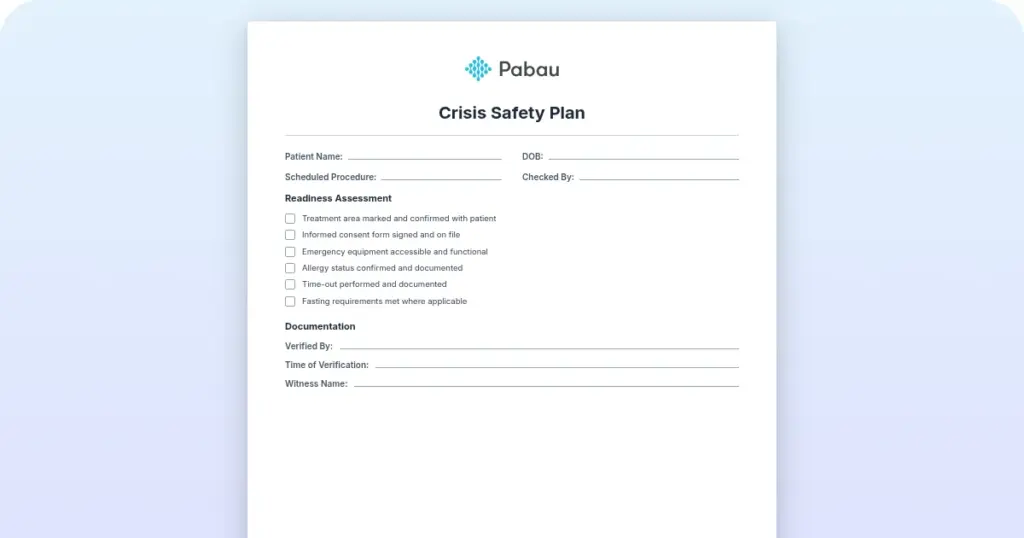
Crisis safety plan template
A crisis safety plan is a short, personalized written plan that a patient and cl...

1
Last Updated: Oct 19, 2026

A behavioral observation checklist is a structured form for recording specific, observable behaviors and how often they appear during a session.
This template lists 36 behavior statements in one flat list, and you mark each one Almost Never, Occasionally, or Frequently.
Two free-text boxes close the form, one for positive behavioral traits observed and one for additional observations or comments.
Completed checklists support treatment planning and progress monitoring, and they create an objective record for peer review or an insurance audit.
Practice management software like Pabau replaces paper checklists with digital forms that save into each client’s record, searchable and comparable over time.
A printable form with header fields for the individual, the observer, their relationship, and the observation date. Rate 36 observable behaviors as Almost Never, Occasionally, or Frequently, then add context in the two free-text boxes for positive traits and additional comments.
Download templateA behavioral observation checklist turns informal impressions into structured, comparable documentation. Use it when you meet a new client, screen for developmental concerns, build a functional behavior assessment, or track treatment progress. The form gives you one consistent way to record what you observed.
Clinicians in psychology, mental health counseling, occupational therapy, and school-based practice all use behavioral observation checklists to document objective findings. This guide walks through what is inside the template, how to complete it, and how to read the ratings across sessions.
The template is a three-page printable PDF. Page one opens with four header fields for the individual’s name, the observer’s name, the observer’s relationship to the individual, and the observation date.
Below the header sits a single instruction line. It asks you to mark the frequency that each of the listed behaviors is displayed.
The form then runs through 36 short behavior statements across pages one and two. Every statement carries the same three response options, so you mark Almost Never, Occasionally, or Frequently for each behavior you rate. A few examples of the wording you will find:
The statements are not grouped under domain headings, and they carry no numeric scores. Attention, activity level, conduct, mood, and social items sit side by side in one continuous list, which keeps the form quick to complete.
Page three closes with two open text boxes. The first is labeled Positive Behavioral Traits Observed. The second is labeled Additional Observations or Comments, and it is where the clinical reasoning goes.
That layout leaves the interpretation to you. Some cases need domain subtotals, antecedent detail, or a severity judgment. Write those into the comments box, or pair this checklist with a fuller psychiatric evaluation template.
A behavioral observation checklist is a standardized form for documenting specific behaviors you observe during a session. It differs from informal notes in two ways. Each behavior is written as an observable statement, and each one is rated on the same fixed scale every time you complete the form.
Behavioral observation checklists support assessment rather than diagnosis. A checklist documents what happened, such as avoided eye contact, three interruptions, or flat affect. A diagnosis explains why, and it needs instruments validated for that purpose. Keeping that line clear protects you and keeps your documentation clinically sound.
The checklist serves three purposes. It creates an objective record, so the next clinician can compare their observations with yours and see whether behaviors are easing or worsening. This informs treatment planning, because a behavior that spikes around one topic changes how you pace a session. It also shows deliberate care during peer review, an insurance audit, or a regulatory inspection.
The five steps below fit inside a normal session workflow.
Accuracy depends on timing. Mark the frequency boxes and write your notes within minutes of the session ending, not hours later when memory has faded. Paper copies are portable but easy to lose. Digital clinical forms inside your practice management system sync the completed checklist to the client record, removing the scanning and filing steps.

Any clinician who documents in-session behavior uses these forms, from private therapists to school psychologists.
Each role reads the same flat list differently. A therapist tends to weight the mood and social items. An occupational therapist watches the movement and repetitive-habit items. A school psychologist focuses on attention and rule-following. Informed consent principles still require you to tell the client that you are conducting behavioral observation. Running observation in a group setting adds group therapy informed consent questions, such as confidentiality limits among participants.
A structured checklist delivers four benefits that show up in both clinical outcomes and day-to-day operations.
Objective documentation: The form replaces first impressions with specific observations. “Client did well” becomes “maintained eye contact through most of the session, answered without delay, volunteered two personal details”. The second version is defensible, comparable across sessions, and something you can act on.
Progress tracking: Completed checklists build a trend. If three attention items move from Frequently to Occasionally over six weeks, you have documented evidence that the intervention is working. Families and payers understand that language, and it supports a case for continued treatment.
Compliance and liability protection: State licensing boards, insurance auditors, and payers expect your record to show that you assessed and monitored the client. A completed checklist demonstrates that. If a case reaches peer review or litigation, your dated ratings and notes show decisions based on documented evidence.
Communication across teams: When a client sees a therapist, a psychiatrist, an occupational therapist, and school staff, observations from each provider build a shared picture. One checklist shows what attention looked like before a medication change. The next shows the same items afterward, which informs the dose decision.
Behavioral observation checklists come in several recognized formats, each suited to a different clinical question.
Your template download sits at the frequency end of that range. It gives you 36 behavior statements, three response options for each, and two free-text boxes for context. If a case needs antecedent and consequence detail, record it in the Additional Observations or Comments box or add a dedicated ABC sheet.
Good documentation turns a completed form into a clinical record. Four principles carry most of the weight.
Be specific and observable: “Client was anxious” is vague. “Talked faster, interrupted twice, shifted in the seat repeatedly during discussion of family conflict” is observable and defensible. Write what you saw and heard, not your interpretation of it.
Include context: “Limited eye contact” gains meaning when you add “during discussion of trauma history”. That tells the next clinician eye contact may return on safer topics. Context prevents misreading and points to the next treatment adjustment.
Document interventions and responses: If the client avoided a task, note what you tried and how they responded. “Avoided speaking about school. Offered a written option and the client wrote a paragraph.” That shows clinical problem-solving rather than data collection alone.
Use standardized language: Skip slang and casual phrasing. “Client was chill” becomes “relaxed posture and calm tone”. Consistent language means other clinicians read your observations the same way you meant them.
Where you can, route the finished checklist through automated clinical workflows so it attaches to the progress note by itself. You can then quote the ratings in your narrative without retyping them, and the wording stays consistent across the chart.
Plenty of practices still run behavioral observation on paper. Someone prints the form before a session, marks it by hand, then scans or files it later. Sheets go missing, and comparing week one with week eight means working through a folder.
Practice management software like Pabau replaces that loop with a digital version of the same form. You build the 36 statements and their three frequency options once, then reuse the form at every session. Each completed checklist saves into the client’s record, dated and searchable.
Because the ratings sit in the record as data, you can open the last three observations together before a review and see which items moved. Automated messages can also reach a parent, teacher, or caregiver before the session, so their input arrives before you rate anything.
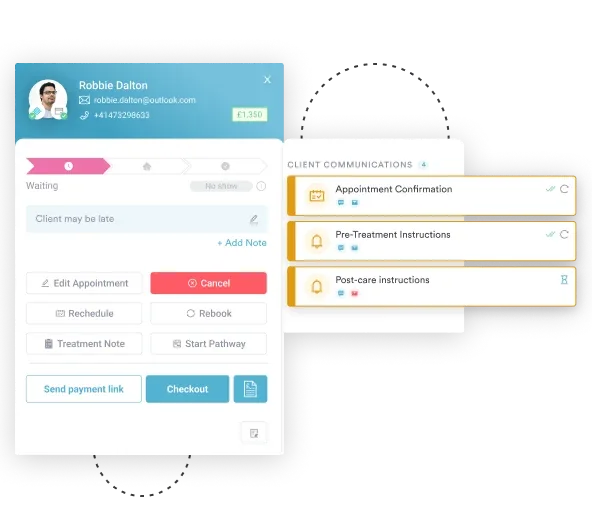
The result is one place where every observation, progress note, and consent form for that client already sits together. Nothing needs rescanning, and a colleague covering for you can see the behavioral history in seconds.

Replace paper checklists with digital forms that save into the client record, so you can compare frequency ratings across sessions without hunting through a folder.

A behavioral observation checklist is only as useful as the discipline behind it. Mark the same 36 statements the same way at every session, and the record starts answering clinical questions on its own.
Keep the limits of the form in view as you use it. It records how often a behavior appears, not why it appears and not how severe it is. Those judgments belong in your written notes and, where the case calls for it, in a fuller functional behavior assessment.
Print it and file it by hand if that suits your practice. If you would rather have the ratings searchable and comparable, move the same form into your documentation system. Our guide to safer clinical notes covers the habits that keep those records defensible. Book a demo to see how Pabau keeps every behavioral observation attached to the client’s record.

Need a fuller record of what is going well? Strengths and qualities worksheet gives clients a structured way to name the traits you log as positive observations.
Want precise words for the affect you observed? Negative emotions list collects the vocabulary that keeps your written descriptions consistent across the chart.
Want to explore what’s behind the observed behavior? defense mechanisms worksheet uses self-reflection scenarios to help clients notice the defenses they rely on.
Observing symptoms that suggest a delusional disorder? delusional disorder DSM-5 template helps clinicians evaluate and document symptoms against DSM-5 diagnostic criteria.
A behavioral observation checklist is a structured form for recording specific behaviors observed during a session. You rate each behavior on a fixed scale, then add written context. It differs from informal notes by using a consistent format that creates measurable, comparable data across sessions and clinicians.
Document behavioral observations by recording specific, observable actions (not interpretations) with their context and your clinical response. Mark the rating scale during or immediately after the session. Add notes explaining what triggered the behavior, then file the form in the client’s permanent record. Digital forms integrated into your practice management system ensure consistency and accessibility.
A behavioral observation checklist can support autism screening by documenting observable behaviors such as eye contact, social reciprocity, repetitive actions, and sensory responses. It is not a diagnostic instrument. Autism diagnosis requires formal assessment tools validated for that purpose. Use checklists to flag areas for deeper evaluation, then administer validated diagnostic instruments like the ADOS-2 or ADI-R.
Record behavioral observations at every session if the client’s behavior is clinically significant or treatment-focused. At minimum, complete a baseline checklist at intake and every four to eight weeks during ongoing treatment to track progress. For clients with acute behavioral concerns or those adjusting to new medication, weekly observation is standard. Frequency should match your treatment plan and clinical question.