Anja Dodevska

Shame worksheets: 6 types and when to use each one
Shame worksheets are structured writing exercises that help patients notice, nam...

Last Updated: Nov 2, 2026
Free PDF 3 pages, print-ready Clinician-reviewed
An emotional intelligence scale is a self-report questionnaire that measures how well a person recognizes, understands, and manages their own emotions and other people's. The most widely used free version, the 33-item Schutte scale, asks people to rate statements from 1 (strongly disagree) to 5 (strongly agree). Three negatively worded items are reverse-scored, and the ratings add up to a total between 33 and 165. Clinicians, coaches, and HR teams use that total to structure a conversation about emotional skills, not to make a diagnosis.
A ready-to-use questionnaire covering self-awareness, self-regulation, empathy, and social skills, with Likert-style response items for practitioners.
Start from scratch, or upload this PDF or any form you already use, and Pabau's AI Form rebuilds it with tick boxes, text fields and a signature. Attach it to the treatment once, and every patient gets it on time.
AI Form rebuilds the consent, history and aftercare forms you already use. You review each one, then publish.
Patients complete forms on their phone before they arrive, so the front desk stops retyping paper.
Every signed form is versioned and attached to the treatment record, ready when you need it.
Set how long a consent stays valid. Returning patients skip forms they have already signed.
Supports HIPAA and GDPR compliance AES-256 encryption 4.8 on G2 4.7 on Capterra Trusted by 4,000+ practices worldwide

An emotional intelligence scale is a structured self-report questionnaire covering self-awareness, self-regulation, empathy, and social skills.
Most self-report scales use Likert-type items, so the response format is consistent across the questionnaire.
Scores are norm-referenced, so interpret them against a published normative sample rather than an absolute standard.
Scales support conversations and documentation but do not diagnose a condition or replace certified administration.
Pabau’s free template gives your team a ready-to-use starting point.
An emotional intelligence scale is a questionnaire that measures emotional competence across defined dimensions. Most instruments are built around four core areas: self-awareness, self-regulation, empathy, and social skills.
A scale turns these dimensions into items that a person can rate. The result is a profile rather than a single verdict, which is why most practitioners read subscale scores alongside the total.
When one area needs a closer look, a focused measure helps. The Toronto Empathy Questionnaire looks at empathy alone, and a self-regulation questionnaire targets impulse and stress control.
Two broad traditions shape how emotional intelligence scales are built. Ability models treat EI as a set of skills tested through performance tasks. Mixed or trait models ask people to describe their own emotional habits instead.
The Mayer-Salovey-Caruso Emotional Intelligence Test (MSCEIT) is the best-known ability-based measure. The Emotional Quotient Inventory (EQ-i 2.0) and the Schutte Self-Report Emotional Intelligence Scale take the self-report route. Knowing which tradition an instrument follows tells you what its scores can and cannot show.
Choosing an instrument depends on who will complete it, who will interpret it, and what decision it supports. The table below compares the three instruments most often cited in the literature.
The Emotional Intelligence Consortium maintains a library of EI measures that includes the Schutte scale. It is a useful place to check availability before you choose an instrument.
Scores on a standardized instrument are norm-referenced, meaning they show where a person sits relative to a normative sample. The EQ-i 2.0 uses a mean of 100 and a standard deviation of 15 for its scales. A score near 100 sits around the typical range.
Likert scale questions ask people to rate how much they agree with a statement, usually on a five-point scale from strongly disagree to strongly agree. Each item is scored, reverse-scored where wording is negative, and summed into a subscale.
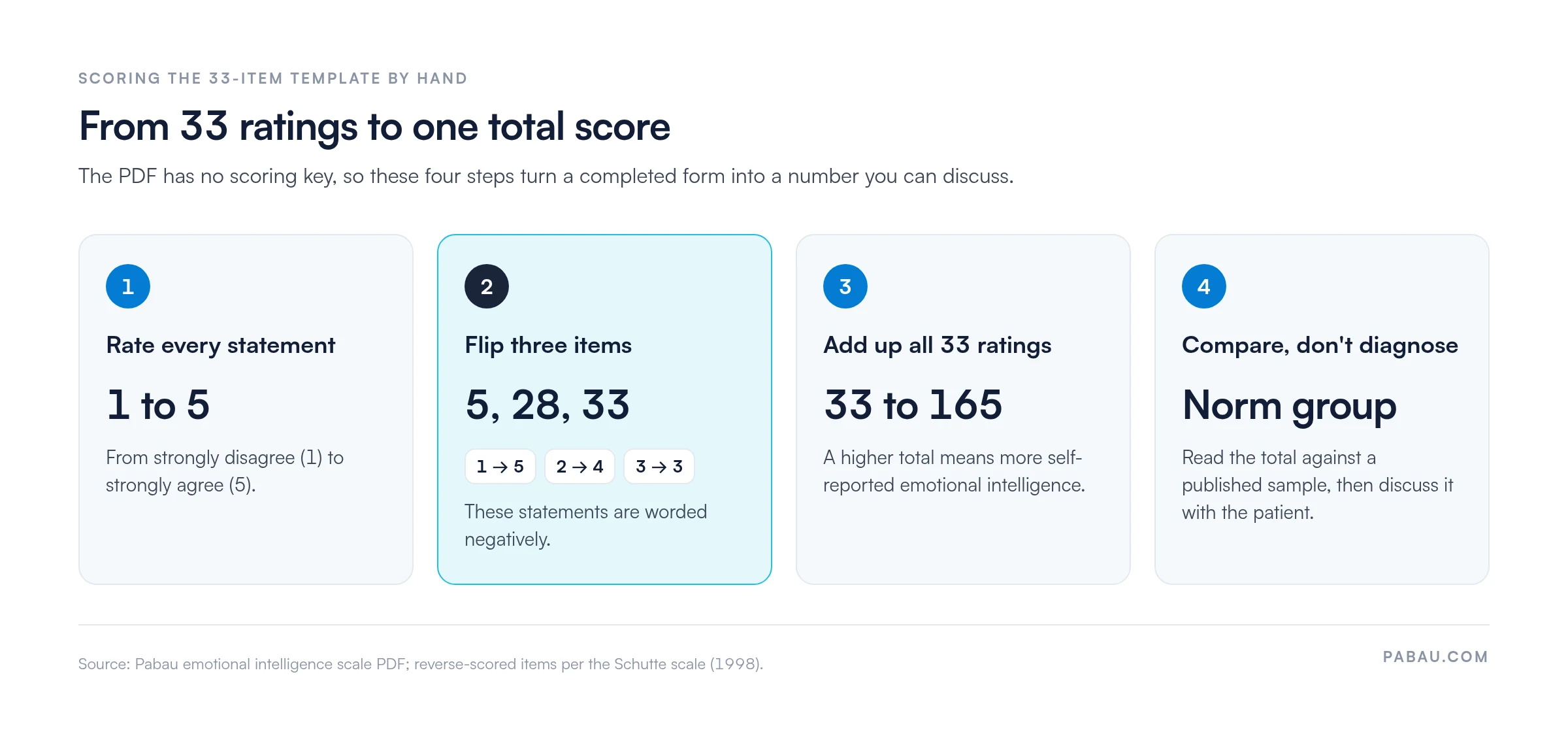
The template’s 33 statements follow the Schutte Self-Report Emotional Intelligence Scale, and the PDF itself carries no scoring key. Each statement gets a rating from 1 (strongly disagree) to 5 (strongly agree).
Items 5, 28 and 33 are worded negatively, so reverse them before you add up. A 1 becomes a 5, and a 2 becomes a 4. The 33 ratings then sum to a total between 33 and 165. Higher totals mean more self-reported emotional intelligence, and the four steps below fit the whole calculation on one page.
Before you use or recommend any scale, check its psychometric evidence. Three properties matter most, and each one decides how far you can trust a score you share with a patient.
A well-documented instrument publishes these figures in its manual. If a template or questionnaire does not explain its norms or validation, treat its scores as a conversation prompt rather than a measurement.
Clinicians often use an emotional intelligence scale during intake, next to a counselor intake form, or as a reflective tool between sessions. The score is most useful when it opens a discussion about how a patient handles stress, relationships, and emotional triggers.
Coaches can log the same goals in structured coaching notes, so the next session starts from them.
Occupational health and HR teams use emotional intelligence scales in leadership development and well-being programs. Results work best as group-level themes, such as a team’s shared strength in empathy, rather than as individual performance ratings.
Where strain is the concern, teams often pair it with the Copenhagen Burnout Inventory, which measures exhaustion at work and in personal life.
Any workplace use should be transparent, voluntary, and handled in line with data protection rules. In the UK, that means GDPR obligations, and in the US, HIPAA applies where the assessment sits within a covered clinical record.
The Pabau emotional intelligence scale template gives practitioners a structured starting point. It follows the same Likert-style logic used across most self-report instruments, so your team can adapt it to its own workflow.
The PDF has no scoring key or norms, so treat it as a practice tool rather than a formal assessment. When a decision depends on the result, use a certified instrument such as the EQ-i 2.0 alongside it.
For patients who struggle to notice their own feelings, an emotional awareness worksheet gives them structured practice between sessions.
Use the template as a pre-session reflection tool, then compare the patient’s own reading of their results with your observations. Note the discrepancies in the clinical record, since they often reveal the most useful starting point for discussion.
Most practices print the PDF, hand it over at reception, and type the total into the notes by hand. Paper copies get lost between sessions. Comparing this month’s score with last quarter’s then means digging through files.
Pabau, the practice software we build for easier therapy practice management, lets you rebuild the scale as a digital form. Patients complete it on their own device before the session, and their answers are saved to their patient record.
You open the session with the responses already in front of you. Repeat scores sit in one file, so progress conversations start from the patient’s own history instead of a stack of paper.

Pabau’s digital forms let patients complete questionnaires before their appointment and save each response to their record. You open the session with results ready, not paperwork.

A self-report emotional intelligence scale earns its place when you treat the total as the start of a conversation. Score the 33 items the same way every time, reverse the three negative ones, and date each result so the next score has a baseline.
The trade-off is precision. A free questionnaire without norms can’t support a formal assessment, so switch to a certified instrument when a decision rides on the result.
Book a demo to see how Pabau sends questionnaires before the session and keeps every result in the patient’s record.

Need a follow-up exercise after a low score? Regulating emotions worksheet gives patients a structured way to practice managing strong feelings.
Want to start with the basics of naming feelings? Identifying emotions worksheet helps patients put words to what they feel.
Measuring how self-worth shifts over time? State self-esteem scale tracks momentary self-esteem across sessions.
Is stress shaping the results? Stress assessment questionnaire maps where pressure is coming from before you plan the next step.
Need a broader personality picture? Personality Assessment Inventory template covers the clinical scales an EI questionnaire leaves out.
An emotional intelligence scale is a self-report questionnaire that measures self-awareness, self-regulation, empathy, and social skills. It produces subscale and total scores that show a profile of emotional competence.
Scores show where a person sits relative to a normative sample. Read subscales together with the total, and interpret results alongside the patient’s own account rather than as a diagnosis.
The best scale depends on the setting and the qualifications available. Certified instruments such as the EQ-i 2.0 suit formal assessment, while free self-report scales suit reflective or exploratory use.
Yes, Pabau offers a free emotional intelligence scale PDF for practitioners. It is a practice tool and does not replace validated, certified instruments.