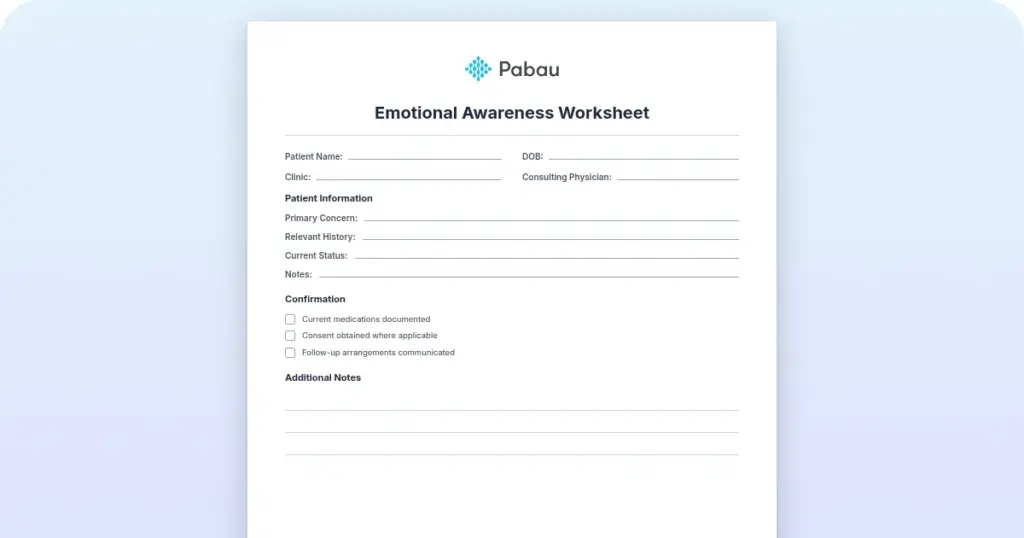
Emotional awareness worksheet
An emotional awareness worksheet is a structured psychoeducational tool that hel...

2
Last Updated: Oct 16, 2026

An emotional scale rates how strong a feeling is, usually from 0 to 10 or 1 to 5, so a vague “I feel bad” becomes a number you can track.
This page includes a ready-to-use emotional scale chart: a 0-10 intensity scale with word anchors and a 1-5 grid for five core emotions (sadness, anger, worry, fear, and happiness).
Common formats include numeric scales, visual analog scales, color or thermometer check-ins, pictorial faces for children, and validated instruments like the DERS, ERQ, and PANAS.
The value comes from repeating the same scale each session, so ratings build one client timeline instead of scattered notes.
Practice management software like Pabau can embed emotional scale items into intake and session forms, so every rating files straight into the client record.
A ready-to-use psychological assessment form covering emotional state evaluation, mood tracking, intensity rating, and clinical documentation. Includes sections for emotional history, current symptoms, coping strategies, and clinical notes for comprehensive mental health assessment.
Download templateAn emotional scale rates how strong a feeling is on a fixed range, usually 0 to 10 or 1 to 5. That turns a vague “I feel bad” into a number you can compare from one session to the next, which is what separates tracked progress from a subjective impression.
Therapy practices that use structured emotional assessment get clearer progress tracking, more informed treatment planning, and better-documented clinical outcomes.
This guide explains what emotional scales are, gives you a ready-to-use 0-10 and 1-5 chart you can copy today, walks through the main scale types and how to use them in sessions, and shows how to record the ratings so they build into one client timeline.
You can also download the free emotional scales template above to print and use right away.
Emotional scales are standardized rating tools that measure the intensity of an emotion or mood at a single moment, most often on a numbered range like 0-10 or 1-5. They move clinicians beyond subjective impressions into structured, repeatable measurement, which matters for diagnosis, treatment planning, and monitoring client progress.
Unlike diagnostic interviews or unstructured conversations, a scale of emotions gives you a quantifiable baseline. A client who rates their anxiety as “7 out of 10” in week one and “4 out of 10” in week six creates objective evidence of change.
That data feeds directly into clinical notes.
A scale of emotions can be as simple as a one-question feelings scale or as detailed as a multi-item questionnaire.
Simple numeric scales (1-10) suit quick mood checks; visual analog scales, where clients mark a point on a continuous line, capture nuance for low-literacy populations; and validated instruments like the Positive and Negative Affect Schedule measure distinct emotional dimensions. All of them do the same job: turning a subjective emotional experience into measurable data that guides clinical decisions.
Here is a ready-to-use emotional scale chart in the two formats clinicians reach for most. Use the 0-10 emotion intensity scale for a quick read on how strong a single feeling is right now, and the 1-5 grid when you want to track several core emotions side by side.
Each row of the intensity scale pairs a number with a word anchor and a suggested response, so the rating points straight to a coping step.
The 1-5 version works well when you want to watch more than one emotion at once. Based on the Likert format used in mental health check-ins, the client rates each of five core emotions from 1 to 5, where 1 means “none,” 3 means “in the middle,” and 5 means “all the way.”
Rating them separately shows, for example, that worry is easing while anger is climbing, a pattern a single overall mood score would hide.
For children, low-literacy clients, or anyone who freezes at a number, a color check-in works as a third quick format: green for calm, yellow for alert or building, and red for overwhelmed.
It maps onto the same 0-10 logic (green roughly 0-3, yellow 4-7, red 8-10) so you can switch a client between formats without losing continuity in the data. The point of any of these charts is the same: give the client language for an internal experience and give yourself a number you can compare later.
Emotional scales come in several formats, from a quick emotion rating scale to a full validated instrument. Understanding the differences helps you match the tool to your client population and clinical setting.
Each format serves a distinct purpose. A numeric emotion rating scale works for quick pulse checks during sessions; visual analog scales are ideal when clients struggle with fixed categories; pictorial scales engage younger clients; and validated instruments provide gold-standard measurement when clinical rigor is essential. Most therapy practices use a combination depending on the assessment phase and client needs.
Introduce the scale as a shared measurement tool, use it at the same point in every session, and record each rating with context in the client record. Those three habits turn a one-off number into comparable data. Here are five operational steps to build an emotional scale, or a mental health check-in scale, into your sessions.
Case closure asks something different of the record, since it must show what changed across the episode rather than how one session went. Running a multi-domain outcome questionnaire at baseline and again at discharge gives that comparison, scored against the patient’s own starting point.
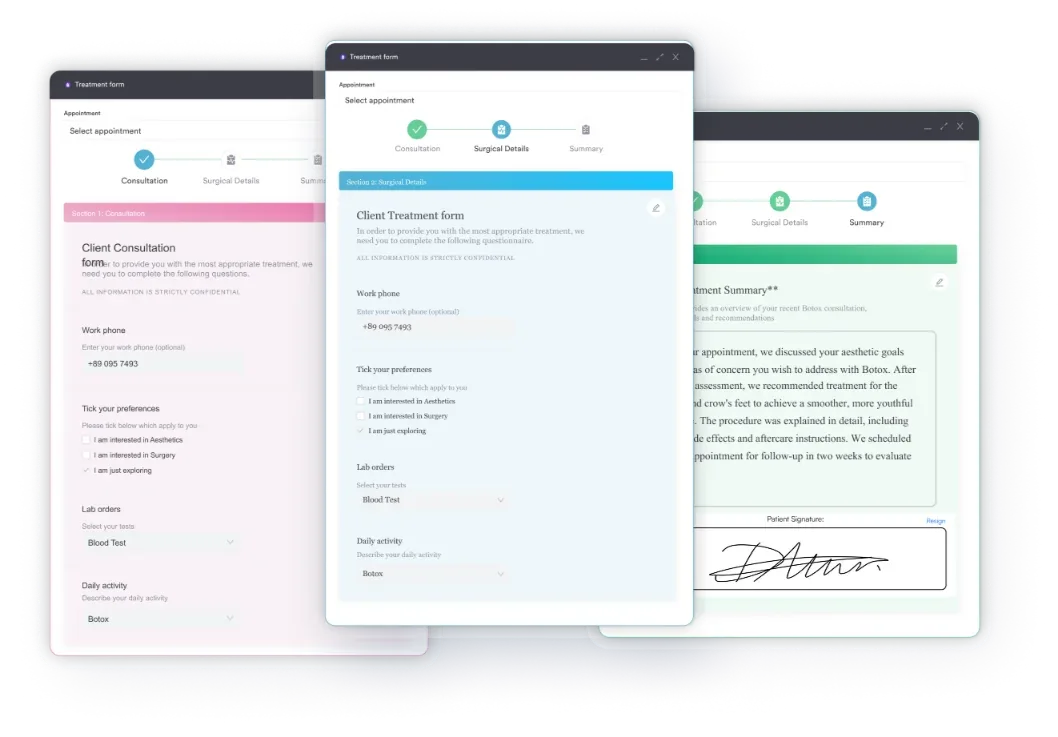
Emotional scales are most useful when the data flows into your digital intake system. Rather than writing scores on paper, embed them in your intake forms so baseline emotional state is captured automatically at the first session, filed in the client record, and available for progress comparison at every future session.
Emotional regulation is a core treatment target in Dialectical Behavior Therapy (DBT) and Cognitive Behavioral Therapy (CBT). Both frameworks rely on emotional scales to measure client progress in managing intense feelings and building coping skills.
In DBT, clinicians use emotion intensity scales throughout the Distress Tolerance and Emotion Regulation skills modules. A client learning to tolerate emotional pain without self-harm might track distress on a 0-10 scale before, during, and after using a coping strategy, so the scale becomes proof of the skill’s effectiveness.
At the top of that scale the session turns to safety work, and the paperwork that follows is a separate question. A no-suicide contract records that the conversation took place, while APA and SAMHSA guidance puts collaborative safety planning first.
In CBT, similar scales track anxiety, depression, and worry intensity to show how thought restructuring and behavioral experiments shift emotional states.
Common validated emotion regulation instruments: the Difficulties in Emotion Regulation Scale (DERS) measures emotion regulation difficulties across six dimensions; the Emotion Regulation Questionnaire (ERQ) assesses cognitive reappraisal and suppression strategies; and the Positive and Negative Affect Schedule (PANAS) distinguishes between positive and negative emotional states, useful for understanding whether a client is sad or anxious. A psychology practice running several assessments needs them scored and stored the same way each time.
Children often lack the vocabulary to describe emotional intensity. “I feel bad” could mean frustration, anxiety, sadness, or anger. A pictorial feelings scale or a simplified numeric scale gives young clients a language for their internal experience and clinicians a way to track emotional change.
Smiley-face scales (ranging from a big smile to tears) work for ages 3-6; simple numeric (1-5) scales suit ages 6-10; and standard 1-10 scales work from age 10 onward as abstract reasoning develops.
Color-coded thermometer scales (green = calm, yellow = alert, red = very upset) are especially popular in school-based mental health because they connect emotional intensity to a familiar visual system.
The key is introducing the scale in child-friendly language: “Show me on this feelings scale how you’re feeling right now” rather than “Rate your emotional state.” Pairing the scale with a drawing activity or sticker placement increases engagement and accuracy, especially for young children.

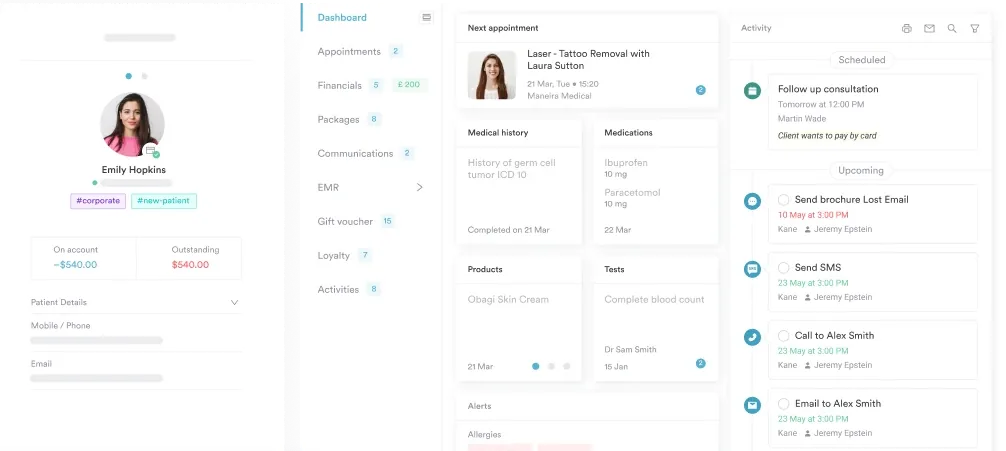
Embed emotional scales directly into your intake forms and client records. Track emotional progress over time without switching between systems.

Most emotional scales live outside the record as a printable PDF you fill in and then re-type. Practice management software like Pabau keeps the scale inside the client record from intake forward, so a rating becomes part of the clinical history the moment it is entered.
Customize your digital intake forms to include emotional scale items, whether numeric, visual analog, or multi-item. When a new client completes intake, their baseline emotional state is captured and stored in their client record. At every future session you can re-administer the same scale, building a longitudinal dataset that shows progress without manual charting.
Pabau Scribe, our AI scribe, can even auto-populate session notes with emotional scale trends, flagging when ratings shift significantly and prompting clinical follow-up questions.
That connection is what a standalone worksheet cannot do. A printable scale gives you one number on one day; an integrated record ties each rating to ongoing documentation, client goals, treatment planning, and progress reports. The scale stops being an isolated data point and becomes a thread running through the whole clinical narrative.
Emotional scales turn clinical assessment from subjective impression into measurable progress. Whether you are tracking mood, anxiety, emotional regulation, or overall well-being, a well-chosen and consistently administered scale gives you data that guides treatment decisions and shows clients their own change over time.
The downloadable emotional scales template above is ready to print and use today. To get the tracking, trend analysis, and automated documentation that a paper chart cannot, embed emotional scale questions into your practice’s digital forms and client records. Schedule a Pabau demo to see how emotional assessment data flows through intake, session notes, and progress reports.

Need a consistent format for session notes? SOAP note for mental health gives therapists a consistent format that supports clinical continuity and regulatory compliance.
Need a printable tool for exploring behavior patterns with clients? Choices and Consequences Worksheet is a free decision-making exercise you can bring into DBT and CBT sessions.
Worried about burnout on your own team? Compassion Fatigue Test is a free 66-item self-assessment for measuring compassion satisfaction and secondary traumatic stress in caregivers.
An emotional scale measures the intensity of a client’s emotional state at a specific moment. Therapists use it to establish baseline emotion, track changes during and after interventions, and provide objective evidence of treatment progress.
The 1-to-5 emotional scale is a Likert-style rating where a client scores a feeling from 1 (none) through 3 (in the middle) to 5 (all the way). It is commonly used to rate five core emotions, sadness, anger, worry, fear, and happiness, separately so each can be tracked over time.
Mood scales typically measure overall affective state (happy, sad, neutral); emotional scales measure specific emotional experiences and their intensity (anxiety level, anger intensity, sadness duration). Many scales measure both, but emotional scales tend to focus on distinct emotional dimensions.
The emotional guidance scale is a separate self-help concept, popularized by Abraham-Hicks, that ranks feelings on a ladder from despair up to joy to help someone shift their mood. It differs from the clinical rating scales used in therapy, which measure the intensity of one specific emotion rather than ranking emotions by vibration.
Emotional intelligence scales measure how well a person perceives, understands, and manages emotions rather than how intense a feeling is right now. Validated examples include the MSCEIT and the EQ-i, and they are generally used for assessment or development rather than session-to-session mood tracking.
Yes. The Spence Children’s Anxiety Scale (SCAS), the Children’s Depression Inventory (CDI), and pictorial scales like smiley-face and thermometer scales are all validated for pediatric populations. Age-appropriateness and format guide selection.
Frequency depends on clinical goals. Most therapists administer emotional scales at the start of every session for ongoing mood tracking, or at key intervention points. Weekly or biweekly reassessment is typical; daily tracking suits intensive outpatient or crisis contexts.
Choose based on your client population, treatment modality, and assessment goals. For rapid mood checks in most adult populations, a simple 1-10 numeric scale works. For DBT, use emotion intensity scales; for children, use pictorial or simplified formats. Consistency matters more than complexity.
No. Emotional scales measure the intensity or frequency of emotional states; they do not diagnose disorders. A high anxiety rating suggests anxiety is present but does not confirm an anxiety disorder, which requires clinical assessment against diagnostic criteria. Use scales as tools within a broader evaluation.