Journal prompts for mental health
Journal prompts for mental health are guided questions that help people process ...

2
Last Updated: Oct 13, 2026

A regulating emotions worksheet walks a client through naming an emotion, testing whether it fits the situation, and choosing a response.
The four core DBT skills it teaches are Opposite Action, Check the Facts, PLEASE, and Mindfulness of Current Emotion.
Match one skill to the way that client’s regulation fails, rather than assigning all four and watching none get practiced.
Emotion regulation lowers the intensity of a feeling, while distress tolerance carries the client through a feeling that will not shift yet.
Sending the worksheet through a client portal gives you a completion date and the client’s answers before the next session starts.
Covers emotion identification, the four core DBT skills, distress tolerance techniques, and space to log what the client practiced between sessions. Suitable for individual therapy, group sessions, and self-directed practice.
Download templateA regulating emotions worksheet is a structured tool for working through one emotion at a time. It walks the client through naming the emotion, testing whether it fits the facts, and choosing a response. It turns emotion regulation theory into steps the client can work in session and repeat between appointments.
The worksheet draws on Dialectical Behavior Therapy (DBT) and Cognitive Behavioral Therapy (CBT). Both frameworks treat thoughts, feelings, and behavior as one loop you can interrupt at any point. The American Psychological Association describes emotion regulation as foundational to treatment across anxiety, depression, personality disorders, and trauma.
The hard part is not teaching the four skills. It is deciding which one to hand a specific client first. A client who avoids needs a different starting point than one who ruminates, and assigning all four at once usually means none get practiced.
The completed sheet also doubles as an assessment. Which skill the client actually reached for tells you where their regulation breaks down, and that shapes the next phase of the treatment plan.
The worksheet builds on four DBT skills, each aimed at a different way emotion regulation fails. Emotion regulation is only one of four DBT modules. A broader DBT therapy worksheet covers the mindfulness, distress tolerance, and interpersonal skills that sit alongside it.
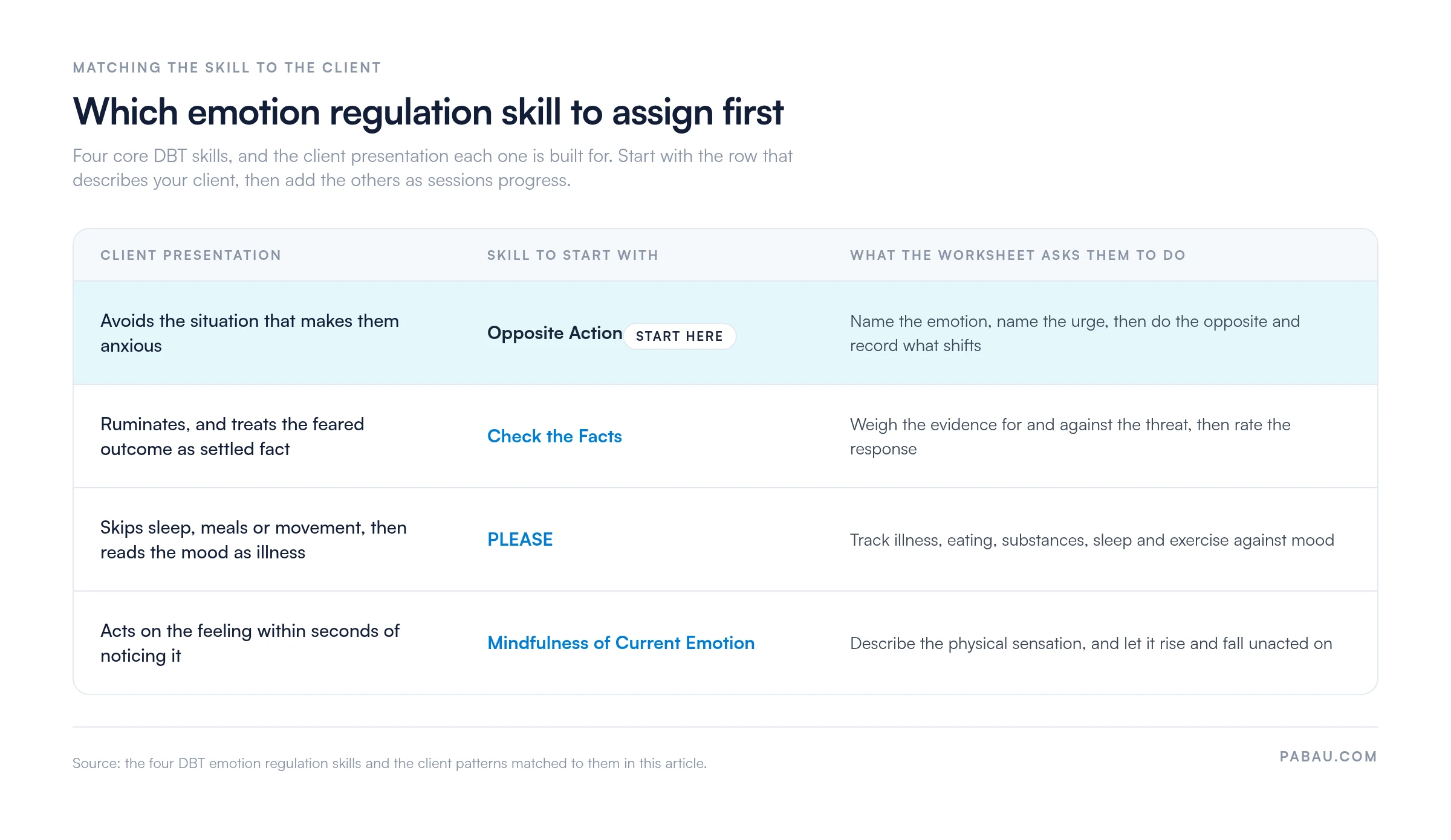
Opposite Action asks the client to act against the urge their emotion produces. Anxiety urges avoidance, so the opposite action is approaching. Sadness urges withdrawal, so the opposite action is contact. The worksheet has them name the emotion, name the urge, do the opposite, and record what changed.
That record is the point. It breaks the loop where avoiding keeps anxiety in place, and where withdrawing deepens low mood.
Check the Facts is a reality test. The client answers four questions on the sheet: what is the threat, what supports it, what contradicts it, and is my reaction proportionate. The technique comes from cognitive therapy. It separates a response that matches the situation from one built on catastrophizing or overgeneralizing.
PLEASE stands for PhysicaL illness, Eating, Avoiding mood-altering substances, Sleep, and Exercise. These five habits set the biological floor that mood sits on. The worksheet has the client log them next to how they felt that day.
A client running on four hours of sleep and no lunch will read ordinary sadness as depression, or mild irritation as rage. PLEASE restores the baseline before you ask them to work on the emotion itself.
This skill teaches the client to observe an emotion without acting on it or arguing with it. Instead of suppressing anger or analyzing it, they describe it: “I notice anger. My heart is racing and my shoulders are tight. This will rise and fall.” The worksheet prompts them through the sensation, the thought, and the urge, without treating the thought as fact.
Worksheet integration works when the client understands why they are filling it in. These five steps cover the introduction, the first completion, and the review that follows.
Step three carries most of the judgment, so the matches are worth setting out side by side.
Before a client can regulate an emotion, they have to name it. Plenty of people report feeling “bad”, “stressed”, or “off” without separating anger from sadness, or anxiety from disappointment.
The sheet opens with an identification section that splits primary emotions from secondary ones. Primary emotions are the core feelings: fear, sadness, anger, disgust, joy. Secondary emotions are feelings about feelings, like shame about anger or anxiety about sadness.
That granularity earns its place. A client who can say “this is anger, not failure” responds differently from one still fused with general distress. If you want a scored baseline before the skill work starts, an emotion regulation questionnaire measures how the client handles feelings today.
Adult versions treat workplace stress, relationship conflict, money worry, and identity transitions as the triggers. They assume the client can reason abstractly and think about their own thinking. Most add sections on values-based living, long-term goals, and distress tolerance for the times an emotion will not shift.
If your caseload is working adults, pick a version that translates the skills into work contexts. Opposite Action fits social anxiety before a team meeting, and PLEASE skills fit shift work that wrecks sleep.
Children need shorter sentences, concrete examples, and something to look at. Pediatric versions use emotion faces, color coding, and story prompts: “Your friend didn’t invite you to lunch. What emotion is happening?” They lean on behavioral strategies like Opposite Action and physical movement rather than abstract cognitive work.
Teen versions sit between the two, adding peer relationships, academic pressure, and identity to the list of triggers. A therapy worksheet for kids that a parent can follow too gets reinforced at home, which is usually where the practice has to happen.
Emotion regulation and distress tolerance are separate DBT modules that work together. Emotion regulation changes or lowers the intensity of a feeling. Distress tolerance carries the client through a feeling that will not change yet. A full worksheet carries both, because some situations call for change and others call for acceptance.
A paper worksheet is easy to hand out and hard to follow up. You do not know whether the client filled it in. The completed copy sits in a folder rather than beside the note it belongs to. Therapy practice management software closes that loop.
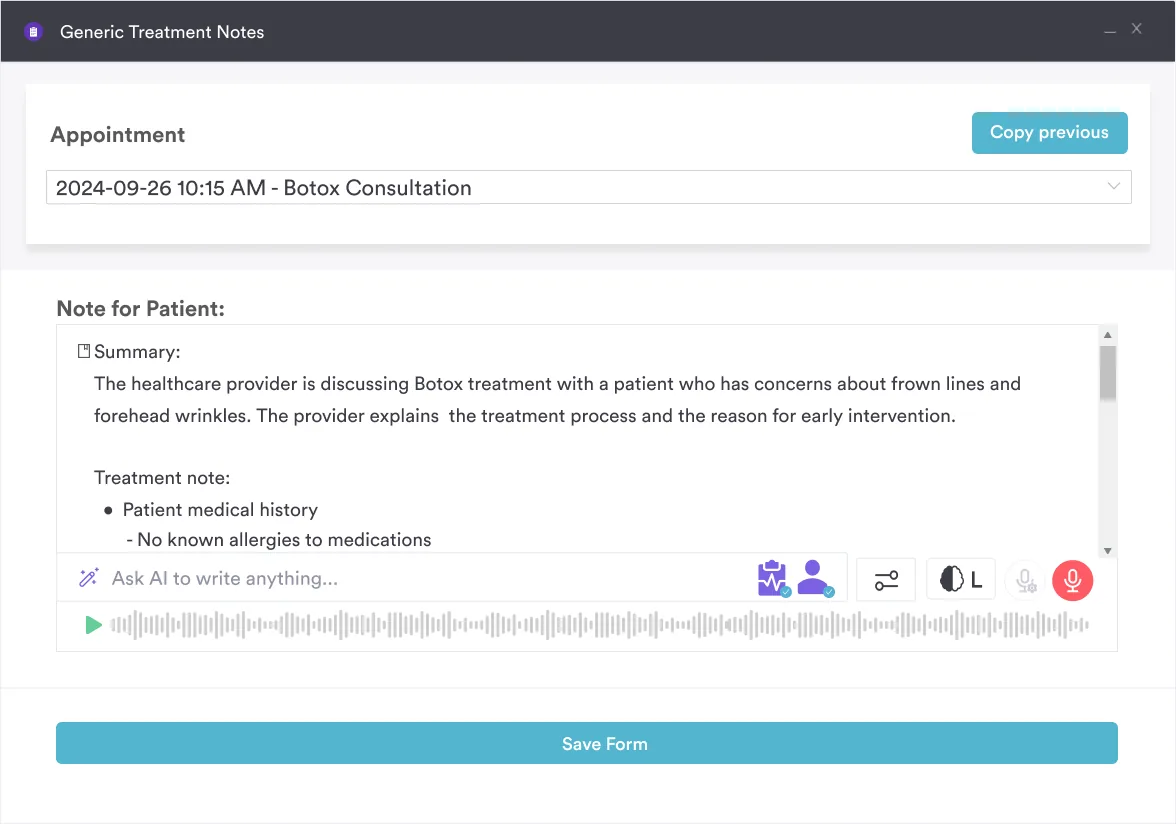
Practice management software like Pabau lets you store the worksheet in each client’s record and send it through the client portal. Completion is timestamped, so you can see before the session opens whether the client did the practice. Their answers attach to the clinical note instead of arriving as a loose PDF.
From there the record does the work for you. Reporting is included in every Pabau subscription, so you can see which skills a client has worked and how often. A mental health EMR that holds the notes, the forms, and the schedule together also means the next clinician picks up the same picture.

Assign worksheets through the client portal, see who completed them, and build emotion regulation into the treatment plan without a second system.

Emotion regulation is learnable, which is the whole premise of handing a client a worksheet. The sheet does not do the work, though. What decides whether it helps is the match between the skill you assign and the way that client’s regulation fails.
So pick one skill, work the first sheet through together, and review what came back before you add a second. A client who practices one skill imperfectly for two weeks learns more than one who reads about four.
Download the PDF and use it in your next session. Tracking who completed what is often the part that keeps slipping. Book a demo and see how a finished worksheet lands in the client’s record for you.

Looking for a structured framework to guide long-term treatment planning? Mental health EMR practice software helps clinicians organize skill-building across phases of therapy.
Need a plan for the sessions where regulation skills are not enough? Crisis intervention strategies for clinicians sets out what to do when a client arrives in acute distress.
Working with a client who cannot rate how angry they are? The anger meter worksheet gives them a simple intensity scale to fill in before the skill work starts.
Client can name the feeling but cannot say it out loud? The expressing emotions worksheet covers the step after identification, which is putting the emotion into words.
Emotional regulation is the ability to notice an emotion, work out what triggered it, and choose a response instead of reacting automatically. It matters because unregulated emotion drives impulsive decisions, relationship conflict, and neglected health. The National Institute of Mental Health links emotion regulation deficits to depression, anxiety, personality disorders, and substance use. Teaching the skills in therapy reduces symptoms and improves day-to-day functioning.
The four core DBT emotion regulation skills are Opposite Action, Check the Facts, PLEASE, and Mindfulness of Current Emotion. They cover acting against an urge, reality-testing a feeling, managing physical self-care, and observing an emotion without acting on it. One worksheet teaches all four, so the client can find out which of them fits their own pattern.
Worksheets on their own are teaching tools. Filling one in alone means no personalized feedback, no coaching in the moment, and no accountability. They still help between sessions, or for someone exploring the skills before starting treatment. For personality disorders, trauma, or severe depression, professional guidance makes the work both safer and more useful.
Mindfulness breaks the automatic loop of emotion, reaction, and reinforcement. Observing a feeling without judging it or acting on it puts space between the feeling and the behavior. Over time, moving from being consumed by an emotion to simply noticing it reduces overwhelm and widens the client’s choices. It works particularly well for rumination and anxiety-driven avoidance.
Yes. Child and teen versions use simpler language, visual aids such as emotion faces and color-coded feelings, and age-appropriate scenarios like peer conflict or school stress. ADHD and behavioral programs commonly build emotion worksheets into treatment. Parents who learn the same skills can reinforce them at home and model emotional awareness for their children.
Emotion regulation changes or lowers the intensity of a feeling. Distress tolerance accepts a painful emotion and manages it when immediate change is not possible. A client with anxiety uses Opposite Action to attend a feared event. If the anxiety stays afterwards, grounding and breathing help them sit with what is left. Comprehensive treatment needs both.