Physician credentialing checklist
A physician credentialing checklist lists every license, certificate, verificati...

Last Updated: Oct 23, 2026
A diaper weight chart matches a baby’s or adult’s weight to the right diaper size, which helps families avoid leaks and skin irritation. Newborn diapers fit babies up to 10 lbs and size 1 fits 8 to 14 lbs. After that, most babies move up a size every few months. Weight is the starting point, though brand ranges overlap and body build matters too.
This guide gives the weight thresholds for every standard size, plus brand tables for Huggies and Pampers and adult incontinence sizing. The downloadable sheet lets you record each baby’s weight and size at well-child visits.
A printable two-page sheet for logging a baby’s age, weight, and diaper size at each visit, with who recorded it and when. It also has fields for the reference range you used, its source, and the date you checked it.
Download template
A diaper weight chart maps each standard size, from preemie through size 7, to a weight range in lbs and kg. It gives pediatric teams and caregivers a consistent starting point.
Weight ranges overlap by 2-10 lbs between consecutive sizes. Huggies and Pampers ranges also differ noticeably, by up to several pounds, so fit checks always supplement weight data.
Signs to size up include red marks at the waist or thighs and leaks despite correct fastening. Tabs that only just reach the center of the front panel are another.
Pabau, the practice management platform we build, keeps weight readings and visit notes in the patient record. Diaper advice then stays part of the well-child visit.
The diaper weight chart below covers every standard consumer size from preemie through size 7. Ranges for newborn through size 6 match Huggies’ published chart. Because ranges overlap and every baby’s build differs, treat these figures as a starting range rather than a precise cutoff.
Sizes 1 and 2 overlap at 12-14 lbs, and sizes 3 and 4 overlap at 22-28 lbs. When a baby sits in an overlapping range, let the fit indicators in the sections below guide the final choice.
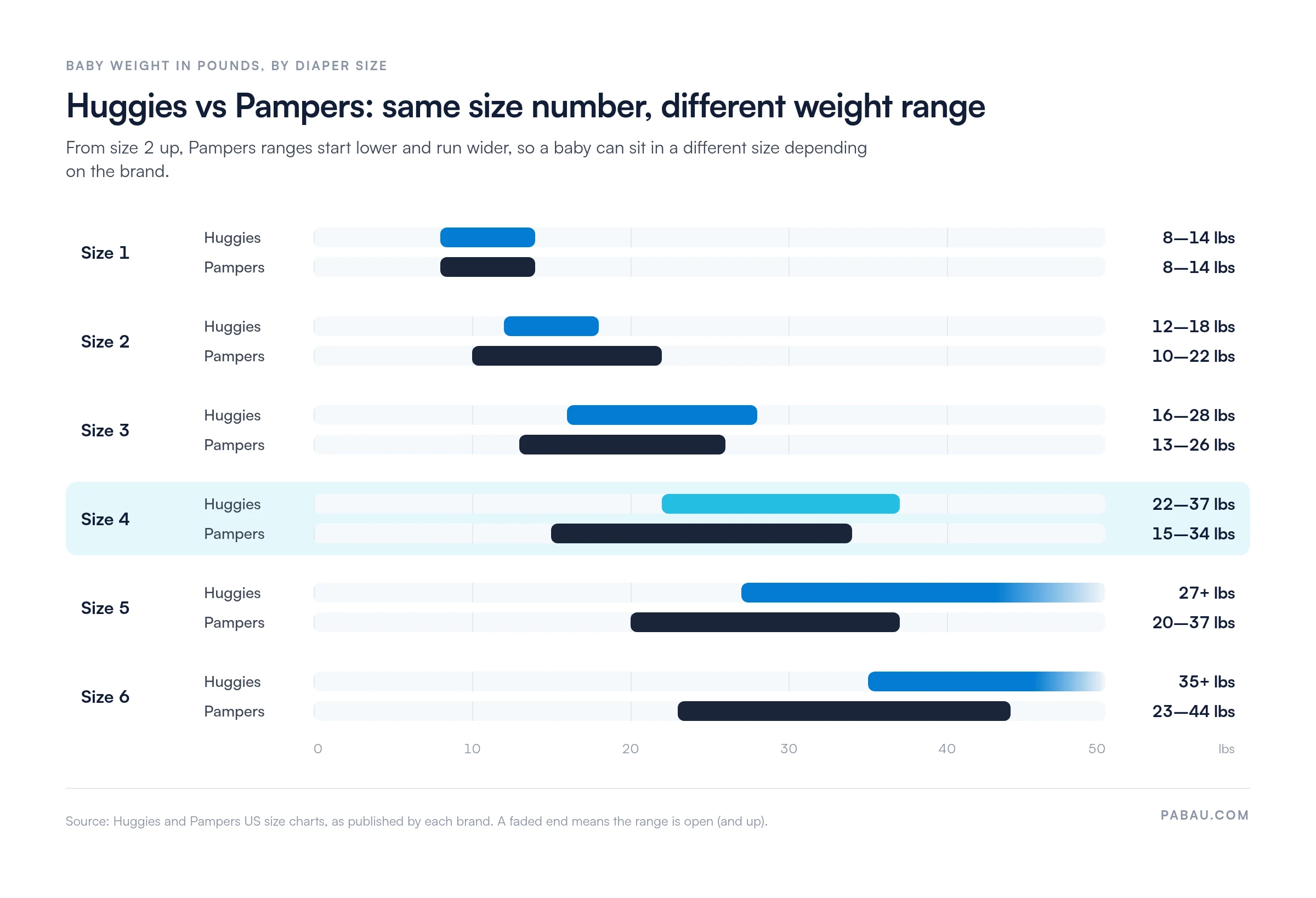
Huggies publishes its own weight thresholds for each size, and they match the general chart above from newborn through size 6. Pampers draws its lines differently, and the two brands’ ranges differ noticeably, by up to several pounds. Use these figures when families ask specifically about Huggies sizing.
Pampers publishes the ranges below, from preemie through size 8. Always verify against the current Pampers size guide before counseling families, as brand specifications occasionally update.
Set side by side, the two brands rarely agree on where a size starts. Pampers size 4 begins at 15 lbs, while Huggies size 4 begins at 22 lbs. The same baby can land in a different size number depending on the brand.
Adult incontinence products are sized primarily by waist and hip circumference, not weight. Weight is a rough secondary guide only. For accurate adult sizing, measure at the waist and at the widest point of the hips. Then use the larger of the two measurements to select a size.
Weight figures above are general estimates. Two adults of the same weight may need different sizes depending on body shape, so the tape measure takes priority over the scale.
Newborn diapers typically fit babies up to about 10 lbs, though many families skip NB entirely if their baby arrives above 8 lbs. Preemie sizes fit babies under 6 lbs. For very low birth weight infants, ask the NICU nursing staff about preemie sizing until the baby is gaining weight steadily.
Families often keep a small supply of NB alongside size 1 in the first month, and some babies stay in NB for 3-4 weeks. The birth weight recorded at the newborn exam is the baseline for every size decision after it.
Plotting the weight at the 2-week, 1-month, and 2-month visits on a pediatric growth chart shows when a size change is due. The diaper chart then tells you which size the new weight points to.
Breastfed babies follow the WHO curves, so plot those weights on a breastfed baby weight chart covering birth to 24 months. The weights you already take at each visit cover both sheets.
Size up when the current diaper stops fitting comfortably, whatever the scale says. A baby crossing a weight threshold is the cue to check fit, and the signs below tell you whether to switch.
Gaps or sagging at the waist point the other way and can mean a size down. When a baby sits in the overlap zone and the fit looks right, the larger size is usually the safer pick. A slightly roomy diaper rarely causes problems, while a too-small one causes redness and discomfort quickly.
Not every red patch under a diaper comes from sizing. A pediatric rash chart separates irritant, candidal, and allergic diaper rash, and gives the first-line treatment for each.
The weight chart is a starting point. Fit quality depends on body shape, leg circumference, and how the diaper is fastened. Two babies of the same weight may need different sizes because of differences in torso length and thigh build.
A properly fitting diaper passes three quick checks at every change:
Pediatric practices that document growth measurements at well-child visits can check weight against the chart. They can then flag a size change before parents notice problems.
When counseling new parents on diaper sizing, pair the diaper weight chart with the two-finger waistband test. Weight tells you which sizes to consider. The fit test tells you which one to use. A one-minute demonstration at the 1-month visit gives parents a check they can repeat at home.
In many pediatric practices, diaper advice is given out loud while the weight behind it sits in a separate log. The printed chart goes home in a diaper bag, and the next clinician has no note of what the family was told.
Pabau stores each visit’s weight and notes together in the patient record. You can send this sheet as a digital form before or after the visit, so it’s filed against the right patient automatically.
It sits inside our software for family practices, alongside scheduling, reminders, and billing. At the next well-child visit, the clinician sees the last weight, the last size advice, and the form the family received.

Keep growth data, weight logs, and patient notes in one place. Your pediatric team spends less time on admin and more time with families.

Weight picks the shortlist and fit picks the diaper, so give families both at the same visit. Ask which brand they buy, because Huggies and Pampers can put the same baby in different size numbers from size 2 up.
The trade-off is two minutes of fit coaching at the 1-month visit. That costs less than a run of phone calls about leaks and red marks later. It also gives parents a test they can repeat on their own.
Book a demo to see how Pabau keeps weight logs and sizing advice in one patient record for your pediatric team.

Tracking growth between well-child visits? Pediatric growth chart calculator template helps you track a child’s growth from one visit to the next.
Recording the birth weight and first checks? Newborn exam template gives you a downloadable checklist for the first newborn examination.
Counseling parents on feeding as well as diapers? Infant milk intake chart sets out typical feeding volumes from birth to 12 months.
Need normal vital sign ranges by age? Pediatric vital signs chart sets out normal ranges by age for quick reference at the visit.
Planning a full well-child examination? Pediatric physical examination guide walks through each part of the exam, step by step.
A diaper weight chart is a reference table that matches a baby’s body weight to the corresponding diaper size. It gives caregivers and clinicians a consistent starting point for choosing a product. Charts typically run from preemie through size 7 for babies and from small through X-large for adult incontinence products.
A 10 lb baby sits at the top of the newborn range and the low end of size 1 (8-14 lbs). Most families move to size 1 around this weight, but fit should confirm the switch. If the tabs still fasten in the center zone and the waistband passes the two-finger test, newborn may work a little longer.
No. Huggies and Pampers weight ranges differ noticeably, by up to several pounds in some sizes. Other brands such as Coterie or Seventh Generation may vary further. Always check the brand-specific chart for the product a family is using rather than assuming universal ranges apply.
Yes. Body shape, thigh circumference, and torso length all affect fit independently of weight. A baby with chunky thighs may need a larger size than weight alone suggests. A long, lean baby of the same weight may fit a smaller one. Weight is the starting point, and fit checks determine the final size.
Size up when you see red marks at the waist or thighs after removal, or tabs that barely reach the center panel. Recurring leaks despite correct fastening are another sign. Fit indicators should drive the switch more than weight alone. When in doubt, try one size up for a day before committing to a bulk purchase.