HIPAA compliant texting: What you can send patients & how to communicate securely
HIPAA compliant texting is possible when a text holds no protected health inform...

Last Updated: Oct 16, 2026

A comprehensive newborn exam is the systematic head-to-toe physical assessment of a neonate performed within 24-72 hours of birth to identify congenital anomalies, birth injuries, and transition-of-care issues.
The structured assessment covers vital signs, anthropometrics (weight, length, head circumference), and all organ systems including cardiovascular, respiratory, neurological, and skin evaluation.
Documentation of APGAR scores, primitive reflexes (Moro, rooting, grasp, sucking), and any abnormal findings is essential for clinical decision-making and legal protection.
Practice management software like Pabau lets you capture all exam components with digital forms and customizable templates, attach photos and findings, and create audit-ready clinical records within minutes.
A ready-to-use assessment framework covering vital signs, anthropometric measurements, head-to-toe system assessment, APGAR scoring, and newborn screening procedures.
Download templateEvery newborn needs a systematic physical exam within the first 24 to 72 hours of life, and it’s easy to miss a step when you’re relying on memory or scattered notes.
This newborn exam template gives your team one standardized checklist for vital signs, growth measurements, system-by-system findings, APGAR scoring, and mandatory screening, so every infant gets the same thorough evaluation and a properly documented record every time.
A newborn exam is a comprehensive clinical assessment performed on all neonates within the first 24 to 72 hours after birth. Healthcare professionals-including pediatricians, neonatologists, family medicine physicians, and midwives-conduct this systematic evaluation to identify normal findings, detect congenital anomalies, assess birth injuries.
The newborn exam serves multiple clinical purposes. It establishes baseline health status, screens for life-threatening conditions (critical congenital heart disease, metabolic disorders, hearing loss), evaluates the infant’s transition from intrauterine to extrauterine life, and provides legal documentation of the child’s condition at birth. Each examination component-from vital signs to neurological reflexes-carries specific clinical significance.
According to the American Academy of Pediatrics, or AAP, a thorough newborn exam requires systematic assessment of every organ system. The examination is documented in the clinical record, communicates findings to other care providers, and forms the foundation for ongoing pediatric surveillance.
Surveillance continues at the visits that follow, where a well-child visit checklist records growth plotting, developmental milestones, and behavioral screening.
A newborn exam template standardizes the assessment process and ensures no critical element is missed during the initial evaluation. Nurses assessing non-newborn patients rely on a similar structure with a general health assessment form.
The template creates a structured clinical record that can be easily shared across care settings, referenced at follow-up visits, and integrated into the infant’s permanent medical record. Using digital forms and templates in practice management software accelerates documentation and ensures consistent capture of all required findings.
A newborn assessment form follows the same head-to-toe sequence on a printable sheet. It leaves space for APGAR scores, vital signs, primitive reflexes, Ballard gestational age scoring, and screening results.
The newborn exam template supports multiple healthcare settings and professional groups.
An occupational therapy platform can store each completed scale beside the patient’s goals and session history.
Completeness and consistency: A structured template reduces the risk of overlooking critical findings. Every clinician uses the same assessment framework, ensuring uniform documentation across your practice or facility.
Clinical safety and regulatory compliance: Comprehensive documentation of the newborn exam provides evidence of due diligence in screening for congenital conditions. The template documents your adherence to AAP guidelines and state newborn screening mandates, protecting both the patient and your practice from liability.
Efficient care transitions: When results are documented in a standardized format, handoffs to other providers (pediatricians, specialists, public health) are clearer. A shared record reduces duplicate testing and accelerates identification of abnormalities requiring urgent referral or intervention.
Time savings for clinicians: A digital template with customizable fields and pre-filled normal ranges. Pre-and post-care instructions can be auto-populated and sent to families, reducing administrative burden.
Track all newborn exam findings in a single system. When your clinical records, newborn screening results, and family communication live in one place, like they do in Pabau, you eliminate lost records, reduce data entry errors, and ensure no follow-up referrals slip through the cracks. Practices with high newborn volumes see a meaningful drop in time spent on documentation as a result.
The APGAR score (Appearance, Pulse, Grimace, Activity, Respiration) is the most widely used tool for rapid assessment of the newborn’s condition immediately after birth.
A total score of 7-10 is reassuring and reflects a vigorous newborn. A score of 4-6 is moderately abnormal and warrants close observation with possible intervention. A score of 0-3 signals severe depression and calls for immediate resuscitation per Neonatal Resuscitation Program (NRP) guidelines.
In practice, NRP resuscitation starts from a rapid initial assessment of tone, breathing, and heart rate in the seconds after birth, not from waiting on the numeric APGAR score. The score itself is assessed at 1 minute and again at 5 minutes to track the newborn’s response to any resuscitation.
After the newborn exam is complete, multiple screening tests are performed within the first 24-48 hours of life. According to the American College of Medical Genetics and Genomics, or ACMG, state-mandated newborn screening programs now include metabolic disorder screening, hearing assessment, critical congenital heart disease (CCHD) screening, and other tests depending on regional guidelines.
Integrating screening test results with the physical exam findings provides a complete picture of the newborn’s health status.
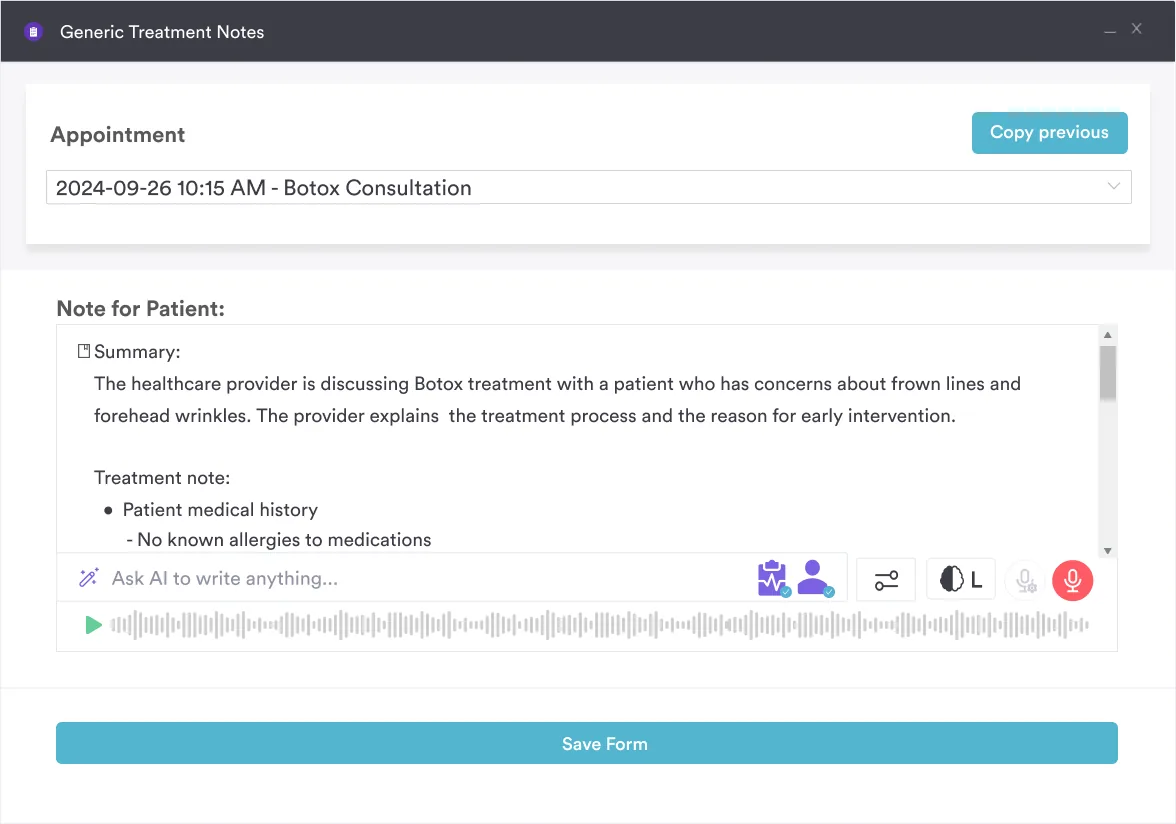
Modern practice management software lets you create customized newborn exam documentation workflows. Structured templates capture APGAR scores, vital signs, anthropometrics, system-by-system findings, primitive reflexes, and screening results in standardized fields.
Digital documentation offers time savings: auto-populated normal ranges eliminate manual lookups, voice-to-text features accelerate narrative note entry, and pre-built parent education handouts auto-generate based on exam findings. Your clinical team spends less time on paperwork and more time with patients, while the permanent record is audit-ready and easily shared with specialists or follow-up providers.
Normal variants: Many findings observed during the newborn exam are transient and resolve without intervention. Caput succedaneum (head swelling from birth trauma), cephalohaematoma (blood under scalp), and mild jaundice in the first 24 hours are common. Vernix (waxy coating), lanugo (fine body hair), and milia (tiny white bumps on the nose) are normal skin findings.
Red flag findings: Persistent cyanosis (blue lips/fingers), severe respiratory distress (grunting, flaring, retractions), absent or extremely weak primitive reflexes, feeding difficulty, jaundice within the first 24 hours of life, and asymmetric findings all warrant urgent follow-up evaluation. A positive Barlow or Ortolani maneuver (hip click during examination) signals possible developmental dysplasia and requires imaging and orthopedic referral.
A systematic newborn exam template ensures every infant receives a complete, consistent health assessment within hours of birth. Whether you document findings on paper or use digital forms in Pabau, a thorough, organized evaluation protects the newborn’s health and your practice’s credibility. Download the template above and customize it to your practice’s workflow today. Book a demo to see how Pabau fits into your newborn exam workflow.

Assessing pain in a non-verbal patient? Abbey Pain Scale template scores six behavioral categories in one minute to guide pain management.
Managing a patient’s GERD symptoms? Acid reflux care plan covers symptom assessment, trigger identification and dietary guidance for GERD management.
Caring for a patient with reduced capacity? Activity intolerance nursing care plan structures assessment, diagnosis and outcome measurement for reduced physical capacity.
A newborn exam is a comprehensive physical assessment performed on all neonates within 24-72 hours after birth by a pediatrician, family medicine physician, or midwife. It evaluates vital signs, growth parameters, and all organ systems to detect congenital anomalies, birth injuries, and transition-of-care issues.
A score of 7-10 is reassuring and indicates a vigorous newborn. A score of 4-6 is moderately abnormal and warrants observation with possible intervention, while a score of 0-3 requires immediate resuscitation. NRP resuscitation starts from a rapid initial check of tone, breathing, and heart rate, not from waiting on the numeric score. The test itself is performed at 1 minute and again at 5 minutes after birth.
Essential components include vital signs (heart rate, respiratory rate, temperature, oxygen saturation), measurements (weight, length, head circumference), general appearance and skin assessment, head and fontanelle examination, eye red reflex testing, heart and lung auscultation, abdominal palpation, genitalia and anus assessment, hip examination (Ortolani and Barlow maneuvers), and primitive reflex documentation (Moro, rooting, grasp, sucking).
Normal newborn vital signs are: heart rate 100-160 beats per minute, respiratory rate 30-60 breaths per minute, axillary temperature 36.5-37.5°C, and oxygen saturation greater than 95% on room air. These ranges guide immediate assessment of the newborn’s condition and readiness for discharge.
The Newborn and Infant Physical Examination (NIPE) is the UK NHS screening programme performed within 72 hours of birth and again at 6-8 weeks. It follows the same systematic head-to-toe approach as the US newborn exam but is integrated into the UK’s public health surveillance system for all infants.
Use a structured template or checklist that captures all system-by-system findings, APGAR scores, vital signs, measurements, primitive reflexes, and any abnormal findings with clinical significance. Digital documentation in a practice management system ensures consistency, prevents omissions, and creates an audit-ready record for regulatory and liability purposes.