Health appraisal form
A health appraisal form is a record a licensed provider signs to document someon...

1
Last Updated: Oct 13, 2026
A newborn feeding schedule is a framework for how often and how much a baby eats in the first weeks of life. Most newborns feed 8 to 12 times every 24 hours. The pattern shifts with feeding method, and at this age hunger cues beat the clock.
This guide sets out typical frequencies and volumes week by week, and how breastfeeding and formula schedules differ. It also covers cluster feeding, premature babies, and the signs that a baby is thriving. The downloadable template below is a practical way to document early nutrition and diaper output.
A printable daily tracker for feed times, volumes, feeding type, and wet and dirty diaper counts across the first four weeks. Use one sheet per day, with space for notes to take to your pediatrician.
Download template
Newborns feed 8 to 12 times per 24 hours at first, roughly every 2 to 4 hours.
Hunger cues such as rooting, hand-to-mouth movements, and fussiness are a better guide than the clock.
Bottle volumes climb from about 1 to 2 oz per feed in week one to roughly 4 oz by one month.
Cluster feeding in the evening is normal in the first weeks and does not mean your milk supply is low.
Track feeds, amounts, and wet and dirty diapers on the free template so checkups start from a record.
Newborns should feed 8 to 12 times per 24 hours during the first few weeks, according to the American Academy of Pediatrics (AAP). Exclusively breastfed babies usually feed every 2 to 4 hours. Bottle-fed newborns typically eat every 2 to 3 hours. Individual babies vary widely around those averages.
The bigger decision is responsive feeding versus clock feeding. The AAP recommends responsive feeding, which means offering milk whenever your baby shows hunger cues. A baby crying from hunger is already past the early signs. Catching those earlier signs leads to calmer feeds.
Rooting is usually the first cue parents learn to read, and it is one of several reflexes that fade over the first months. An infant reflexes chart shows which ones appear at birth and when each one disappears.
A baby who sleeps through feeds and is hard to rouse needs a check rather than a longer nap. Jaundice is one common reason, and an infant bilirubin chart shows how levels are read against a baby’s age in hours.
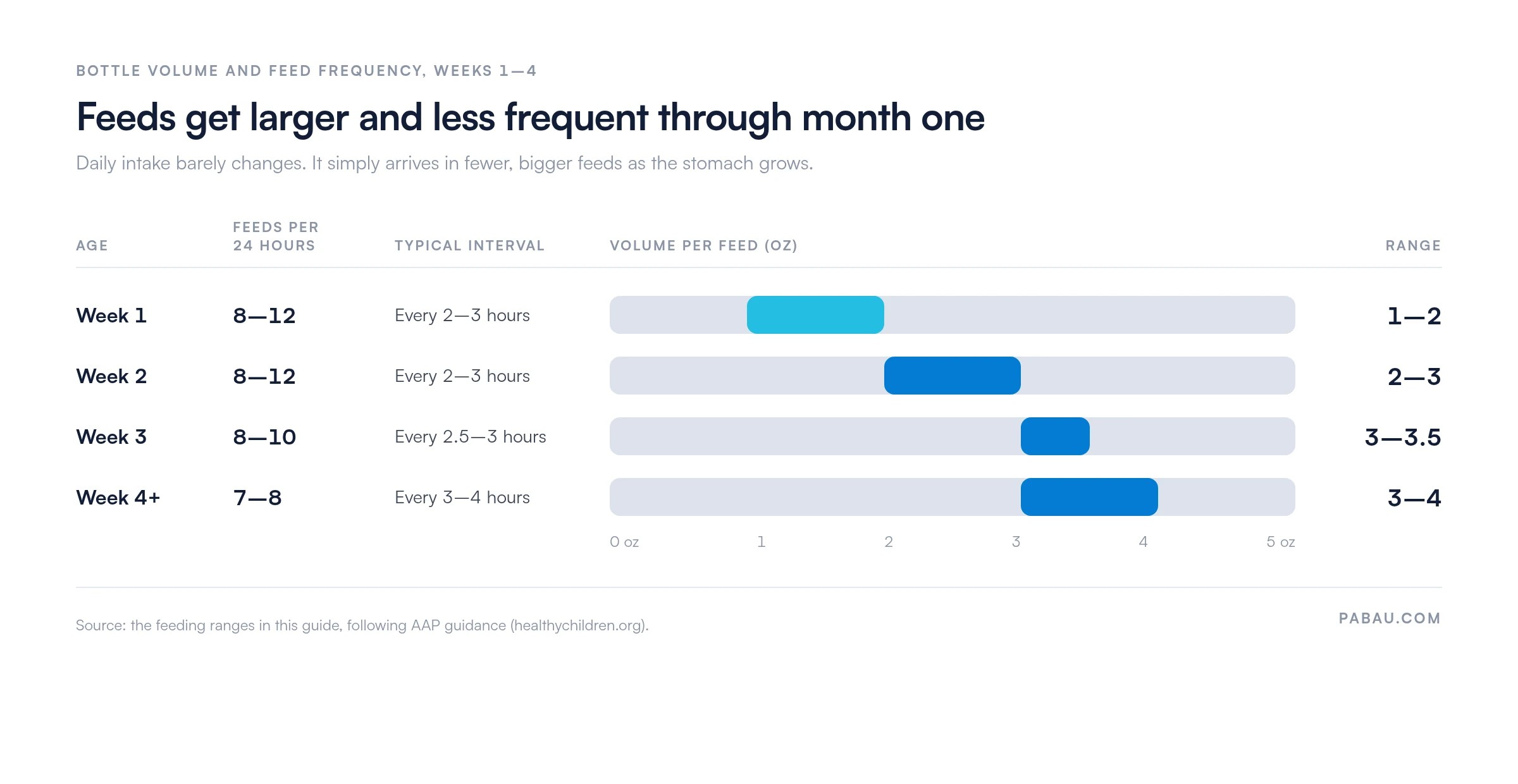
The table below shows typical week-by-week patterns. These are general ranges rather than prescriptions, and a baby who feeds more or less often can still be perfectly healthy.
The trend across those rows matters more than any single row. Volume per feed roughly doubles over the month while the number of feeds falls, so daily intake stays broadly level.
Breastfed newborns feed more often than formula-fed babies because breast milk digests faster. Most exclusively breastfed babies nurse 8 to 12 times per 24 hours in the first weeks. Intervals vary more than with formula, because milk transfer differs between babies and mothers.
The AAP recommends exclusive breastfeeding for about the first six months. In the newborn period, feed on demand rather than to a fixed schedule. This supports the supply-and-demand cycle, because the more your baby feeds, the more milk your body makes.
Formula-fed newborns follow a steadier pattern than breastfed babies, because formula takes longer to digest. Most bottle-fed newborns eat every 2 to 3 hours, which works out at roughly 8 to 12 feeds per 24 hours. The volume per feed climbs as your baby grows.
Never push a baby to finish a bottle. Babies self-regulate well when they are fed responsively. Stop the feed when your baby turns away, closes their mouth, or loses interest.
Volumes vary by feeding method and by the size of the baby. Formula-fed babies take about 1 to 2 oz per feed in week one, rising to around 4 oz by one month. Breastfed babies take similar volumes, though you cannot measure them directly.
A useful rule of thumb is about 2.5 oz per pound of body weight per 24 hours. A 7-pound newborn needs roughly 17.5 oz a day, spread across 8 to 12 feeds. Treat it as an estimate rather than a target, because growth, wet diapers, and contentment between feeds tell you more.
If you want those daily totals written out by weight, an infant milk intake chart does the arithmetic for you. It converts a baby’s weight into a daily range and a per-feed figure.
Cluster feeding is a run of feeds bunched close together over a few hours, usually in the late afternoon or evening. Feeds may come every 1 to 2 hours during that stretch. It is normal, and it does not mean your baby is going hungry.
Cluster feeding is a standard newborn pattern rather than a sign of low supply. The extra demand signals your body to make more milk, which is part of how supply is established.
Premature babies are fed according to their adjusted age, also called corrected age, rather than their age since birth. A baby born 8 weeks early has an adjusted age of 0 weeks at 8 weeks old.
Ask your pediatrician or neonatologist for a schedule built around your baby. Very premature babies, born before 32 weeks, often start on very small volumes given by feeding tube.
Some begin with as little as 0.1 oz at a time, then move to the bottle or the breast. Feeding readiness depends on how well the baby tolerates nutrition and coordinates sucking with swallowing.
Rather than counting ounces, watch for the signs that feeding is going well.
Your pediatrician plots that weight on a growth curve at every visit, which shows the trend rather than a single number. A pediatric growth chart does the same percentile math between appointments.
If your baby is not meeting these markers, or if feeding worries you, contact your pediatrician or a lactation consultant. Raising it early helps catch feeding problems before they affect growth.
The template records feeding patterns, milk intake if you bottle-feed, and diaper output. Your midwife or pediatrician may ask for exactly that at a checkup.
Print one sheet per day, or start a fresh sheet every few days. Bring the pages to the first checkup, usually at 3 to 5 days old, and to later pediatrician visits. Feeding and output are part of the newborn exam, so the clinician will have the numbers in front of them.
Practices can collect the same information without paper. Digital intake forms and automated reminders let a team send a feeding questionnaire home and get the answers back into the record.
A paper feeding log usually leaves the practice at discharge and is never seen again. The parent fills in two days, the sheet goes into a bag, and the next check starts from memory.
Pabau, the practice management platform we build, sends the same tracker as a digital form on a schedule the team sets. Parents complete it on a phone, and the answers land in the patient record before the appointment.
Teams running general practice and family care use GP clinic software to hold that record in one place, alongside appointments, growth measurements, and recall reminders. The 6-week check then opens with two weeks of feeding data rather than a blank page.

Pabau sends feeding and wellness forms to parents before a visit and chases the ones that come back late. Every answer files itself into the patient record.

Feeding a newborn settles faster once you watch the baby instead of the clock. The ranges in this guide tell you whether you are in normal territory. Diapers, weight, and a settled baby tell you whether it is working.
Write the feeds down for the first month, even roughly. Two weeks of rough notes answer more questions at a checkup than any attempt to recall the week.
For practices handing this template out, collecting it back is the work. Book a demo to see how Pabau gathers feeding records from parents and files them before the visit.

Packing for the birth? Hospital bag checklist lists what to take for the parent and the baby, feeding supplies for the first days included.
Wondering how feeding affects sleep? Pediatric sleep questionnaire gives practices a structured way to record night waking, feeds, and settling patterns.
Running a newborn checkup? Pediatric review template covers the history, growth, and development questions that follow on from feeding.
Need the full head-to-toe exam? Pediatric physical examination walks through each body system in order, with the findings worth documenting.
Newborns feed 8 to 12 times per 24 hours in the first weeks. Breastfed babies average every 2 to 4 hours and bottle-fed babies every 2 to 3 hours. Use hunger cues such as rooting and hand-to-mouth movements rather than the clock.
Formula-fed newborns take about 1 to 2 oz per feed in week one, rising to around 4 oz by one month. Breastfed babies take similar volumes, though exact amounts are hard to measure. A general guideline is about 2.5 oz per pound of body weight per 24 hours.
Yes. Cluster feeding means feeds bunched close together over a few hours, usually in the evening and often every 1 to 2 hours. It is most common in weeks 1 to 4 and does not mean your milk supply is low.
Look for at least 5 to 6 wet diapers and 3 to 4 dirty diapers per 24 hours by day 5. Add steady weight gain after the initial loss, and a baby who settles after feeds. Contact your pediatrician if your baby is not meeting these markers.
Yes. Premature babies are fed on adjusted age, counted from the due date rather than the birth date. Ask your neonatologist for a schedule built around your baby’s health and feeding readiness.
The AAP and WHO recommend responsive feeding, which means feeding when your baby shows hunger cues rather than on a fixed schedule. It supports milk supply and fits newborn physiology better than clock feeding.