Maja Popovska

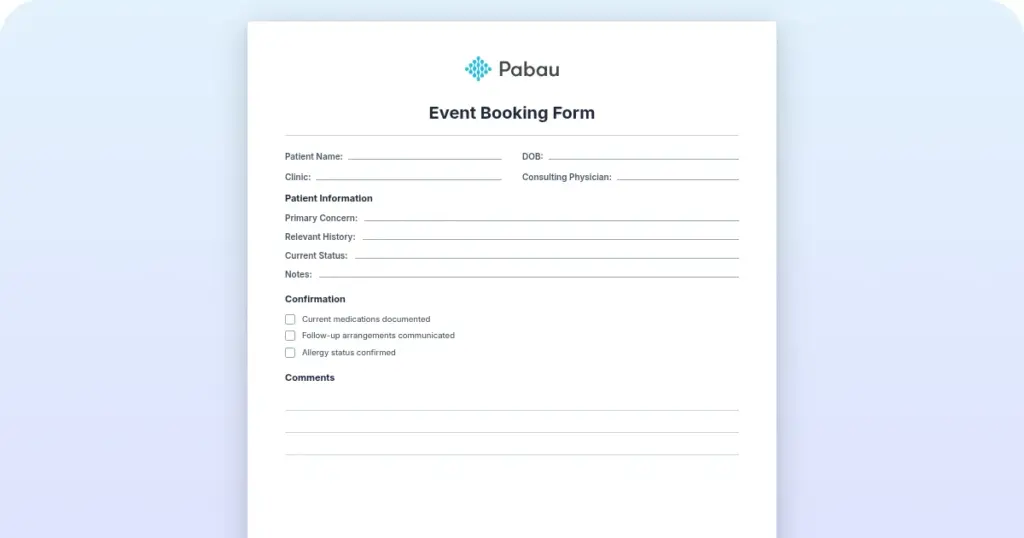
Event booking form
What is an event booking form? An event booking form is a structured document th...

1
Last Updated: Nov 12, 2026
Free PDF 3 pages, print-ready Clinician-reviewed
A personal training assessment form is a structured intake document that captures a new client's health history, fitness goals, lifestyle habits and baseline physical data before the first session. Trainers use it to check suitability for exercise, flag risks that need medical clearance, and build a programme that fits the client. Without one, key safety details often surface only after training has started.
Many trainers rely on memory, a verbal chat or a loose notes app for this stage. That works until a client mentions a heart condition halfway through a session. A written form gives every client the same screening, creates a record you can refer back to, and shows you have asked the right questions.
This guide explains what the form should cover, how it differs from a PAR-Q, and how to use it with in-person and online clients. It also covers how often to reassess and how to store the completed forms securely. You can download the template at the end of this introduction.
A ready-to-use assessment covering health history, medical screening questions, fitness goals, lifestyle habits, physical baselines and consent declarations for new personal training clients.
Start from scratch, or upload this PDF or any form you already use, and Pabau's AI Form rebuilds it with tick boxes, text fields and a signature. Attach it to the treatment once, and every patient gets it on time.
AI Form rebuilds the consent, history and aftercare forms you already use. You review each one, then publish.
Patients complete forms on their phone before they arrive, so the front desk stops retyping paper.
Every signed form is versioned and attached to the treatment record, ready when you need it.
Set how long a consent stays valid. Returning patients skip forms they have already signed.
Supports HIPAA and GDPR compliance AES-256 encryption 4.8 on G2 4.7 on Capterra Trusted by 4,000+ practices worldwide

A personal training assessment form screens health, goals and lifestyle before the first session
It should include PAR-Q style medical questions and a clear informed consent section
Reassess at set intervals and whenever a client’s health or goals change
Store completed forms securely, since health data is sensitive under GDPR
Pabau keeps assessment forms in the client record and sends them automatically at booking
A personal training assessment form is a written pre-programme document that collects a client’s medical background, training history and goals. It sits between the enquiry and the first workout. Its job is to confirm the client is ready to exercise, and to give the trainer enough detail to design a safe starting plan.
It differs from a PAR-Q in scope. A PAR-Q is a short yes/no screen for readiness to exercise. The assessment form goes further, capturing history, goals, lifestyle and baseline measurements that shape the programme itself.
It also differs from a liability waiver. The waiver records the risks the client accepts. The assessment records what the trainer knows about the client, so the two documents usually sit side by side.
The template above is a ready-to-print PDF for new clients. It is a starting point, not a legal document in its own right. Adapt the wording to your certifying body’s guidance and your local rules before you use it.
A complete personal trainer fitness assessment form covers six areas, each serving a different decision. Medical questions determine whether the client needs clearance first. Goals and preferences shape the programme. Lifestyle answers explain recovery and adherence risks.
| Section | What it captures | Why it matters |
|---|---|---|
| Health history | Conditions, medications, injuries | Identifies contraindications |
| Fitness goals | Targets, timeline, motivation | Sets the programme direction |
| Lifestyle | Sleep, diet, hydration, stress | Affects recovery and adherence |
| Baselines | Body measurements, strength, cardio, flexibility | Provides a measurable starting point |
| Consent | Risk acknowledgement and signature | Documents informed agreement |
Ask about diagnosed conditions, current medications, past injuries and any symptoms during exertion. A yes to chest pain, dizziness or breathlessness should trigger a referral to a physician before training begins. The form should say so plainly.
Record the client’s main goal, a realistic timeline and the training styles they enjoy. Note availability and any equipment access. Clear goals give you a benchmark for progress at later reassessments.
Capture typical sleep hours, daily activity outside sessions, water intake and stress levels. These answers explain why a client may struggle with recovery. They also help you set realistic weekly volume.
Keep the health questions near the top of the form. Clients are more likely to answer honestly before they reach the goals section, and you spot contraindications before planning anything.
Baseline data turns a conversation into a measurable starting point. The American College of Sports Medicine (ACSM) recommends fitness assessments before a new exercise programme, and its guidance on exercise testing sets out the broad categories used here. Record what you measure and the method, so the same test can be repeated later.
Movement screens such as the overhead squat or a single-leg balance show how the client moves under load. Note pain, asymmetry or compensation patterns on the form. Pair each result with the test used so the record stays useful.
Remote clients need the same screening as in-person clients, delivered in a way they can complete alone. Send the form digitally before the first video call so you can review answers in advance. Pabau’s digital forms can be sent at booking and stored in the client record.
A PAR-Q is a short readiness screen, and the assessment form is a full intake record. Use the PAR-Q, or the PAR-Q+ published by the Canadian Society for Exercise Physiology (CSEP), as the first gate. Use the assessment form to build the programme after the client passes it.
Complete the full form once at the start, then review the key sections at set points. Many trainers reassess every 4 to 6 weeks for new clients, though the interval varies by certifying body and programme. ACSM advises periodic reassessment without fixing a single interval.
Health data is special category data under UK and EU GDPR, so forms need secure storage and a clear retention period. Paper forms in a gym office rarely meet that standard. A digital record with access controls and an audit trail is easier to defend.
Pabau stores assessment data in a GDPR-compliant environment with configurable retention settings and audit trails. Trainers working in clinical or medical fitness settings should also check their own HIPAA obligations for US clients.
A personal training assessment form is a written intake document that records a client’s health history, goals, lifestyle and baseline measurements before training starts. It helps trainers confirm suitability and design a safe programme.
Include health history and medical screening questions, fitness goals, lifestyle habits, physical baselines, movement notes and a signed consent section. Keep medical questions near the top.
Yes, the template above is available as a PDF download. Review the wording against your certifying body’s guidance before use.
No, a PAR-Q is a short readiness screen, while the assessment form captures full history, goals and baselines. Most trainers use the PAR-Q first and the assessment form second.
Complete the full form at the start, then review key sections every 4 to 6 weeks and after any change in health. Reassessment intervals vary by certifying body.