Fertility clinic marketing: Strategies that attract & convert patients
Fertility clinic marketing is how a fertility practice attracts, educates, and c...

Last Updated: Oct 14, 2026
A mind over mood worksheet is a cognitive behavioral therapy form that takes a client from a triggering situation to a balanced alternative thought. Christine Padesky and Dennis Greenberger wrote the set, and Guilford Press publishes it.
The set has four forms, each with a different job. The 7-column thought record does the cognitive work, and the other three handle symptom tracking, avoidance, and clients who need a gentler start. The template below covers thought records, mood tracking and behavioral activation planning, so you can hand a client a form today.

A mind over mood worksheet is a CBT form for identifying automatic thoughts, testing them against evidence, and building a balanced alternative.
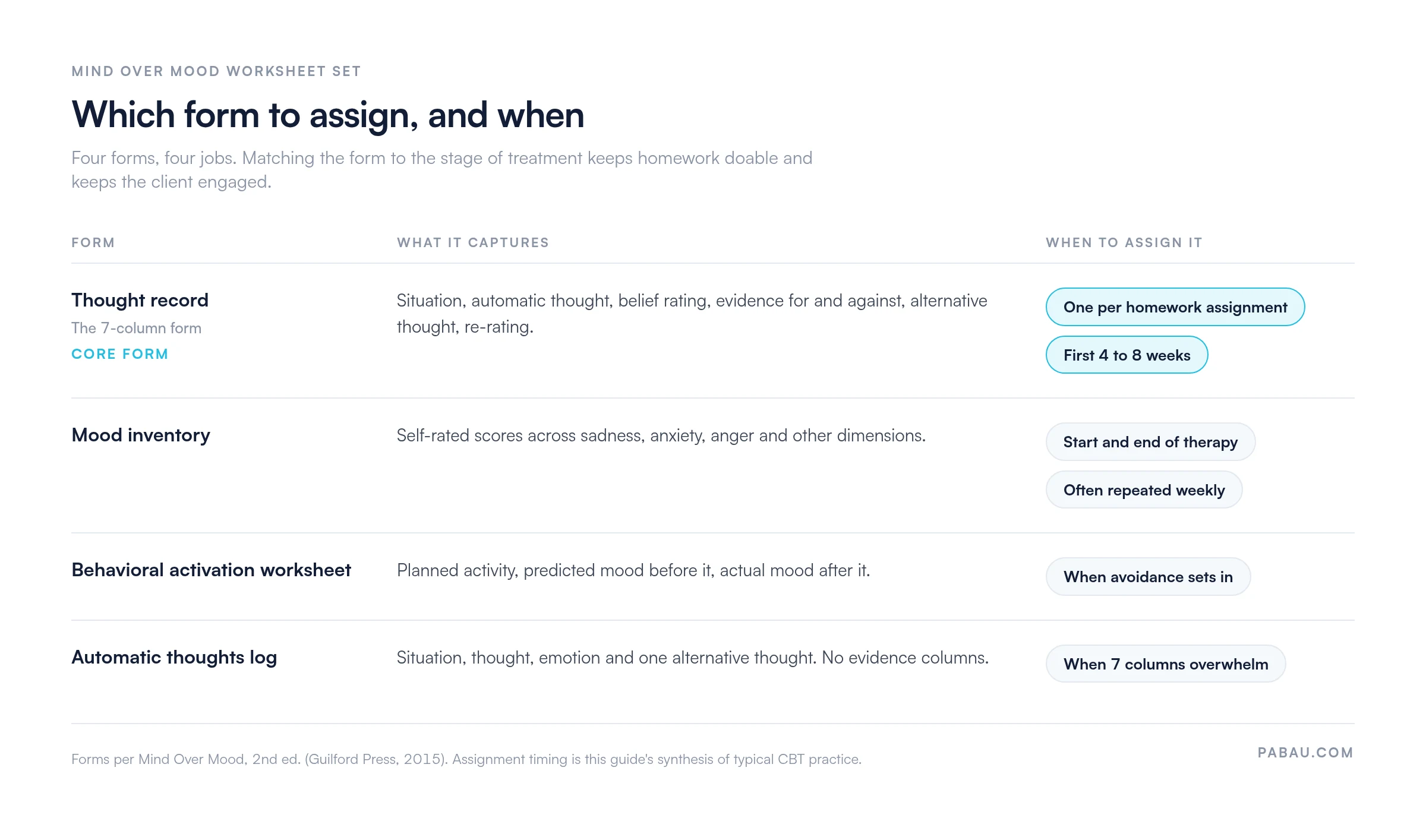
The four core forms are the 7-column thought record, the mood inventory, the behavioral activation worksheet, and the automatic thoughts log.
Therapists must buy the Mind Over Mood book or license official digital versions to reproduce the worksheets for clients.
Free sample worksheets sit on mindovermood.com, so you can evaluate the format before committing to the book.
Practice management software like Pabau turns the worksheet into a digital form, sends it before the session, and stores the completed copy.
A structured therapeutic tool for identifying, understanding, and modifying negative thought patterns using cognitive behavioral therapy principles. Includes thought records, mood tracking, and behavioral activation planning.
Download templateA mind over mood worksheet is a structured clinical form used in cognitive behavioral therapy to examine and modify negative thought patterns. The worksheets come from the book Mind Over Mood, first published in 1995. Guilford Press released the second edition in October 2015.
The principle behind them is simple. Automatic thoughts, the immediate reactions we have to a situation, shape mood and behavior. Documenting those thoughts, testing their accuracy, and writing an alternative perspective shifts the emotional response that follows.
These forms show up across therapy practices, counseling centers, coaching practices, and student counseling services. They are also useful for mental health practice management teams handling documentation for a large caseload. The cognitive behavioral therapy behind them is well established, and the American Psychological Association recommends CBT as a treatment for post-traumatic stress disorder.
Working through a thought record takes five steps that mirror the CBT model. Each one builds awareness and moves toward a change the client can act on.
This sequence is the 7-column thought record, and it is the centerpiece of the Mind Over Mood program. Therapists walk clients through it repeatedly until the cognitive model becomes second nature. Many clients report that after 8 to 12 weeks of practice, catching and challenging a thought stops feeling like a worksheet exercise.
The worksheets are built for several audiences, and the version you assign depends on which one you are working with.
A worksheet does two jobs at once. It gives the client structure, and it gives the therapist a record to plan the next session from.
The Mind Over Mood second edition carries several worksheet templates, each aimed at a different therapeutic goal. The grid below shows what each form captures and when to hand it over.
Four practices make the difference between a worksheet that gets completed and one that gets ignored. First, introduce the cognitive model explicitly, early in treatment. Clients who understand why a thought record works are far more likely to do the homework.
Second, complete one thought record together in session before assigning it. That scaffolding stops clients getting lost when they try it alone. Practices that assign worksheets across a full caseload usually track them inside therapy and counseling software rather than a paper file.
Third, review completed worksheets in the following session. Ask what was hard, what was easy, and what patterns the client noticed. Fourth, adjust the level. Some clients do better with the simple log while others need the full seven columns, and that flexibility keeps engagement up.
Important copyright note: Mind Over Mood worksheets are the intellectual property of Christine Padesky, Dennis Greenberger, and Guilford Press. Therapists must buy the book or license official digital versions from mindovermood.com to reproduce worksheets for clients.
Photocopying and redistributing them without permission violates copyright. Free samples on the official site let you judge the format first.
A single worksheet documents one moment. A run of them surfaces patterns, and that is where the clinical value compounds. Certain situations reliably trigger catastrophic thinking, some automatic thoughts resist every challenge, and particular alternative thoughts land better for that individual.
The mood inventory supports that work by giving you a baseline. Have the client complete one before a week of thought-record practice and again after it. Comparing week one against week four usually shows measurable movement, which is a strong motivator for staying with the homework.
Number the worksheets you hand out and log the date on each one. When a client brings back five thought records, the sequence tells you which situations keep recurring. That ordering is easy to lose the moment the forms sit in a folder.
Storing completed worksheets digitally makes that comparison much easier. Paper forms in a folder hide the trend. A client record holding every completed worksheet shows it in order.
Most therapy practices still run worksheets on paper. You print the form, hand it over at the end of a session, and hope it comes back next week. The completed sheet then gets scanned, filed, or left in a folder that nobody opens between appointments.
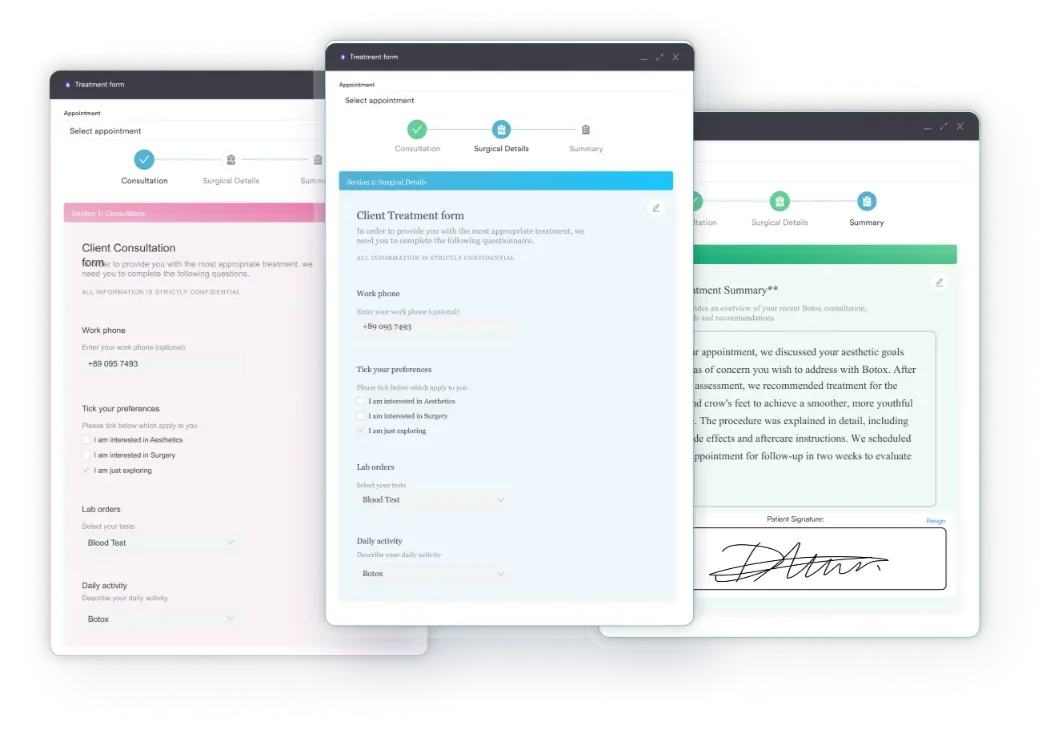
Practice management software like Pabau rebuilds the worksheet as a digital form instead. You send it to the client before the session, they complete it on their phone, and the answers land in their record. That removes the scanning step and the folder of loose paper.
Because the form sits in the client record, you can read last week’s thought record before the appointment starts. Pabau Scribe, our AI scribe, then drafts the session note from what you discuss. The cognitive work gets documented without extra typing after hours.
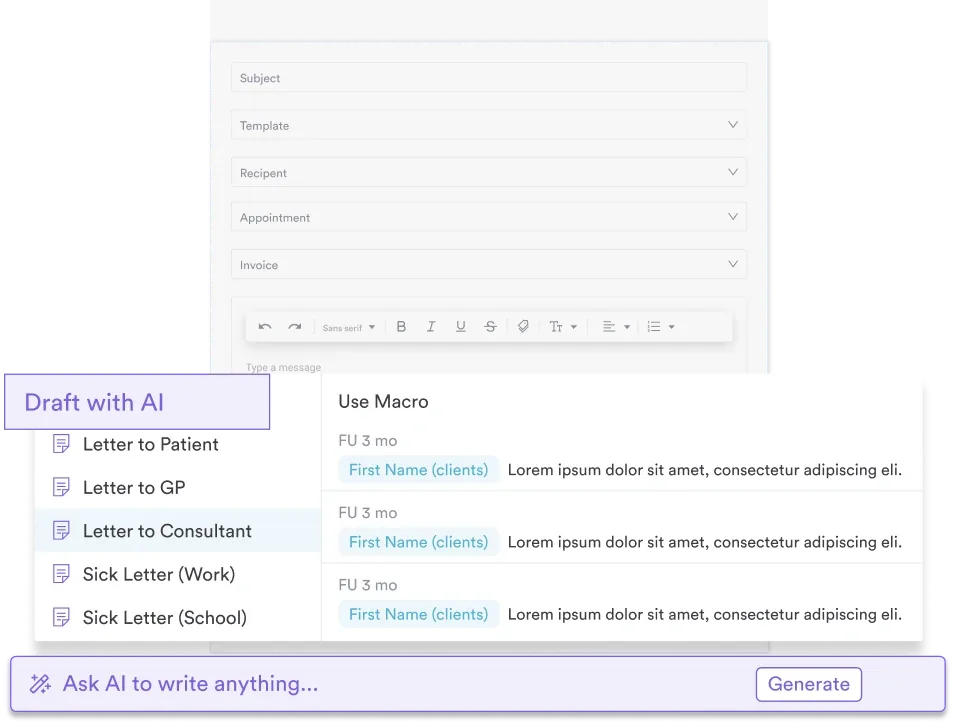

Simplify worksheet delivery, automate clinical documentation, and track client progress with practice management built for therapy.

The worksheet itself is settled ground. Its value in your practice rests on two habits. The client has to complete it, and you have to read it before the next session.
So pick one form and start there. Assign the 7-column record if the client can handle it, and the automatic thoughts log if seven columns would put them off. Keep the copyright position clean by buying the book or licensing the official digital set.
The delivery side is where a practice usually loses the thread, and that is a software problem rather than a clinical one. Book a demo to see how Pabau sends therapy worksheets, tracks completion, and files the results in the client record.

Need the form for avoidance? Behavioral activation worksheet covers activity planning, predicted mood, and what the client actually felt afterward.
Structuring a first mental health assessment? Psychiatric evaluation template lays out the sections a full intake assessment needs.
Need to handle an acute presentation? Crisis intervention strategies covers de-escalation techniques that sit alongside routine CBT work.
The second edition includes the 7-column thought record (the core worksheet), mood inventory forms, behavioral activation sheets, and an automatic thoughts log. Additional worksheets for specific applications (sleep, relationships, work) are available on mindovermood.com and in supplementary resources.
Free sample worksheets are available at mindovermood.com/worksheets/ for evaluation. Therapists who want to reproduce the full set for clients must purchase the Mind Over Mood book. The alternative is licensing official digital versions through Guilford Press. Unauthorized photocopying violates copyright.
Identify the triggering situation, then write down the automatic thoughts that came with it. Rate how strongly you believe each thought from 0 to 100 percent. Examine the evidence for and against it. Then write a balanced alternative thought and re-rate your belief. Therapists usually complete one in session before assigning it as homework.
The program is designed for both. Clients working with a therapist use worksheets as structured homework that deepens the therapeutic work. Individuals also complete the worksheets independently using the Mind Over Mood book as a self-help guide. Research supports effectiveness in both contexts, though therapist guidance typically accelerates learning and insight.
The second edition (2015) includes updated examples, slightly refined worksheet layouts for clarity, and additional worksheets for modern applications (social anxiety, perfectionism, etc.). The core 7-column thought record is functionally the same. The second edition reflects three decades of clinical feedback, and the authors recommend it over the first.