Trauma response test: Free template for clinicians
A trauma response test is a structured screening questionnaire that helps clinic...

8
Last Updated: Oct 15, 2026

A cognitive restructuring worksheet is a core CBT tool that helps clients identify and challenge automatic negative thoughts in a structured, evidence-based format.
The worksheet guides clients through five steps: name the triggering situation, capture the automatic thought, rate the emotion, weigh the evidence with Socratic questions, and write a balanced alternative thought.
Our distortion-to-reframe table and a filled-in worked example show exactly how a single anxious thought moves through the worksheet, from an 80/100 emotion rating down to 35/100.
The 3 C’s of cognitive restructuring (catch it, check it, change it) give clients a plain-language version of the same process to use between sessions.
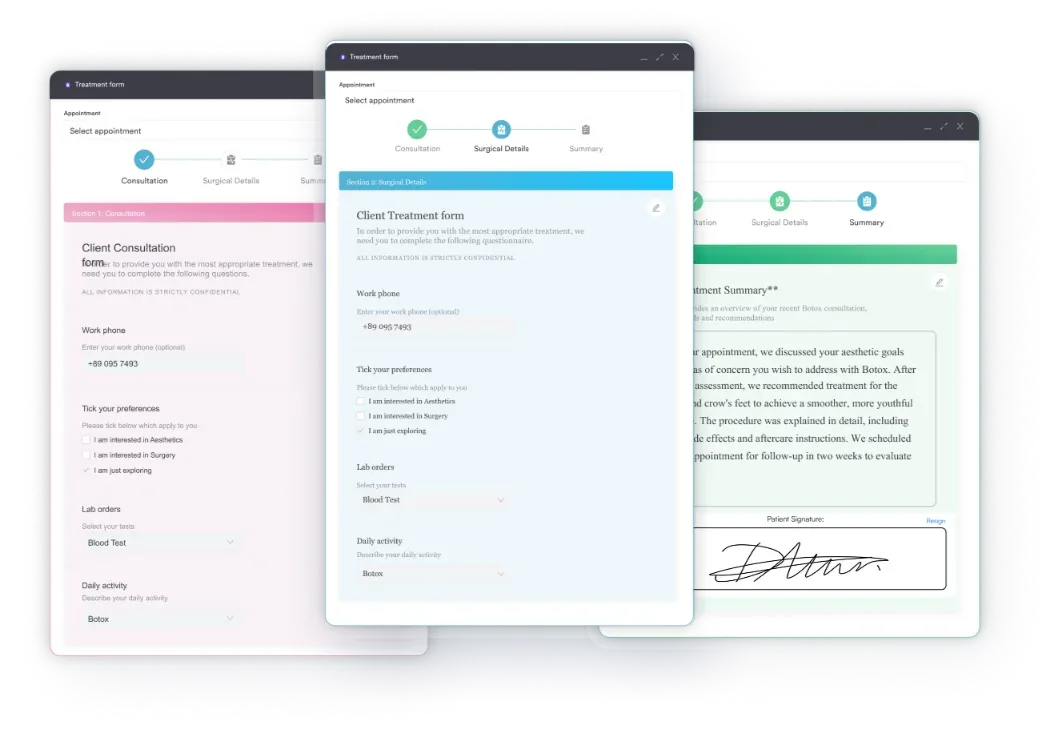
Storing completed worksheets in practice management software like Pabau keeps each client’s thought records in one place alongside their notes, so progress is easy to review over time.
A ready-to-use PDF that walks clients through identifying automatic negative thoughts, examining the evidence for and against them, and developing balanced alternative thoughts using structured CBT methodology.
Download template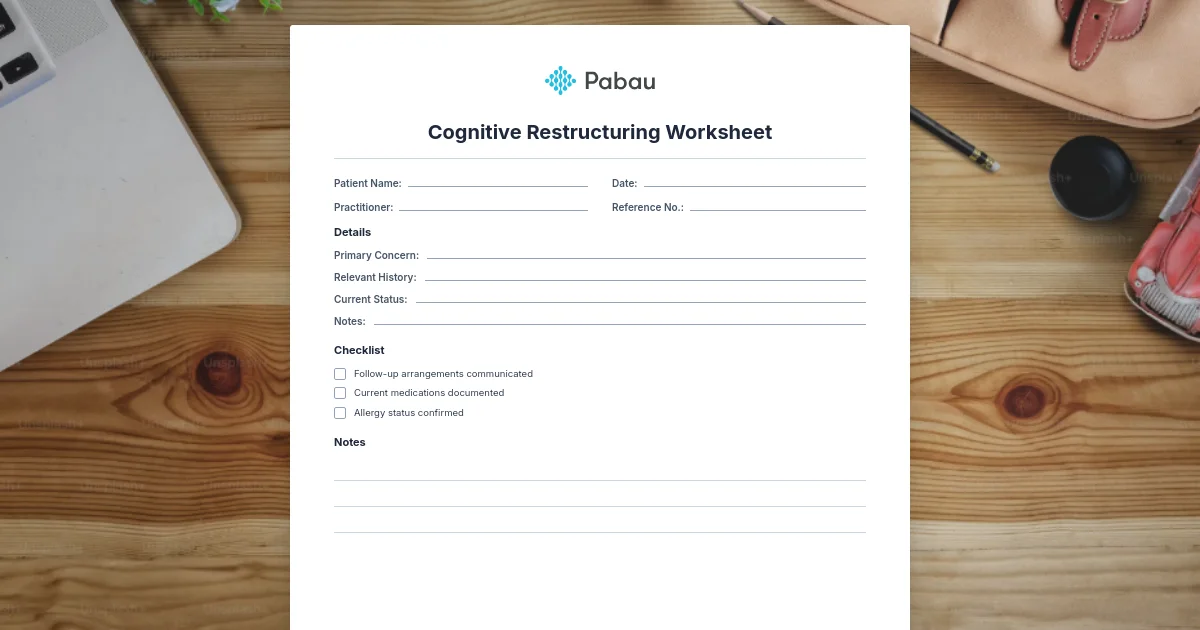
Many therapists guide clients through cognitive restructuring from memory, and the process loses consistency from one session to the next. Clients can name an unhelpful thought but stall when it comes to examining and challenging it.
This free cognitive restructuring worksheet gives you that missing structure: a step-by-step PDF that helps you facilitate evidence-based cognitive behavioral therapy (CBT) with the same rigor every time.
Below, you’ll find how the worksheet works, a filled-in example that carries one anxious thought all the way through it, a distortion-to-reframe table you can keep beside you in session, and the facilitation techniques that make the tool land. Download the cognitive restructuring worksheet PDF above and follow along.
A cognitive restructuring worksheet is a therapeutic tool used in evidence-based cognitive behavioral therapy to help clinicians guide clients through identifying and challenging automatic negative thoughts. It provides a structured, step-by-step format that makes the cognitive restructuring process transparent, repeatable, and easy to track across sessions.
The worksheet maps the CBT triangle onto the page: a situation triggers a thought, the thought drives an emotion, and that emotion shapes behavior. By slowing this chain down and putting it in writing, clients see that the thought, not the situation itself, is the leverage point.
It’s grounded in CBT theory developed by Albert Ellis and Aaron Beck, who both showed that changing thought patterns produces measurable improvements in mood and functioning.
The worksheet captures five core elements: the situation triggering the thought, the automatic negative thought that arose, the emotion (and its intensity) that followed, the evidence for and against the thought, and a more balanced alternative thought.
Mental health practitioners, including therapists, counselors, psychologists, and psychiatrists.
Work through the cognitive restructuring worksheet in five steps, guiding the client to reach each conclusion themselves rather than supplying it. Pacing and clinical judgment matter as much as the sequence.
Here is the same worksheet completed end to end for one client, “Maya,” who came in with social anxiety. Most worksheets you’ll find online are blank grids; this shows what a good one looks like once it’s filled.
| Worksheet step | Maya’s entry |
|---|---|
| Situation | Said hello to a coworker in the hallway; they walked past without replying. |
| Automatic negative thought | “They think I’m annoying and don’t want to talk to me.” |
| Cognitive distortion | Mind reading |
| Emotion (0 to 100) | Anxiety 80, shame 60 |
| Evidence for the thought | They didn’t respond that one time. |
| Evidence against the thought | They had earbuds in; they’ve chatted warmly before; people miss a quiet hello all the time. |
| Balanced alternative thought | “They probably didn’t hear me. One missed hello doesn’t mean they dislike me.” |
| Emotion re-rated | Anxiety 35, shame 20 |
Document each step within digital intake forms or your structured client record so the thought work is retrievable for future sessions and continuity of care.
The 3 C’s of cognitive restructuring are catch it, check it, change it: catch the automatic thought as it happens, check it against the evidence, and change it into a balanced alternative. It’s a plain-language version of the same process the worksheet formalizes, and it maps cleanly onto the worksheet columns.
Give clients the 3 C’s as a verbal shorthand for moments when reaching for the full worksheet isn’t practical, such as mid-conversation or on a commute. The full “catch it, check it, change it” worksheet is for the deeper, written work in and between sessions; the three words are what they carry into the rest of their week.
If your current platform cannot handle digital worksheets, compare Carepatron alternatives before committing.
Cognitive distortions are habitual thinking errors that maintain anxiety and depression, and naming the distortion is the first step to changing it. As clients work through the cognitive restructuring worksheet, they’ll usually recognize one or more of these patterns in their automatic thoughts.
Use this as a distortions worksheet in its own right: match the thought to a distortion, ask the Socratic question, and draft the reframe.
| Cognitive distortion | What it sounds like | Socratic question to challenge it | Balanced reframe |
|---|---|---|---|
| Catastrophizing | “I made a small mistake at work, so I’ll be fired and lose everything.” | “What’s the most likely outcome, not the worst one?” | “A small mistake usually means a quick fix, not the end of my job.” |
| All-or-nothing thinking | “If this isn’t perfect, it’s a complete failure.” | “Is there any middle ground between perfect and failure?” | “It’s good enough in most ways, with a few things to improve.” |
| Overgeneralization | “I failed one interview, so I’ll never get a job.” | “Does one event really predict every future one?” | “One interview didn’t go well; the next is a separate chance.” |
| Mind reading | “Everyone in that room thinks I’m boring.” | “What actual evidence do I have about what they think?” | “I can’t know their thoughts; no one said or showed that.” |
| Emotional reasoning | “I feel anxious, so something bad must be about to happen.” | “Is a feeling proof, or just a feeling?” | “Anxiety is uncomfortable, but it isn’t evidence of danger.” |
| Should statements | “I should be able to handle this without help.” | “Would I hold a friend to this same rule?” | “Asking for help is reasonable, not a personal failing.” |
Other common distortions worth teaching include magnification and minimization (blowing up negatives while downplaying positives) and personalization (taking the blame for events outside your control). Whether you call it a thought distortion worksheet or a distorted thinking worksheet, the goal is the same: make an abstract habit concrete enough for the client to catch and challenge.
Practitioners across mental health and behavioral health settings find worksheets make these patterns tangible and teachable.
Cognitive restructuring and cognitive reframing describe distinct clinical processes, and knowing the difference tells you which intervention to reach for. In short: restructuring tests whether a thought is true; reframing shifts how you look at it.
Cognitive restructuring is a structured, evidence-based process where the client systematically examines the accuracy of an automatic thought using evidence and logic. It answers: “Is this thought factually true?” The cognitive restructuring worksheet guides that examination step by step, making it repeatable and measurable. It’s the primary intervention taught in CBT training programs.
Cognitive reframing is less structured. It shifts perspective or looks at a situation from a different angle, often more quickly and intuitively. A therapist might ask: “How else could you look at this?” A cognitive reframing worksheet can help clients practice generating those alternative viewpoints, but it isn’t the same rigorous evidence-examination that restructuring demands.
Use cognitive restructuring when the client needs to examine a core belief or a persistent thought pattern in depth. Use reframing when you want a quick perspective shift or a gentler alternative viewpoint. The cognitive restructuring worksheet is built for the former: systematic, thorough, and trackable across sessions.
The worksheet works for both anxiety and depression, though the content of the automatic thoughts differs. Pairing it with a validated screening tool like the Major Depression Inventory helps track symptom severity alongside the thought work.
For anxiety: clients typically catastrophize about future threats, and automatic thoughts center on danger, loss of control, or humiliation. Examples: “Something bad will happen,” “I’ll panic and lose control,” “Everyone will judge me.”
Restructuring helps them weigh the realistic probability of the feared outcome against their ability to cope. As they practice challenging negative thoughts, anxiety intensity usually falls because they’ve separated the feared outcome from the evidence. Pairing restructuring with a mindful breathing script keeps the physical symptoms in check while the cognitive work catches up.
For depression: clients often ruminate on past failures or hold hopeless beliefs about the future, with thoughts centered on worthlessness, helplessness, or permanent failure. Examples: “I’m a failure,” “Nothing ever changes,” “I’m unlovable.”
Restructuring helps them spot the thinking errors (overgeneralization, should statements, all-or-nothing thinking) and build balanced, realistic alternatives. Pairing the worksheet with patient care management strategies and behavioral activation (scheduling pleasurable activities) strengthens outcomes.
How you introduce and guide the worksheet matters as much as the worksheet itself. These facilitation techniques keep the work collaborative and evidence-based.
Store completed worksheets in your mental health EMR system so you and the client can review progress over time and spot patterns in their most frequent cognitive distortions. A therapy practice running weekly sessions accumulates history faster than a paper file can carry.

Pabau’s digital forms, client records, and clinical notes help therapists organize cognitive restructuring work seamlessly-so you can focus on the client relationship, not paperwork.

Cognitive restructuring is one of the most evidence-backed tools in therapy. The National Institute of Mental Health, or NIMH, recommends it as a first-line intervention, and NICE guidelines back the same approach for both generalized anxiety disorder and depression.
Cognitive restructuring turns vague emotional struggles into concrete, solvable problems. The worksheet gives you and your clients a shared language for that work: structured, repeatable, and grounded in decades of research.
Download the free template above, walk through the five steps with your next anxious or depressed client, and watch how naming the thought and testing its accuracy shifts their mood. If you’d like to see how digital documentation can keep every client’s thought records organized and reviewable in one place, book a demo with Pabau.

Need to gauge whether a client is ready to engage with the work? The Readiness to Change Questionnaire scores motivation before you start restructuring sessions.
Documenting each restructuring session? Progress notes for psychotherapy keep the thought work tied to measurable treatment goals.
Want clients working on their thinking between sessions? A self-reflection worksheet gives them a lighter, journal-style follow-up to the full worksheet.
Looking to build on the emotion-naming step? Emotional intelligence worksheets help clients get more precise about what they’re feeling before they rate it.
Need a behavioral activation companion for depressed clients? A daily routine worksheet structures the small activities that rebuild momentum for adult clients.
Cognitive restructuring is a CBT technique where clients identify automatic negative thoughts and systematically examine their accuracy using evidence. By separating thoughts from facts, clients develop more balanced thinking patterns that reduce emotional distress and change behavior.
Work through five steps: name the triggering situation, identify the automatic thought, rate the emotion’s intensity, examine the evidence for and against the thought using Socratic questions, and develop a balanced alternative thought. Guide the client to discover the insight themselves rather than telling them the thought is wrong.
The 3 C’s are catch it, check it, change it: catch the automatic thought, check it against the evidence, and change it into a balanced alternative. They give clients a plain-language shorthand for the same process the worksheet sets out in full, easy to use between sessions.
The most frequent are catastrophizing, all-or-nothing thinking, overgeneralization, mind reading, and emotional reasoning. Teaching clients to spot these thinking errors helps them catch unhelpful thoughts and challenge them independently between sessions.
Cognitive restructuring is a structured, evidence-based process where clients systematically examine a thought’s accuracy. Cognitive reframing is a less formal perspective shift. Use restructuring for core beliefs and persistent patterns, and reframing for quick perspective shifts or gentler alternative viewpoints.
Yes. For anxiety, the worksheet helps clients weigh catastrophic predictions and see the feared outcome is less likely than it feels. For depression, it helps surface hopelessness and worthlessness thoughts, then challenge overgeneralization and all-or-nothing patterns.
The same worksheet adapts for children and adolescents with simpler wording and concrete examples, and the 3 C’s (catch it, check it, change it) work well as a memorable version for younger clients. For adults, you can use the full evidence columns as written.
Therapists introduce the worksheet, normalize automatic thoughts, use Socratic questioning to guide the client’s own discovery, slow down to capture exact wording, and assign between-session practice. Digital documentation helps capture the work efficiently while keeping the focus on the therapeutic relationship.