Anja Dodevska

DASES: Drug Avoidance Self-Efficacy Scale
DASES at a glance and what it measures DASES stands for Drug Avoidance Self-Effi...

1
Last Updated: Oct 29, 2026
Free PDF 2 pages, print-ready Clinician-reviewed
A hypomania test is a structured screening questionnaire that helps clinicians spot hypomanic symptoms that need further assessment. This template uses the Hypomania Checklist-32 (HCL-32), a widely used self-report form of 32 yes/no statements about a past "high" period. Its authors proposed a total of 14 or more as the cutoff for further assessment. Hypomania is a milder form of mania. The episode lasts at least four days and others notice it, but it causes no marked impairment, hospitalization, or psychosis. The test screens and does not diagnose, so bipolar II or another mood disorder needs assessment by a qualified mental health professional.
A two-page HCL-32 hypomania checklist with name, age, gender, and date fields, then 32 yes/no statements about a past "high" period. Items cover sleep, energy, mood, confidence, talkativeness, risk-taking, spending, and substance use.
Start from scratch, or upload this PDF or any form you already use, and Pabau's AI Form rebuilds it with tick boxes, text fields and a signature. Attach it to the treatment once, and every patient gets it on time.
AI Form rebuilds the consent, history and aftercare forms you already use. You review each one, then publish.
Patients complete forms on their phone before they arrive, so the front desk stops retyping paper.
Every signed form is versioned and attached to the treatment record, ready when you need it.
Set how long a consent stays valid. Returning patients skip forms they have already signed.
Supports HIPAA and GDPR compliance AES-256 encryption 4.8 on G2 4.7 on Capterra Trusted by 4,000+ practices worldwide

A hypomania test is a screening checklist, not a diagnostic tool.
The HCL-32 contains 32 yes/no self-report items, scored against a cutoff.
Hypomanic episodes must last at least four days under DSM-5 criteria.
A positive screen needs clinician follow-up before any diagnosis is made.
Sent as a digital form in Pabau, our practice management software, the checklist files its results against the patient record.
A hypomania test is a clinical screening questionnaire that helps practitioners flag hypomanic symptoms for further assessment. It gives clinicians a structured, repeatable record of mood elevation, energy changes, and behavior before a full clinical interview begins.
Screening is not diagnosis. Clinicians use these results to decide whether a patient needs a fuller evaluation against DSM-5 criteria. The American Psychiatric Association sets out those criteria for hypomanic episodes.
The downloadable PDF is a two-page form that the patient completes, built on the 32 items of the HCL-32. It asks the patient to recall a period when they felt “high” and to answer every statement about that time, not about today.
Grouped by what they ask about, the 32 statements lean heavily toward behavior rather than mood.
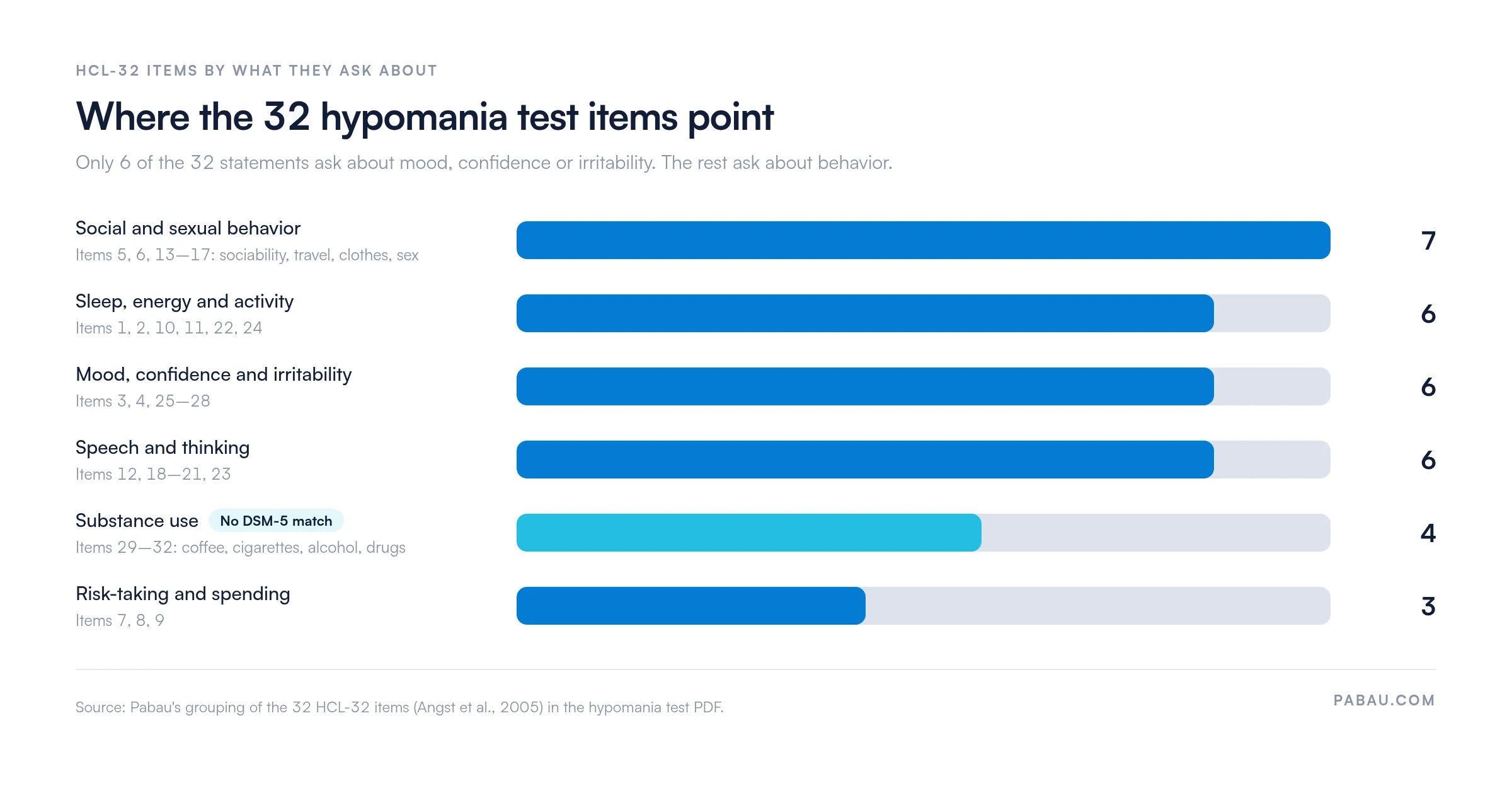
Most items line up with a DSM-5 symptom, such as needing less sleep or talking more. The coffee, cigarette, alcohol, and drug items do not. They still pick up changes that patients rarely mention unless someone asks.
Administer the test at intake or before a review appointment, after you have explained that it is a screening step. Ask the patient to answer each statement about a past period when they felt “high”, as the form instructs. Then go through the answers with them rather than scoring them in isolation.
Audit your intake workflow before rolling out any screen. Confirm who administers the test, who reviews the score, and where the result is filed. A screen with no owner for the follow-up step creates the risk you are trying to prevent.
Under DSM-5, a hypomanic episode requires a distinct period of abnormally and persistently elevated, expansive, or irritable mood. Increased energy or activity must accompany it, lasting at least four days. The episode must also show at least three additional symptoms from a defined list, and it must not cause marked impairment or psychosis.
Hypomania vs mania comes down to severity and impact. Hypomania is milder and shorter, with no psychotic features and no need for hospital care. Mania is more severe and can require hospitalization or include psychotic features.
The HCL-32 is scored by counting the yes answers across its 32 items, and the total is compared with a cutoff. Angst and colleagues proposed a cutoff of 14 in the original validation work. Later studies have used different cutoffs for different populations, so confirm the threshold your protocol uses.
A score above the cutoff is a reason to investigate further, not a finding. Review the items the patient endorsed, compare them with their account, and consider the other conditions that can mimic hypomania.
Some practices run a second bipolar screen alongside it. Mood Disorder Questionnaire scoring checks symptom count, whether symptoms occurred together, and the level of impairment, rather than one total.
Hypomania is a feature of bipolar II disorder, which is defined by at least one hypomanic episode and at least one major depressive episode. A hypomania test can flag the hypomanic component, but it cannot establish the depressive history or rule bipolar disorder in or out.
To screen the wider bipolar spectrum, including depressive swings, pair it with the Bipolar Spectrum Diagnostic Scale.
Several conditions share features with hypomania, which is why a screen should never be read alone. Restlessness, distractibility, and racing thoughts can appear in ADHD, while anxiety can produce sleep disruption and agitation.
Ask about onset, duration, and whether the change is new. Use the screening result as one input, and document your differential reasoning in the same record. Where attention problems dominate the history, an ADHD screening test documents that side of the picture.
Psychiatry and psychology practices use hypomania screens during assessment, while therapy and counseling practices use them to decide when to refer. Primary care and ADHD assessment services may also encounter hypomanic symptoms during intake.
A standard template gives every clinician the same items, which makes results comparable across patients and over time. It also leaves a documented record of what was asked, which supports audit and clinical governance.
Handle the data carefully. Mental health screening results are sensitive, and in the US the HHS HIPAA guidance governs how they are stored and shared.
On paper, the checklist gets handed over at reception, counted by hand, and scanned into a folder. The total and the follow-up decision then sit apart from the answers that produced them.
Pabau sends the checklist as one of your digital intake forms before the visit. The completed answers file against the consultation, so you review them next to your notes instead of in a separate folder.
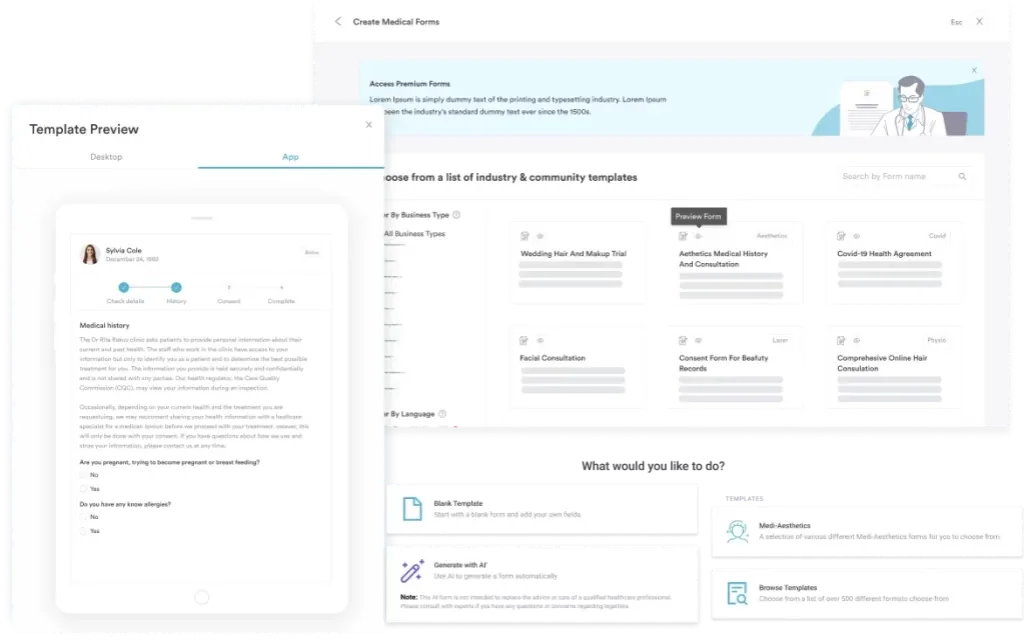
The screen, your differential reasoning, and the next step then live in one place, which is what an audit asks to see. Practices that run Pabau as their software for therapy practices get forms, notes, and booking in a single subscription, with every feature included.

See how Pabau sends digital forms before an appointment and files each completed response against the consultation, so results are reviewed in one place.

The HCL-32 earns its place at intake because it asks about behavior patients rarely volunteer, from extra spending to extra coffee. Its limit is just as clear. A total at or above the cutoff tells you where to look, never what you will find.
Treat it as the first step of a documented pathway: screen, interview against DSM-5 criteria, rule out ADHD and anxiety, then record the decision. Book a demo to see how Pabau keeps that whole pathway in one patient record for your therapy practice.

Screening a teenager? Teenage bipolar test covers manic and depressive episodes and behavioral change in younger patients.
Planning support after a diagnosis? Bipolar workbook gives patients mood tracking charts and CBT-based worksheets.
Reviewing medication options? Mood stabilizer medication list groups the drugs used in bipolar disorder by class.
Teaching the condition to nursing students? Bipolar disorder ATI template structures bipolar disorder in the ATI Active Learning format.
A hypomania test is a screening questionnaire that flags hypomanic symptoms for clinician review. It is not a diagnostic tool and does not replace a clinical interview.
Hypomania is defined by an episode of elevated or irritable mood lasting at least four days, with noticeable change from usual functioning. Feeling happy alone does not meet that definition, so a clinician should assess the pattern.
Yes, ADHD can share restlessness and distractibility with hypomania. Onset, episodic pattern, and mood change help clinicians tell them apart.
A positive screen should prompt a full clinical interview and a review of history. The clinician decides on any further assessment or referral.