Patient financing: How to offer it and stay compliant
Patient financing lets patients spread the cost of treatment over weeks or month...

Last Updated: Oct 7, 2026

A color your feelings worksheet is a three-page coloring-and-reflection tool: clients color a feelings face, a set of nature elements, and the leaves of a tree, then answer open-ended questions about the colors they chose.
It gives clients, especially kids and clients who struggle to name emotions, a low-pressure way into a feelings conversation. No drawing skill or set vocabulary is required.
The tree exercise is part of the standard worksheet for every client, not a special alternative reserved for trauma cases. Adjust pacing and language by age instead of swapping exercises in or out.
Practice management software like Pabau lets you attach completed worksheets to the client record, note which colors and images came up, and revisit them alongside progress notes in later sessions.
A free, printable coloring-and-reflection worksheet you can use in session or send home. Three coloring exercises (a face, nature elements, and a tree) followed by reflection questions the client answers in their own words.
Download templateA color your feelings worksheet is a printable coloring-and-reflection exercise. Clients color a face, some nature elements, and the leaves of a tree to show how they feel right now, then answer a few open questions about what came up. No body diagram to fill in and no color-emotion key to memorize, just crayons and a short set of honest questions.
It earns its place in a caseload for one simple reason: plenty of clients, kids especially, can’t yet put a feeling into words. Coloring gives them something to do with their hands while the conversation catches up, and it works just as well as a quiet check-in for teens and adults who go quiet in the chair.
The worksheet is three pages. Page one has an optional name and date field, then three coloring prompts: a face the client colors to match their current feeling, a set of nature elements colored to fit their mood, and a tree whose leaves each stand in for a different feeling. There’s no legend to build first and no body outline to shade in. The client just picks whatever color feels right for whatever they’re coloring. Practice management software for therapists keeps scheduling, notes and billing against one client record.
Pages two and three are reflection questions: how did coloring these images make you feel, did the colors match your emotions, which color did you feel most connected to and why, and what other ways could you express your feelings creatively. Clients answer in their own words, in the boxes provided, or out loud if you’re working with a younger child who isn’t writing yet.
All three exercises, the face, the nature elements, and the tree, are part of the standard worksheet. The tree isn’t a separate version held back for clients with trauma histories; every client gets all three, and you simply spend more or less time on each one depending on what the session calls for.
People connect colors with feelings well before they can describe those feelings out loud. A 2025 systematic review of more than a century of research on colors and emotions found consistent, though not universal, links between certain hues and emotional states, and it notes those links vary by person and by culture.
That’s the point of this worksheet: it doesn’t ask a client to match red to anger and blue to sadness. It asks which color feels right to them, right now.
The activity draws on principles used in art therapy and in developmental and color psychology, not on a specific clinical protocol. The American Art Therapy Association has been careful to draw a line between recreational coloring and the work of a credentialed art therapist: coloring on its own isn’t art therapy, and this worksheet doesn’t claim to be either.
Used well, it complements the work of a credentialed art therapist rather than replacing it, and it stands on its own as a check-in tool for clinicians who aren’t art therapists.
This worksheet works across a wide age range and a range of settings.
Children as young as four or five can take part with an adult reading the prompts aloud and pointing to colors. School-age kids and teens usually complete it independently. Adults use it too, particularly clients who intellectualize their feelings or go quiet under direct questioning.
It’s not the right first step for every client, though. Someone who finds open-ended prompts overwhelming, or who shuts down at any request to reflect on paper, may do better starting with a shorter, more structured check-in and returning to this worksheet once some trust is built.
The worksheet does most of the work for you. Your job is pacing, tone, and what you do with what comes up.
Mara, 9, was referred after her parents separated. She answers most questions with a shrug. In session three, her therapist hands her the worksheet and says, “Let’s color for a bit, you pick the colors.” Mara colors the face gray. She moves through the nature elements quickly, mostly blue. Then she spends nearly ten minutes on the tree, giving almost every leaf a different color.
When her therapist asks which color she felt most connected to, Mara says purple, “because it’s kind of sad and kind of okay at the same time.” That single sentence, with no color-emotion legend prompting it, becomes the opening line for the rest of the session.
The core activity stays the same across ages. What changes is language, pacing, and how much of the reflection you ask a client to put into writing.
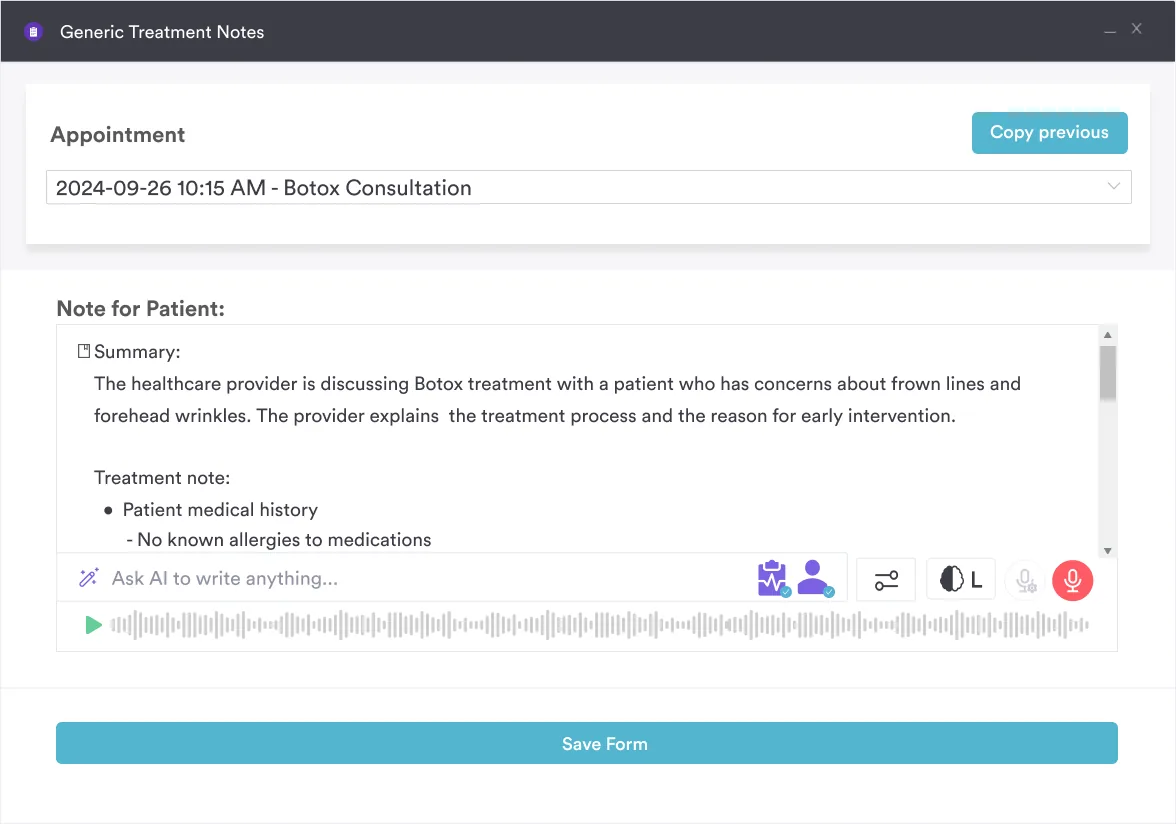
A completed worksheet is only useful if you can find it again. Pabau’s digital forms and client records let you attach a scanned or photographed worksheet directly to the client’s file, so it sits next to your session notes instead of in a separate paper folder.
Over several sessions, patterns become visible. Does the same color keep showing up for this client? Did the reflection answers get longer, or shorter? Pabau’s client record makes it easy to pull up past worksheets during a session, and Echo AI, Pabau’s AI scribe, can fold your observations from the coloring exercise straight into a structured note.

Pabau’s digital forms and client records let you store and retrieve tools like the color your feelings worksheet without leaving your clinical workflow. Book a demo to see how.

A color your feelings worksheet won’t diagnose anything, and it isn’t trying to. What it does is give a client, especially one who struggles to find the words, a low-pressure way to show you something true. Coloring a face, a few nature elements, and a tree, then answering a handful of open questions, is often enough to open a conversation that a direct question wouldn’t.
Once you’re running it regularly, the record you keep of it matters almost as much as the session itself. Pabau lets you attach completed worksheets to the client’s file, next to your notes, so you can see how a client’s colors and answers shift across sessions instead of relying on memory.
Book a demo to see how it fits alongside the rest of your clinical documentation.

Turning practice goals into trackable tasks? Action plan template structures goals into specific, assigned, time-bound tasks with fields for owners and deadlines.
Explaining an ADHD diagnosis to parents? ADHD handout for parents covers the three DSM-5 types and home strategies families can use together.
Monitoring a client’s response to ADHD medication? ADHD medication monitoring sheet tracks dosage, side effects and rebound patterns across titration and maintenance phases.
No. There’s no CPT code specific to art therapy in the US. A licensed clinician, art therapist or other licensed mental health professional, bills the session under standard psychotherapy CPT codes such as 90832, 90834, or 90837. Eligibility depends on the clinician’s license and payer rules, not a special art therapy code.
Not quite. The pictures are simple on purpose, but the worksheet pairs each one with reflection questions, so coloring becomes something you can talk about in session rather than a stand-alone relaxation activity.
Yes. Send the PDF ahead of time, or have the client color on paper at home while you watch on screen, then talk through the reflection questions together on the call.
No. The worksheet doesn’t include a color key, and clients often surprise you, calm can be red just as easily as blue. Ask about the choice instead of checking it against a chart.
There’s no fixed schedule. Some clinicians reuse it every few sessions as a quick check-in, others save it for moments when a client seems stuck for words. Compare answers over time rather than any single session.
Yes, it’s designed to be printed and used freely in your practice. Keep a stack of blank copies on hand, or load the PDF into your digital forms so it’s ready whenever a session calls for it.