Free exercise log template: PDF and printable (2026)
An exercise log template is a ready-made sheet for recording every workout in th...

1
Last Updated: Oct 23, 2026
The bear hug test is a quick shoulder special test that screens for subscapularis tears, one of the easiest rotator cuff injuries to miss. A patient who cannot hold the hand pressed on the opposite shoulder against the examiner’s resistance may have a subscapularis problem. In the study that introduced it, the bear hug test caught 60% of the tears confirmed at arthroscopy. That beat the belly press, Napoleon and lift-off tests.
Getting it right matters, because a missed tear can leave a patient on the wrong rehab plan. Below, you’ll find the setup, how to grade the result, how it stacks up against the other tests, and a free recording form.
A one-page recording form with spaces for the patient’s name, the test date and your findings. Print it for the exam room or keep it with the patient’s notes.
Download template
The bear hug test screens for subscapularis tears through resisted internal rotation, with the palm on the opposite shoulder.
It is positive when the examiner can lift the hand off the shoulder, or the patient is clearly weaker than the other side.
In the original 2006 study it caught 60% of tears, more than the belly press, Napoleon or lift-off tests.
A positive result suggests at least 30% of the tendon is torn, so confirm it with MRI or ultrasound.
Record the side, elbow position, hold time and the other arm’s result so the next clinician can repeat the test.
The bear hug test is a resisted special test used to detect subscapularis tears and weakness. The patient presses the hand into the shoulder while the examiner tries to lift it off by pulling the forearm. The elbow is held forward throughout. That position loads the subscapularis in resisted internal rotation.
Barth, Burkhart and De Beer first described the test in 2006 in a paper in Arthroscopy. It has since become a routine part of shoulder assessment in physical therapy and sports medicine.
The subscapularis is the largest and most powerful of the four rotator cuff muscles. It runs from the front of the shoulder blade to the lesser tubercle of the humerus. Its main job is internal rotation of the shoulder.
Use the bear hug test when a patient has pain at the front of the shoulder or weakness reaching behind the back. Trouble tucking in a shirt is another common clue. It also earns a place whenever you suspect wider rotator cuff involvement.
It works best alongside other shoulder special tests, since no single maneuver covers every lesion. Here is how to run it.
Set the patient up the same way every visit, so results stay comparable over time.
Record a positive result when the examiner can lift the hand off the shoulder, or the patient is clearly weaker than the other side. Some researchers set the weakness cut-off at 20% less resistance than the uninjured arm.
A positive test suggests subscapularis insufficiency, but it does not confirm a tear on its own. Confirmation usually requires MRI or ultrasound, read alongside the history and your other shoulder tests.
Say a 54-year-old patient fell onto an outstretched arm three weeks ago. Now they struggle to tuck in a shirt on the right side. Their lift-off test is normal, yet you lift the right hand off the shoulder with little effort. The left side holds firm.
That pattern fits a partial tear of the upper subscapularis better than a massive one. Lift-off tests tend to stay negative until about three-quarters of the tendon is torn. Refer for imaging, and note both tests and both sides.
In the original study, 68 patients were examined before shoulder arthroscopy, which then served as the reference standard. Subscapularis tears turned up in 29.4% of them.
The bear hug test was the most sensitive, at 60%. The belly press reached 40%, the Napoleon test 25% and the lift-off test 17.6%. All four were highly specific, from 91.7% for the bear hug to 100% for the lift-off.
The tear size each test needs explains that spread, as the chart below shows.
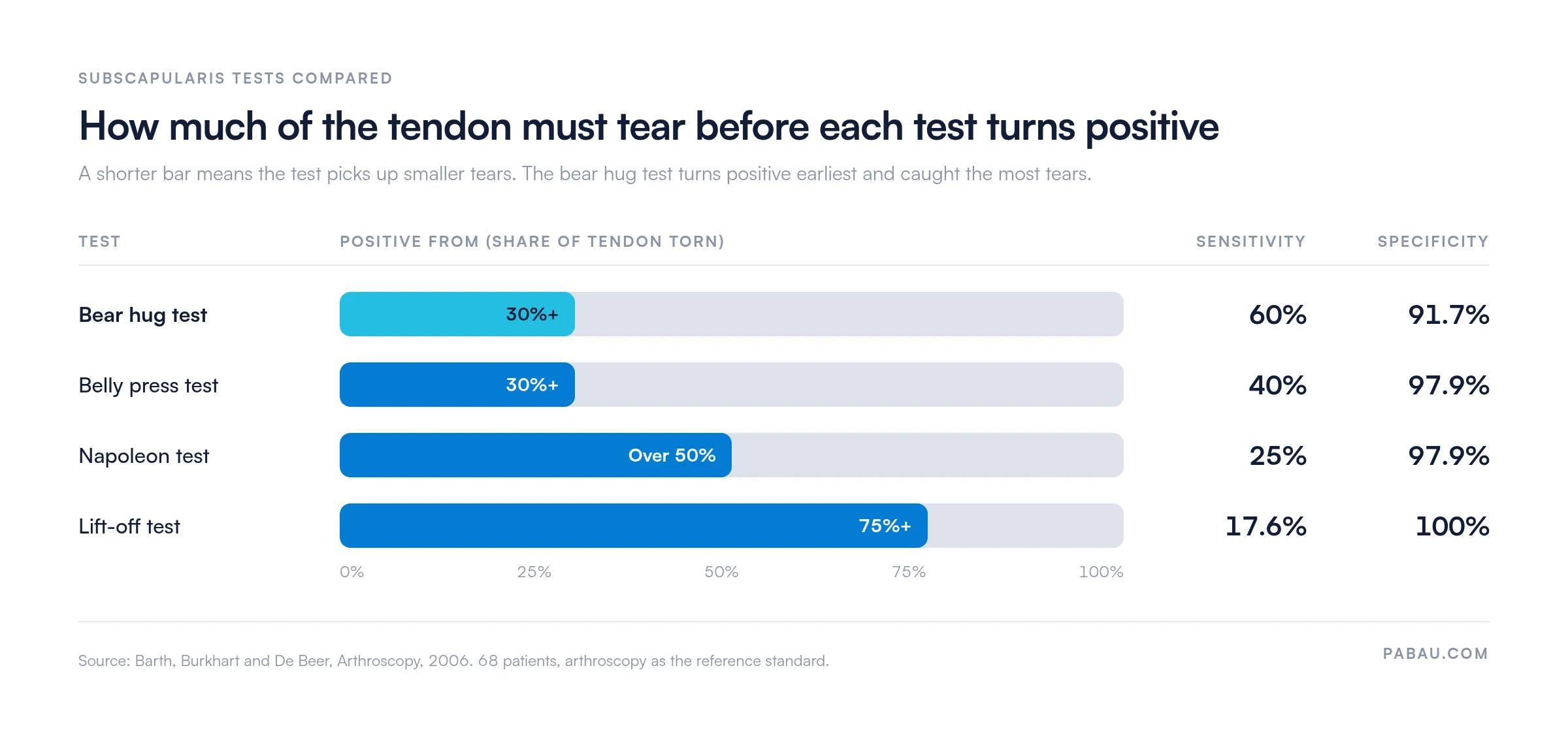
Positive bear hug and belly press tests suggest at least 30% of the tendon is torn. The Napoleon test needs more than half, and the lift-off test at least 75%. Even so, all four tests together missed 40% of the tears in the study.
Later studies report wider ranges. A 2015 Brazilian study found 75% sensitivity but only 56% specificity. When the history still points to a tear, a negative test should not stop a referral.
Each test loads the subscapularis in a different position, so the right choice depends on the patient in front of you.
The lift-off test needs the hand behind the back, which a stiff or painful shoulder often cannot reach. The bear hug avoids that problem, because the hand stays in front of the body.
The belly press test matched the bear hug on overall accuracy in the original study. Running both together gives you a second reading on the same tear size.
Stay within your scope of practice. Scope and referral pathways differ by state, country and qualification, so check your regulator’s guidance.
Run the bear hug test as part of a sequence, never in isolation. Start with history and range of motion, then add resisted tests. Only then decide whether imaging is needed.
Our guide to the shoulder exam walks through the full sequence, including the tests that pair well with this one.
A bear hug result is only useful if someone else can run the same test the same way. That means writing down the setup, not just the verdict.
Record the side tested, the position used, and whether the patient could hold the position for the full hold time. Those three details make the result reproducible for the next clinician who reviews the notes.
The free form above gives you a place for the date and your notes. Many teams copy these fields into their physical therapy SOAP notes, so the test sits with the rest of the exam.
In US physical therapy, special tests are part of the evaluation codes (97161 to 97163) and aren’t billed on their own. So the test earns its keep in the note, which is another reason to document it fully.
Physical therapists, physiotherapists and musculoskeletal clinicians use the form when they examine shoulder patients. Sports medicine teams and orthopedic practices use it too, when they need a consistent record of subscapularis testing.
A shared form also reduces variation between clinicians, which makes follow-up results easier to trust. It gives you a clear audit trail if a referral or treatment plan is questioned later.
Paper forms get filed, scanned or lost. Comparing this visit’s bear hug result with last month’s then means hunting through notes. Pabau, the practice management platform we build for allied health teams, keeps those results in one patient record.
Turn the template into one of Pabau’s digital forms, and every clinician captures the same fields each time. Results sit next to the appointment, treatment notes and invoices, so the next clinician sees the history before the patient sits down.
Practices running a full physical therapy EMR also skip re-typing paper findings at the end of the day.

See how Pabau’s digital forms and treatment notes store each special test result with the patient, ready for the next visit.

Run the bear hug test whenever internal rotation feels weak, and always run it on both sides. It is the most sensitive of the common subscapularis tests, yet it still misses tears.
So treat a positive result as a reason to image, and a negative one as a single data point among several. Write down the setup every time, because a test nobody can repeat can’t track recovery.
Book a demo to see how Pabau keeps every shoulder test result in one patient record, ready for the next visit.

Checking the biceps tendon next? Speed’s test covers technique and interpretation for anterior shoulder pain.
Suspect impingement as well? Neer’s test explains how to perform and read this impingement screen.
Is the scapula part of the problem? Scapular assistance test shows how assisted rotation changes pain and range.
Mapping where the pain sits? Rotator cuff pain location diagram links each pain site to the muscle most likely involved.
Worried about instability? Shoulder relocation test covers technique, interpretation and accuracy.
The Napoleon test is a version of the belly press. The patient presses the palm into the abdomen while you watch the wrist. If they can only press by flexing the wrist to about 90 degrees, the test is positive. That suggests more than half of the subscapularis is torn.
Most acute tears follow a fall, a forceful push of the arm into external rotation, or an anterior shoulder dislocation. In older adults, tears can also develop gradually alongside wider rotator cuff wear.
Small or partial tears are usually managed first with physical therapy that rebuilds internal rotation strength. Larger traumatic tears are often referred for surgical repair. Early referral matters, because a torn tendon can retract over time.
No. The test alone cannot confirm a full-thickness tear. MRI or ultrasound is generally needed, and arthroscopy remains the reference standard.