CRM for chiropractors: how to manage patients, bookings and marketing
A CRM for chiropractors is a patient relationship management system built around...

Last Updated: Oct 13, 2026
Speed’s test is a shoulder provocation test that loads the long head of the biceps tendon to reproduce anterior pain. The arm sits at 90 degrees of flexion, the elbow stays straight, and the palm faces the ceiling. You press down, and pain in the bicipital groove counts as a positive result.
One caveat shapes how much weight that result deserves. Reported sensitivity runs from 32% to 69%, so Speed’s test screens for biceps and labral problems rather than confirming them. Technique slips widen the margin further.
What follows covers the mechanics, the accuracy data, the common errors, and the tests that belong beside it.

Speed’s test loads the long head of the biceps through resisted forward flexion, with the elbow extended and the forearm supinated.
A positive result is pain in the bicipital groove, which points to bicipital tendinopathy or a SLAP lesion.
Reported sensitivity sits between 32% and 69% and specificity between 56% and 75%, so the test screens rather than confirms.
Pair it with Yergason’s test and the O’Brien test before you commit to a diagnosis or a referral.
Practice management software like Pabau keeps shoulder findings in the patient record, so repeat testing can be compared over time.
Speed’s test looks for pain coming from the long head of the biceps tendon, or from the superior labrum it anchors to. Physical therapists and sports medicine clinicians reach for it when a patient reports pain at the front of the shoulder.
The logic behind it is straightforward. Loading the tendon in a position that mimics the aggravating movement should reproduce the patient’s pain. Where that pain then appears tells you which structure is likely involved.
Use it when a patient presents with:
The tendon runs an awkward route. It starts at the supraglenoid tubercle and the superior labrum, then crosses the glenohumeral joint.
From there it drops into the bicipital groove, between the greater and lesser tuberosities. Along the way it changes direction twice inside a narrow bony corridor.
That corridor is the problem. Swelling, an osteophyte, or heavy overhead loading presses the tendon against the groove walls.
The transverse humeral ligament holds it in place, and a lax or torn ligament lets the tendon slip medially. Patients often describe a clunk, which helps separate groove pathology from a SLAP lesion.
Three features make this tendon unusually prone to tendinopathy:
All of that explains the test position. Supination raises tension through the biceps, and 90 degrees of flexion recreates the arc where overhead athletes usually feel pain.
Speed’s test applies both at once, which is why it provokes groove pain more reliably than palpation alone.
Technique decides the result. A slightly bent elbow or a rotated forearm changes which structures take the load, and specificity drops with it.
Write the finding down while it is fresh. A usable record names the position used, the flexion angle, the elbow and forearm position, the side tested, and where the pain sat.
Structured assessment templates inside physical therapy EMR software keep those fields in front of you. The flexion angle and the pain location then reach the record every time.

A positive Speed’s test is pain, or a clear rise in tenderness, right at the bicipital groove during resisted flexion. Pain anywhere else weakens the finding considerably.
Location matters more than intensity. The table below turns what the patient reports into a next step.
False positives are common, and the cause is mechanical. Shoulder flexion also loads the subacromial space, the rotator cuff, and the acromioclavicular joint. Pain from any of those can surface in the test position, which is why a single positive result never settles a diagnosis.
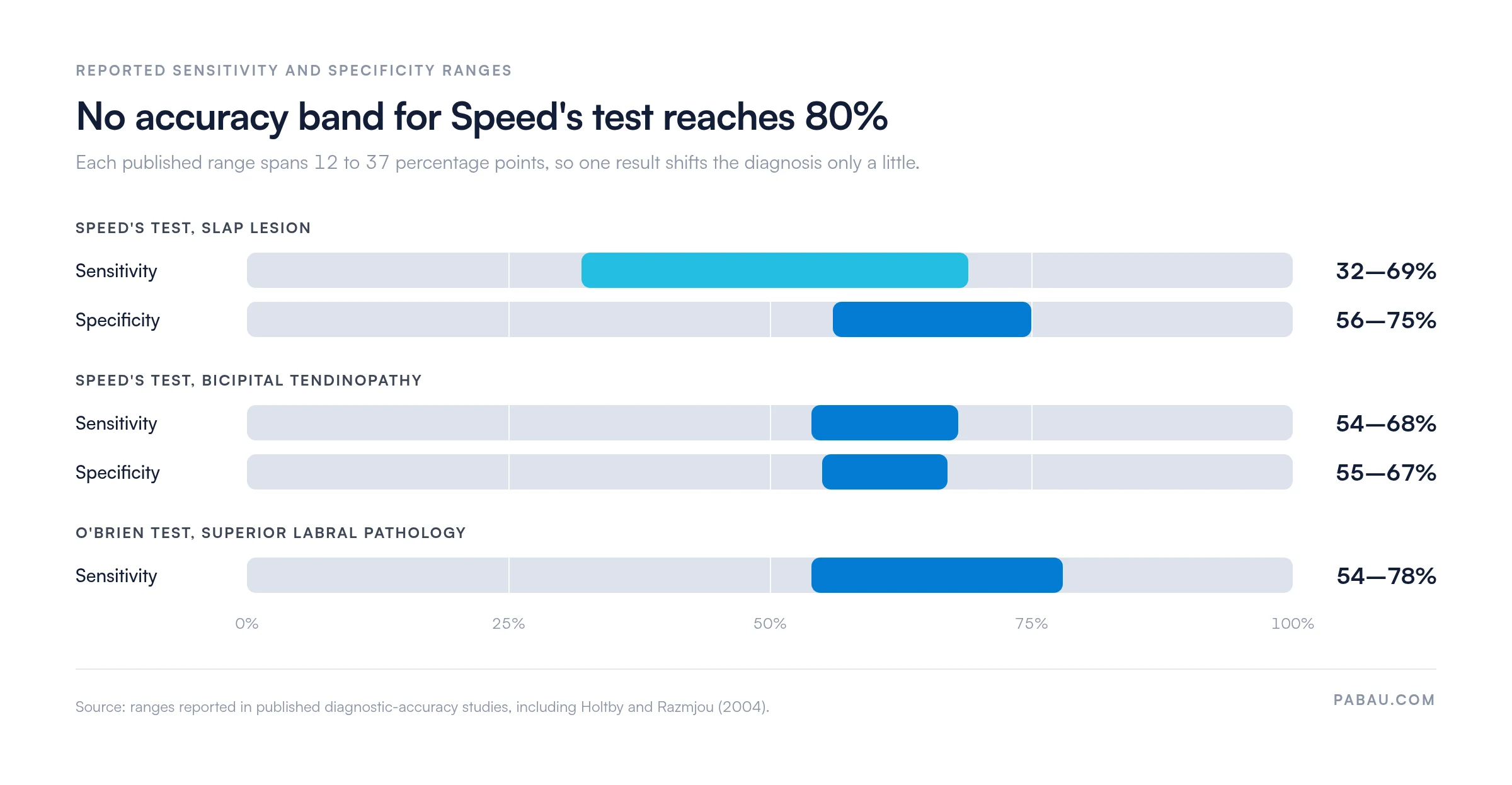
Published accuracy for Speed’s test is moderate and inconsistent. The most cited evidence comes from Holtby and Razmjou (2004), published in Arthroscopy: The Journal of Arthroscopic and Related Surgery, 2004;20(3):231-236.
They report sensitivity for SLAP lesions between 32% and 69%, and specificity between 56% and 75%. The figures shift with the population studied and the reference standard used.
Plotted side by side, those ranges make the point faster than the numbers do.
Likelihood ratios put a number on that. A positive likelihood ratio of roughly 1.5 to 2.0 for SLAP detection nudges the post-test probability upward, but not far. A negative result carries similarly weak ruling-out power.
The practical reading stays the same throughout. Speed’s test earns its place inside a systematic examination, not as a decision point on its own.
Record the reasoning as well as the result. A positive Speed’s test alongside a negative cluster deserves a short note explaining your thinking. That note protects you medico-legally, and it makes your referral letter far easier to act on.
Most false positives and false negatives trace back to four errors. All four are easy to avoid once you know to watch for them.
The 60-degree version still deserves a second look. For stiff or post-surgical shoulders it is sometimes the only position available. At 60 degrees the subacromial contribution drops slightly, which can improve specificity where impingement co-exists. Either way, record the angle you used.
A positive Speed’s test narrows the field without closing it. Five conditions account for most genuine positives in patients with anterior shoulder pain.
Overhead athletes often arrive with two or three of these at once. That is the case for working through the cluster rather than stopping at the first positive finding.
Experienced clinicians rarely run Speed’s test alone. Knowing how it differs from Yergason’s test and the O’Brien active compression test helps you build the right combination for each presentation.
Speed’s test and Yergason’s test both target the long head of the biceps, but they load it differently. Speed’s test uses a long lever and resisted flexion. Yergason’s test uses resisted supination with the elbow at 90 degrees. When both reproduce groove pain, genuine biceps pathology becomes much more likely.
For a suspected labral tear, the O’Brien test is the stronger choice, with reported sensitivity of 54% to 78% for superior labral pathology. Its position also separates AC joint pain from labral pain, which Speed’s test cannot do.
One more option is worth keeping in the toolkit. The biceps load test loads the tendon with the shoulder abducted and externally rotated, giving you a second angle on a suspected SLAP lesion.
No shoulder special test carries enough accuracy to drive management alone. The American Physical Therapy Association takes the same view of special tests generally, so run a cluster and read the findings together.
A workable cluster for suspected biceps or labral pathology runs like this:
Imaging becomes reasonable once the cluster agrees. Positive findings across all three tests, plus an overhead mechanism and local groove tenderness, justify a referral for MRI arthrogram. Plain MRI misses many SLAP lesions, and an arthrogram improves detection considerably.
Repeat testing is where the record earns its keep. Retesting at intervals turns a one-off finding into outcome data you can show the patient and the referring clinician. Practices carrying heavy musculoskeletal (MSK) caseloads often run sports medicine software that keeps those findings on one patient timeline.

A shoulder examination usually gets recorded twice. The findings get scribbled during the session, then typed into the notes later, often at the end of a long day. Detail fades in between, and the flexion angle or the exact pain location is usually the first casualty.
Practice management software like Pabau closes that loop. Assessment templates put the same fields in front of every clinician, so a Speed’s test finding is captured the same way each time. Pabau Scribe, our AI scribe, drafts the note from the consultation itself. The draft lands in the patient record, not in a separate document.
Because the findings live inside medical records software rather than in a side file, repeat assessments line up beside each other. You can see whether a provocative test is settling across a treatment course, so your discharge summaries and referral letters cite something concrete.
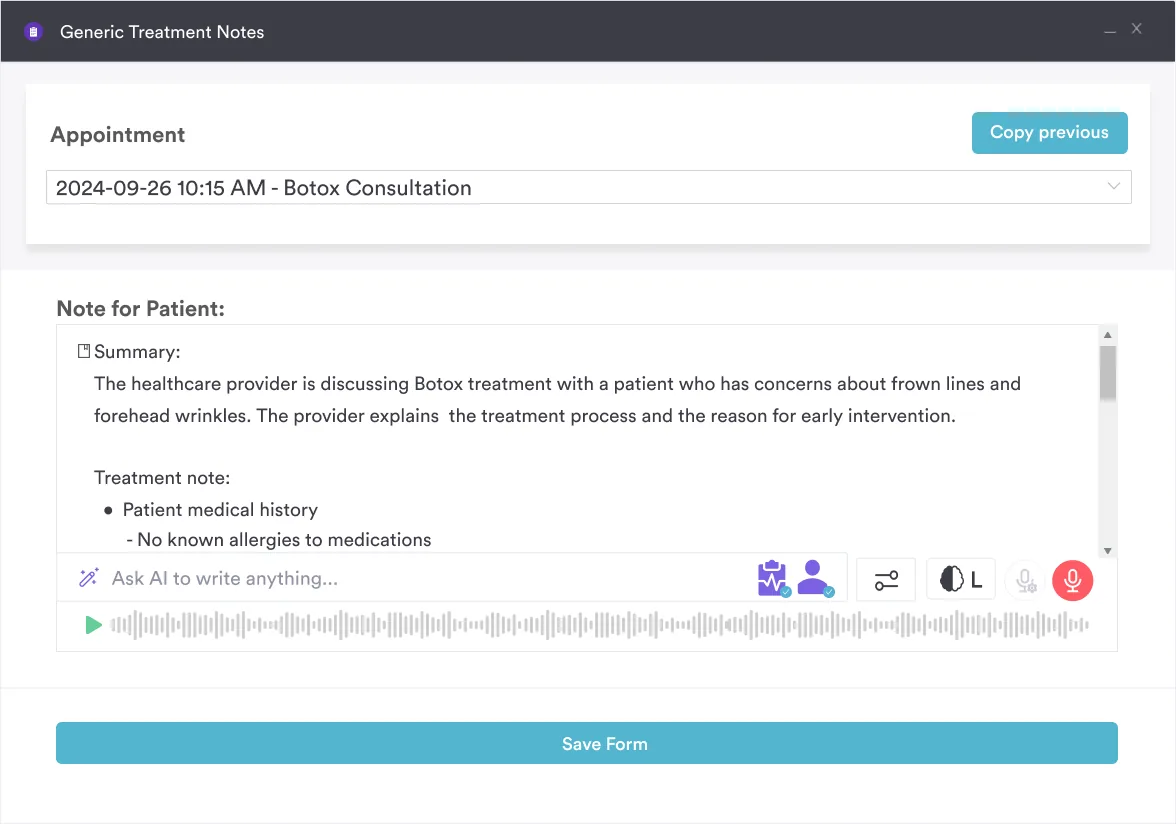

Pabau gives physical therapy and sports medicine practices structured assessment templates, AI-drafted notes, and one timeline per patient. Shoulder findings stay comparable from the first visit through to discharge.

Speed’s test earns its keep as a fast, low-cost screen, as long as you treat the result as one input rather than an answer. Get the elbow straight, the forearm supinated, and the pain location pinned down, and the finding is worth something. Skip those details and it is noise.
The trade-off is worth remembering. A test this quick will never be decisive, so its value comes from what you pair it with and how carefully you write it down. Build the cluster, record the angle, and your referral letters stop reading like guesswork.
Of those three habits, consistent documentation is the easiest to fix this week. Book a demo to see how Pabau keeps shoulder assessment findings comparable from the first visit through to discharge.

Ruling out impingement next? Neer’s test covers the impingement screen that pairs naturally with a lateral-pain result.
Suspect the rotator cuff instead? Infraspinatus test walks through the external rotation screen for posterior cuff involvement.
Tracking shoulder progress across a treatment course? Shoulder range of motion template gives you a printable sheet for recording measurements at every visit.
Running a sports medicine caseload? Sports medicine practice management software covers scheduling, clinical notes, and patient engagement built for high-volume MSK work.
Opening or growing a physical therapy practice? Opening a physiotherapy clinic covers registration, compliance, staffing, and the software decisions that shape day-one operations.
Expect mild discomfort rather than sharp pain. Warn the patient that the aim is to reproduce their familiar symptom, and ask them to speak up as soon as it appears. Stop the moment they report a sharp or spreading pain. Building resistance gradually keeps the test tolerable and keeps the finding clean.
Record the position, the flexion angle, the elbow and forearm position, and the side tested. Then name where the pain sat, using the patient’s own words alongside your anatomical description. Add your interpretation and the other tests you ran. A finding written this way still makes sense to a colleague six months later.
Yes, and retesting at intervals turns a one-off finding into outcome data. A test that provokes less pain over several weeks supports the rehab plan you chose. A test that stays sharply positive after six to eight weeks is a reason to revisit the diagnosis or refer on.
Sometimes, if the patient can reach roughly 60 degrees of flexion without pain from the movement itself. The 60-degree position loads the tendon less, so treat the result cautiously and note the angle you used. Where flexion is too restricted, Yergason’s test is the better option, since the arm stays by the side.