Scapular assistance test: Procedure, interpretation and free template
The scapular assistance test is a manual examination in which the clinician supp...

1
Last Updated: Oct 19, 2026

The shoulder relocation test assesses anterior glenohumeral instability by applying a posteriorly directed force to the proximal humerus.
A true positive is relief of apprehension, not relief of pain, and conflating the two is the most common interpretation error.
Overall accuracy runs above 80% when apprehension defines a positive result, and below 50% when pain does.
The test is only interpretable after a positive apprehension test, inside the sequence of apprehension, relocation, and anterior release.
Practice management software like Pabau lets physical therapy teams record which criterion was applied, not just the result.
Anterior shoulder instability gets diagnosed at the examination table far more often than in the scanner. What separates a confident clinical diagnosis from an unnecessary MRI referral is usually how one examination sequence is performed and read. The shoulder relocation test sits at the center of that sequence.
This guide covers the biomechanics, the step-by-step technique, and the published accuracy data. It also covers the apprehension-versus-pain distinction that decides the result, and where the test belongs in a full instability battery. It is written for physical therapists, orthopedic clinicians, and sports medicine practitioners.
The shoulder relocation test is a provocative examination maneuver used to assess anterior glenohumeral instability. It is also called the Jobe relocation test, after Dr Frank Jobe, who described it in overhead athletes. Some sources call it the Fowler sign or Fowler test. All three names refer to the same maneuver.
The test works by reversing the mechanical stress that provokes apprehension in an unstable shoulder. Placing the glenohumeral joint in 90 degrees of abduction and maximal external rotation loads the anterior capsule and labrum. If the humeral head is predisposed to anterior subluxation, that position triggers a protective apprehension response.
A posteriorly directed force on the proximal humerus then seats the humeral head back into the glenoid and removes the threat. Apprehension resolves, and that resolution is the positive sign.
The test is never performed in isolation. It is the second test in a standard sequence, always preceded by the anterior apprehension test. Without a positive apprehension test first, there is no baseline to compare against and the result cannot be interpreted.
Anterior glenohumeral instability usually follows damage to the anteroinferior labrum and capsule, the inferior glenohumeral ligament (IGHL) complex, or both. A Bankart lesion, where the anteroinferior labrum detaches from the glenoid rim, is the most frequent structural finding after a first-time anterior dislocation. It occurs in roughly 85 to 97% of traumatic cases, according to peer-reviewed literature on unstable shoulder evaluation.
When those stabilizing structures are disrupted, the humeral head can translate anteriorly under combined abduction and external rotation. The relocation test exploits that anatomy. The posteriorly directed force stands in for the compromised anterior restraints and blocks the abnormal translation that generated the apprehension.
Knowing the mechanism helps you interpret equivocal results and decide when companion tests are needed. A shoulder with significant labral damage but little capsular laxity tends to produce clear apprehension and equally clear relief. One with multidirectional instability or posterior impingement produces a muddier picture.
Technique has to be standardized. Small changes in arm position or force direction alter the load on the anterior capsule, and they change the odds of eliciting a true positive.
The anterior apprehension test and the relocation test are two halves of one diagnostic sequence, not independent tests. The apprehension test establishes that 90 degrees of abduction with external rotation provokes a protective response. The relocation test then asks where that response comes from. Anterior instability resolves under posterior force, and other causes either do not resolve or resolve only partially.
Running the relocation test after a negative apprehension test produces an uninterpretable result. With no apprehension to relieve, the posterior force has nothing to act on. Laid out end to end, the sequence and its decision point look like this.
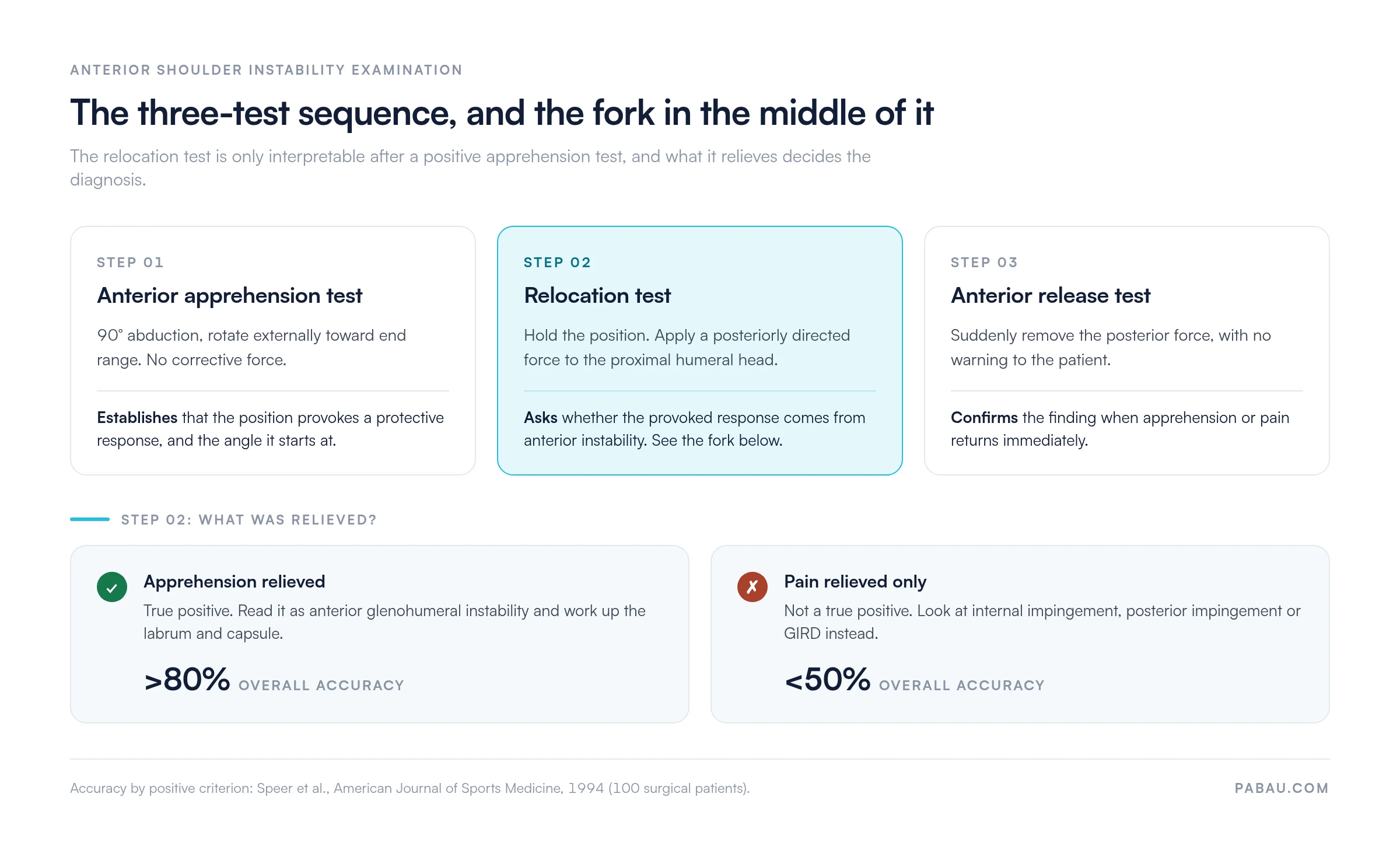
Interpretation turns on which symptom the posterior force relieves. Apprehension and pain point at different pathology, so the two responses are not interchangeable.
Jobe described the test as positive when apprehension is relieved, not when pain is relieved. The two responses reflect different pathophysiology, and the accuracy figures separate sharply along that line.
A 1994 evaluation of the relocation test in 100 surgical patients put numbers on it. Overall accuracy ran above 80% when apprehension alone defined a positive result. It fell below 50% when pain alone did, per the American Journal of Sports Medicine evaluation.
Apprehension relief means the patient’s sense of the shoulder giving way disappears while the humeral head is held posteriorly. That response is mechanically specific to anterior instability. The stabilizing force is doing the job the compromised anterior structures can no longer do.
Pain relief on its own, with no change in apprehension, also shows up in internal impingement, posterior shoulder impingement, and glenohumeral internal rotation deficit (GIRD). In those conditions the posterior force shifts the contact zone on the glenoid or posterior labrum, which eases impingement pain.
Treating that as a positive instability test over-diagnoses anterior instability and leaves impingement pathology uninvestigated. The practical rule is to make the patient separate two sensations. One is the shoulder feeling like it might slip out, the other is plain pain. Prompt them before you apply the posterior force, so they have a baseline to compare against.
Published accuracy varies with the study population, the reference standard, and the positive criterion applied. Treat any single-figure sensitivity or specificity claim with skepticism, and work from the reported range instead.
The literature points one way. Used alone, the test’s moderate sensitivity means a negative result does not safely rule out instability. Used after a positive apprehension test, and followed by the anterior release test, diagnostic confidence rises substantially. That is also the reading in the PMC review on physical examination of the unstable shoulder.
Record the degree of external rotation at which apprehension first appeared during the apprehension test. Then note whether apprehension resolves at that same degree, or only at full external rotation. That graded pattern tells a following clinician far more than a binary positive or negative.
The relocation test is most informative inside a structured battery. Four companion tests commonly appear alongside it in practice and in the literature. Knowing when each one is indicated, and what each one adds, is what separates a systematic examination from a scattered one.
This is the natural continuation of the relocation test. The shoulder stays at 90 degrees of abduction and external rotation, with apprehension already relieved by the posterior force. The examiner then removes that force without warning. A positive anterior release test is an immediate return of apprehension or pain.
The sudden provocation is more sensitive to instability than the slow external rotation of the apprehension test. The patient cannot recruit protective muscle guarding in time. Several studies report it outperforms the apprehension test and the relocation test individually. A positive release alongside a positive relocation is treated as confirmatory by many orthopedic authorities.
The load and shift test measures humeral head translation directly. The examiner loads the joint axially, then shifts the humeral head anteriorly and posteriorly to grade the translation. It complements the relocation test by quantifying laxity rather than provoking apprehension. A shoulder can be lax on load and shift without being clinically unstable, so running both helps separate pathological instability from asymptomatic hyperlaxity.
The sulcus sign assesses inferior instability and multidirectional instability (MDI). With the patient seated and the arm at the side, apply downward traction to the forearm. A visible sulcus below the acromion means the inferior glenohumeral ligament is lax. A positive sulcus sign alongside a positive relocation test points toward MDI rather than isolated anterior instability, which changes the management plan.
The anterior apprehension test sets the baseline for the whole sequence. It uses the same 90-degree abduction and external rotation position, but the examiner rotates toward end range without applying any posterior force. Apprehension at that stage is what makes the relocation test interpretable.
In sport and rehabilitation the apprehension test doubles as a return-to-play criterion. Apprehension that persists after conservative rehabilitation flags an ongoing instability risk, and it is a reason to hold a throwing athlete back.
Five confounders account for most false positives and missed diagnoses with the Jobe relocation test, each changing what a positive result is allowed to mean.
These limitations point to one principle: the shoulder relocation test should never carry a diagnostic decision alone. It’s one data point alongside the history, the imaging, and the rest of the examination battery.
Administering the test is straightforward. The harder part is knowing when to reach for it and what to do with a positive result. It also matters how you record the findings, so the next clinician can act on them.
When imaging is indicated, plain radiographs stay first-line for excluding bony Bankart lesions and Hill-Sachs deformities. MRI arthrography gives better labral characterization for surgical planning. CT arthrography is preferred where glenoid bone loss is suspected.
A positive relocation test never justifies a surgical referral on its own. A consistently positive three-test sequence in a young overhead athlete with a dislocation history is a different matter. Range measurements belong in the same record. A printable shoulder range of motion chart keeps them beside the special test findings, rather than in a separate note.
Most instability findings get written up as free text. One clinician records “relocation positive”. Another records “apprehension relieved at 80 degrees of external rotation”. A third records pain relief without saying which criterion they applied. Six weeks later, nobody can tell whether the shoulder improved or the examiner changed.
Practice management software like Pabau lets you build the sequence into a form instead. A physical therapy EMR template can hold the apprehension onset angle, the relocation result, the criterion applied, and the anterior release finding as separate fields. Every clinician fills in the same fields, so the record reads the same way across the team.
For teams running several clinicians or locations, physiotherapy practice management software keeps those templates in one place. Each completed examination attaches to the client record. Progress across a rehabilitation block then reads at a glance. If your physical therapy or sports medicine practice wants that consistency, book a demo with the team.


Pabau’s digital forms let physical therapy teams capture the apprehension, relocation and anterior release sequence as structured fields. Findings then stay comparable between clinicians and across visits.

If you take one habit from this into your next shoulder assessment, make it the criterion. Ask the patient to separate apprehension from pain before you apply the posterior force, and write down which one changed.
That habit costs about ten seconds. It also moves the test from roughly coin-flip accuracy to above 80%. That one answer decides whether the next step is an instability workup or an impingement workup.
The rest follows from the record. Capture the onset angle, the criterion, and the release result. The clinician who sees the patient next can then read the shoulder instead of re-examining it. Book a demo to see how Pabau structures musculoskeletal assessment records for physical therapy and sports medicine teams.

Suspect a labral tear behind the apprehension? O’Brien’s test gives you a labral-specific finding that the relocation test cannot provide.
Ruling impingement in or out? Neer’s test covers the subacromial impingement picture that pain-only relocation relief often points to.
Working up the rotator cuff as well? Drop arm test screens for a full-thickness supraspinatus tear in the same examination.
Need the supraspinatus isolated? Full can test is the other Jobe eponym, and it targets supraspinatus strength rather than instability.
Recording the whole shoulder assessment? Shoulder range of motion template gives you a printable chart for the measurements that sit beside the special tests.
The shoulder relocation test assesses anterior glenohumeral instability. It is performed after a positive anterior apprehension test. If a posteriorly directed force on the proximal humerus relieves the patient’s apprehension, the test is positive for anterior instability.
No. The relocation test is not specific for SLAP tears, which are superior labrum anterior-to-posterior tears. Both a SLAP lesion and anterior instability can produce a positive result in the same position. MRI arthrography is the investigation of choice for characterizing labral pathology.
The anterior release test, also called the surprise test, follows the relocation test immediately. The examiner suddenly removes the posteriorly directed force from the humeral head. An immediate return of apprehension or pain confirms the relocation finding and is highly specific for anterior instability. The full three-test sequence gives much higher diagnostic confidence than any single test.
A positive relocation test implicates the anterior stabilizing structures of the glenohumeral joint. The main ones are the anteroinferior labrum, damaged in a Bankart lesion, and the inferior glenohumeral ligament complex. Imaging is needed to establish which structure is compromised and how badly.