Spinal nerve diagram: The 31 nerve pairs, levels and dermatomes
A spinal nerve diagram maps the 31 pairs of spinal nerves that leave the spinal ...

4
Last Updated: Oct 9, 2026
A rotator cuff pain location diagram maps where each of the four cuff muscles sends pain. It tells you which muscle a patient’s shoulder complaint points to. Supraspinatus hurts at the side of the shoulder. Infraspinatus aches deep at the back, yet refers to the front. Teres minor stays at the back and side, while subscapularis reaches the back of the shoulder and the wrist.
That matters because referred pain rarely sits over the injured tendon. Read the map wrong and you test, treat and code the wrong structure. So the walkthrough below starts where every assessment should, with the spot the patient points to.
A one-page clinical form with patient name and date fields. It has a findings box for the marked areas and suspected muscle, plus space for notes.
Download template
Each of the four rotator cuff muscles refers pain to its own zone, often well away from the injured tendon.
Supraspinatus refers to the side of the shoulder and upper arm, while infraspinatus aches at the back and refers to the front.
Teres minor refers to the back and side of the shoulder, and subscapularis to the posterior shoulder, scapula, back of the arm and wrist.
Pain location narrows the suspect, but cuff tests such as the empty can, lag signs and bear hug confirm it.
Record the marked area, the suspected muscle and the test results together, so the note supports the ICD-10 code you choose.
Start with anatomy. Each muscle sits in a different part of the shoulder complex. Each also has a typical referral pattern when it’s strained, torn or carrying an active trigger point.
Read the other way round, the same patterns become a lookup. Start where the patient marks the chart, then find the muscle to suspect and the test that checks it.
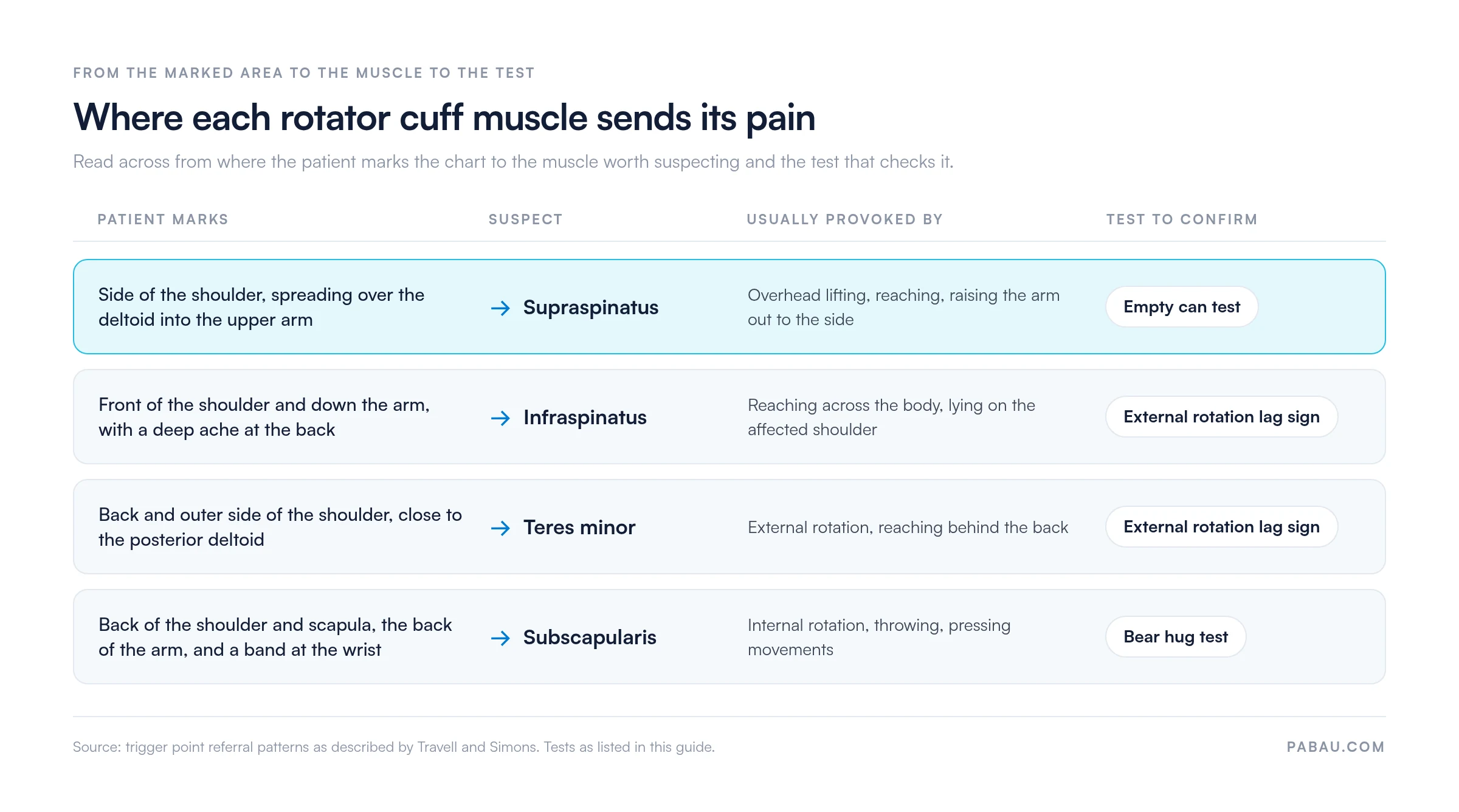
The supraspinatus is the most commonly torn rotator cuff muscle. Its pain sits on the outer edge of the shoulder and often spreads down the upper arm over the deltoid. Patients feel it most with overhead lifting, reaching and raising the arm out to the side. Supraspinatus problems also frequently coexist with shoulder impingement.
Infraspinatus injury feels like a deep ache at the back of the shoulder. Oddly, it refers to the front of the shoulder and down the arm. Night pain is common in rotator cuff problems and often affects sleeping on the shoulder. Patients also report pain when reaching across the body, such as fastening a seatbelt, which is cross-body adduction.
Teres minor produces pain at the back and side of the shoulder. It’s frequently missed because its pattern overlaps with infraspinatus. Subscapularis is often overlooked too. It refers pain to the back of the shoulder and scapula, down the back of the arm, and to a band around the wrist.
Suspect subscapularis in throwers and in patients who struggle to rotate the arm outward. The belly press test is a quick way to check its strength alongside the bear hug.
Myofascial trigger points in the cuff produce referred pain that spreads well beyond the muscle itself. The classic reference, Travell & Simons’ Myofascial Pain and Dysfunction, documents these patterns in detail.
Infraspinatus trigger points typically refer to the front of the shoulder. Subscapularis can refer to the wrist, and supraspinatus radiates along the side of the arm. When a patient marks a body chart, these patterns help you separate trigger point pain from a structural tear pattern.
The diagram works best as one step in a structured exam. Here’s the order that keeps it useful.
Several shoulder conditions hurt in the same places. The usual mimics are impingement, acromioclavicular (AC) joint arthritis, biceps tendinopathy and cervical radiculopathy. Use the marked area to shortlist, then lean on the differentiators below.
Once the pain is mapped, run standardized orthopedic tests to confirm cuff involvement. Common tests include the empty can, drop arm, external rotation lag sign and bear hug (subscapularis) for the cuff. Hawkins-Kennedy and Neer sit alongside them as impingement screens.
For technique and how to read each result, see our guide to shoulder special tests. Combined with the marked area, the results guide whether to refer for imaging or specialist review.
Here’s how the pieces fit for one illustrative patient. A house painter in his fifties reports right shoulder pain that’s worse working overhead.
Notice what the note doesn’t say. It doesn’t call the tear partial or complete, because nothing has confirmed a tear yet. That restraint matters when you pick a code.
Accurate coding supports both billing and the clinical record. Common ICD-10 codes for nontraumatic rotator cuff tears include the following.
A tear from a recent injury is coded from the injury chapter instead, under S46.0. Until a tear is confirmed, the symptom code M25.511 (pain in right shoulder) or M25.512 (left) is often the honest choice.
The mistakes that trip claims up are usually simple. An unspecified-side code goes out when the side is in the note. A tear gets called complete on clinical tests alone. Or wrist pain is documented without linking it to the shoulder findings.
Once the cuff is confirmed, management usually begins with conservative care. That means relative rest, ice or heat, gentle range-of-motion work and progressive strengthening aimed at the affected muscle.
The diagram guides exercise choice. Supraspinatus pain calls for scapular stabilization and controlled overhead work. Infraspinatus pain responds well to external rotation strengthening. Subscapularis involvement calls for internal rotation and pressing exercises.
Most uncomplicated cuff strains and mild tendinopathy improve within six to 12 weeks of consistent therapy. Partial-thickness tears may need three to six months, while full-thickness tears often warrant orthopedic consultation and imaging. Track progress on a range of motion chart next to the pain diagram.
When you find a cuff trigger point on palpation, the diagram helps you explain it to the patient. Many are surprised that a tender spot behind the shoulder causes their pain at the front. That explanation eases worry and improves follow-through with hands-on therapy and home exercise.
Describe both the trigger point and its referral in the note. For example: “Tender infraspinatus trigger point. Sustained pressure reproduced anterior shoulder pain, consistent with infraspinatus referral.”
Sports medicine practices get particular value from this. A dated baseline marking shows whether infraspinatus pain is shrinking, which helps both patient conversations and clinical reasoning.
Many practices still mark pain on paper body charts, then scan them or lose them between visits. Pabau, the practice management platform we build for clinicians, moves that step online. Patients complete digital intake forms before the appointment through a patient portal, including where their shoulder hurts.

During the session, Pabau Scribe, our AI scribe, drafts the treatment note while you examine. You spend less time typing trigger point findings and more time with the patient. Forms, notes and test results land in one record, the core of a connected physical therapy EMR.
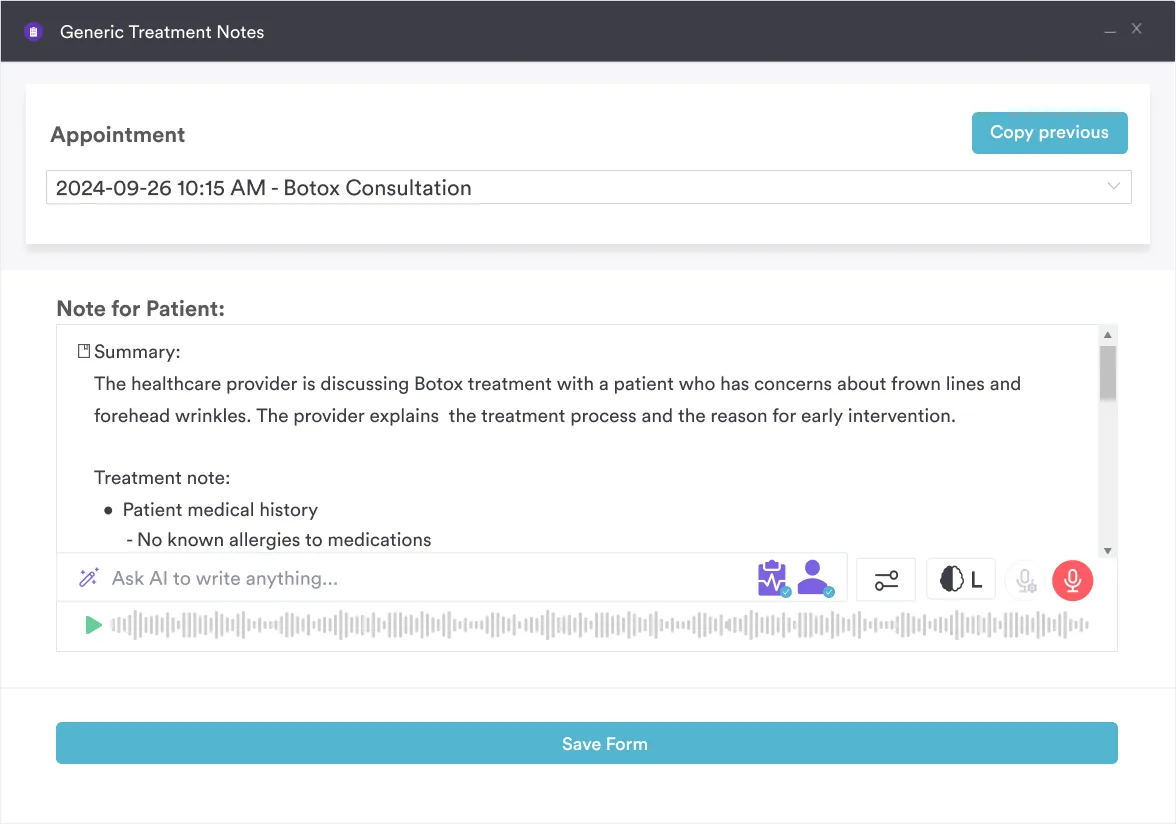
The outcome is a pain map you can compare at every follow-up. When the marked area shrinks, you have dated evidence of progress for the patient and for discharge planning.

Capture pain location data, document trigger point findings, and track treatment progress in one integrated clinical record.

Treat the patient’s marked area as a starting hypothesis. Where it lands narrows the suspect to one or two muscles. The tests then decide, and the note records only what they proved.
Do that consistently and two things change. Your treatment targets the right muscle sooner, and your codes stay defensible. The trade-off is a few extra minutes at intake, which a dated baseline repays at every follow-up.
Book a demo to see how Pabau keeps pain maps, test results and treatment notes together for your shoulder patients.

Working through a full shoulder workup? Shoulder exam: A complete clinical guide walks through history, inspection, palpation and special tests in order.
Need to map pain beyond the shoulder? Body pain chart template gives you front and back silhouettes with a 0-10 severity scale.
Planning the rehab phase? Scapular stabilization exercises covers 10 exercises that support shoulder recovery.
Looking for software built around physical therapy? Physical therapy EMR shows how Pabau handles booking, notes and records for PT practices.
Night pain is common with rotator cuff problems. Lying on the affected side compresses the cuff. Lying on the other side can let the arm fall across the body and load it. A pillow supporting the arm often helps.
No. Frozen shoulder, or adhesive capsulitis, stiffens the joint capsule, so the arm loses movement even when you move it for the patient. With a cuff problem, passive movement is usually preserved, while active movement is painful or weak.
Not always. Ultrasound and MRI can both show cuff tears. Imaging is usually ordered for marked weakness, a recent injury, or no improvement after conservative care. Many practices start therapy first and image only if strength doesn’t return.
The wrist, yes. Infraspinatus trigger points can refer pain to the front of the shoulder and down the arm. Subscapularis trigger points commonly refer to the posterior shoulder and the wrist. Neck pain with arm tingling points more toward the cervical spine.
For nontraumatic tears, M75.101 and M75.102 cover an unspecified tear of the right or left shoulder. M75.111 and M75.112 cover an incomplete tear, and M75.121 and M75.122 a complete tear. Laterality and imaging findings decide the choice.